
Best Replacement Brine Tanks: Size, Salt Capacity and the Parts That Must Match

The best replacement brine tanks for most homes are 18 inch round tanks, 33 or 40 inches tall, supplied with a 4 inch brine well, a safety float and an air check that suit your control valve. AFWFilters' 18x33 round tank holds about 375 lb of salt. That is roughly six months between top-ups for a family of four. The tank itself is a plastic box. What makes it work is that the float, air check and brine line inside it match your valve.
So this guide sizes the tank on salt capacity and refill interval, then lists the parts that have to match.
Disclosure: Hard Water Solved may earn a commission if you buy through links on this page, at no extra cost to you. It does not change which products we include or how we rank them. Read our disclaimer.
How We Chose
Methodology. Nothing on this page was physically tested. Tanks were compared on footprint, salt capacity as stated by the seller, and the internal parts supplied, from sellers' product pages.
- Included: complete brine tanks with a brine well and safety float, sold on Amazon.com.
- Normalised: each size is converted to months between salt top-ups at three illustrative usage levels, using the sellers' own salt capacities.
- Excluded: loose floats, brine wells, grids and overflow fittings, which are covered as parts; cabinet softener salt bins, which are not sold separately as standard tanks.
- Prices are not listed here because they change often. Use the buttons to see the current price on Amazon.
Before You Buy: Does the Tank Need Replacing?
Most brine tank complaints are not tank faults. An overflowing tank is a valve or float problem. A tank with a hard crust or a hollow bridge of salt needs breaking up and cleaning, not replacing. A softener that has stopped using salt usually has a blocked injector or brine line, covered in why a water softener is not using salt.
Replace the tank when it is cracked, split at the overflow fitting, warped, or too small for how often you are refilling it. If only the float or brine well has failed, the part costs far less than the tank: AFWFilters lists a Fleck 2310 safety float valve, a complete float and air check assembly, and a 4 inch brine well as separate parts. How each part works and how to test it is in water softener brine tank internals.
Size vs Salt Capacity vs Refill Interval
The salt a tank holds sets how often you lift a bag. Sellers state the capacity for each size. The interval depends on how much salt your softener uses, which is set by your hardness, your water use and the salt dose programmed into the valve.
Estimating your salt use. A metered softener at an efficient 6 lb per cubic foot salt setting gets about 3,500 grains of hardness removal per pound of salt, using published design guidance for standard resin of about 21,000 grains per cubic foot at that dose, summarised in Water Conditioning & Purification. A family of four using about 260 gallons a day on 15 gpg water removes about 3,900 grains a day, so it uses a little over a pound of salt a day. That is about 35 to 40 lb a month. Timer valves and heavy salt settings use far more.
| Tank (inches) | Salt it holds (seller) | Footprint | 40 lb bags to fill | Months to one-third full at 20 / 40 / 80 lb a month |
|---|---|---|---|---|
| 11 x 36 square | about 150 lb | 11 x 11 in | about 4 | 5.0 / 2.5 / 1.3 |
| 14 x 36 square | about 200 lb | 14 x 14 in | about 5 | 6.7 / 3.3 / 1.7 |
| 18 x 33 round | about 375 lb | 18 in circle | about 9 | 12.5 / 6.3 / 3.1 |
| 18 x 40 round | about 450 lb | 18 in circle | about 11 | 15.0 / 7.5 / 3.8 |
Capacities from AFWFilters' product pages, checked 2 October 2026. US Water Systems also lists its 18 inch complete brine tank at 375 lb, and Fresh Water Systems lists its 18x40 round replacement tank at 450 lb. Intervals are illustrative: full to one-third full at the stated monthly use.
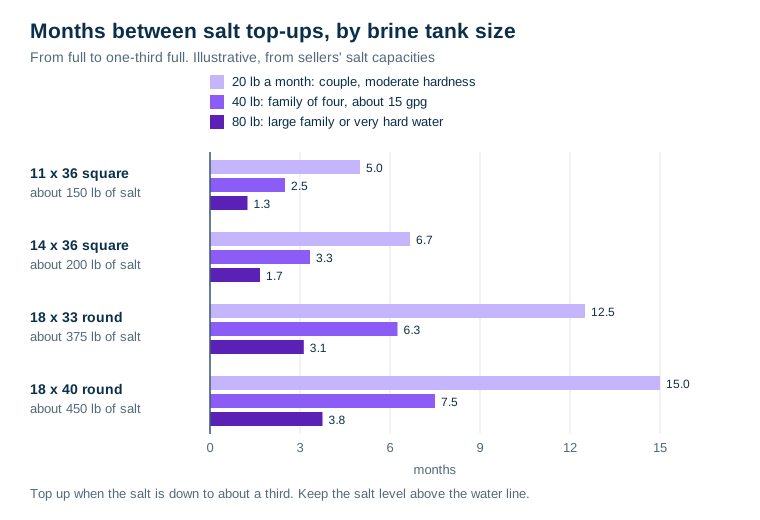
Two things follow. First, a bigger tank does not use more salt. Salt use is set by the valve, not the tank, so a larger tank only means fewer top-ups. Second, the gain from 18x33 to 18x40 is modest, about a month at typical use. Buy the 40 inch tank for a very hard well or a large household, or if you want to fill it twice a year.

The Parts That Must Match Your Valve
A replacement tank arrives with parts already fitted. Check each one against what came out of the old tank before you order.
| Part | What must match | How to check |
|---|---|---|
| Safety float and brine valve | The valve family. Fleck valves pair with Fleck's 2310 safety float. AFWFilters sells its float-only tank versions for Autotrol valves and its float plus air check versions for Fleck | Read the part number on the old float body |
| Air check | Fitted at the bottom of the brine assembly on valves that draw brine through it, to stop air reaching the resin tank | Look for a check ball housing at the foot of the old float rod |
| Brine line size | 3/8 inch tubing on most home softeners | Measure the old tube's outside diameter |
| Brine well diameter | 4 inch wells are common; the float must slide freely inside | Measure the old well |
| Float height | On metered valves the valve times the refill and the float is only a backstop. On float-controlled valves the float height sets the salt dose | Note the old clip position before you take it apart |
| Overflow fitting | Must sit below the float's shut-off level, with its own gravity line to a drain | Check the new tank's elbow height |
| Salt grid | Keep one if the old tank had one; Fleck's manual says to cut the air check level with the grid | Look under the old salt |
The two that cause most trouble are the float and the overflow. A float meant for one valve can shut off too early, starving the refill, or never close at all. And an overflow line teed into the softener's pressurised drain line can push water back into the tank. The right overflow route is set out in brine tank full of water or overflowing.
The Best Replacement Brine Tanks, Pick by Pick
| Pick | Size and salt | Includes | Amazon |
|---|---|---|---|
| AFWFilters 18x33 black round | 18 x 33 in, about 375 lb | 4 in brine well, safety float, air check | Check price on Amazon |
| AFWFilters 18x33 blue round with salt grid | 18 x 33 in | Safety float assembly, salt grid | Check price on Amazon |
| Complete 18x40 with 2310 safety float | 18 x 40 in, about 450 lb for this size | 2310 safety float | Check price on Amazon |
| 18x33 with 2310 safety float | 18 x 33 in | 2310 safety float | Check price on Amazon |
AFWFilters 18x33 black round with float and air check: best for most homes
- What it is: an 18 inch round, 33 inch tall tank with a 4 inch brine well, safety float and air check, described by AFWFilters as used with Fleck control valves.
- Salt: about 375 lb, per AFWFilters.
- Colours: AFWFilters' own store also lists it in almond and blue.
This is the standard brine tank on most two-tank Fleck softeners, so on a Fleck system it is close to a like-for-like swap. At typical family use it goes about six months between top-ups.
Wrong for: tight utility spaces where an 18 inch circle does not fit, and non-Fleck valves, where the float and air check need checking first.
AFWFilters 18x33 blue round with salt grid: for systems that ran a grid
- What it is: the same 18x33 size with a safety float assembly and a salt grid included, per the Amazon listing title.
Buy this one if the old tank had a grid plate. The valve's refill and the air check height were set around it. Without the grid, salt sits in the water at the bottom, which can encourage mushing.
Wrong for: systems set up without a grid, where it adds nothing but cost.
Complete 18x40 with 2310 safety float: most salt between top-ups
- What it is: an 18 inch round, 40 inch tall tank with Fleck's 2310 safety float, per the listing title.
- Salt: the 18x40 size holds about 450 lb on AFWFilters' and Fresh Water Systems' figures.
At 80 lb a month, which a large family on very hard water can reach, this tank goes nearly four months between top-ups against about three for the 18x33. It is also the tank to choose if you want to fill it twice a year at typical use.
Wrong for: basements where lifting a 40 lb bag over a 40 inch rim is a problem, and households whose use is low enough that the 33 inch tank already lasts six months or more.
18x33 with 2310 safety float: the plain Fleck-ready alternative
- What it is: an 18x33 brine tank fitted with Fleck's 2310 safety float, per the listing title. The listing title does not mention an air check, so confirm one is included or reuse yours.
Wrong for: buyers who want the air check, brine well and grid confirmed in writing before paying.
If an 18 inch tank will not fit
AFWFilters lists square tanks for tight spaces: an 11x36 holding about 150 lb and a 14x36 holding about 200 lb, both with a 4 inch brine well, safety float and air check. We did not confirm Amazon listings for these sizes. At 40 lb a month the 14 inch square needs salt about every three months, so it suits small households or a tight closet.
Swapping the Tank
- Bypass the softener and unplug the valve, or set it so it will not regenerate during the job.
- Disconnect the brine line at the float assembly, and the overflow tubing at the elbow.
- Empty and lift out the old tank. Scoop out remaining salt and water first. A full tank is far too heavy to move.
- Set the new tank on a level, clean floor close enough that the brine line runs without kinks.
- Reconnect the brine line to the new float assembly, and run the overflow to a floor drain or standpipe by gravity, on its own line.
- Add water and salt. Add a few gallons of water first, or start a manual refill, then fill with salt, keeping the salt level above the water.
- Run a manual regeneration and watch the brine draw lower the water level. The float should not interfere with a normal refill.
Who Should Buy None of These
- Owners of cabinet softeners. The brine tank is part of the housing.
- Anyone whose tank overflows. Fix the valve, float or injector. A new tank will overflow the same way.
- Tanks with only a failed float or brine well. Replace the part for a fraction of the price.
- Salt bridges and mushing. Break up and clean out the old salt, then change salt type if needed. The tank is not the problem.
For most homes, the answer is an 18x33 round tank with a safety float and air check that match the valve. Choose the 18x40 if you want fewer top-ups, and a square tank only where an 18 inch circle will not fit.
Frequently Asked Questions
What size brine tank do I need for my water softener?
For most homes, an 18 inch round tank, 33 or 40 inches tall. The 18x33 holds about 375 lb of salt according to AFWFilters and US Water Systems, which is roughly six months between top-ups for a family of four using about 40 lb a month. Square 11 or 14 inch tanks fit tight spaces but hold about 150 to 200 lb, so they need salt every two to three months at the same use.
Can I replace just the brine tank on a water softener?
Yes, on a two-tank softener with a separate brine tank. Move the brine line to the new tank and make sure its safety float and air check suit your control valve. Fleck valves pair with a 2310 safety float and an air check. Cabinet softeners have the brine tank built into the housing and cannot take a standard replacement tank.
How much does a replacement brine tank cost?
The price rises with size, from an 11x36 square up to an 18x40 round, and with what is supplied inside it: a complete tank with a brine well, safety float and air check costs more than a bare shell, and a salt grid adds to it. Prices change often, so check the current price on the listing before you order.
Does a brine tank need a salt grid?
Not always. A grid plate raises the salt above a layer of water at the bottom of the tank. Many modern softeners refill only a few gallons and run without one. If your old tank had a grid, keep one in the new tank, because the valve's refill and the air check height were set around it. Fleck's manual says to cut the air check level with the grid plate when a grid is used.
Why is my brine tank overflowing, and do I need a new one?
Usually not. Overflow is almost always caused by the control valve refilling too long, a stuck safety float, a leaking brine valve or a blocked injector, not by the tank itself. Replace the tank only if it is cracked, warped or too small. Fix the float or valve first, or the new tank will overflow too.
