
How to Set the Salt Dose on a Water Softener
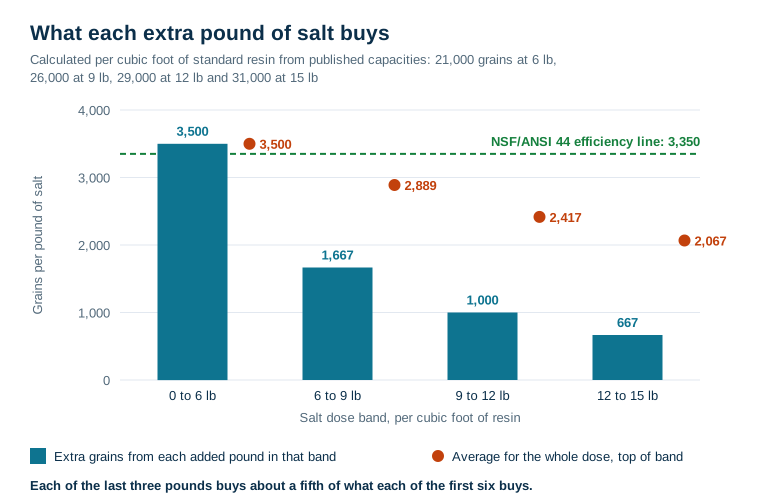
The water softener salt dose setting decides how much capacity each regeneration restores and how much salt it costs. The key fact is that capacity does not rise in step with salt. Per cubic foot of standard resin, the first 6 lb each buy about 3,500 grains of capacity. Each pound from 12 to 15 lb buys only about 667 grains. That makes a low dose about 70 percent more efficient per pound than the maximum, and the efficient setting is rarely the one the unit ships with.
Setting the dose takes three steps: pick the dose from the curve, enter it the way your valve expects, and then change the capacity entry to match. The third step is the one most people miss.
The Capacity-Per-Pound Curve
The design guidance published in Water Conditioning & Purification gives standard resin about 21,000 grains per cubic foot at 6 lb of salt, 26,000 at 9 lb, 29,000 at 12 lb and 31,000 at 15 lb. Most tables stop at the average efficiency: capacity divided by salt. The more useful number for choosing a dose is the marginal one: how much extra capacity each additional pound buys.
| Dose per cu ft | Capacity per cu ft | Average grains per lb | Extra grains per added lb in this band |
|---|---|---|---|
| 6 lb | ~21,000 | ~3,500 | ~3,500 (0 to 6 lb) |
| 9 lb | ~26,000 | ~2,890 | ~1,667 (6 to 9 lb) |
| 12 lb | ~29,000 | ~2,420 | ~1,000 (9 to 12 lb) |
| 15 lb | ~31,000 | ~2,070 | ~667 (12 to 15 lb) |
Calculated from the published per-cubic-foot capacities.
Read the last column. Moving from 12 to 15 lb costs 3 lb of salt per cubic foot for 2,000 grains. The same 3 lb at the bottom of the curve would have bought more than 10,000. That extra salt is not lost capacity in the resin. Most of it goes to the drain unused.
Manufacturer data shows the same shape. Pentair's spec sheet for its whole-house softeners rates the 1.0 cubic foot unit at 17,500 grains with 3.9 lb of salt (4,487 grains per lb), 25,200 grains at 9.8 lb and 33,500 grains at 15.6 lb (about 2,150 grains per lb). The highest setting nearly doubles capacity for four times the salt.
Where the Efficient Setting Sits
Two published lines mark the efficient end.
- The efficiency-rating line. The criteria summarised by the U.S. Department of Energy's Building America Solution Center require "a rated salt efficiency of not less than 3,350 grains of total hardness exchange per pound of salt". On the table above, only doses at or below about 6 lb per cubic foot clear it.
- Valve design bands. Clack's WS1 control valve manual sorts softener doses into three bands: under 7.5 lb of salt per cubic foot (6,000 to 3,501 grains per lb), 7.5 to 12 lb (3,500 to 2,501), and over 12 lb (2,500 to 1,700). The valve lengthens its brine and rinse stages as the dose rises, taking the whole cycle from 57 minutes in the lowest band to 99 in the highest. A heavier dose also costs more water and time.
So a starting dose of about 6 lb per cubic foot is efficient on both measures. It is not automatically right for every house. The next section shows when to go higher.
Choosing Your Water Softener Salt Dose Setting
The trade-off is simple. A lower dose means less capacity per cycle, so more cycles, but far less salt per grain of hardness removed. Worked for one household: four people, 300 gallons a day, 15 gpg water, a 1.5 cubic foot softener on a metered valve with a one-day reserve.
| Dose per cu ft | Salt per cycle | Capacity | Regenerates about every | Salt per year |
|---|---|---|---|---|
| 6 lb | 9 lb | 31,500 grains | 6 days | ~550 lb (about 14 bags of 40 lb) |
| 9 lb | 13.5 lb | 39,000 grains | 8 days | ~615 lb (about 15 bags) |
| 15 lb | 22.5 lb | 46,500 grains | 10 days | ~820 lb (about 21 bags) |
Calculated. Real use varies with the reserve and how the valve rounds to whole nights.
The economy dose saves about a third of the salt compared with the maximum, and regenerating every six days does the bed no harm. For this household, 6 lb per cubic foot is the right choice. How efficiency is measured and claimed is covered in what water softener salt efficiency means.
Go higher than about 6 lb per cubic foot when:
- The low dose makes the unit regenerate every 1 to 3 days. That usually means the softener is small for the household. More salt stretches the cycle, but at the cost shown in the curve. Frequent cycles also use more water.
- The water carries iron. Iron is harder to strip from resin than calcium. Many manufacturers call for a heavier dose and more frequent regeneration on iron-bearing water. Follow your valve maker's guidance.
- The water is very hard and must test near zero. A lightly regenerated bed leaves more hardness on the resin, so slightly more can slip through. For household use this is rarely noticeable. Test after any change.
Do not go below your valve's minimum setting, and do not use a dose change to fix a softener that is too small. If the economy dose means cycling daily, the resin volume is the problem.
Setting the Dose on the Valve
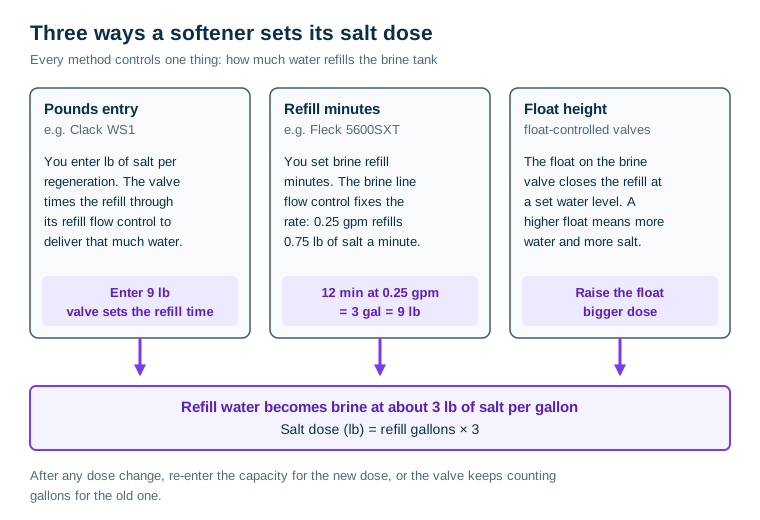
Every method controls the same thing: how much water refills the brine tank. The refill water dissolves salt to make brine. Fleck labels its brine line flow controls in both units, for example "0.25 GPM (0.75 lbs NaCl/min)", which works out to about 3 lb of salt per gallon of refill.
Pounds entry (for example Clack WS1)
In OEM softener setup, step 5S asks for "the pounds of salt per regeneration". Enter the total for the unit, not per cubic foot: 9 lb for a 1.5 cubic foot unit at 6 lb per cubic foot. The valve times the refill to deliver it. On a Clack valve, step 4S just before it is the capacity in grains, so you set both on consecutive screens.
Refill minutes (for example Fleck 5600SXT)
The dose is the brine refill step time. Work it out from the brine line flow control:
Refill minutes = pounds of salt ÷ (BLFC gpm × 3)
| BLFC | Salt per minute | 9 lb | 13.5 lb | 22.5 lb |
|---|---|---|---|---|
| 0.25 gpm | 0.75 lb | 12 min | 18 min | 30 min |
| 0.50 gpm | 1.5 lb | 6 min | 9 min | 15 min |
The flow ratings and salt rates are those listed in Fleck's 5600SXT service manual. Check which flow control your valve has before you calculate.
Salt level (Low, Medium, High)
Some packaged systems hide the numbers. Pentair's whole-house systems offer Low, Medium and High salt levels. Its manual describes Low as giving "greater salt efficiency" for small families and low hardness, and High as giving "the most capacity" for large families and high hardness. The refill and capacity adjust together, so there is no separate recalculation. If your household would sit at 6 days or more between cycles on Low, use Low.
Float height (float-controlled brine valves)
On systems where the brine valve float, not a timer, ends the refill, the float's height sets the water level and so the dose. Raise it for more salt, lower it for less. Measure the water depth after a refill before and after the change. Brine tanks vary in diameter, so a given height does not equal a given number of pounds. Float adjustment, and the difference between a dose-setting float and a safety float, is covered in water softener brine tank internals.
The Recalculation That Must Follow
A dose change is not finished until the capacity entry matches it. The valve counts gallons from the capacity you entered, not the salt it drew.
Example: a 1.5 cubic foot softener moved from 22.5 lb (15 lb per cubic foot) to 9 lb (6 lb per cubic foot).
- New capacity = 1.5 × 21,000 = 31,500 grains. It was 46,500.
- New gallons per cycle on 15 gpg = 31,500 ÷ 15 = 2,100 gallons. It was 3,100.
- Enter 31,500 as the capacity, or choose the matching salt level on a packaged system.
- Check the reserve. A fixed reserve in gallons can stay. A percentage reserve will shrink with the capacity.
- Regenerate to start the new count, then watch the gallons remaining the next day.
Skip step 3 and the valve keeps counting 3,100 gallons from a bed that now gives 2,100. The last thousand gallons of every cycle are hard. Entering both values in one sitting is covered in how to set capacity and reserve on a softener.
Confirm the Dose You Set Is the Dose You Get
The setting is what the valve intends. What reaches the resin depends on the refill and the brine draw working.
- Measure a refill. After a regeneration, note the water depth in the brine tank, or time the refill into a bucket with the brine line disconnected if your manual allows it. Gallons × 3 should be close to your dose.
- Track salt use for two months. Salt used ÷ number of regenerations should be near the setting. Much more means too much water is refilling. Much less means brine is not being drawn.
- Keep salt above the water. The brine can only be as strong as the salt it sits in. Where to keep the level is in how much salt to keep in a brine tank.
What the Salt Dose Cannot Do
- It cannot make a small softener big. Past about 12 lb per cubic foot, extra salt adds little capacity and mostly goes to the drain.
- It cannot fix fouled or damaged resin. Iron-coated or chlorine-damaged resin will not take up extra brine in a useful way.
- It does not change what a softener removes. A heavier dose removes more hardness per cycle, not other contaminants. It does not treat bacteria, nitrate, lead or chlorine.
- It does not make water taste salty when set correctly. Salty water after regeneration is a rinse or brine-draw fault, not a dose.
Start at about 6 lb per cubic foot, change the capacity to match, and check the salt use after two months.
Frequently Asked Questions
What is the best salt setting for a water softener?
For most homes, around 6 lb of salt per cubic foot of resin, which gives high salt efficiency with a sensible time between regenerations. At that dose standard resin removes about 3,500 grains per pound of salt. Heavier doses add capacity but at a falling rate. Go higher only when the lower dose makes the softener regenerate more often than every 3 days or so, or when iron or very hard water calls for it.
How many pounds of salt per regeneration should my softener use?
Multiply the resin volume in cubic feet by the dose per cubic foot. A 1.0 cubic foot softener at 6 lb per cubic foot uses 6 lb per regeneration, a 1.5 cubic foot unit uses 9 lb and a 2.0 cubic foot unit uses 12 lb. The same unit at 15 lb per cubic foot would use 15, 22.5 and 30 lb. Always convert a pounds setting back to pounds per cubic foot to judge it.
Does a higher salt setting make water softer?
Not noticeably for household use. A higher dose mainly makes each cycle last longer by restoring more of the resin's capacity. The water in between regenerations is soft at any sensible dose. Very low doses can let slightly more hardness slip through, which matters only on very hard water or where the water must test close to zero.
How do I change the salt setting on a Fleck softener?
On Fleck 5600SXT-type valves the dose is set by the brine refill time. The brine line flow control fixes the refill rate, and Fleck labels its 0.25 gpm control at 0.75 lb of salt per minute. So 12 minutes of refill makes about 9 lb of salt. After changing the refill time, change the unit capacity to the capacity at the new dose, or the meter will count the wrong number of gallons.
Do I need to change anything else after changing the salt dose?
Yes, the capacity. The valve works out how many gallons it can deliver from the capacity you entered. Lower the dose without lowering the capacity and it will run out of soft water before it regenerates. Raise it without raising the capacity and it regenerates early and wastes salt. Valves that ask for a salt level, not grains, usually adjust capacity automatically.
Why is my softener using more salt than the setting says?
Usually because it regenerates more often than it should, or because more water is refilling the brine tank than the setting intends. Check the hardness and reserve entries, look for a day override set too short, and measure the water in the brine tank after a refill. A worn refill flow control or a mis-set float can put in more water, and every extra gallon dissolves about 3 lb of salt.
