
What Is Water Softener Salt Efficiency?
Water softener salt efficiency is the number of grains of hardness the softener removes for every pound of salt it uses. It is calculated as capacity divided by salt dose at the same setting. Efficiency is highest at low salt doses and falls as the dose rises. An efficiency-rated softener must reach at least 3,350 grains per pound. That is why a single softener can be sold as both "high capacity" and "high efficiency", but never at the same setting.
That last point is the one to keep in mind whenever you read a softener spec sheet. This page shows why, using real rated figures.
How to Calculate Water Softener Salt Efficiency
The formula is simple:
Salt efficiency (grains per pound) = capacity (grains) ÷ salt dose (pounds)
Both figures must come from the same salt setting. Manufacturers publish capacity at several doses, and each one gives a different efficiency.
Pentair's whole-house softener spec sheet is a useful example because it publishes three settings for each of three sizes, plus a rated efficiency for each size:
| Resin | Salt dose | Rated capacity | Salt efficiency |
|---|---|---|---|
| 1.0 cu ft | 3.9 lb | 17,500 grains | 4,487 (printed) |
| 1.0 cu ft | 9.8 lb | 25,200 grains | 2,571 |
| 1.0 cu ft | 15.6 lb | 33,500 grains | 2,147 |
| 1.5 cu ft | 5.2 lb | 24,300 grains | 4,637 (printed) |
| 1.5 cu ft | 14.3 lb | 37,000 grains | 2,587 |
| 1.5 cu ft | 23.4 lb | 48,600 grains | 2,077 |
| 2.0 cu ft | 7.5 lb | 34,600 grains | 4,613 (printed) |
| 2.0 cu ft | 18.75 lb | 50,400 grains | 2,688 |
| 2.0 cu ft | 30 lb | 64,000 grains | 2,133 |
The bold figures appear on the sheet. The rest are calculated by dividing the two columns. In every size, the pattern is the same. The lowest dose gives around 4,500 to 4,600 grains per pound. The highest gives a little over 2,000, less than half as much.
Notice what else the table says. The resin volume makes almost no difference to efficiency at a given dose per cubic foot. At their efficient settings, the 1.0, 1.5 and 2.0 cubic foot units use between about 3.5 and 3.9 lb of salt per cubic foot, and all get about 4,500 to 4,600 grains per pound. Efficiency is set by the salt dose per cubic foot, not by the size of the softener.
Why Efficiency and Capacity Move in Opposite Directions
It comes down to what the resin prefers.
Softener resin holds calcium and magnesium more strongly than it holds sodium. That is what makes softening work: hard water flows through, and the resin swaps its sodium for the hardness it prefers. Regeneration has to reverse that swap, which means pushing against the resin's preference. The only way to do it is with a large excess of sodium in concentrated brine.
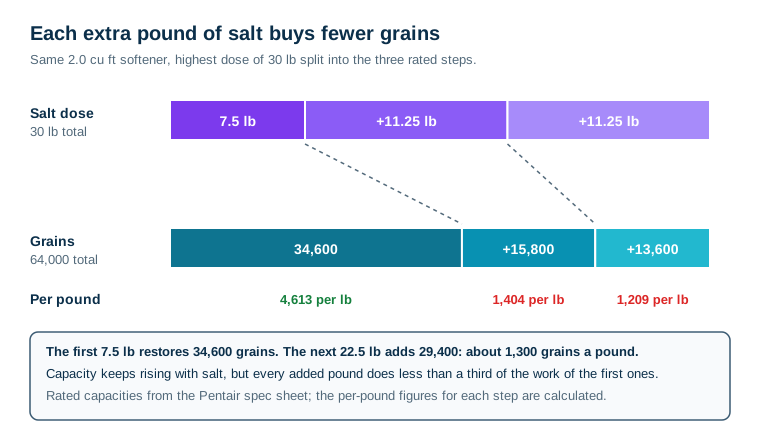
The first part of the salt dose does the easy work. It strips the hardness that comes off most readily and restores a large share of the bed. Each additional pound has to push off hardness that is held more tightly, and a growing share of its sodium passes through unused and out to the drain. The result is diminishing returns.
The Pentair 2.0 cubic foot figures show it clearly:
- The first 7.5 lb restores 34,600 grains. That is 4,613 grains per pound.
- The next 11.25 lb (to 18.75 lb) adds 15,800 grains, about 1,404 per pound.
- The last 11.25 lb (to 30 lb) adds 13,600 grains, about 1,209 per pound.
Every pound after the first 7.5 does less than a third of the work of the first ones. Capacity keeps rising with salt, which is why manufacturers quote it at the highest dose. Efficiency keeps falling, which is why they quote it at the lowest. The two numbers are two ends of the same curve.
One Spec Sheet, Two Headlines
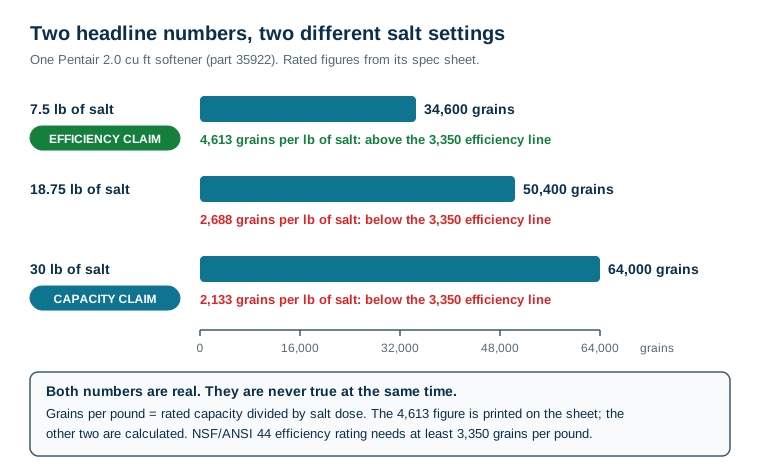
Here is where marketing takes advantage of the curve. The 2.0 cubic foot Pentair unit is a "64,000-grain" softener with a rated efficiency of "4,613 grains per pound." Both are printed on the same sheet, and both are accurate. They are not true at the same time.
- At the setting that delivers 64,000 grains, it uses 30 lb of salt per regeneration and removes 2,133 grains per pound.
- At the setting that delivers 4,613 grains per pound, it restores 34,600 grains per regeneration, about 54% of the headline capacity.
Nothing here is dishonest. Pentair lists the dose next to every figure. The problem arises when a product page, sales pitch or comparison chart pulls the two headlines out of their rows and puts them side by side as if they describe one operating state. "High capacity, high efficiency" is a contradiction at any single setting. The same gap between the grain number on the box and what you actually get is covered from the capacity side in advertised vs usable water softener capacity.
The Certification Threshold: 3,350 Grains per Pound
There is an official line for what counts as efficient. The NSF/ANSI 44 standard for residential softeners includes optional efficiency rating provisions. The Department of Energy's Building America guide to water softeners summarizes what an efficiency-rated softener must do:
| Requirement | Figure |
|---|---|
| Salt efficiency | not less than 3,350 grains of total hardness exchange per pound of salt |
| Water efficiency | not more than 5.0 gallons of water per 1,000 grains of hardness removed |
| Regeneration control | demand-initiated, by flow meter or hardness sensor. Time-clock units "do not qualify" |
Two other benchmarks sit alongside it:
- EPA WaterSense. Its consumer fact sheet on water-efficient softeners recommends models with "greater than 3,350 grains of total hardness exchange per pound of salt" and, more strictly than NSF, "4 gallons of water or less per 1,000 grains of hardness removed."
- California. Health and Safety Code section 116785 requires softeners that discharge to a community sewer and were installed after January 1, 2002 to be certified at no less than 4,000 grains per pound.
On the Pentair table, only the lowest setting of each size clears 3,350, and all three also clear California's 4,000. The middle and high settings, the ones behind the model's capacity name, do not come close. For what the rest of the standard covers, see what NSF/ANSI 44 means.
How to Read a Salt Efficiency Claim Critically
When a softener is described as "high efficiency", run through these questions.
- At what salt dose? An efficiency figure without a dose is incomplete. It will be the lowest dose the valve offers.
- What capacity does that dose give? Find the capacity in the same row. If it is too small for your household, you will regenerate so often that water use climbs.
- Is it certified or just claimed? "Efficiency rated" under NSF/ANSI 44 means it was tested. "Up to" figures and marketing copy are claims. Check the listing, not the brochure.
- What about water efficiency? Salt efficiency and water efficiency are separate. A unit can be salt-efficient and still use a lot of water per regeneration. NSF's rating includes both.
- Is regeneration demand-initiated? A timer softener wastes salt whatever its rated efficiency, because it regenerates whether the resin needs it or not.
- Is the rating achievable on your water? Rated figures come from lab tests on clean water. Hellenbrand's manual notes that operating efficiency "is typically less than the tested efficiency." Iron, manganese and high hardness push real efficiency down.
A claim that passes all six is a real efficiency number. A claim that fails the first two is usually a capacity-marketing number with an efficiency label on it. Checking Morton's salt-savings claim against a well-set metered softener applies these questions to one brand, and comparing Morton and Whirlpool on annual salt and 10-year running cost applies them to two units from the same maker.
What an Efficient Setting Costs You
Efficient settings save salt, but they are not free. Take an illustrative household of four using 60 gallons per person per day on 15 gpg water. That is 3,600 grains a day, about 1.31 million grains a year. Run it through the Pentair 2.0 cubic foot unit, ignoring reserve capacity to keep the arithmetic readable:
| Setting | Salt per regeneration | Regenerations a year | Salt a year |
|---|---|---|---|
| 7.5 lb (4,613 gr/lb) | 7.5 lb | about 38 | about 285 lb |
| 18.75 lb (2,688 gr/lb) | 18.75 lb | about 26 | about 489 lb |
| 30 lb (2,133 gr/lb) | 30 lb | about 21 | about 616 lb |
The efficient setting uses less than half the salt of the highest one. In exchange:
- It regenerates more often. Each regeneration uses water and time, so the water saving from less brine is partly offset. This is why the water efficiency limit sits beside the salt limit in certification.
- Each cycle holds less. At 34,600 grains, this household regenerates about every 9 to 10 days. A smaller bed at the efficient setting may need regenerating every two or three days, which is too often for most people. Resin sizing and salt dose have to be chosen together, as covered in how to set the salt dose on a water softener.
- Iron can rule it out. Some manufacturers restrict their most efficient salting to clean water. Hellenbrand, for example, limits its high-efficiency setting to water with iron below 0.5 ppm.
For most city-water homes with a correctly sized bed, the efficient end of the range is the right one. The salt saved each year usually outweighs the extra regenerations by a wide margin.
Why Salt Efficiency Matters Beyond Your Salt Bill
The same number decides several other things:
- Rebates. Utility and sewer district rebate programs often require a demand-initiated, efficiency-rated unit. See water softener rebates and incentives.
- Legality in restricted areas. California's 4,000 grains-per-pound condition is an efficiency test. Some local ordinances require the most efficient units available.
- Chloride in wastewater. All the chloride in the salt goes down the drain. Halving the salt halves the chloride your softener sends to the sewer or septic system.
- Septic performance. Industry-funded research found that very inefficient softeners, around 1,000 grains per pound, made septic tank effluent worse, while efficient ones did not.
What Salt Efficiency Cannot Tell You
- It does not measure softening quality. Efficiency says nothing about hardness leakage, the small amount of hardness that gets through. Very low salt doses can allow more leakage on very hard water.
- It does not include water use. Check gallons per 1,000 grains separately.
- A rated figure is not your figure. Real efficiency depends on your water, your settings and how often the softener regenerates.
- It cannot rescue an oversized salt setting. A softener's efficiency is whatever its current dose makes it. The single most useful thing an owner can do is check which setting their softener is on.
Water softener salt efficiency is one number, but it only means something next to the salt dose that produced it. Ask for both, and the "high capacity, high efficiency" contradiction disappears.
Frequently Asked Questions
What is a good salt efficiency for a water softener?
At least 3,350 grains of hardness removed per pound of salt, which is the salt efficiency an NSF/ANSI 44 efficiency-rated softener must reach. California requires 4,000 grains per pound for softeners that drain to a sewer and were installed after 2002. Many modern softeners reach 4,000 to 4,600 at their lowest salt setting, and fall to around 2,000 at their highest.
How do you calculate water softener salt efficiency?
Divide the capacity in grains by the salt dose in pounds at the same setting. A softener rated 34,600 grains at 7.5 lb of salt has a salt efficiency of 34,600 ÷ 7.5 = 4,613 grains per pound. The same unit rated 64,000 grains at 30 lb manages 2,133 grains per pound. Always use a capacity and a salt dose from the same row of the spec sheet.
Why does a higher salt setting give lower efficiency?
Softener resin holds calcium and magnesium more strongly than sodium. The first pounds of salt displace the hardness that comes off most easily. Each additional pound has to push against the hardness the resin holds most tightly, so it restores fewer grains. On one Pentair spec sheet, the first 7.5 lb restores 34,600 grains, while each pound beyond that adds only about 1,300.
Is a high efficiency water softener worth it?
Usually, if it is set to run efficiently. Running at a high-efficiency setting can cut salt use by half or more for the same hardness removed. The trade-offs are more frequent regenerations, which use more water, and lower capacity per cycle, so the resin bed must be sized with that in mind. Iron in the water can also rule out the lowest salt settings.
What does NSF/ANSI 44 efficiency rated mean?
It means the softener was tested under the standard's efficiency provisions. As summarized by the Department of Energy's Building America program, it must remove at least 3,350 grains of hardness per pound of salt, use no more than 5.0 gallons of water per 1,000 grains removed, and regenerate on demand using a meter or sensor. Timer softeners do not qualify.
Can a water softener be high capacity and high efficiency?
Not at the same setting. The high capacity figure is measured at a high salt dose and the high efficiency figure at a low one. A softener can offer both as options, but at any one setting you get one or the other. Read which salt dose each number comes from.
