
Best Air Injection Iron Filters, Checked Against Your Well Pump
The best air injection iron filters for most wells are the AFWFilters Air Injection Silver 10 for everyday iron, Oceanic's 10x54 AIO if you want to spend less, and Oceanic's 12x52 AIO for heavy iron with sulfur. All three remove iron, manganese and hydrogen sulfide with air alone, no chemicals. They only work if your well pump can hold their backwash flow, which runs from 5 gpm for the Silver 10 to 10 gpm for the 12x52. Check that first.
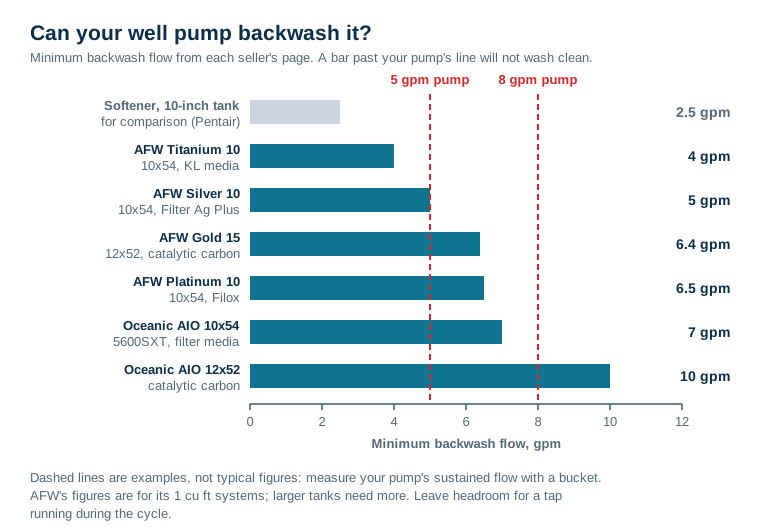
That backwash figure rules out more wells than any ppm rating does. The chart below sets each unit's backwash flow against example pump rates, and the cutaway shows why the single-tank design has replaced the older venturi systems.
Disclosure: Hard Water Solved may earn a commission if you buy through links on this page, at no extra cost to you. It does not change which products we include or how we rank them. Read our disclaimer.
Best Air Injection Iron Filters at a Glance
| Pick | Tank and media | Seller's rating (Fe / Mn / H2S) | Service flow | Minimum backwash | Amazon |
|---|---|---|---|---|---|
| AFWFilters Air Injection Silver 10 | 10x54, 1 cu ft Filter Ag Plus, Fleck 2510 AiQ | 10 / 2 / 4 ppm | 10 gpm peak | 5 gpm | Check price on Amazon |
| Oceanic AIO 10x54 | 10x54, 1 cu ft filter media, Fleck 5600SXT | Not stated for this version | 7 gpm service, 10 peak | 7 gpm | Check price on Amazon |
| Oceanic AIO 12x52 | 12x52, 1.5 cu ft catalytic carbon, Fleck 5600SXT | 27 / 11 / 17 ppm | 9 gpm service, 15 peak | 10 gpm | Check price on Amazon |
How We Chose
Methodology. Nothing on this page was physically tested. Specifications come from each seller's product page, and backwash figures are the minimums the sellers publish. Ratings are quoted as the sellers state them.
- Included: complete single-tank air injection oxidation (AIO) filter systems on an automatic backwashing valve, sold new on Amazon, whose seller publishes a minimum backwash flow.
- Ranked on: backwash flow first, because a unit your well cannot wash will foul whatever its rating. Ratings came second.
- Excluded: units whose backwash flow we could not find (listed separately below), AFW's Titanium, Platinum and Gold systems, which we could not match to Amazon listings, and chlorine or permanganate systems, which are not air injection.
- Prices are not listed here because they change often. Use the buttons to see the current price on Amazon.
These filters belong ahead of any softener in the house. How they fit into the full well setup, with the test panel to run first, is covered in water softener for well water.
Check the Backwash Before the PPM Rating

An air injection filter cleans itself by running water backwards through the bed, fast enough to lift the media and flush the trapped rust to drain. If the flow is too low, the bed never lifts fully. Iron builds up, channels form, and the filter starts letting iron through within months. That is why the backwash figure is a hard limit, not a guideline.
The numbers in the chart come straight from the sellers:
- AFWFilters publishes a comparison table of its four air injection lines: 5 gpm for Silver and Gold, 6.5 gpm for Platinum and 4 gpm for Titanium, all for 1 cubic foot systems. It adds that larger systems need more. Its 1.5 cu ft Gold 15 in a 12-inch tank, for example, needs 6.4 gpm.
- Oceanic lists 7 gpm for its 10x54 tank on a Fleck 5600SXT and 10 gpm for its 12x52.
- For comparison, a water softener in a 10-inch tank needs about 2.5 gpm on Pentair's spec sheet. An air injection filter of the same diameter needs about twice that.
Two things stand out. First, the 10-inch Oceanic needs 2 gpm more than AFW's Silver 10 in the same size tank, so whatever you save on it can cost you the fit. Second, the 12x52's 10 gpm is beyond many domestic pumps. A pump that delivers 8 gpm on a quick test can fall well below that after a few minutes of continuous running.
How to test your pump. Fill a 5-gallon bucket from an outside tap with everything else off, time it, and keep repeating for as long as a full backwash runs (the valve manual lists the cycle times). The sustained figure, not the first fill, is the one to compare. Well pump flow and backwashing walks through both tests and the workarounds if your well falls short.
Head-Space Air Pocket vs External Venturi
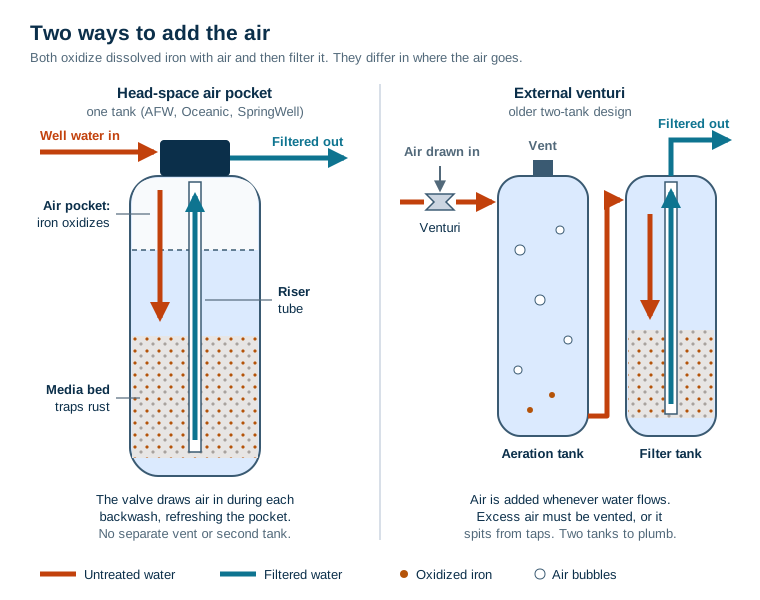
Both designs do the same chemistry. Dissolved iron, manganese and sulfide meet oxygen, turn into particles and are filtered out. They differ in where the air goes in.
Head-space air pocket (AIO). The control valve keeps a pocket of compressed air in the top of the tank. Incoming water falls through it, oxidizes, and passes down through the filter media. At each backwash the valve flushes the bed and draws a fresh charge of air back in. Oceanic describes the daily backwash as both cleaning the bed and "adds a fresh air pocket". AFW and Oceanic both describe the single tank as removing the need for a separate tank or pump. Every pick on this page uses this design.
External venturi. A venturi fitting on the inlet pipe sucks air into the water whenever it flows. The aerated water needs a tank with a vent to release the excess air, and then a separate filter tank. Oceanic's product pages describe these as the older approach.
What the difference means when you buy:
| Head-space AIO | External venturi | |
|---|---|---|
| Tanks to plumb | One | Two, plus a vent |
| When air is added | At each backwash | Whenever water flows |
| Air in the house lines | Possible if the pocket is overcharged | Common without a working vent |
| Depends on backwash frequency | Yes, the pocket shrinks between backwashes | Less so |
| Space | One tank footprint | Two tanks |
The trade-off for the single tank is the backwash schedule. The air pocket is used up as water passes through it, so these units backwash often: daily for Oceanic, and at least every 3 days for AFW's Silver. A heavy-use household on a 3-day setting can run the pocket down before the next refresh.
The Best Air Injection Iron Filters, Pick by Pick
AFWFilters Air Injection Silver 10: best for most wells
- Tank and media: 10x54 tank, 62 inches tall overall, with 1 cubic foot of Filter Ag Plus on gravel. Fleck 2510 AiQ air injection head (previously the AIS10-25SXT) with bypass.
- Seller's rating: iron up to 10 ppm, hydrogen sulfide up to 4 ppm, manganese up to 2 ppm. 10 gpm recommended peak flow.
- Backwash: 5 gpm minimum, at least every 3 days.
- Warranty: 1 year on the control head, 10 years on the tank, per AFW.
- Running cost: AFW sells a replacement 1 cu ft Filter Ag Plus kit when the media wears out.
The Silver 10 has the lowest backwash demand of the three picks, which makes it the one most wells can run. Its ratings cover the commonest well problem: a few ppm of clear-water iron, a trace of manganese and a mild sulfur smell. AFW also describes the 2510-series valve as having stronger backwash ability than the smaller Fleck 5600.
Watch for: the 2 ppm manganese and 4 ppm sulfide limits. Above either one, look at the 12x52.
Wrong for: a pump that cannot hold 5 gpm for the full cycle.
Oceanic AIO 10x54: lower cost, higher backwash
- Tank and media: 10x54 tank with 1 cubic foot of filter media, pre-filled, on a Fleck 5600SXT air injection head with bypass.
- Seller's rating: Oceanic does not list ppm ratings for this 5600SXT version. Its 2510SXT version of the same tank is listed at 23 ppm iron, 13 ppm sulfur and 8 ppm manganese.
- Flow: up to 7 gpm service, 10 gpm peak for under 10 minutes.
- Backwash: 7 gpm minimum.
- Media life: about 5 years on average, per Oceanic.
- Amazon listing: its title names Oceanic and a Fleck 5600SXT AIO, but we could not confirm it is this exact tank, so check the size before ordering.
This is usually the least expensive of the three picks. The catch is in the chart: it asks the well for 7 gpm, 2 gpm more than AFW's 10-inch tank. If your pump holds 8 gpm or more, that does not matter. If it holds 5 or 6, the lower cost is a false saving.
Watch for: the missing ppm ratings on this version. Ask Oceanic to confirm your iron, manganese and sulfide figures before you buy.
Wrong for: marginal wells, and anyone who wants a published rating to hold the seller to.
Oceanic AIO 12x52: best for heavy iron and sulfur
- Tank and media: 12x52 tank with 1.5 cubic feet of catalytic carbon, pre-loaded, on a Fleck 5600SXT air injection head. Oceanic also sells a 12x52 on a Fleck 2510SXT.
- Seller's rating: iron up to 27 ppm, sulfur up to 17 ppm, manganese up to 11 ppm, on Oceanic's product page.
- Flow: 9 gpm service, 15 gpm peak for under 10 minutes.
- Backwash: 10 gpm minimum, daily.
The wider tank holds half as much media again as the 10-inch picks, and catalytic carbon adds help with sulfide. That is why its ratings are the highest on this page. For a well with a strong rotten-egg smell and heavy iron, it is the only chemical-free unit here with headroom.
Watch for: the 10 gpm backwash, the highest here. It needs a strong pump and a drain line that can take 10 gpm without backing up. Check which media and valve the Amazon listing ships with, because Oceanic sells several 12x52 versions.
Wrong for: most average wells. If your pump holds less than about 10 gpm with headroom, a 10-inch unit with a lower rating will outperform it in practice.
Also Listed on Amazon, Not Ranked
| Listing | What we confirmed | Why it is not ranked | Amazon |
|---|---|---|---|
| Premier AIO, Fleck 2510SXT | Listing title: iron, sulfur and manganese, model 10T-FE | Built by Nelsen; we could not reach a maker or retailer page to check ratings or backwash flow | Check price on Amazon |
| DuraWater Air Injection Iron Eater 1.0 | Listing title: 1.0 cu ft media for iron, manganese and H2S | No backwash figure we could verify. Oceanic sells an "Iron Eater" 10x54 catalytic carbon AIO, but we could not confirm it is the same unit | Check price on Amazon |
| American Water Solutions AIO Heavy Weight | Listing title: Fleck 2510SXT, extended 10-year warranty | No maker page found; ratings and backwash flow unverified | Check price on Amazon |
If you are drawn to one of these, ask the seller for two numbers in writing before you order: the minimum backwash flow, and the ppm limits for iron, manganese and hydrogen sulfide.
What Air Injection Cannot Do
- Iron bacteria. Slime coats the media and valve. Disinfect the well first.
- Heavy sulfide with no margin. Penn State Extension notes aeration "is normally not used when hydrogen sulfide concentrations exceed about 2 mg/L" and recommends chlorination for levels above about 6 mg/L. Sellers rate their AIO tanks far higher because the media helps. Those ratings are the best case.
- A smell that is only in the hot water. That usually comes from the water heater's anode rod, not the well. It is explained in why a sulfur smell remains after softening.
- Hardness. An iron filter does not soften. If the water is hard, the softener goes after it.
Setting One Up So It Keeps Working
- Schedule the backwash for the dead of night, when no one draws water. Any tap running during the cycle steals flow from the bed.
- Stagger it from a softener. If both units regenerate at 2 a.m., the pump has to supply both at once. Set them hours apart.
- Size the drain. At 7 to 10 gpm, a small drain line or a floor drain that backs up will restrict the backwash.
- Expect a burst of air at first. A newly charged air pocket can push air into the house lines. If it persists, the seller can adjust the air draw.
- Retest after a month. A lab check of iron and manganese after the filter confirms it is doing what the rating says.
Who Should Buy None of These
- Wells that cannot hold 5 gpm. Every pick needs at least that.
- Wells with iron bacteria. Disinfection comes first, and continuous chlorination may be the long-term answer.
- Manganese well above iron, on low-pH water. Manganese needs more oxidizing push than iron. A greensand or chlorine system suits it better. Our separate best iron filters for well water roundup compares those technologies.
- Hot-water-only sulfur smell. Replace the anode rod before buying a filter.
- Low, dissolved iron on hard water. A fine-mesh softener may handle both on its own.
The best air injection iron filter is the one your pump can backwash, with a rating that covers your test result and some margin. For most wells that is the Silver 10. Move up to the 12x52 only when the iron and sulfide demand it and the pump can feed it.
Frequently Asked Questions
How much backwash flow does an air injection iron filter need?
Between about 4 and 10 gpm for the residential units on this page, set by the tank size and the media. AFWFilters lists 5 gpm for its 1 cubic foot Silver system and 4 gpm for its Titanium. Oceanic lists 7 gpm for its 10x54 tank and 10 gpm for its 12x52. Your pump must hold that flow for the whole backwash, with some headroom for a tap running at the same time.
Do air injection filters remove sulfur smell?
Yes, within their rating. AFWFilters rates its Silver 10 for 4 ppm of hydrogen sulfide and Oceanic rates its 12x52 for 17 ppm. Penn State Extension is more cautious about air alone, noting aeration is not normally used above about 2 mg/L. The media in an air injection tank does part of the work, so treat high seller ratings as best cases and leave margin.
How often does an air injection iron filter backwash?
Often. Oceanic describes a daily backwash for its AIO tanks, and the backwash also refreshes the air pocket. AFWFilters gives a minimum of every 3 days for its Silver and Gold systems, every 2 days for Platinum and every 7 days for Titanium, and says heavy iron or high water use may need more. Schedule it for the middle of the night, away from any softener's regeneration.
What is the difference between an AIO filter and a venturi air injection system?
An AIO (air injection oxidation) filter keeps an air pocket in the top of a single tank and refreshes it at each backwash. An external venturi system draws air into the water on the inlet pipe whenever water flows, so it needs a vented aeration tank and a separate filter tank. Every pick on this page is the single-tank head-space type.
Will an air injection iron filter work with iron bacteria?
Not on its own. Iron bacteria form slime that coats the media and the valve, and the Minnesota Department of Health notes they feed by combining iron with oxygen. Disinfect the well first. If the bacteria keep returning, chlorine injection ahead of a backwashing filter is the usual answer.
How long does the media in an air injection filter last?
Oceanic says its standard filter media lasts about 5 years on average and its Katalox Light version about 7. AFWFilters sells a replacement 1 cubic foot Filter Ag Plus kit for its Silver system. Heavy iron, short backwashes or chlorinated water shorten media life.
