
How Well Pump Flow Limits Treatment Backwashing
Your well pump flow rate for backwash has to cover the softener's drain-line flow for the whole backwash and rinse, not just for a minute. That flow is set by tank diameter: about 2 gpm for a 9-inch tank, 2.5 gpm for a 10-inch and 3 to 3.5 gpm for a 12-inch. A weak well can deliver it for a few minutes from water stored in the casing and then fall short. Two bucket tests tell you which kind of well you have.
This page covers whether the well can support backwashing equipment at all. Once you know the flow it can sustain, the sizing method that starts from that number is in sizing a softener for a low-yield well.
Why Backwash Is a Flow Problem, Not a Pressure Problem
Backwash reverses the water up through the resin to lift the bed, loosen it and carry trapped sediment and iron to the drain. It only works if the bed actually expands. A WC&P design guide for softeners says the flow "must be sufficient to expand the bed at least 50 percent". Purolite's C100E resin data sheet asks for 50 to 70 percent expansion "for at least 10 to 15 minutes".
The valve fixes the flow, not you. A small rubber restrictor in the drain fitting, the drain line flow control (DLFC), sets the backwash rate for the tank. Clack's WS1 service manual states that its flow controls hold their rated flow within ±10% across 20 to 125 psi. As long as the pressure stays above that floor, the valve takes the same gallons per minute whether your pressure switch is set to 30/50 or 40/60.
That is the catch on a well. The valve asks for a fixed flow for a fixed time, and the well has to supply all of it. If the supply falls short partway through, pressure drops below the flow control's working range. Backwash flow sags, the bed stops lifting and the cycle carries on as if nothing had happened.
Nothing warns you. No error code, no noise, no visible change. What follows is the slow sequence described in resin channeling: the bed packs down, water finds paths through it, and hardness starts coming through the softener earlier and less predictably.
Pump Rate Is Not Well Yield
Most advice stops at "time a bucket at the pressure tank". That measures the pump. It does not measure the well, and on a low-yield well the difference is the whole problem.
- Pump rate is how fast the pump can lift and push water.
- Well yield is how fast the aquifer refills the well. Penn State Extension's fact sheet on using low-yielding wells defines it as "the maximum rate in gallons per minute (GPM) that a well can be pumped without lowering the water level in the borehole below the pump intake."
- Casing storage is the buffer between the two. The same fact sheet puts a 6-inch well at about 1.47 gallons per foot of water, so 100 feet of standing water holds about 147 gallons.
- Pressure tank storage is small. Penn State notes that only about 20 percent of a pressure tank's volume is usable, so a 42-gallon tank discharges about 8 gallons before the pump starts.
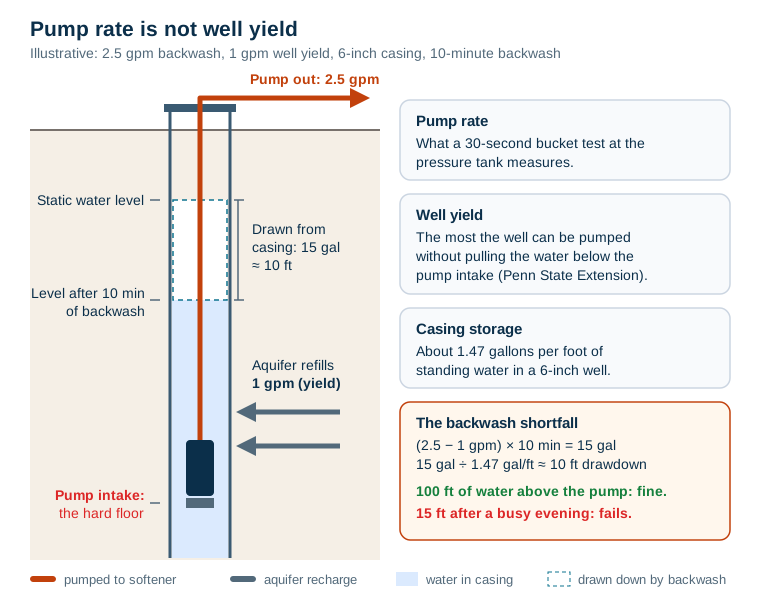
Why a weak well can pass a quick test. Say a pump delivers 2.5 gpm and the well yields 1 gpm. For each minute of backwash, the pump takes 1.5 gallons more than the aquifer puts back, and the difference comes out of the casing. Over a 10-minute backwash that is 15 gallons, about 10 feet of drawdown in a 6-inch well (an illustrative example, not a measured one). A well with 100 feet of water above the pump shrugs that off. A well with 15 feet does not, especially if the evening's showers and laundry have already drawn it down.
Penn State also points out that water levels move with the seasons. A well that typically has 100 feet of water "may have less than 20 feet of water storage during a drought." A backwash that works in April can fail in September.
Test 1: Measure the Pump Rate With a Bucket
This gives you the ceiling. The well can never deliver more than the pump does.
- Use a spigot close to the pressure tank, ideally the drain valve on the tank tee or the nearest hose bib, ahead of any filters.
- Run water until the pump starts. You want to measure the pump, not water leaving the pressure tank.
- Open the spigot fully and time a 5-gallon bucket from empty to full, in seconds.
- Convert: gpm = 300 ÷ seconds. Do it twice and average the two.
| Seconds to fill 5 gallons | Pump rate |
|---|---|
| 30 | 10 gpm |
| 60 | 5 gpm |
| 100 | 3 gpm |
| 120 | 2.5 gpm |
| 150 | 2 gpm |
If the pump rate is already below the backwash figure for the tank you want (see the table further down), stop there. The answer is a smaller tank or a storage-buffered design. If it is comfortably above, go on to Test 2, because this number says nothing about how long the well can keep it up.
Test 2: The Sustained Run at Backwash Rate
This is the test that answers the real question. You run the well at the softener's backwash rate for as long as a regeneration sends water to drain, and watch whether the flow holds.
- Find your target rate. Use the drain line flow control figure for the tank you plan to buy (it is in the valve's specification sheet), or the table in the next section.
- Find the drain time. Add the programmed backwash and rapid rinse minutes from the valve manual. If you do not have them yet, use 20 minutes. Then add 10 minutes of margin for other water use during the cycle.
- Set a hose bib to the target rate. Partly close the spigot until a 5-gallon bucket fills in the matching time. At 2.5 gpm that is 120 seconds.
- Run it for the full time and re-time the bucket every 5 minutes. Watch the pressure gauge at the pressure tank as you go.
- Run the test at the worst time. That means the evening, after the household's heaviest use, and ideally late in a dry season. A test on a wet spring morning flatters the well.
What passing looks like. The bucket time stays within a few seconds of where you set it. Pressure cycles normally between cut-in and cut-out. The water stays clear.
Stop signs. Stop the test immediately if any of these happen:
- Sputtering or air at the spigot. The water level has reached the pump intake. Running on means running the pump without water.
- Pressure falling below the cut-in setting and not recovering with the pump running. The pump is no longer keeping up.
- Sand, grit or cloudy water appearing partway through, which is another sign of a well being pulled down hard.
- Bucket times getting steadily longer, even if pressure looks normal.
If your pump has a low-water cutoff or a pump protection control, it may shut the pump off during this test. That is a fail, not a nuisance.
The test cannot hurt the well if you stop at the first stop sign. It also cannot replace a proper yield test by a well contractor, who measures the water level itself with a meter while pumping at a set rate. If your state keeps well completion reports, the yield and static water level recorded when the well was drilled are worth looking up before you start.
Well Pump Flow Rate vs Backwash Demand, by Tank Diameter
The backwash flow a softener needs is set by the area of the resin bed, so tank diameter drives it. The grain rating on the box does not. The WC&P design guide gives backwash rates for softener resin that rise with water temperature, because warm water expands the bed less and needs more flow to lift it:
- 4.2 gpm per square foot at 50°F
- 5.0 gpm per square foot at 59°F
- 5.5 gpm per square foot at 68°F
The first three columns below multiply those rates by each tank's bed area. The last column gives published figures from manufacturer specification sheets for real residential softeners.
| Tank diameter | Bed area | At 50°F | At 59°F | At 68°F | Published figure |
|---|---|---|---|---|---|
| 8 inch | 0.35 sq ft | 1.5 gpm | 1.7 gpm | 1.9 gpm | — |
| 9 inch | 0.44 sq ft | 1.9 gpm | 2.2 gpm | 2.4 gpm | 2 gpm (ECI Fleck catalog, 9×48) |
| 10 inch | 0.55 sq ft | 2.3 gpm | 2.7 gpm | 3.0 gpm | 2.5 gpm (Pentair spec sheet, 10×44 and 10×54) |
| 12 inch | 0.79 sq ft | 3.3 gpm | 3.9 gpm | 4.3 gpm | 3.5 gpm (Pentair, 12×48); 3 gpm (ECI Fleck, 12×52) |
| 13 inch | 0.92 sq ft | 3.9 gpm | 4.6 gpm | 5.1 gpm | — |
| 14 inch | 1.07 sq ft | 4.5 gpm | 5.3 gpm | 5.9 gpm | 5 gpm (ECI Fleck, 14×65) |
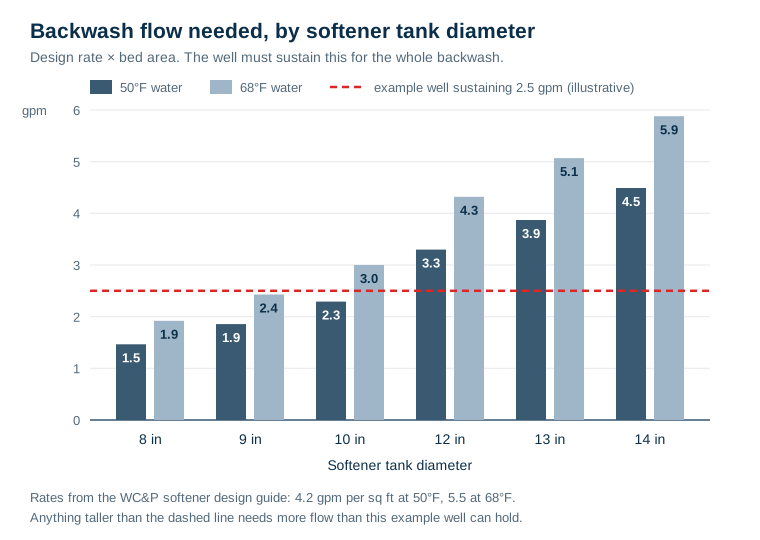
How to use the table.
- Well water is usually cool, so the 50 to 59°F columns are the realistic ones for most US wells. That works slightly in a weak well's favor.
- Your valve's flow control is what counts. The manufacturer picks a flow control near these figures. The number stamped on it, or printed in the spec sheet, is what the valve will draw from your well.
- Add everything that regenerates at the same hour. An iron filter needs far more backwash than a softener, and two units backwashing together can ask for 10 gpm or more. Staggering them is covered in pretreatment order before a softener. If you are choosing an iron filter, compare the backwash flow each air injection unit needs with the flow your well held in Test 2.
- Leave headroom. A household that runs a tap or flushes a toilet during regeneration takes water from the same pump.
Reading the Result
Compare the flow the well held steady in Test 2 with the published figure for the tank you want.
| Your result | What it means | Next step |
|---|---|---|
| Sustained flow well above the tank's backwash rate, with no stop signs | The well can support that tank | Size the softener in the normal way |
| Sustained flow only just covers it, or held only in a wet season | Marginal. It works until a dry month or a busy evening | Drop one tank diameter and accept more frequent regeneration |
| Pump rate or sustained flow below even a 9-inch tank's rate | The well cannot support a backwashing tank at its own pace | A storage-buffered design, or talk to a well contractor about yield |
Large single tanks are where this bites first. Comparing 80,000 grain single tanks with twin tanks on backwash flow shows how a 13-inch tank's demand of about 4.6 gpm compares with a twin that asks far less of the well.
Workaround 1: A Smaller-Diameter Tank
Dropping from a 12-inch to a 10-inch tank takes the backwash demand from about 3.5 gpm to 2.5 gpm on the Pentair figures. Dropping to a 9-inch takes it to about 2 gpm.
What you give up:
- Resin per inch of height. A narrower tank holds less resin at the same height. Some of that comes back by going taller: Pentair lists 1.0 cubic foot in a 10×44 tank and 1.5 in a 10×54, both at 2.5 gpm backwash.
- Days between regenerations. Less resin means the softener regenerates more often. That is fine for the resin but uses a little more salt and water over a year.
- Peak service flow. A smaller tank passes less water at a given pressure drop. On a weak well that rarely matters, because the well itself limits peak flow.
How far you can take this, and what to do when even the smallest tank regenerates too often, is worked through step by step in sizing a softener for a low-yield well.
Workaround 2: Storage-Tank Buffering
Penn State describes an intermediate storage system as a non-pressurized tank between the well and the house. The well pump fills it at a rate "slightly less than the yield of the well", and a second pump repressurizes the water for the house. A float switch controls the well pump, and a low-water cutoff in the well protects it.
With the softener downstream of the booster pump, backwash draws on stored water at the booster's rate. The well refills the tank overnight at its own pace.
What you give up:
- Cost. Penn State's 2005 fact sheet estimated a household system at under $1,500 before chlorination. Prices have risen since, so treat that as a floor rather than a quote.
- A second pump and its electricity, plus a second thing to fail.
- Space and freeze protection. The tank needs a heated space or burial below the frost line. Penn State's rule of thumb is 100 gallons of storage per person.
- Water quality in the tank. An open tank needs periodic cleaning, and some systems add chlorination at the storage stage.
What This Test Cannot Tell You
- It measures one day. Yield and water level change with the seasons. If you can only test once, test late in the dry season.
- It is not a certified yield test. It tells you whether the well can supply one specific flow for one specific time. A driller's pumping test with a water-level meter tells you what the aquifer can actually yield.
- A softener does nothing for yield. It removes hardness. It does not add water, and no setting on the valve reduces the backwash rate below what the resin bed needs to expand.
- Passing does not mean the water needs only a softener. Iron, manganese, sediment and bacteria each have their own test and their own place in the treatment train.
Run both tests before you buy, not after the resin has started channeling. A well pump flow rate that holds steady through a full backwash-length run means backwashing equipment will work. One that sags means the tank diameter, or the plumbing layout, has to change first.
Frequently Asked Questions
How many gpm does a water softener need to backwash?
It depends on the tank diameter, not the grain rating. Published residential figures run from about 2 gpm for a 9-inch tank to 2.5 gpm for a 10-inch tank and 3 to 3.5 gpm for a 12-inch tank. Worked from a design rate of 4.2 to 5.5 gpm per square foot of bed, a 14-inch tank needs roughly 4.5 to 5.9 gpm. The exact figure is stamped on the drain line flow control in your valve.
Can my well pump keep up with a water softener?
Two numbers decide it: the rate your pump delivers and the rate your well can sustain for the whole regeneration. Time a 5-gallon bucket at the pressure tank to get the pump rate. Then run a hose at the backwash rate for 20 to 30 minutes and see whether the flow and pressure hold. If they hold, the well can support that tank. If the flow sags or the pump starts spitting air, it cannot.
What happens if a softener does not get enough backwash flow?
The resin bed never lifts and loosens properly. Sediment and iron stay in the bed, the beads pack down, and water starts to cut channels through the resin instead of passing evenly through it. Nothing alarms. The first sign is usually hardness showing up at the tap earlier and less predictably than it should, weeks or months later.
What is the difference between pump rate and well yield?
Pump rate is how fast the pump can move water. Well yield is the rate the aquifer refills the well. Penn State Extension defines yield as the maximum rate a well can be pumped without lowering the water level below the pump intake. A pump can outrun a low-yield well for a while by drawing on water stored in the casing, which is why a 30-second bucket test can pass while a 20-minute backwash fails.
What if my well cannot supply enough backwash flow?
There are two practical options. Choose a smaller-diameter softener tank, which needs less backwash flow, and accept more frequent regeneration. Or add an atmospheric storage tank and booster pump so the softener backwashes from stored water while the well refills the tank at its own pace. The first is cheaper. The second is the only answer when even a small tank's backwash rate is more than the well can sustain.
Does a bigger pump solve a low-flow backwash problem?
Only if the pump was the limit and the well can yield more. If the aquifer is the limit, a bigger pump empties the casing faster and reaches the intake sooner. That can mean air, sediment and a pump running without water. A well contractor can tell you which limit you have from a proper yield test and the well completion report.
