
Can a Water Softener Be Used on Private Well Water?
A water softener for well water removes hardness just as it does on city water, and it is often the right purchase. On its own, though, it's rarely enough. Well water can also carry iron, manganese, hydrogen sulfide, low pH, sediment and bacteria, and each needs its own treatment stage in the right order. Test for all of them before you buy.
That last sentence is where most well owners go wrong, and the mistake always looks the same.
The Mistake That Defines Well Water Softening
A homeowner gets a hardness number, often from a test strip or a dealer's kitchen demonstration, and buys a softener sized to it. For the first few months everything is fine. Then the soft water starts running out before regeneration. Orange tint appears after the softener cycles. The salt use seems right, but the water isn't soft. By year two the resin is fouled, the valve is sticking, and the owner has concluded that softeners don't work on well water.
The softener was doing what it was built for. What failed was the diagnosis. That hardness number said nothing about the iron that was coating the resin, the low pH that was holding iron in solution, the sediment packing the bed, or the bacteria growing in it. Each of those was already in the water on the day of the test. Nobody tested for them.
Penn State Extension's water softening fact sheet gives the fix plainly: "Have the water tested by an independent lab," because "an independent lab test is not expensive and will protect you from being oversold." It also names the limit: softening "will not necessarily remove any of the more serious drinking water contamination problems."
So the rest of this guide follows the order a well owner should work in: test fully, route each result to its stage, then size and place the softener last.
What a Water Softener for Well Water Does, and Does Not Do
A softener is an ion-exchange tank. Resin beads hold sodium (or potassium) loosely, and give it up in exchange for positively charged ions that pass through, mainly calcium and magnesium. Regeneration with brine resets the beads. That's all it does, and it explains both its strengths and its limits on a well.
| Well water problem | What the softener does | Verdict |
|---|---|---|
| Hardness (calcium, magnesium) | Removes it | The job it is designed for |
| Dissolved (ferrous) iron at low levels | Exchanges it, but uses up capacity | Tolerated, within the manufacturer's limit and with compensation |
| Oxidized (ferric) iron, rust particles | Traps it as dirt, can't release it in regeneration | Harmful. It fouls the resin |
| Manganese | Exchanges small amounts, which are harder to strip off | Tolerated only at low levels |
| Hydrogen sulfide (rotten-egg smell) | Nothing useful | Needs its own stage |
| Low pH (acidic water) | Doesn't raise pH | Needs a neutralizer |
| Sediment, sand, silt | Collects it in the bed | Harmful. It packs the bed and wears the valve |
| Bacteria, including iron bacteria | Nothing. The bed can become a place for them to grow | Needs disinfection. A softener is not a safety device |
| Nitrate, arsenic and other health contaminants | Not a softener's job | Needs specific, certified treatment |
Manufacturers say the same thing in their manuals. One consumer manual we checked rates the softener for up to 2 ppm of dissolved ferrous iron. It then warns that supplies with "ferric hydroxide iron, iron bacteria, low pH, taste and odors" may need extra equipment, and that the unit is not intended for water that is "microbiologically unsafe or of unknown quality" without disinfection. Why well water tends to be hard in the first place, and why two wells a mile apart can differ so much, is covered in why well water is often hard.
The Full-Panel Test: Seven Results You Need Before Buying
EPA's guidance on protecting your home's water recommends testing a private well every year for total coliform bacteria, nitrates, total dissolved solids and pH. When a softener is being considered, it adds iron and manganese. Put those together with what a softener actually cares about and you get this panel:
| # | Test | Why it decides the equipment |
|---|---|---|
| 1 | Total hardness (ask for gpg or mg/L as CaCO₃) | Sizes the softener. Test more than once, because well hardness drifts with the seasons |
| 2 | Iron, dissolved and total (filtered and unfiltered on the same sample) | The gap between the two numbers is iron that has already oxidized, and a softener can't handle that part |
| 3 | Manganese | Low levels matter. EPA's aesthetic guideline is 0.05 mg/L |
| 4 | pH and alkalinity | Below about 6.7, iron chemistry and corrosion both change, and a neutralizer usually goes in first |
| 5 | Hydrogen sulfide (or at least note any rotten-egg smell) | Needs oxidation or aeration. A softener won't touch it |
| 6 | Total coliform and E. coli | Positive results mean disinfection comes before anything else |
| 7 | Nitrate and TDS | Health and baseline checks that EPA recommends every year, whether or not you soften |
Add tannins if the water has a yellow or tea-coloured tint, and add sediment or turbidity if you see grit in toilet tanks or aerators.
How the sample is drawn matters as much as what's on the list. Iron in particular changes in the bottle, as explained in testing iron and manganese before sizing a softener. For hardness specifically, including where to draw the sample relative to the pressure tank, see how to test hardness in private well water.
The Treatment-Train Decision Tree
Work through the test results in this order. Each question either adds a stage ahead of the softener or sends you somewhere else first.
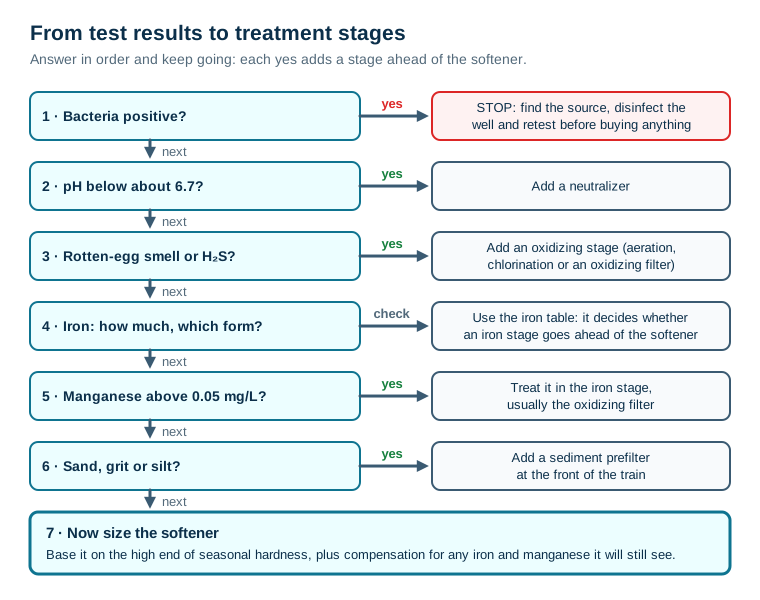
1. Bacteria positive? → Stop. Find the source, disinfect the well, and retest before buying any equipment. A softener put into contaminated water can harbour bacteria in the bed. If the problem is iron bacteria (slimy, rust-coloured growth in the toilet tank), no softener fixes it.
2. pH below about 6.7? → Add a neutralizer ahead of the softener, straight after the sediment prefilter. Low pH also affects how iron behaves and corrodes copper plumbing. How pH and hardness readings interact is covered in reading pH and hardness together.
3. Rotten-egg smell or measurable hydrogen sulfide? → Add an oxidizing stage (aeration, chlorination or an oxidizing filter) ahead of the softener. Why the smell survives softening is in why a sulfur smell remains after softening.
4. Iron: how much, and in which form? Penn State Extension's guidance on iron and manganese in private water systems gives these working bands:
| Iron result | Where it goes |
|---|---|
| Below 0.3 mg/L (EPA's staining guideline) | No iron stage needed. Size the softener normally |
| Dissolved iron below 5 mg/L, pH above 6.7 | The softener can carry it, within its own rated limit and with sizing compensation |
| Combined iron and manganese about 3 to 10 mg/L | Oxidizing filter (such as manganese greensand) ahead of the softener |
| Above 10 mg/L | Oxidation followed by filtration ahead of the softener |
| Any significant oxidized iron (rusty at the tap) | Filter it out first, whatever the concentration. Penn State notes oxidized iron and manganese "will foul the softener resin" |
Which form you have is the most important fact in this tree. How to tell them apart with a glass of water and a lab request is in dissolved vs oxidized iron in well water. What a softener can realistically take is in can a water softener remove iron?, and when the answer is "both units" rather than "one or the other", see water softener vs iron filter.
5. Manganese above 0.05 mg/L? → Treat it in the same stage as iron, usually the oxidizing filter. Manganese stains black, and it clings to resin more stubbornly than iron does.
6. Sand, grit or silt? → Add a sediment prefilter at the front of the treatment train. Choosing a micron rating and knowing when to change it are covered in when to replace a sediment prefilter before a softener.
7. Now size the softener. Base it on the high end of your seasonal hardness range, plus compensation for any iron and manganese the softener will still see. That arithmetic is worked through in how iron changes water softener sizing. With the iron result and the size in hand, softeners sorted by the iron level they can carry narrows the choice.
The Order the Stages Go In
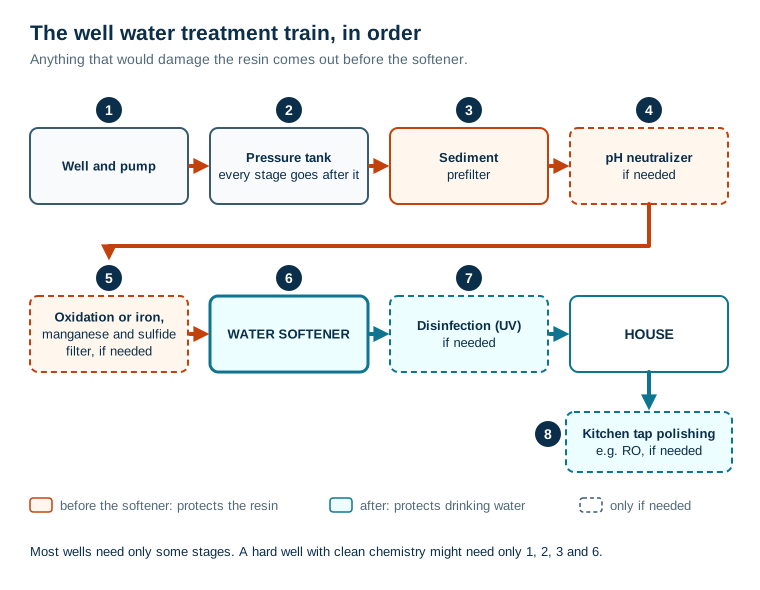
Once the decision tree has told you which stages you need, the order follows one rule: anything that would damage the resin comes out before the softener, and anything that protects drinking water goes after it.
A typical full train on a well looks like this:
- Well and pump
- Pressure tank (every treatment stage goes after this)
- Sediment prefilter
- pH neutralizer, if needed
- Oxidation or iron, manganese and sulfide filter, if needed
- Water softener
- Disinfection (UV), if needed
- Drinking-water polishing at the kitchen tap, such as reverse osmosis
Most wells need only some of these. A hard well with clean chemistry might need only stages 1, 2, 3 and 6. What each combination costs installed, plus its yearly running cost, is worth pricing before you commit to a train. The exact position of the softener relative to the pressure tank, the outdoor taps and the water heater is laid out in where to install a softener on a well system. The order and thresholds for the filters that protect it are in iron filter before water softener: pretreatment order.
What Changes About the Softener Itself on a Well
The decision tree picks the stages. A few things about the softener also differ on a well supply:
- Pressure and flow come from your pump. Manufacturers publish operating limits. One consumer manual we checked lists 25 to 125 psi, and another requires at least 3 gallons per minute at the inlet so the unit can regenerate. A healthy pressure-tank system normally works within these, but a weak pump or a low-yield well may not.
- Regenerate more often, not less. If the softener is carrying some dissolved iron, shorter intervals between regenerations give the iron less time to oxidize on the beads. Stretching the interval to save salt is a false economy on a well.
- Budget for resin cleaning. A softener that legitimately carries small amounts of iron should get a resin cleaner on a schedule, not as a rescue. Resin and iron cleaners covers when this helps and when it doesn't.
- Retest yearly. Well chemistry changes. Iron that wasn't there at purchase can appear, and a softener that was right in year one can be overloaded by year five. If brown water starts appearing after regeneration, brown water after softener regeneration is the diagnosis to start with.
The Well Water Series: Where to Go Next
This page is the hub for our well-water guides. Start with the one that matches the question you have now:
Testing and diagnosis
- How to test hardness in private well water
- Test iron and manganese before sizing a softener
- Dissolved vs oxidized iron in well water
- Why well water is often hard
Iron and the softener
- Can a water softener remove iron?
- How iron changes water softener sizing
- Water softener vs iron filter
Layout and pretreatment
- Where to install a softener on a well system
- Iron filter before water softener: pretreatment order
- When to replace a sediment prefilter
Other problems softeners don't fix
A softener on a well is a good investment when it is the last stage of a system built from a full test. It is a costly lesson when it is the only stage, chosen from one hardness number. The test costs far less than the lesson.
Frequently Asked Questions
Can you use a regular water softener on well water?
Yes. A standard ion-exchange softener removes calcium and magnesium from well water exactly as it does from city water. The difference is everything else well water can carry, such as iron, manganese, hydrogen sulfide, low pH, sediment and bacteria. Some of those the softener tolerates in small amounts, some damage it, and some it does nothing about. Whether a regular softener is enough depends on a full water test, not on hardness alone.
Do I need a water softener if I have well water?
Only if the water is hard enough to cause problems. Many wells are hard, but not all, because hardness depends on the rock the aquifer runs through. Test hardness first. A well with low hardness but high iron or low pH needs an iron filter or a neutralizer, not a softener. EPA's private well guidance suggests testing for iron and manganese when a softener is being considered.
How much iron can a water softener handle on well water?
It depends on the unit and on the form of the iron. Penn State Extension places softening within its range for dissolved iron below about 5 mg/L, with pH above 6.7. Individual manufacturers rate their units lower or higher, and one consumer manual we checked rates its softener for up to 2 ppm of dissolved ferrous iron. Iron that has already oxidized, the kind that makes water look rusty at the tap, fouls the resin at any level and has to be filtered out first.
Why did my well water softener stop working after a couple of years?
Most often because of something the original test never measured. Iron or manganese coat the resin, oxidized iron clogs it, sediment packs the bed, or bacteria form slime inside it. Each of these slowly cuts capacity until hardness breaks through. The softener was usually the right equipment for the hardness but the wrong equipment to be the only stage on that well.
Does a water softener make well water safe to drink?
No. A softener exchanges hardness minerals for sodium or potassium. It is not a disinfection device and it is not a treatment for nitrate, arsenic or other health-related contaminants. Penn State Extension notes that softening will not necessarily remove the more serious drinking water problems. Test annually for bacteria, nitrate, pH and dissolved solids as EPA recommends, whether or not you soften.
What order should well water treatment go in?
Generally: pressure tank, then sediment filtration, then any pH correction and iron, manganese or sulfide removal, then the softener, and finally any disinfection or drinking-water polishing. The logic is that each stage protects the one after it, so anything that would foul or damage resin comes out before the softener. The exact stages depend on what your test finds.
