
Best Carbon Prefilters Before a Water Softener: Months of Protection on Chlorine vs Chloramine
The best carbon prefilters for a water softener depend on one thing first: whether your city uses free chlorine or chloramine. On free chlorine, a non-backwashing carbon tank such as the Aquasana Rhino EQ-1000 is the simplest buy, rated for 1,000,000 gallons or 10 years. That is about ten years for a family of four. On chloramine, buy catalytic carbon in a backwashing tank, such as AFWFilters' 1.5 cubic foot catalytic carbon system on a Fleck 5600SXT, and size it for your peak flow.
Gallon ratings are chlorine figures. On chloramine the same tank protects a fraction of the flow, and this page shows how much.
Disclosure: Hard Water Solved may earn a commission if you buy through links on this page, at no extra cost to you. It does not change which products we include or how we rank them. Read our disclaimer.
How We Chose
Methodology. Nothing on this page was physically tested. Each prefilter was compared from the maker's or seller's product page on media type and volume, rated capacity and flow.
- Included: whole-house carbon systems sold on Amazon.com, suitable for installing ahead of a softener.
- Normalised: gallon ratings are converted to months at two illustrative household uses, and media volume is converted to the flow each tank can treat at the contact time chlorine and chloramine need.
- Excluded: replacement cartridges and loose media, under-sink filters, and combination softener-plus-carbon units, which are a different purchase.
- Prices are not listed here because they change often. Use the buttons to see the current price on Amazon.
First, Find Out Which Disinfectant You Have
Your utility's annual Consumer Confidence Report names the disinfectant. You can also test at a tap before the softener with a kit that reads free and total chlorine. If total runs well above free, most of the residual is chloramine. The EPA's page on chloramines in drinking water says more than one in five Americans drinks chloraminated water, so do not assume.
Whether you need carbon at all is a separate question, and the answer is often no on a low free chlorine residual. The payback is worked through in when city chlorine requires carbon pretreatment. What chloramine does to resin, and why ordinary carbon struggles with it, is in how chloramine affects a water softener. This page assumes you have decided to buy and covers which one. And if your softener has simply stopped softening, rule out a brine-side fault before blaming chlorine: why a water softener is not using salt covers that check.
Gallons to Exhaustion, Converted to Months
A gallon rating tells you nothing until you set it against your household's use. We use two illustrative figures: about 51,000 gallons a year for two people and about 102,000 gallons a year for a family of four, at about 70 gallons per person per day.
| Prefilter | Rated capacity (maker) | Months for two people | Months for a family of four | On chloramine |
|---|---|---|---|---|
| Aquasana Rhino EQ-1000 | 1,000,000 gal or 10 years | 120 (10-year limit first) | about 118 | Not rated; Aquasana sells a separate Rhino Chloramines model |
| Aquasure Fortitude Pro | 1,000,000 gal or 6 years | 72 (6-year limit first) | 72 (6-year limit first) | Aquasure claims chloramine removal; contact time limits it to about 1 gpm |
| AFWFilters catalytic carbon, 1.5 cu ft, backwashing | No gallon rating on the product page | about 48 to 60 | about 48 to 60 | Built for chloramine; test between tanks yearly |
| Oceanic 1 cu ft GAC, backwashing | No gallon rating found | about 48 to 60 | about 48 to 60 | Not suitable |
Months for the backwashing tanks use the four to five years between media changes that sellers commonly quote for city water. They are a planning figure, not a rating. On chloramine, plan on the low end and test.
The Rhino and the Fortitude Pro both carry a million-gallon rating, but the Fortitude Pro's time limit is shorter. For a family of four that means a media change after 6 years instead of about 10.
Chlorine vs Chloramine: Why the Same Tank Protects Less
Carbon removes free chlorine fast. It removes chloramine slowly, by breaking it down on the carbon surface. The Water Quality Association's chloramine fact sheet notes that chloramine can need a carbon contact time of 10 minutes or more for complete removal. Catalytic carbon is made to speed that reaction, and the site's planning figure for it is about 3 minutes, against about 1.5 minutes for free chlorine.
Contact time is simple arithmetic: minutes = media volume in gallons ÷ flow in gpm, and one cubic foot of media holds 7.48 gallons. So the flow a tank protects is its media volume in gallons divided by the contact time.
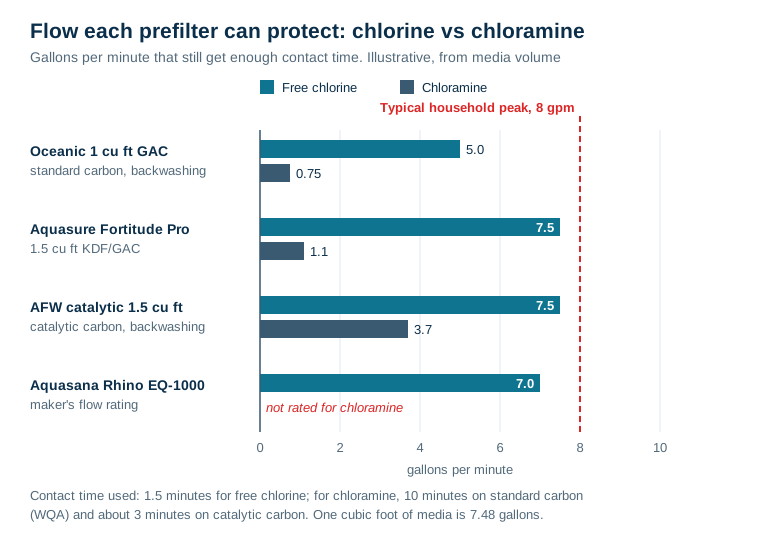
Three things follow:
- On free chlorine, all four protect normal flows. The 1.5 cubic foot tanks cover about 7.5 gpm, close to a typical 8 gpm household peak.
- On chloramine, standard carbon covers about 1 gpm. That is a single tap. At a shower or two, most of the chloramine reaches the resin.
- Catalytic carbon gets you to about 3.7 gpm in a 1.5 cubic foot tank. AFWFilters rates this system at 3 gpm service flow. For an 8 gpm peak on chloramine, the site's sizing puts the need at roughly 3.2 cubic feet of catalytic media. AFWFilters sells 2.0, 2.5 and 3.0 cubic foot catalytic systems for that.
The Best Carbon Prefilters, Pick by Pick
| Pick | Media | Backwashes? | Rated capacity | Amazon |
|---|---|---|---|---|
| Aquasana Rhino EQ-1000 | Carbon and KDF | No | 1,000,000 gal or 10 yr | Check price on Amazon |
| AFWFilters Digital Catalytic Carbon 15, Fleck 5600SXT | 1.5 cu ft catalytic carbon | Yes | No gallon rating | Check price on Amazon |
| Aquasure Fortitude Pro | 1.5 cu ft KDF/GAC | Manual flush | 1,000,000 gal or 6 yr | Check price on Amazon |
| Oceanic 1 cu ft GAC, Fleck 5600 | 1 cu ft GAC | Yes | Not stated | Check price on Amazon |
Aquasana Rhino EQ-1000: best for free chlorine with no drain or power
- What it is: a carbon and copper-zinc (KDF) whole-house tank with a pre-filter. It needs no electricity, drain line or backwashing, per Aquasana.
- Capacity and flow: 1,000,000 gallons or 10 years; 7 gpm rated, 14.6 gpm peak, per the Rhino product page.
- Evidence: Aquasana states it is tested to NSF/ANSI 42 for chlorine reduction, and its tank is WQA-certified to NSF/ANSI/CAN 61 for materials.
- Upkeep: the standard 20 inch pre-filter is changed every 2 months, or every 6 months with Aquasana's low-maintenance option.
- Warranty: 10-year limited warranty and a 90-day satisfaction guarantee.
The Rhino is the easiest prefilter to live with on a free chlorine supply. Because it does not backwash, it never competes with the softener for drain flow or regeneration time. For a family of four, the million-gallon rating and the 10-year limit arrive at about the same time.
Wrong for: chloramine supplies. Aquasana sells a separate Rhino Chloramines model with catalytic carbon. Buy that from Aquasana if you want this format on chloramine; we did not check it on Amazon.
AFWFilters Digital Catalytic Carbon 15 with Fleck 5600SXT: best for chloramine
- What it is: 1.5 cubic feet of catalytic carbon over a gravel bed in a 10x54 tank, with a Fleck 5600SXT digital control head that backwashes automatically.
- Flow: 3 gpm service flow; needs at least 5.5 gpm available for backwash, per AFWFilters. It is sized for one or two bathrooms and two or three people.
- Claims: removes chloramine, chlorine, iron up to 10 ppm and hydrogen sulfide up to 10 ppm, per AFWFilters' product page.
- Media: AFWFilters sells replacement catalytic carbon by the cubic foot and half cubic foot, enough to re-media this tank.
This is the only pick here made for chloramine, and catalytic carbon is what makes chloramine removal practical in a household-size tank. Its 3 gpm rating is the honest limit. A bigger home on chloramine needs one of AFWFilters' larger catalytic systems, not this one. The Fleck Centaur catalytic carbon listing on Amazon is an alternative, but we could not verify its seller.
Wrong for: houses with a peak flow well above 3 gpm on chloramine, and homes with no drain or outlet near the softener. It also needs its regeneration scheduled apart from the softener's.
Aquasure Fortitude Pro: lower price, shorter rated life
- What it is: a 1.5 cubic foot KDF and GAC whole-house system with a 20 inch pleated sediment filter, per the Amazon listing title.
- Capacity: up to 1,000,000 gallons or 6 years, per Aquasure's product page. Aquasure says its media removes chlorine and chloramine.
- Warranty: 5-year limited warranty when registered online within 60 days.
- Upkeep: owner reviews on Aquasure's page describe a manual flush every week or so.
On free chlorine, it usually costs less than the Rhino up front, with the same million-gallon rating but a 6-year time limit. On chloramine, Aquasure's claim needs the contact-time caveat: at 10 minutes, 1.5 cubic feet of standard carbon covers only about 1 gpm.
Wrong for: chloramine supplies relying on it to protect resin at normal flows, and owners who do not want a manual flushing routine.
Oceanic 1 cu ft GAC on a Fleck 5600: a backwashing tank for free chlorine
- What it is: a 9x48 tank with 1 cubic foot of granular activated carbon on a Fleck 5600 valve, per the Amazon listing title.
A backwashing GAC tank keeps the bed loose and lasts years on free chlorine. At 1 cubic foot it covers about 5 gpm of free chlorine at 1.5 minutes of contact. That suits a smaller home.
Wrong for: chloramine, larger homes with an 8 gpm peak, and buyers who want a published gallon rating.
Upkeep Over Ten Years
An illustrative model for a family of four on free chlorine. It leaves out sediment pre-filters, water and power for backwashing, and installation.
| Prefilter | Media changes in 10 years |
|---|---|
| Aquasana Rhino EQ-1000 | none (rating reached at about 10 years) |
| Aquasure Fortitude Pro | one media replacement at 6 years |
| AFWFilters catalytic 1.5 cu ft | one re-media at about 4 to 5 years |
On free chlorine the Rhino needs the least upkeep, and it is the simplest. On chloramine the comparison changes. The AFWFilters catalytic tank is the only one here that protects the resin at real flows, so it is the one to cost.
Cartridge Prefilters: When They Make Sense
A large 20 inch cartridge housing is cheaper and needs no drain. It also holds far less carbon than a tank, so it gives little contact time at whole-house flows and needs frequent changes. NDSU Extension's rule of thumb for high-volume carbon filters is every three to six months of use. A cartridge suits a small home on low free chlorine, or a temporary fix. For resin protection on chloramine, it is not enough.
Fitting a Carbon Prefilter Ahead of a Softener
- Order: sediment, then carbon, then softener. Give each unit its own bypass.
- Schedule backwashing tanks apart. If both units backwash, set the carbon to regenerate first and the softener after it finishes.
- Check the combined pressure drop. A carbon tank and softener in series can take 15 to 25 psi at busy flow.
- Test yearly. Check total chlorine between the carbon and the softener. When it appears, the media is due.
Who Should Buy None of These
- Low free chlorine homes. Under about 0.5 mg/L, 10 percent crosslink resin at the next rebed is often cheaper than carbon. See the payback figures in the carbon pretreatment guide linked above.
- Well owners with no chlorinator. There is no chlorine to remove from the resin's point of view.
- Chloramine homes with a peak flow far above 3 gpm, looking at the 1.5 cubic foot tanks. Size up to 2.5 or 3.0 cubic feet of catalytic media instead.
- Homes that rarely use water for long periods. Carbon removes the disinfectant, and a bed that sits unused can grow bacteria. Flush it after time away.
For most free chlorine homes, the Rhino is the simplest prefilter, with no media change for about ten years. On chloramine, buy catalytic carbon sized for your peak flow. Measure the disinfectant before you buy, because the same tank does a very different job on each.
Frequently Asked Questions
What is the best carbon prefilter for a water softener?
On free chlorine, a non-backwashing tank such as the Aquasana Rhino EQ-1000, rated for 1,000,000 gallons or 10 years, is the simplest choice. On chloramine, choose catalytic carbon in a backwashing tank, such as AFWFilters' 1.5 cubic foot catalytic carbon system on a Fleck 5600SXT, and size it for your peak flow. Standard carbon removes little chloramine at household flow rates.
How long does a whole-house carbon prefilter last?
On the makers' ratings, the Aquasana Rhino lasts up to 1,000,000 gallons or 10 years, which a family of four reaches in about 10 years, and the Aquasure Fortitude Pro up to 1,000,000 gallons or 6 years. Backwashing carbon tanks are commonly quoted at four to five years between media changes on city water. Test for chlorine after the filter once a year rather than relying on the calendar.
Does a carbon prefilter remove chloramine?
Only if it gives enough contact time. The Water Quality Association notes chloramine can need 10 minutes or more of carbon contact for complete removal, against about 1.5 minutes for free chlorine in typical sizing. Catalytic carbon speeds the reaction to roughly 3 minutes on the site's planning figure. A 1.5 cubic foot catalytic tank therefore protects about 3.7 gpm on chloramine, against about 7.5 gpm on free chlorine.
Should the carbon filter go before or after the water softener?
Before. The carbon removes the chlorine or chloramine so the resin never sees it. If the softener comes first, its resin is oxidised the whole time and the carbon only improves taste. A sediment filter, if you need one, goes ahead of both.
Is a cartridge carbon filter enough to protect softener resin?
Rarely for long. A 20 inch cartridge holds far less carbon than a tank, so it gives less contact time and needs changing often. NDSU Extension's rule of thumb for high-volume carbon filters is every three to six months of use. A cartridge suits a low-flow home or a short-term fix, but a tank is the usual choice for whole-house resin protection.
