
How Chloramine Affects a Water Softener
A chloramine water softener setup has a slower problem than one on free chlorine, but a harder one to fix. Chloramine oxidises resin more slowly than free chlorine, yet it stays in the water for days, and standard carbon barely removes it at household flow rates. Protecting the resin takes catalytic carbon and roughly twice the contact time of a free chlorine filter.
The EPA's page on chloramines in drinking water says more than one in five Americans drinks water treated with chloramines. Some utilities switched to meet disinfection byproduct requirements. If you are one of them, or your utility switches while your softener is in service, the carbon choices below matter more than the softener itself.
What Chloramine Does to a Softener
Chloramine is formed when a utility adds ammonia to chlorine. It damages resin by the same route as chlorine: it breaks the divinylbenzene cross-links that keep each bead rigid, so the beads swell, lose capacity and eventually fracture. That mechanism, and how to detect it in your own bed, is covered in how chlorine damages water softener resin. This page does not repeat it.
What changes with chloramine is the exposure pattern:
| Free chlorine | Chloramine | |
|---|---|---|
| Oxidising strength | Stronger | Weaker, so slower per mg/L |
| Persistence in the mains | Fades over hours to days | Holds its residual much longer |
| Residual reaching a house far from the plant | Often low | Often close to the dosed level |
| Standard carbon at household flows | Removes it readily | Removes it poorly |
| What protects the resin | Carbon at normal contact time | Catalytic carbon at longer contact time |
The net effect: a slower attack that never lets up, and one that most off-the-shelf carbon filters do not stop. A softener cannot help, because chloramine is a neutral molecule and resin only exchanges charged ions.
Why Standard Carbon Underperforms on Chloramine
Free chlorine reacts almost immediately on a carbon surface. That is why a modest carbon tank strips it out in the minute or two the water spends passing through.
Chloramine does not react that fast. Carbon removes it by catalysing its breakdown into chloride and ammonia compounds, and that reaction is slow. The Water Quality Association's chloramine fact sheet states that "A bed contact time of 10 minutes or greater can be required for complete catalysis." It also notes three other factors:
- Finer mesh carbon works better, because it has more surface area.
- Removal depends on pH, and catalytic carbons have shown better chloramine removal at higher pH.
- The breakdown products can be taken out by further ion exchange treatment or reverse osmosis.
What that means in a house. A whole-house carbon tank sized for free chlorine typically gives one to two minutes of contact at peak flow. On chloramine that is a fraction of what standard carbon needs. The filter removes some chloramine when it is new and the flow is low. Then it breaks through, often within weeks, and the owner concludes the filter is faulty. It is not faulty. It is the wrong size and the wrong media for the job.
What Catalytic Carbon Changes
Catalytic carbon is activated carbon treated during manufacture so its surface speeds up the chloramine breakdown. Calgon Carbon's data sheet for CENTAUR 12x40, a widely used catalytic carbon, lists chloramine removal among its applications and claims a "smaller system size as compared to standard carbons." It also says that, depending on the reactant, its concentration and the conditions, contact time in fixed beds "is typically less than seven minutes."
Read that carefully. It does not say catalytic carbon removes chloramine as fast as ordinary carbon removes free chlorine. It says the contact time is shorter than standard carbon would need, which is enough to get the tank down to household size. You still need more media than you would for free chlorine.
What catalytic carbon does not change:
- It still needs periodic backwashing and eventual media replacement.
- It still leaves no disinfectant in the lower part of the bed, with the bacteria risk that brings. That risk is covered in when city chlorine requires carbon pretreatment.
- It does not soften, remove lead or remove PFAS unless a specific product is certified for those claims.
Check the certification of the specific model. Chloramine reduction claims for whole-house filters are tested under NSF/ANSI 42. Look for the claim on the exact model, not the brand.
Chloramine Water Softener Pretreatment: The Sizing Difference, Quantified
The same formula applies to both disinfectants. Cubic feet of media equals peak flow in gpm times contact time in minutes, divided by 7.48 (the gallons in one cubic foot). Only the contact time changes.
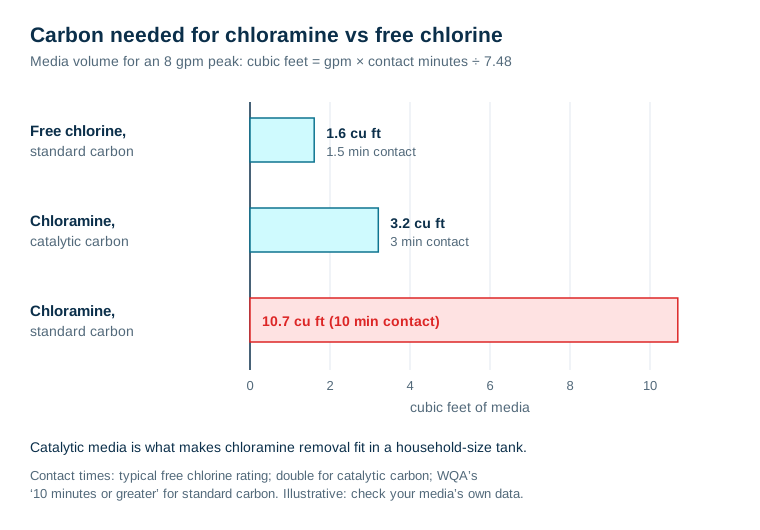
Worked for an 8 gpm peak (illustrative planning figures):
| Disinfectant and media | Contact time used | Media needed | What that means |
|---|---|---|---|
| Free chlorine, standard carbon | 1.5 min | 1.6 cu ft | A 2 cu ft tank |
| Chloramine, catalytic carbon | 3 min | 3.2 cu ft | Roughly twice the tank |
| Chloramine, standard carbon | 10 min (WQA figure) | 10.7 cu ft | Not a household option |
The free chlorine figure matches common ratings of about 5 gpm per cubic foot. Three minutes for catalytic carbon is a planning figure, not a guarantee. Calgon puts catalytic contact times at up to seven minutes depending on conditions. Size up if your residual is high, your water is cold, or your pH is low, and ask the seller for the contact time their chloramine claim was tested at.
The tank consequence. Twice the media usually means a wider tank, and a wider tank needs more backwash flow than a small control valve can deliver. That, and scheduling it around the softener, is in how a whole-house carbon filter and softener work together.
Which Disinfectant Does Your Utility Actually Use?
Do not guess, and do not rely on what a neighbour or a dealer says. Three checks, in increasing order of certainty about your own tap:
1. The Consumer Confidence Report. It names the disinfectant used by the system. Look in the regulated table for chloramines or total chlorine, and in the text for a description of treatment.
2. Ask the water quality desk. Ask which disinfectant serves your address, the residual range they carry, and whether they run a temporary free chlorine period. Some systems use different disinfectants in different zones, or buy chloraminated water from a wholesaler.
3. Test free and total chlorine yourself. Use a kit that reads both. Total chlorine is free plus combined chlorine. On a city supply, a total reading well above the free reading means most of the residual is combined chlorine, which is chloramine. A supply on free chlorine shows free and total close together.
| Your tap test | What it usually means | Equipment implication |
|---|---|---|
| Free and total both near zero | Low residual, or already filtered | Check your carbon. If there is none, resin exposure is low |
| Free close to total | Free chlorine supply | Standard carbon, normal contact time |
| Free low, total much higher | Chloramine supply | Catalytic carbon, longer contact time |
| Free suddenly high on a chloramine supply | A temporary free chlorine period | Normal, and it should end within weeks. Check the dates with the utility |
The Mid-Year Switch Nobody Tells You About
Disinfectant choice is not permanent. Utilities change it, and softener owners rarely hear about it in a way that connects to their equipment.
Permanent conversions. A utility moves from free chlorine to chloramine, often to meet disinfection byproduct rules. There is usually a public notice, but it is often aimed mainly at dialysis patients and aquarium owners, not at softener owners.
Temporary free chlorine periods. Many chloramine systems switch back to free chlorine for a few weeks, often in spring, to clean the mains. The residual can run higher than normal while it lasts.
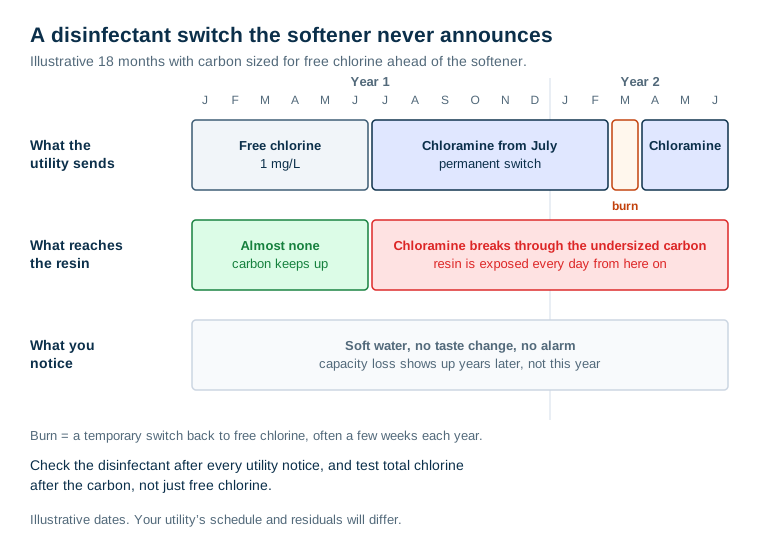
Why the switch shortens resin life without a warning. Picture a house with a free chlorine carbon filter that has worked well for years. The utility switches to chloramine in July. From that day, the undersized carbon lets most of the chloramine through, and the resin is exposed every day. Nothing changes at the tap. The water still tests soft and the taste barely shifts, so nobody suspects anything. The damage shows up years later as falling capacity and rising salt use, and by then it cannot be reversed.
How to catch it:
- Test total chlorine after the carbon filter, not just free chlorine, every few months. Any total chlorine there means the resin is exposed.
- Read every utility notice about disinfection, and ask whether a change is planned before you buy a filter.
- Log gallons between regenerations. A steady downward trend with no other explanation is the oxidation signature. How to keep that log is in how to check if your water softener is working.
What Neither the Softener Nor the Carbon Can Do
- A softener does not remove chloramine. Not with any salt, setting or resin.
- Higher cross-link resin slows the damage but does not stop it. On chloramine it belongs alongside carbon, not instead of it. What resin to specify at replacement is covered in water softener resin life and when to replace it.
- Carbon does not disinfect. It removes the disinfectant, so the water after it is no longer protected by a residual.
- Point-of-use filters protect nothing upstream. An under-sink unit fixes the kitchen tap. The resin has already seen the chloramine.
What to Do, In Order
- Confirm the disinfectant from the utility and with a free and total chlorine test.
- If it is chloramine, specify catalytic carbon, sized at about three minutes of contact at your peak flow as a starting point, and more if your residual is high or your water is cold.
- Ask for the tested contact time and the NSF/ANSI 42 chloramine claim for the specific model. Comparing carbon prefilters on capacity, flow and yearly cost gives you a shortlist to hold to those two numbers.
- Check the backwash flow the larger tank needs against your valve and supply.
- Test total chlorine after the carbon every few months, and replace the media when it appears.
- Watch for utility notices. A switch from chlorine to chloramine turns a correctly sized filter into an undersized one overnight.
- Fit the carbon before the next resin bed, not after it. If you are replacing the whole softener, comparing city-water softeners on resin crosslink and carbon stage shows which packages still leave chloramine to a separate catalytic tank.
A chloramine water softener problem is silent, which is exactly why it costs so much. Find out what your utility adds, size the carbon for it, and test after the carbon rather than at the tap. On city water in general, the wider decision is set out in do you need a water softener on city water.
Frequently Asked Questions
Does chloramine damage water softener resin?
Yes. Chloramine oxidises the cross-links that hold resin beads together, the same basic damage chlorine does. Monochloramine is a weaker oxidant than free chlorine, so it works more slowly at the same concentration. But it persists in the distribution system and arrives at the house at a steady residual, so the resin is exposed every day for its whole service life.
Will a regular carbon filter remove chloramine?
Not well at household flow rates. Standard activated carbon removes chloramine by slowly catalysing its breakdown, and the Water Quality Association notes that a bed contact time of 10 minutes or more can be needed for complete removal. A whole-house tank sized for free chlorine gives one to two minutes. Catalytic carbon, made to speed that reaction, is what makes chloramine removal practical in a household-size tank.
How do I know if my water has chlorine or chloramine?
Your utility's annual Consumer Confidence Report names the disinfectant, and the water quality desk will tell you if you ask. You can also test at the tap with a kit that reads free and total chlorine. If total chlorine is well above free chlorine, most of the residual is combined chlorine, which on a treated city supply means chloramine.
What size catalytic carbon filter do I need for chloramine?
Size it on contact time at your peak flow. A useful planning figure is about twice the contact time used for free chlorine, around three minutes. Cubic feet of media equals peak gpm times contact minutes divided by 7.48, so an 8 gpm peak needs about 3.2 cubic feet of catalytic carbon. Check the specific media's data, because the required contact time rises with higher residuals, colder water and lower pH.
Is chloramine worse than chlorine for a water softener?
In practice, usually yes. At the same concentration it oxidises resin more slowly, but it does not fade in the pipes the way free chlorine does, so the exposure is steadier. It is also much harder to filter out, so homes on chloramine are more likely to end up with carbon that is too small, or with no protection at all.
Does a water softener remove chloramine?
No. Chloramine is a neutral molecule, and softener resin exchanges charged ions like calcium and magnesium. It passes through the bed, oxidising the resin on the way, and reaches the tap unchanged. Only carbon, preferably catalytic carbon, or a system certified for chloramine reduction removes it.
