
When City Chlorine Requires Carbon Pretreatment
A carbon filter before water softener resin pays for itself once enough chlorine would otherwise reach the bed. With the illustrative prices below, that happens at about 1.1 mg/L of free chlorine if you would replace the whole softener, and about 1.6 mg/L if you would just re-bed it. Below about 0.5 mg/L, carbon rarely pays on resin savings alone. On chloramine, it is the default.
Most advice skips the arithmetic and says carbon is always needed on city water. That is not true, and the arithmetic takes ten minutes. How chlorine breaks down the resin is already covered in how chlorine damages water softener resin. This page covers the decision: whether you need carbon at all, what size, and the one risk carbon itself brings.
Step One: Measure the Chlorine That Reaches the Softener
Every figure below depends on one input, and a utility's annual average is not it.
Test free and total chlorine at a tap before the softener. A hose bib or a test port on the inlet side is ideal. Let it run for a minute, then use a kit that reads both values. Free chlorine is what attacks the resin fastest, and a total well above free means chloramine is in the water. That changes the equipment, as covered in how chloramine affects a water softener.
Use the high reading, not the typical one. Residual varies with distance from the plant, the season and the utility's dosing. EPA allows up to 4.0 mg/L of chlorine as a maximum residual disinfectant level under its National Primary Drinking Water Regulations, so the range between a quiet street at the end of a main and a house near the plant can be wide. Test in two seasons if you can, and ask the utility whether it runs a yearly free chlorine period.
Write down three numbers: your highest free chlorine reading, whether total runs well above free, and the age of your current resin.
Carbon Filter Before Water Softener: The Payback Math
The decision is economic. Carbon costs money every year. Chlorine costs resin every year. Carbon is worth buying when the resin it saves is worth more than the carbon costs.
The resin side. A commonly used planning figure across the resin industry is that each 1 mg/L of chlorine residual roughly halves expected bed life. Ecolab Purolite's note on factors affecting softening resin performance and life sets out the oxidation mechanism behind it. Treat it as a planning figure, not a laboratory constant. Temperature, iron and how hard the bed works all move it.
The carbon side. A backwashing carbon tank has an installed price, a valve with a service life, and media that needs replacing every few years.
The worked example (illustrative). These figures are round numbers chosen to show the method. Your quotes will differ, so replace them with your own.
| Input | Illustrative value |
|---|---|
| Resin life on unchlorinated water | 12 years |
| Re-bed cost, parts and labour | $800 |
| Or: full softener replacement | $1,500 |
| Carbon system installed | $1,200, spread over a 15-year valve and tank life = $80 a year |
| Carbon media change | $250 every 4 years = about $62 a year |
| Carbon cost per year | about $140 |
The extra resin cost chlorine causes each year is the resin cost at your residual minus the resin cost with carbon in place (12-year life):
| Free chlorine at the softener | Resin life, unprotected | Extra cost a year if you re-bed | Extra cost a year if you replace the unit | Carbon at $140 a year |
|---|---|---|---|---|
| 0.3 mg/L | 9.8 years | $15 | $29 | Does not pay |
| 0.5 mg/L | 8.5 years | $28 | $52 | Does not pay |
| 1.0 mg/L | 6.0 years | $67 | $125 | Close to break-even if you would replace the unit |
| 1.5 mg/L | 4.2 years | $122 | $229 | Pays if you would replace the unit |
| 2.0 mg/L | 3.0 years | $200 | $375 | Pays either way |
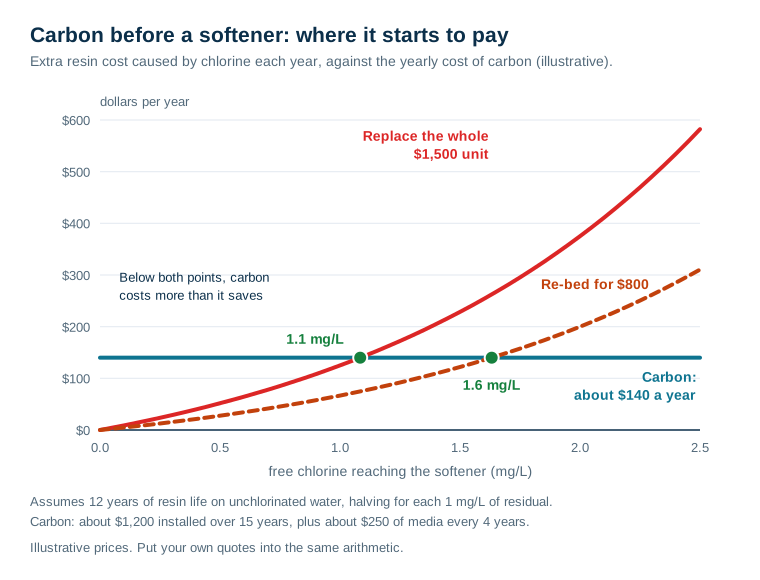
How to read your own result. The crossing point is where the lines meet. It moves left, towards lower residuals, when resin work is expensive in your area, when you would replace the whole unit rather than re-bed, or when a DIY carbon install brings the yearly carbon cost down. It moves right when re-bedding is cheap or when you would pay for professionally installed carbon at the top of the price range.
What the Payback Math Leaves Out
The table counts resin only. Several real costs and benefits sit outside it, and they mostly push towards carbon:
- Chlorine taste at every tap. If that is why you are reading this, carbon is a taste purchase with resin protection as a bonus. The taste side is covered in chlorine taste after a water softener.
- Chloramine. It persists in the water and needs catalytic media, which changes the size and price of the filter, but it also makes unprotected resin a worse bet.
- Pressure loss from degraded resin. Swollen, oxidised beads pack tighter, and the house loses pressure long before the water goes hard.
- Unplanned failures. A re-bed on your schedule costs less than one that happens because the taps went hard.
Two things push the other way:
- Short stays. If you will move within three or four years, the resin you save belongs to the next owner.
- A cheaper hedge exists. Higher cross-link resin, commonly 10 percent divinylbenzene instead of 8, lasts longer on chlorinated water for a modest premium at re-bed time. The options at replacement are in water softener resin life and when to replace it.
Sizing the Carbon for Contact Time, Not Pipe Size
If the math says yes, the next mistake is buying on pipe size or a headline gallons-per-minute figure. NDSU Extension's guide to sediment, activated carbon and mixed media filtration puts it plainly: "The efficiency of these filters is determined by the length of time the contaminants are in contact with the carbon."
The formula. Empty bed contact time, in minutes, equals the bed volume in gallons divided by the flow in gallons per minute. One cubic foot of media holds 7.48 gallons of bed volume.
Contact time at common tank sizes:
| Media volume | At 6 gpm | At 8 gpm | At 10 gpm |
|---|---|---|---|
| 1.0 cu ft | 1.2 min | 0.9 min | 0.7 min |
| 1.5 cu ft | 1.9 min | 1.4 min | 1.1 min |
| 2.0 cu ft | 2.5 min | 1.9 min | 1.5 min |
| 2.5 cu ft | 3.1 min | 2.3 min | 1.9 min |
What to aim for on free chlorine. Backwashing carbon units are commonly rated at about 5 gpm per cubic foot of media, which works out at about 1.5 minutes of contact. Treat that as the floor at your peak flow. A four-person house with two showers and a washing machine running might peak around 8 gpm, which points to 1.6 cubic feet of media and, in practice, a 2 cubic foot tank.
Estimate your peak honestly. Add up the fixtures that realistically run together. Showers are typically 1.5 to 2.5 gpm, a washing machine fill a few gpm, and an irrigation zone on the house supply can add more than everything else together. If irrigation runs through the softener line, it runs through the carbon too.
Chloramine is a different calculation. Catalytic carbon and roughly double the contact time. The sizing difference is quantified in how chloramine affects a water softener.
Tank diameter has a second consequence. A wider tank needs a higher backwash flow to lift the bed, and not every control valve can supply it. That, and how to schedule two backwashing tanks on one supply, is covered in how a whole-house carbon filter and softener work together.
The Oversizing Trap: Bacteria in a Still, Dechlorinated Bed
It is tempting to take the sizing table and simply buy the biggest tank. Do not. Carbon removes chlorine near the top of the bed, and the water below that point has no disinfectant left in it.
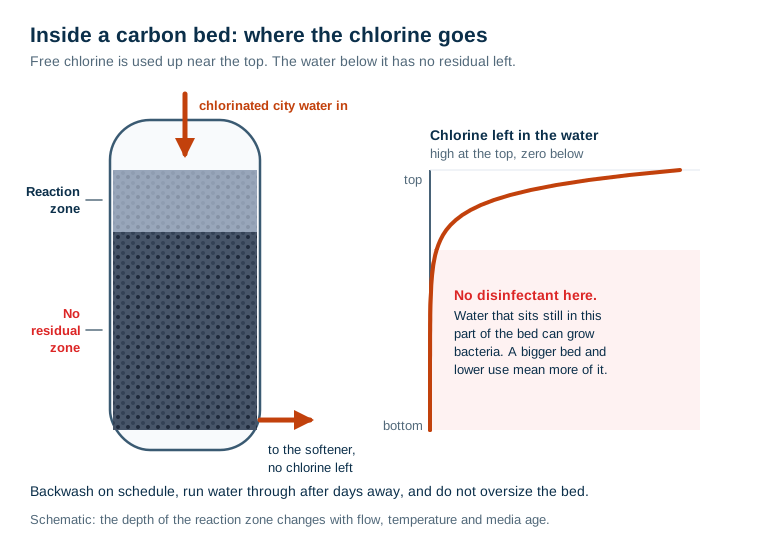
NDSU Extension's warning is specific: "When your AC filter becomes loaded with organic contaminants or the filter is not used for a more than five days, it can become a food source for bacteria." An oversized bed makes that worse in two ways. More of its volume sits below the reaction zone, and at household flows the water spends longer in it.
How to keep a carbon bed from becoming a bacteria bed:
- Size to your real peak, not the biggest tank the valve will take.
- Keep the automatic backwash on schedule. Backwashing with incoming chlorinated water scours the bed and briefly returns a residual to it.
- Flush after time away. After a vacation, run several taps for a few minutes before anyone drinks the water.
- Put sediment ahead of carbon on a supply that carries silt, so organic debris does not collect in the bed. When that prefilter needs changing is set out in when to replace a sediment prefilter before a softener.
- Remember the softener downstream now receives dechlorinated water too. Follow the manufacturer's sanitising guidance whenever the unit is opened for service.
Carbon is not a disinfection step. If the utility issues a boil-water notice, the filter does not change what you should do.
When Carbon Is Optional, and the Cheaper Alternatives
Under about 0.5 mg/L of free chlorine, with no chloramine, the resin loss is real but small. Three alternatives cost less than a whole-house carbon tank:
| Option | Protects the resin | Fixes taste | Relative cost |
|---|---|---|---|
| Higher cross-link resin at the next re-bed | Partly: slows the damage | No | Small premium on media |
| Under-sink carbon or RO at the kitchen tap | No | Kitchen tap only | Low |
| Nothing, plus a planned re-bed | No | No | The resin table above |
| Whole-house carbon before the softener | Yes | Every tap | Highest up front |
A softener cannot remove chlorine by itself, whatever the salt, setting or resin. Only carbon, or a technology built for the job, takes it out.
Your Decision, In Order
- Test free and total chlorine before the softener, and keep the highest reading.
- Chloramine present? Plan catalytic carbon, sized for longer contact time.
- Free chlorine only? Put your own re-bed or replacement quote and carbon price into the payback table.
- Under about 0.5 mg/L: skip whole-house carbon, and specify higher cross-link resin at the next re-bed.
- Around 1 mg/L and above: carbon usually pays, and pays sooner if you would replace the whole unit.
- Size on contact time at your real peak flow, using about 1.5 minutes for free chlorine. Use the same yardstick when comparing cartridge and tank carbon prefilters on capacity, flow and yearly cost.
- Do not oversize. Keep the backwash scheduled and flush after time away.
- Install the carbon first, then the softener, and do it before the next resin bed goes in, not after.
So is a carbon filter before water softener resin worth it? It is neither a scam nor a must-have. It is a purchase with a break-even point, and your chlorine test and a resin quote tell you which side of it you are on.
Frequently Asked Questions
Do I need a carbon filter before my water softener?
Not always. It depends on the chlorine residual reaching the softener and on what replacing the resin would cost you. On free chlorine, carbon usually starts paying for itself somewhere between about 1 and 1.6 mg/L, depending on whether you would re-bed the old unit or replace it. Well below 0.5 mg/L it rarely pays on resin savings alone. On a chloramine supply, catalytic carbon ahead of the softener is the sensible default.
Should a carbon filter go before or after a water softener?
Before, if the point is to protect the resin. Carbon placed first removes the chlorine before it reaches the softener, so the resin never sees it. Carbon placed after the softener still fixes the taste, but the resin is oxidised the whole time. A sediment filter, if you need one, goes ahead of both.
How long does a whole-house carbon filter last?
It depends on the chlorine level, the gallons treated and the media volume. Backwashing tank units on municipal water commonly go several years between media changes, and some sellers quote four to five years. Large cartridge housings need changing far more often, and NDSU Extension's rule of thumb for high-volume carbon filters is every three to six months of use. Replace the media when total chlorine starts showing up after the filter, not on a date.
What size carbon filter do I need for a whole house?
Size on contact time at your peak flow, not on pipe size. Contact time in minutes is the bed volume in gallons divided by the flow in gallons per minute, and one cubic foot of media is 7.48 gallons. Free chlorine carbon is commonly rated at about 5 gpm per cubic foot, which is about 1.5 minutes of contact. At an 8 gpm peak that means about 1.6 cubic feet, so a 2 cubic foot tank. Chloramine needs roughly twice that with catalytic carbon.
Can a whole-house carbon filter grow bacteria?
Yes. Carbon strips the chlorine out, so the water sitting in the lower part of the bed has no disinfectant left. NDSU Extension warns that a carbon filter not used for more than five days, or loaded with organic matter, can become a food source for bacteria. Backwash it on schedule, run water through after time away, and do not oversize the bed.
Is a carbon filter worth it for city water?
It is worth it if your free chlorine residual is around 1 mg/L or higher, if you are on chloramine, or if you want the chlorine taste gone at every tap. On a low-residual supply, where the only benefit is slightly longer resin life, a higher cross-link resin at the next re-bed can be the cheaper way to get most of the protection.
