
Best Electronic Water Descalers: 3 Picks Ranked on Buyer Protection
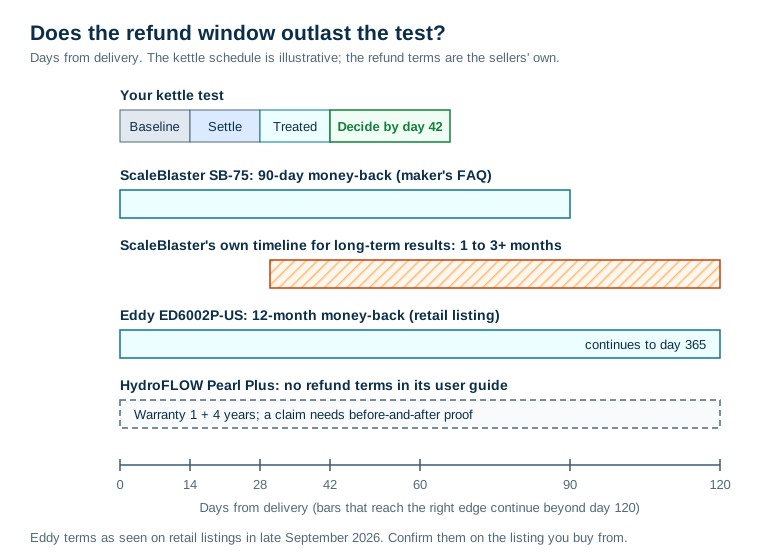
The best electronic water descalers are the ones that let you get your money back if they do nothing, because the evidence that they work in a given house is thin and mixed. On that basis, the Eddy ED6002P-US ranks first, with a 12-month money-back window on its retail listings, and it is usually the least expensive of the three. The HydroFLOW Pearl Plus is second, with the longest warranty at five years. The ScaleBlaster SB-75 is third: its 90-day refund ends before its own "long-term results" timeline does. None of them softens water. Independent testing found devices like these cut scale by about half, so buy one only to test it, and run the kettle test below before the window closes.
Disclosure: Hard Water Solved may earn a commission if you buy through links on this page, at no extra cost to you. It does not change which products we include or how we rank them. Read our disclaimer.
The Best Electronic Water Descalers at a Glance
| Rank | Model | Refund window | Stated hardness limit | Independent study cited by maker | Warranty | Amazon |
|---|---|---|---|---|---|---|
| 1 | Eddy ED6002P-US | 12 months, per retail listings | About 20 gpg | None we could find | Not confirmed | Check price on Amazon |
| 2 | HydroFLOW Pearl Plus | Not in the user guide; confirm with seller | Not stated | Third-party-verified industrial case studies only | 1 year plus 4-year extension | Check price on Amazon |
| 3 | ScaleBlaster SB-75 | 90 days (maker's FAQ) | 19 gpg | None on its residential pages | 3 years | Check price on Amazon |
How We Ranked Them
Methodology. Nothing on this page was physically tested. Because the independent evidence for this category is mixed, we did not rank on performance claims. We ranked on buyer protection, using the makers' own FAQs, user guides and warranties and the retail listings.
- Ranked on: the length of the money-back window (it has to outlast a fair test), a stated hardness limit you can check against your water, whether the maker cites any independent study, and the warranty terms.
- Included: clamp-on electronic or electromagnetic descalers for a whole house, sold on Amazon.
- Excluded: permanent-magnet clamps; and any listing claiming to "soften" water or reduce hardness, which these devices cannot do.
- Prices are not listed here because they change often. Use the buttons to see the current price on Amazon.
What the Evidence Says, in One Paragraph
The strongest independent test of home descalers is WateReuse Research Foundation project 08-06, led by Arizona State University. Using the German DVGW W 512 heated protocol, it found that "both electromagnetic treatment and electrically induced precipitation reduced scale formation by approximately 50 percent", and that the scale left behind was "a 'soft' scale that was easily removed by brushing". It found no change in hardness, which is why no descaler can fix spotting, soap scum or lather. The full picture, including where the wider research disagrees, is in our comparison of a water softener vs an electronic descaler. For this page, the takeaway is practical: a result is possible, not likely enough to buy on faith.
The Three Descalers, Ranked on Buyer Protection
1. Eddy ED6002P-US: longest refund window
- Type: clamp-on electronic unit with coil windings, no plumbing changes
- Stated hardness: about 20 gpg on its listings
- Refund: 12-month money-back, as advertised on retail listings in late September 2026
Eddy ranks first because a full year is long enough to test properly: a baseline, a settling period, a treated period and a repeat check months later. It is also usually the least expensive unit here, so the money at risk is smallest.
We could not reach Eddy's own website on 2 October to confirm the refund terms, the warranty or any study, so all three come from the listings. Before buying, read the listing you are buying from for three details: who honours the refund (the maker or the marketplace seller), whether the unit must be returned in its box, and who pays return shipping.
Watch for: third-party sellers. A marketplace listing can carry its own shorter returns policy. Buy from a seller whose page states the 12-month terms.
2. HydroFLOW Pearl Plus: longest warranty, clearest small print
- Type: clamp-on unit fixed to the pipe with cable ties and run from a plug-in DC power supply; fits copper, PVC and PEX pipes up to 1.5 inches outer diameter
- Coverage: homes up to 3,000 sq ft, per HydroFLOW; the lower-priced Pearl covers up to 2,000 sq ft
- Warranty: one-year limited warranty, plus an automatic four-year extension for the Pearl, Pearl Plus and HS40
HydroFLOW publishes its terms in the Pearl Plus user guide, and they are worth reading closely. To claim under the warranty you need proof the unit was installed properly "and before-and-after proof that such Product is not operating as warranted". The same document says HydroFLOW "makes no guarantee of performance other than as set forth above". It also gives no hardness limit and no money-back terms. Retail research on 29 September recorded a 12-month money-back offer for the Pearl Plus, so get the refund policy in writing from whoever sells it to you.
On evidence, HydroFLOW's site lists case studies with "independent third-party verification" by engineering firms such as CH2M and Jacobs. They are industrial: wastewater plants and belt filter presses. They show the maker will submit its product to outside checking. They say nothing direct about a house on 15 gpg water.
Watch for: the warranty's proof rule. It is the reason to run the kettle test below even if you never plan to return the unit. Dated photos of scale before and after are the "before-and-after proof" the warranty asks for.
3. ScaleBlaster SB-75: clearest specs, shortest window
- Type: clamp-on electronic unit for copper, PVC, CPVC and PEX
- Stated hardness: up to 19 grains per gallon (325 ppm), homes under 4,000 sq ft
- Refund: 90-day money-back guarantee, per ScaleBlaster's FAQ
- Warranty: 3 years
ScaleBlaster gives the most usable specification of the three: a hardness figure, a house size and a pipe list. The problem is timing. Its own "what to expect" page describes long-term results over "1–3+ months", and its FAQ says removing existing scale takes "about three months". Its refund window is 90 days. If results arrive at the slow end of the maker's own range, the guarantee has already gone.
The same pages also say soap "may lather better". Lather depends on hardness, and descalers leave the hardness in the water. Do not use lather to judge it either way.
Watch for: the clock. Run the kettle test in the first six weeks, so that you decide with weeks of the window still left.
The Kettle Scale Test to Run During the Refund Period
A hardness test cannot tell you anything about a descaler, because the minerals stay in the water. Why that trips people up is covered in scale prevention vs hardness removal. Scale is what you are paying to reduce, so measure scale. An electric kettle concentrates weeks of it in one visible spot.
You need: one electric kettle used only for the test, citric acid or white vinegar to descale it, a phone camera and a notebook.
- Days 0 to 14, baseline. Leave the descaler in its box. Descale the kettle until the base is bright. Every day, fill it to the same mark from the same cold tap and boil it the same number of times, for example three. Empty it after it cools. Do not rinse or wipe it. On day 14, photograph the base in the same light, from the same angle. Then wipe one half with a dry cloth and note whether the scale comes away or stays put.
- Days 14 to 28, fit and settle. Fit the unit on the main line, upstream of the kitchen tap, following the maker's coil or clamp instructions. Descale the kettle again. Keep using the tap as normal. Makers describe changes building over weeks, so give it this period.
- Days 28 to 42, treated run. Descale the kettle one more time and repeat exactly the step-1 routine for 14 days. Photograph it and do the same wipe test.
- Day 42, decide. Compare the two photos and the two wipe tests. The independent study found treated scale was softer and easier to brush off. If the treated run looks the same as the baseline, and wipes off no more easily, ask for your refund while there is time left.
Keep the photos with your receipt. For HydroFLOW in particular, they are the evidence its warranty asks for. If the result is borderline and your window is a year long, repeat the treated run at around six months.
Two things this test cannot do: tell you about scale inside a water heater, which takes far longer to show, or tell you the water is softer. It is a quick, fair check of the one thing a descaler claims to change.
Fitting One So the Test Is Fair
Where the unit goes decides whether the kettle ever sees treated water.
- Put it upstream of the tap you test from. A unit on the main line, after the meter or pressure-reducing valve and before the first branch, treats every tap. HydroFLOW's guide recommends the cold feed to the water heater "for optimal performance", but a kitchen cold tap is not downstream of that point. Because the Pearl Plus clamps on with cable ties and comes with a removal tool, fit it on the main line for the six-week test, then move it to the heater feed if you keep it.
- Follow the coil or clamp count exactly. ScaleBlaster's FAQ says to wrap its coil the recommended number of times and not to over-wrap. Eddy's coils are also wound around the pipe, to the count in its instructions. A short-cut installation is a fair reason for a seller to refuse a refund.
- Check for an electrical loop on metal pipe. HydroFLOW warns that a unit fitted where current has an easy path from one side to the other traps the signal, "which damages the equipment along with greatly reducing its performance". Its fix is to move the unit outside the loop, for example before the earth grounding point. Plastic pipe avoids the problem.
- Plan the power. All three need a nearby outlet. HydroFLOW's power supply is rated for 41 to 104°F, so an unheated garage in winter may be outside its tested range.
- Expect your joints to need a look. HydroFLOW's warranty excludes leaks caused when existing scale loosens, and says owners have a duty to inspect compression joints periodically. That applies to any product that claims to shift old scale.
Running Costs and Years of Cover
None of the three has a cartridge, salt or media to replace. The running cost is a small amount of electricity. What separates them after purchase is how long the maker stands behind the unit, and how long you have to get your money back:
| Model | Warranty | Refund window |
|---|---|---|
| Eddy ED6002P-US | Not confirmed | 12 months, per retail listings |
| HydroFLOW Pearl Plus | 5 years (1 + 4) | Not stated by the maker |
| ScaleBlaster SB-75 | 3 years | 90 days |
Two points follow. Between HydroFLOW and ScaleBlaster, the choice comes down to the refund window, the hardness limit and the warranty length, so compare the current prices against those years of cover. And a long warranty only helps if you can prove a fault. HydroFLOW's asks for before-and-after evidence, which is one more reason to keep your kettle photos.
Claims to Walk Away From
Some listings for this category make claims the independent evidence does not support. Skip any listing that says:
- "Softens water" or "reduces hardness". The minerals stay in the water. A seller who says otherwise is counting on you not testing.
- "Soft, silky water" or "better lather". Both depend on hardness, which does not change.
- "Certified to NSF/ANSI 44". That standard covers ion-exchange softeners. A descaler showing it deserves a hard look at the listing database.
- "Works on any hardness" or no limit at all. ScaleBlaster's 19 gpg figure is the kind of number to look for.
- A 30-day guarantee. It closes before even a short kettle test can finish.
Who Should Buy None of These
- Anyone who wants soft water. Spot-free glass, better lather and softer laundry need the hardness removed. If that is the goal, start with how to size a water softener instead.
- Water harder than about 20 gpg. ScaleBlaster's own limit is 19 gpg, and halving a heavy scale load still leaves a heavy scale load.
- Iron or manganese in the water. No clamp-on device treats them.
- Homes that can take a tank. If you can fit a salt-free conditioner, the same independent study measured more than 88 percent scale reduction for crystal-forming media against about 50 percent for electronic devices.
- Buyers who cannot use the refund. If the only listing available has a 30-day return policy, or you will not have time to run a test, the main protection this page ranks on is gone.
- Very soft water. Below about 3 gpg there is little scale to prevent.
If you still want to try one, the Eddy's year-long window gives you the most room to find out. Whichever you choose, start the kettle test on the day it arrives.
Frequently Asked Questions
Do electronic water descalers really work?
Partly, and not the way most listings suggest. A WateReuse Research Foundation study led by Arizona State University found electromagnetic and electrically induced devices reduced scale formation by about 50 percent under the DVGW W 512 heated test, and the scale that did form was softer. They do not remove hardness, so they do not stop spotting or improve soap lather. Results vary with the water and the installation.
Which electronic water descaler has the longest money-back guarantee?
Of the models on this page, the Eddy ED6002P-US, whose retail listings in late September 2026 advertised a 12-month money-back guarantee. ScaleBlaster's own FAQ gives a 90-day money-back guarantee. HydroFLOW's Pearl Plus user guide contains a warranty but no money-back terms, so confirm the refund policy with the seller in writing before buying.
How long does an electronic descaler take to work?
Makers say weeks to months. ScaleBlaster's own guidance lists short-term changes in the first few weeks and long-term results over one to three or more months, with existing scale taking about three months. That is why the refund window matters: a 90-day guarantee can close before the maker's own long-term timeline is over.
Will a hardness test show whether a descaler is working?
No. A descaler leaves calcium and magnesium in the water, so a hardness test strip reads the same before and after. Judge it by scale instead. A kettle test is the quickest way: boil the same tap water on the same routine before and after fitting the unit, and compare how much scale forms and how easily it wipes off.
What hardness can an electronic descaler handle?
Most residential units are rated for moderate hardness. ScaleBlaster rates its SB-75 up to 19 grains per gallon, and the Eddy is listed at about 20 gpg. HydroFLOW's Pearl Plus user guide states no hardness limit. On water harder than about 20 gpg, or with iron or manganese present, a partial scale reduction is unlikely to be enough.
Is an electronic descaler better than a salt-free conditioner?
On the independent evidence, no. The same study that measured about 50 percent for electronic devices measured more than 88 percent for template-assisted crystallization media. A descaler's advantages are price and installation: it clamps onto the pipe with no plumbing work, which suits renters and homes where the main line cannot be cut.
