
Scale Prevention vs Hardness Removal
Scale prevention vs hardness removal is the distinction that sorts every hard water product on the market. Scale prevention leaves calcium and magnesium in the water and stops them forming hard deposits, mainly where water is heated. Hardness removal takes them out, so the water tests soft and also stops spotting glass, curdling soap and stiffening laundry. They overlap on water heaters and part ways almost everywhere else.
Most arguments about salt-free systems are really arguments about which goal a buyer needed. Pick the goal first and the product choice becomes easy.
Two Goals Hiding Under One Complaint
"Hard water problems" sounds like one thing. It is at least three, and they happen by different routes.
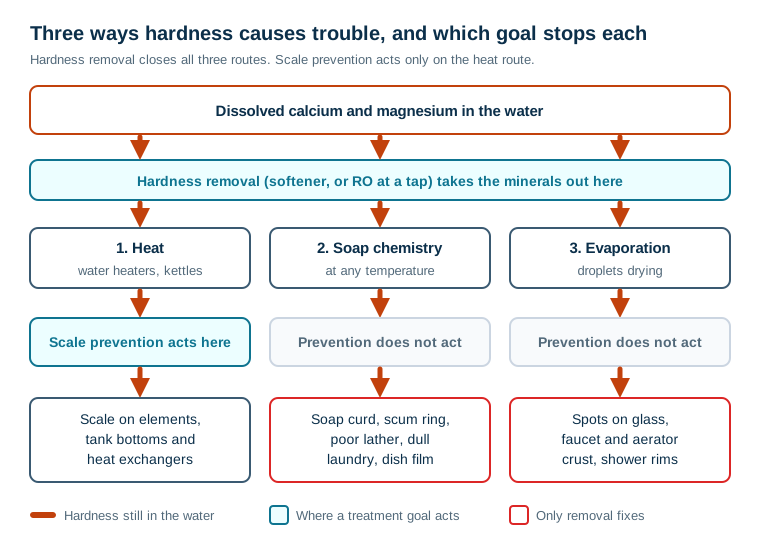
Route 1: heat. Heating water drives calcium carbonate out of solution, and it lands on the hottest surface available: a heater element, a tank bottom, a tankless heat exchanger, a kettle base. This is scale in the strict sense, and it is the route both goals address.
Route 2: soap chemistry. At any temperature, dissolved calcium and magnesium react with soap to form insoluble curd. That uses up soap before it lathers, leaves a ring in the tub and a film in the shower, and holds dirt in laundry. Penn State Extension's water softening guide sums it up as "scales on pots, soap films on skin, and detergent curds in the washing machine."
Route 3: evaporation. When a droplet dries on glass, a faucet or a car, whatever minerals it carried stay behind as a spot. Nothing needs to be heated. Crust on a faucet aerator and a white rim on the shower door are mostly this route.
Scale prevention intervenes on route 1. It does nothing on routes 2 and 3, because the minerals that cause them are still in the water. Hardness removal takes the minerals out before any route begins. Everything else on this page follows from that.
Scale Prevention vs Hardness Removal: The Benefit Table
Here are twelve outcomes people buy hard water treatment for, with what each goal delivers when the equipment is working and within its limits.
| Outcome | Scale prevention (conditioner) | Hardness removal (softener) |
|---|---|---|
| 1. Scale in a tank water heater | Reduced, often substantially | Prevented |
| 2. Scale in a tankless heat exchanger | Reduced, within the product's hardness limit | Prevented |
| 3. Crust in kettles and coffee makers | Slower, some residue still forms on very hard water | Largely prevented |
| 4. Scale narrowing hot water pipes | Reduced | Prevented |
| 5. Spots on glass and shower doors | No change | Largely prevented |
| 6. Crust on faucets and aerators | Little change | Largely prevented |
| 7. Soap lather and soap scum | No change | Much improved |
| 8. Stiff laundry, detergent dose | No change | Improved, if you cut the dose |
| 9. Cloudy film on dishes | No change | Improved |
| 10. Skin and hair feel | No change | Changes, the familiar slippery rinse |
| 11. Hardness test reading | Unchanged | Near zero |
| 12. Sodium added to the water | None | Yes, in proportion to hardness removed |
Rows 1 to 4 are where the two goals overlap. Rows 5 to 10 belong to hardness removal alone. Rows 11 and 12 are the side effects: one goal leaves a test result unchanged, the other adds sodium. Penn State puts that at 7.5 mg per quart for every grain per gallon removed.
A few rows deserve a note.
- Row 3. Kettles boil the water, so they concentrate whatever is in it. A conditioner slows crusting, but on very hard water some residue still forms. A softener stops almost all of it.
- Row 8. Detergent savings only happen if you actually reduce the dose. Most households keep pouring the same amount. Reduce it a little at a time for as long as the wash still comes out clean.
- Row 11. A high test reading after a conditioner is correct, not a fault. The full explanation is in does a salt-free system actually soften water.
Every Technology on the Market, Sorted by Goal
Once the goal is clear, the products fall into two groups.
| Technology | Goal | How it works | Evidence to look for |
|---|---|---|---|
| Ion exchange softener | Removal | Resin swaps calcium and magnesium for sodium or potassium | Hardness test near zero at a cold tap |
| Reverse osmosis | Removal, usually at one tap | Membrane rejects most dissolved minerals | Low TDS reading at the RO faucet |
| Lime softening | Removal, at some city plants | Chemicals precipitate hardness before the water reaches you | Your utility's water quality report |
| Template assisted crystallization (TAC) | Prevention | Media seeds microscopic crystals that stay in the water instead of growing on hot surfaces | Independent scale-reduction test data for the specific media |
| Electronic and magnetic devices | Prevention | Claimed to change how minerals crystallize | Independent test data; results vary widely |
| Phosphate feeders | Prevention | Small doses of phosphate interfere with crystal growth | Product certification for the chemical used |
The most useful independent comparison is the WateReuse Research Foundation's evaluation of alternatives to domestic ion exchange softeners, funded with the US Bureau of Reclamation and California's State Water Resources Control Board. In heated tests, TAC cut scale formation by more than 88 percent, while electromagnetic and electrically induced precipitation devices managed about 50 percent. That tells you two things. Prevention can work well, and the technologies in the prevention group are not equal. If you are still weighing an electronic unit, choose one by its refund window and how specific its claims are.
Notice what the study measured: scale on heated surfaces. It did not measure spots, lather or laundry, because those are not what scale prevention acts on.
Why the Two Goals Get Blurred
The confusion is not accidental. Three habits of the market create it.
The product names borrow the other goal's word. "Salt-free water softener" is the most searched name for a conditioner, so that is what it gets called. A buyer who reads "softener" expects the whole benefit table, then sees spots on the shower glass and decides the unit has failed.
The problem list is written as one list. Sales pages for both categories open with the same photos: a scaled heater element, a spotted glass, a crusty showerhead. Only some of those are on the route the product acts on.
Softener sellers overreach too. A softener is sometimes sold as general water purification, which it is not. It does not remove bacteria or most health-related contaminants. Penn State's guide warns that softeners "will not necessarily remove any of the more serious drinking water contamination problems."
The strengths each category really has, and where each wins, are compared side by side in salt-based vs salt-free water treatment.
Which Goal Do You Actually Have?
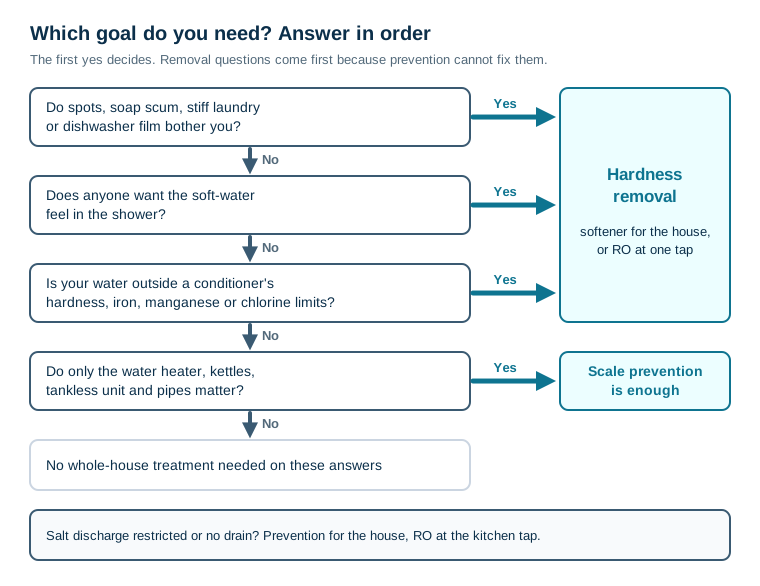
Answer these in order. The first "yes" decides the goal.
- Do spots on glass, soap scum, stiff laundry or dishwasher film bother you? Yes means hardness removal. No prevention product changes any of them.
- Does anyone in the house want the soft-water feel in the shower? Yes means hardness removal.
- Is your water outside a conditioner's limits? Most TAC products publish a maximum hardness and strict limits for iron, manganese and chlorine. If your test results fall outside them, prevention is not reliable, and removal is the safer goal. The numbers are listed in hardness limits for salt-free conditioners.
- Is your concern only the water heater, tankless unit, kettle and pipes? Then scale prevention is a legitimate goal, and a well-chosen conditioner delivers most of it.
- Is salt discharge restricted where you live, or is there no drain? Then prevention may be the only whole-house option, with reverse osmosis at the kitchen tap if you want soft drinking water.
If none of the removal questions got a yes, you may not need whole-house treatment at all beyond protecting the heater. Do you actually need a whole-house water softener works through that with your own hardness figure.
Three Households, Three Different Goals
The same water can call for different goals in different homes. These three examples are illustrative, but each is a common situation.
A condo on moderately hard city water, with a tankless heater and no drain near the water heater closet. The owners do not mind spots on the shower glass, but the tankless unit's manufacturer recommends descaling at this hardness. Their goal is scale prevention. A conditioner within its limits protects the heat exchanger without a drain line, and a small reverse osmosis unit at the kitchen sink covers drinking water if they want it.
A family of five on a private well at 20 grains per gallon. Laundry comes out stiff, the dishwasher leaves a film, the kids complain about dry skin and the shower door is white. Every removal question gets a yes. Scale prevention would protect the water heater and leave every other complaint in place. Their goal is hardness removal, and the well test decides what has to go in front of the softener for iron or manganese.
A retired couple on moderately hard water with an electric water heater, who only ever notice kettle scale. Soap and spots do not bother them. The electric heater loses no energy to scale, although scale still shortens element life. Their honest answer may be neither: descale the kettle, flush the heater once a year, and spend the money elsewhere.
In each case the water was not what decided it. The complaints were.
What Each Goal Costs to Pursue
The benefit table is only half the choice. The two goals carry different running costs and side effects.
| Scale prevention | Hardness removal | |
|---|---|---|
| Consumable | Media every few years, or phosphate cartridges | Salt or potassium chloride, refilled regularly |
| Water to drain | None | Each regeneration; EPA WaterSense puts it at 25 gallons a day or more for some units |
| Electricity | Usually none (electronic devices excepted) | Small, for the control valve |
| Drain connection | Not needed | Needed |
| Sodium in drinking water | None added | Added in proportion to hardness |
| Chloride to sewer or septic | None | All of the salt used |
| How you know it works | Slowly, by inspecting heated equipment | Immediately, with a test strip |
The water figure comes from EPA WaterSense, which also says regeneration can use up to 10,000 gallons a year. Whether those costs are worth the benefits depends on how hard your water is and where your drain goes.
How to Check the Goal Was Met
Each goal needs its own check. Using the wrong one is the most common reason people rip out equipment that was working.
For hardness removal, test at a cold tap. A hardness strip or drop kit should read near zero, typically under 1 grain per gallon. If it does not, the softener has a fault or is set up wrongly. Test the raw water at an outdoor tap or with the softener in bypass so you have both numbers.
For scale prevention, inspect heated equipment. A hardness test will read the same as the raw water, so it tells you nothing.
- Before installing, drain a few gallons from the water heater into a bucket and note the sediment.
- Photograph the inside of the kettle.
- After six to twelve months, repeat both. Less sediment, or a finer, looser sediment, is the result you want.
- On a tankless heater, note whether descaling can be spaced further apart.
If you bought a conditioner and the complaint is spots or lather, the check will not help, because those were never on its route.
What Neither Goal Covers
Both goals concern calcium and magnesium only. Neither one:
- disinfects. Bacteria and viruses need disinfection. The CDC's page on home water treatment systems states that softeners "do not remove parasites, bacteria, or viruses."
- reliably removes lead, arsenic, nitrate or PFAS. These need treatment designed and certified for each contaminant.
- fixes corrosive, low-pH water. A neutralizer does that.
- removes existing scale quickly. Softened water dissolves some old deposits slowly. Conditioners do not reliably remove them at all.
Decide which of the three routes is costing you money or annoyance. If it is only heat, scale prevention is a real answer. If soap, spots or laundry are on your list, only hardness removal will do.
Frequently Asked Questions
What is the difference between scale prevention and water softening?
Water softening removes calcium and magnesium from the water, usually by ion exchange, so a hardness test afterwards reads near zero. Scale prevention leaves the hardness in the water and tries to stop it sticking to surfaces as scale, mostly where water is heated. Softening also changes soap, spotting and laundry. Scale prevention does not.
Does a scale inhibitor make water soft?
No. A scale inhibitor or conditioner, whether template assisted crystallization media, a phosphate cartridge or an electronic device, leaves the calcium and magnesium in the water. The water still tests hard and still behaves as hard water with soap and on glass. What changes, when the product works, is how much scale forms on hot surfaces.
Is scale prevention enough for a water heater?
Often, yes, if the water is within the product's limits. In an independent WateReuse study, template assisted crystallization cut scale formation by more than 88 percent in heated tests. A softener protects the heater more completely because the hardness is gone, but for moderately hard city water a good conditioner covers most of the heater benefit.
Why do I still get spots after installing a scale prevention system?
Because spots are not scale in the heater sense. They are the minerals left behind when a droplet evaporates, and a scale prevention system leaves those minerals in the water. Only removing the hardness, with a softener or reverse osmosis at the tap, reduces spotting.
Do I need hardness removal if I only care about my appliances?
Not necessarily. Water heaters, tankless units, kettles and coffee makers are damaged by heat-driven scale, which scale prevention targets. If soap, spots, laundry and skin feel do not bother you, a scale prevention system within its limits may be all you need. Dishwashers are the exception, because film on dishes comes from hardness in the wash water.
Can I use both scale prevention and a softener?
There is rarely a reason to. A working softener removes the hardness a conditioner would act on, so the conditioner has nothing left to do. The usual combination is a softener for the whole house with a hard-water bypass for outdoor taps, or a conditioner for the whole house with reverse osmosis at the kitchen tap.
