
Water Softener vs Electronic and Magnetic Descalers

The electronic descaler vs water softener question has a short answer: a water softener removes calcium and magnesium, so a hardness test proves whether it is working. An electronic or magnetic descaler removes nothing, so your hardness reading will not change at all. The fair question for a descaler is whether it reduces scale, and on that the independent evidence is mixed, partial and highly dependent on conditions.
That distinction is the whole article. Most comparisons either treat descalers as a cheap softener (they are not) or dismiss them as a scam (the evidence does not quite support that either). What follows sticks to what has actually been measured.
Electronic Descaler vs Water Softener: What Each Does to Your Water
A water softener is an ion-exchange tank. Hard water flows through a bed of resin beads that hold sodium (or potassium). The beads grab calcium and magnesium and release sodium in their place. When the resin is full, the unit regenerates with brine and flushes the captured hardness to drain. The EPA describes cation exchange softeners in exactly those terms. The hardness physically leaves the water.
An electronic descaler is a control box, usually plugged into an outlet near the main line, with one or two wire coils wrapped around the outside of the pipe. It drives a varying signal through the coils. The idea is that the induced field changes how calcium carbonate crystallises, so more of it forms as loose particles in the water and less grows as hard scale on surfaces.
A magnetic conditioner does the same job with permanent magnets clamped around the pipe. It needs no power.
Both descaler types have two features in common. Nothing touches the water, and nothing is removed from it. Every milligram of calcium that enters the pipe leaves through your taps.
| Water softener | Electronic descaler | Magnetic conditioner | |
|---|---|---|---|
| Removes hardness | Yes | No | No |
| Hardness test after install | 0–1 gpg | Unchanged | Unchanged |
| Needs salt | Yes | No | No |
| Needs a drain | Yes | No | No |
| Needs power | Usually (non-electric models exist) | Yes, a few watts | No |
| Plumbing work | Cut in, bypass, drain line | None, wraps outside the pipe | None |
| Typical installed cost | $1,200–$3,000 | $150–$600 | $50–$300 |
| Slippery feel, better lather | Yes | No | No |
| Fewer water spots | Yes | No | No |
The costs are typical ranges and vary by region. The two rows that matter most are the first two.
Why a Hardness Test Cannot Validate or Invalidate a Descaler
This is the point most buyers miss, and some sellers rely on.
A hardness test, whether it uses a strip or a drop-count titration, measures the calcium and magnesium in the sample. A softener changes that number, so a test is the right tool: a working softener reads 0 to 1 grain per gallon at a cold tap, and anything higher points to a fault. If you need a refresher on the method, our guide to testing hardness at home covers strips versus drop kits.
A descaler, even a perfectly working one, leaves the calcium in the water. So:
- An unchanged reading does not prove the descaler failed. It is what you should see whether it works or not.
- A lower reading does not prove it works. The calcium has to have gone somewhere, and the likeliest places are your sampling method or your water heater.
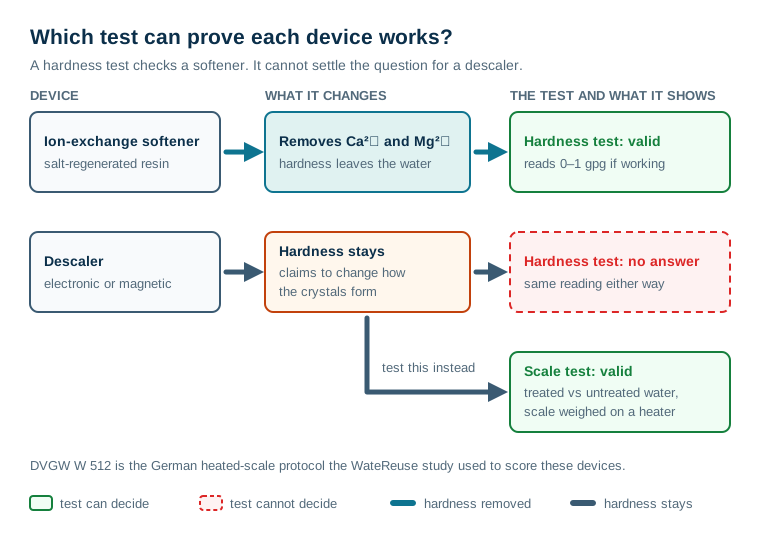
The only measurement that can judge a descaler is a scale measurement: heat treated and untreated water under the same conditions and compare how much scale forms. That is what the German DVGW W 512 protocol does, and it is why credible studies use it rather than a hardness kit.
At home, the practical version is slower. Note the date you install the device, then track things that respond to scale over months: how often the water heater element or tankless unit needs descaling, how fast a kettle crusts, and how much sediment comes out when you flush the heater tank.
The "Reduces Hardness Test Results" Trap
Some descaler marketing, and some in-home demonstrations, show a lower hardness reading after the device goes on. Four things can produce that number without any softening happening:
- Sampling hot water. Scale drops calcium out of heated water inside the heater. A hot-tap sample can read lower than a cold one simply because some calcium has already plated onto your heater. That is the problem, not the fix.
- Sampling after settling. If loose particles form and settle in a jug before the strip goes in, the clear water on top can read slightly low. The same calcium is sitting in the bottom of the jug.
- Different taps or days. Hardness varies between a well-fed and a city-fed supply, between seasons, and between sampling points. A "before" at the kitchen and an "after" at the bathroom is not a comparison.
- Reading strips by eye. Colour-pad strips are banded. A reading one band lower is within the normal error of the method.
If a seller claims a descaler lowers hardness, ask which standard test they used, on which tap, cold or hot, and whether the untreated sample came from the same place on the same day. A device that genuinely removed hardness would need somewhere to put it: media to hold it or a drain to flush it. A coil on the outside of a pipe has neither.
What the Independent Evidence Actually Supports
Here the honest answer is "some, sometimes", which is less satisfying than either side's marketing.
The strongest single source for home-scale devices is WateReuse Research Foundation project 08-06, led by Arizona State University and funded partly by the Bureau of Reclamation. It tested several no-salt technologies against ion exchange using the DVGW W 512 heated protocol, on both Colorado River water and groundwater.
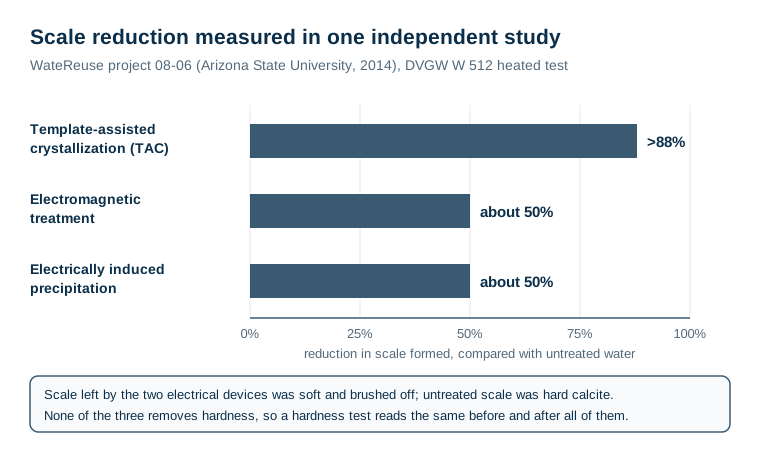
What it found:
- Electromagnetic treatment reduced scale formation by about 50 percent. So did electrically induced precipitation.
- The scale that did form was different. Untreated water left hard calcite that needed acid to remove. The electrically treated water left softer scale that could be brushed off.
- Template-assisted crystallization (TAC) media did far better, at more than 88 percent. It is a different technology, a tank of media rather than a coil, and we explain how a salt-free conditioner works separately.
- Ion exchange and capacitive deionization reduced scale efficiently, because they actually remove the minerals.
Two things limit how far you can stretch those numbers. First, a 50 percent reduction under controlled lab heating is not the same as 50 percent in your water heater, where flow, temperature, water chemistry and how the coil is installed all vary. Second, the wider literature on magnetic devices is genuinely split. Older university work found no effect on hardness or calcium concentration at all, while some newer controlled experiments report modest reductions in deposit weight. A result that appears in some conditions and disappears in others is exactly what "condition-dependent" means.
What the evidence does not support:
- Any change to hardness, sodium or total dissolved solids.
- Soft-water effects: slippery feel, better lather, less soap, fewer spots on glass.
- Removal of existing scale as a reliable, predictable outcome. Some units claim it; independent support is thin.
- Protection of cold-water fixtures, where most visible spotting happens. The mechanism, where it works at all, is about what happens when water is heated.
Where a Descaler Might Earn Its Place
Given all that, there are still situations where a descaler is a reasonable purchase rather than a bad one.
- You cannot install a softener. A rental, a condo with no drain access, or a home where the main line is in a finished wall. A coil needs no plumbing work and moves with you.
- Your hardness is moderate and your concern is one appliance. A single water heater on 8 to 12 gpg water, where "less and softer scale" is a meaningful win.
- Local rules restrict brine discharge. Some areas limit or ban self-regenerating softeners, which removes the best-performing option.
- You accept an uncertain result for a low price. At a few hundred dollars and pennies a year to run, some people treat it as a low-cost experiment and track the heater to see what happens. If that is your plan, pick a unit with a long refund window and claims you can check.
It is the wrong purchase when you want what soft water does: spot-free glass, less soap, softer laundry, a slippery feel. It is also the wrong purchase on very hard well water (roughly 20 gpg and above), or when iron or manganese is present. Neither a coil nor a magnet addresses those, and scale loads at that level overwhelm a partial reduction.
A Fair Way to Choose
The decision comes down to what result you need and how you will know you got it.
| If what you need is… | Choose | How you will verify it |
|---|---|---|
| Measurably soft water, fewer spots, less soap | Ion-exchange softener | Hardness test at a cold tap: 0–1 gpg |
| Maximum scale reduction without salt | TAC conditioner | Heater and fixture inspection over months |
| Some scale reduction, no plumbing work, low cost | Electronic descaler | Heater inspection and flush sediment, over months |
| Nothing, because hardness is under about 3 gpg | No treatment | Occasional hardness test |
If salt-free is where you are leaning, read the comparison of salt-based and salt-free water treatment before buying. It covers the category trade-offs in more depth than a single device type can.
How to Read a Descaler's Claims Before You Buy
A few checks separate a seller making careful claims from one making impossible ones.
- "Softens water" or "removes hardness." This is a red flag. The device cannot do it, and a seller who says so either does not understand the product or is counting on you not testing.
- "Tested by an independent lab." Ask which lab, which protocol (DVGW W 512 is the recognised one for scale devices), and for the report itself rather than a summary.
- A certification logo. NSF/ANSI 44 is the standard for ion-exchange softeners, not for coils or magnets, so a descaler showing a softener certification badge deserves a hard look. Ask exactly which standard the device is listed to. A listing claim you cannot find in a public database is marketing. Our guide on how to verify a softener certification shows how to check any logo in a couple of minutes.
- A money-back window. Scale builds over months. A 30-day guarantee expires long before you could tell whether anything changed. Look for 12 months or more. Comparing Eddy and ScaleBlaster on hardness limit, refund window and warranty runs these checks on the two best-known clamp-on units.
What to Do Next
- Test your hardness at a cold tap and write the number down. Under about 3 gpg, you may not need anything.
- Decide which result you need. Soft water points to a softener. Heater protection alone opens the salt-free options.
- If you buy a descaler, do not re-test hardness to judge it. Log water heater maintenance, flush sediment and kettle scaling instead, and give it at least six months.
- If the plan was a descaler because a softener seemed impossible, check the constraint first. A drain, an outlet or the space for a brine tank is often easier to solve than it looks.
Frequently Asked Questions
Do electronic water descalers actually work?
Sometimes, partly, and only for scale. The most cited independent test, a WateReuse-funded Arizona State University study using the German DVGW W 512 heated-scale protocol, found electromagnetic treatment and electrically induced precipitation each cut scale formation by about 50 percent, and the scale that did form was soft enough to brush off. Other studies of magnetic devices found no effect. None of them removes hardness, so do not expect soft-water benefits such as better lather or fewer spots.
Will an electronic descaler lower my water hardness reading?
No. A descaler adds nothing to the water and takes nothing out, so the calcium and magnesium are still there when the water reaches your test kit. A reading that stays the same after installation is normal and does not mean the device has failed. A reading that drops is more likely a sampling error than a result.
Is a magnetic water softener the same as an electronic descaler?
They are sold into the same market but work differently. A magnetic unit clamps permanent magnets around the pipe and uses no power. An electronic descaler wraps a wire coil around the pipe and drives a changing signal through it from a plug-in box. Neither is a water softener in the technical sense, because neither exchanges or removes hardness minerals.
Can I use an electronic descaler with a water softener?
You can, but there is little point downstream of a working softener, because the softener has already taken out the minerals that form scale. The combination only makes sense if the descaler protects something the softener bypasses, such as an outdoor line or a separate hot water circuit fed with hard water.
Which is cheaper to run, a descaler or a water softener?
A descaler is far cheaper to run: a few watts of electricity and no salt, water or drain. A softener costs money every month in salt and regeneration water. The fair comparison is cost against result, though. A softener delivers measurable soft water; a descaler delivers, at best, partial scale reduction that you can only confirm by watching your heater and fixtures over months.
What is the best alternative to a water softener that actually reduces scale?
Among the salt-free options, template-assisted crystallization (TAC) media scored highest in the independent WateReuse study, at more than 88 percent scale reduction. It still leaves hardness in the water, so spotting and soap behaviour stay the same, but it is the best-documented no-salt route to protecting water heaters and tankless units.
