
Best Filters for Sulfur Smell in Well Water, by H2S Level
The best filters for sulfur smell in well water are chosen by how much hydrogen sulfide the water carries, after you have ruled out the two sources that need no filter. Under 2 ppm, a backwashing catalytic carbon filter works if the water holds enough oxygen, and AFW's Silver Series air injection filter works if it does not. From 2 to 6 ppm, Oceanic's 12x52 air injection tank with catalytic carbon has the rating to spare. Above 6 ppm, chlorine injection with a contact tank is the usual answer.
Before any of that, smell the hot and cold taps separately. If only the hot water smells, the cause is almost always the water heater's anode rod, and a whole-house filter will not touch it.
Disclosure: Hard Water Solved may earn a commission if you buy through links on this page, at no extra cost to you. It does not change which products we include or how we rank them. Read our disclaimer.
Best Filters for Sulfur Smell at a Glance
| H2S level | Best approach | Pick | Seller's H2S rating | Amazon |
|---|---|---|---|---|
| Under 2 ppm, oxygen 4 mg/L or more | Backwashing catalytic carbon | Abundant Flow catalytic carbon (BWF-CC10-56SXT) | 10 ppm (AFW's current version) | Check price on Amazon |
| Under 2 ppm, low oxygen or iron too | Air injection, filter media | AFWFilters Silver Series air injection, Fleck 5600SXT | 4 ppm | Check price on Amazon |
| 2 to 6 ppm (and above, with margin) | Air injection with catalytic carbon | Oceanic AIO 12x52 | 17 ppm | Check price on Amazon |
| Over 6 ppm | Chlorine feed, contact tank, filter, carbon | No Amazon pick ranked | n/a | n/a |
| Hot water only | Replace the water heater anode | No filter needed | n/a | n/a |
How We Chose
Methodology. Nothing on this page was physically tested. Ratings come from the sellers' product pages, and the bands come from Penn State Extension's guidance on hydrogen sulfide in water wells.
- Included: whole-house, automatically backwashing filters rated for hydrogen sulfide, sold new on Amazon.
- Sorted by: the sulfide band each pick suits with margin, not the highest number on its listing.
- Excluded: cartridge carbon filters (consumables that load up fast on sulfide), Birm filters (Penn State does not recommend them for hydrogen sulfide), the WECO KDF85-1054 (WECO's own table puts its minimum backwash at 16 gpm, beyond most well pumps), and listings whose specs we could not check (see below). Anode rods are the fix for hot-water-only odour, but none is listed as a pick.
- Prices are not listed here because they change often. Use the buttons to see the current price on Amazon.
Sulfur is one of several things a well test covers. How it fits with iron, hardness and bacteria in one treatment plan is covered in water softener for well water.
Find the Source Before You Buy a Filter

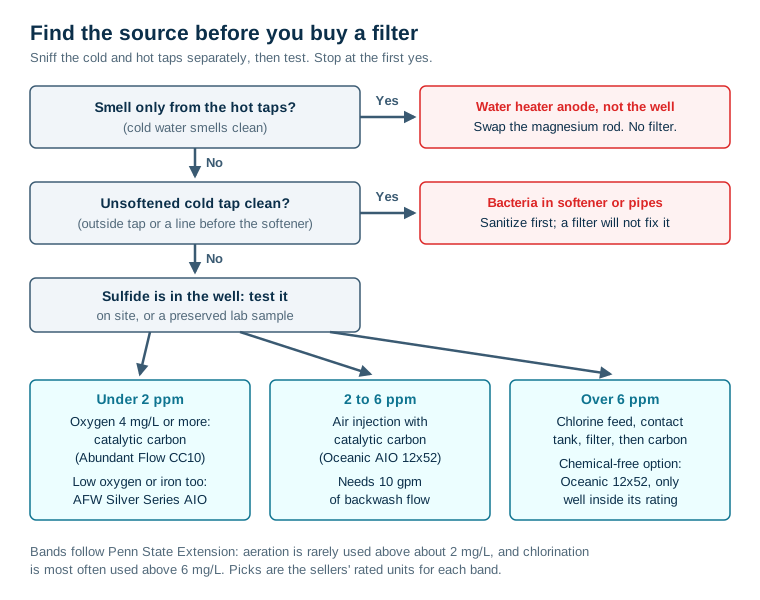
Fill a glass from the cold tap, carry it away from the sink and smell it. Do the same with the hot tap. Then do it once more at a tap ahead of any softener, such as an outside spigot. The pattern tells you where the sulfide comes from:
- Hot only. The water heater is making it. Penn State explains that the heater's magnesium anode rod "can chemically reduce sulfates to form hydrogen sulfide". No whole-house filter fixes that.
- Softened taps smell, the outside tap does not. Sulfate-reducing bacteria are growing in the softener or the house plumbing. Penn State notes softeners can occasionally provide "a favorable environment" for them. Sanitize the softener and pipes. The full test, including the first-draw clue, is in why a sulfur smell remains after softening.
- Every tap smells, hot and cold, including the outside tap. The sulfide is in the well water. Now a filter is the answer, and the next step is a number.
Test the Sulfide Before Choosing a Band
Hydrogen sulfide is a gas and leaves a sample bottle within hours. Penn State says testing "must be done in the home, or the sample must be chemically stabilized before being sent to a commercial testing lab". Ask a state-accredited lab for a preserved bottle and take the sample from a raw-water tap before any treatment.
Ask for two more results on the same visit:
- Iron and manganese. They are often present with sulfide, and they use the same oxidizing capacity. A filter rated for 10 ppm of sulfide alone may not manage 4 ppm of sulfide plus 5 ppm of iron.
- Dissolved oxygen. This decides whether catalytic carbon can work without air. Penn State says catalytic carbon "requires a minimum of 4.0 mg/L of dissolved oxygen in the source water", and deep wells often have less.
Smell alone is a poor gauge. Penn State notes most people can detect hydrogen sulfide "well below 0.5 mg/L", so a strong smell can still be a low reading.
Seller Ratings vs What Penn State Says Each Method Handles
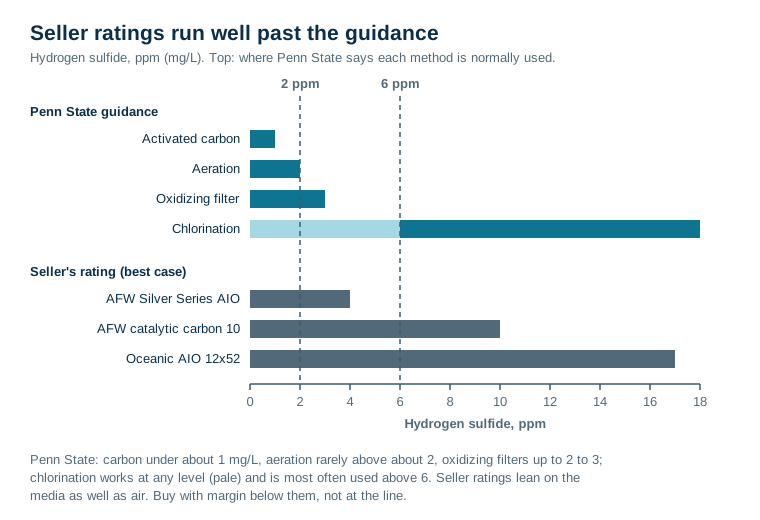
Penn State's guide gives these working ranges:
| Method | Penn State's guidance |
|---|---|
| Activated carbon | May be effective under about 1.0 mg/L, with a large whole-house bed |
| Aeration | "Normally not used when hydrogen sulfide concentrations exceed about 2 mg/L" |
| Oxidizing filters (greensand type) | Can remove up to 2 to 3 mg/L, with more frequent regeneration as levels rise |
| Catalytic carbon | Handles "much higher" levels than activated carbon, but needs 4.0 mg/L of dissolved oxygen |
| Chlorination | Works at any level, "most often applied" above 6.0 mg/L, with at least 20 minutes of contact time |
The sellers' figures are much higher: 4 ppm for AFW's Silver Series air injection, 10 ppm for AFW's catalytic carbon and 17 ppm for Oceanic's 12x52. That gap does not make either side wrong. A modern air injection tank is not plain aeration. The media in the tank adsorbs and oxidizes sulfide as well. But the extension figures are the safe design points, and a seller's figure is the best case. That is why the bands on this page put each pick well below its listed ceiling.
The Best Filters for Sulfur Smell in Well Water, by Band
Under 2 ppm, with oxygen: Abundant Flow catalytic carbon
- What it is: a backwashing catalytic carbon filter. Abundant Flow is AFWFilters' own brand, and AFW's store sells "Abundant Flow" systems alongside its AFW-branded ones. The Amazon listing title is "Abundant Flow Water BWF-CC10-56SXT Catalytic Carbon", which indicates a Fleck 5600SXT valve.
- AFW's current version: the Digital Catalytic Carbon 10 on AFW's own filter valve, with 1 cu ft of catalytic carbon in a 9x48 tank. AFW rates it for up to 10 ppm of hydrogen sulfide and up to 10 ppm of iron, noting that iron removal "requires dissolved oxygen in excess of 4 ppm". It also removes chlorine and chloramine. AFW sizes it for 1 to 2 bathrooms and 2 to 3 people.
Catalytic carbon is the quietest option in this band. There is no air pocket to recharge and no chemical, and it also takes out tastes and odours beyond sulfide. On a well with low sulfide and decent oxygen it is a simple, one-tank fix.
Watch for: dissolved oxygen. Without 4 mg/L, catalytic carbon removes less than its rating suggests. Get the oxygen result before you buy. AFW's page does not list a backwash flow for this unit, so ask for it, and note the small household size it is designed for.
Wrong for: large families, and wells with iron as well as sulfide but little oxygen. The next pick suits those better.
Under 2 ppm, low oxygen or with iron: AFWFilters Silver Series air injection
- What it is: AFW's Silver Series on a Fleck 5600SXT digital air injection valve, with 1 cu ft of Filter Ag Plus in a 10x54 tank and a 1-inch bypass. It ships pre-loaded.
- Seller's rating: iron up to 8 ppm, sulfur up to 4 ppm, manganese up to 2 ppm.
- Backwash: 5 gpm minimum for AFW's 1 cu ft Silver systems, per AFW's comparison table, at least every 3 days.
- Amazon listing: its title is "AFWFilters Air Injection iron filter ... Black Series (1")". We matched it to this unit by name and the 1-inch connection, but could not confirm it, so check the valve and ratings on the listing.
The air pocket supplies the oxygen that catalytic carbon needs the water to bring, which is why this is the pick for low-oxygen wells. It also takes iron, which often comes with sulfide. It is usually the lowest-cost complete system on this page.
Watch for: the 4 ppm sulfide ceiling. In this band you are well inside it, which is the point. If you want the listing we could confirm, AFW's Silver 10 on the larger Fleck 2510 AiQ has the same 4 ppm sulfide rating and 10 ppm iron.
Wrong for: sulfide above about 3 ppm, where it would run close to its limit.
2 to 6 ppm, and heavy sulfur with margin: Oceanic AIO 12x52
- What it is: a 12x52 air injection tank with 1.5 cu ft of catalytic carbon, pre-loaded, on a Fleck 5600SXT air injection head. A daily backwash removes trapped particles and refreshes the air pocket, per Oceanic.
- Seller's rating: iron up to 27 ppm, sulfur up to 17 ppm, manganese up to 11 ppm.
- Flow: 9 gpm service, 15 gpm peak for under 10 minutes.
- Backwash: 10 gpm minimum, on Oceanic's product page.
This tank pairs the two things that work on sulfide without chemicals: air, and catalytic carbon. At 4 or 5 ppm, it runs at about a quarter of its listed ceiling, with room for the iron that usually comes along. It is the only chemical-free pick here that suits a middle-band well with real margin.
Watch for: the backwash. 10 gpm is twice what the AFW units ask. Measure your pump's sustained flow before buying, and make sure the drain can take it. Oceanic sells several 12x52 versions, so confirm the Amazon listing is the catalytic carbon one.
Wrong for: wells that cannot supply 10 gpm, and very heavy sulfide where you want the certainty of chlorine.
Over 6 ppm: When Chlorine Injection Is the Better Buy
Above about 6 ppm, Penn State's guidance is continuous oxidation. A small feed pump injects chlorine solution ahead of a mixing tank or pipe coil sized for "at least 20 minutes of contact time". The sulfide turns into solid sulfur, a backwashing filter catches it, and a carbon filter removes the leftover chlorine taste. Potassium permanganate feeding ahead of a greensand filter is another option Penn State describes for this range.
It is more maintenance than air injection. The chlorine tank needs refilling, and the filter and carbon need servicing. But there is no rating to run out of, and chlorine also tackles the sulfate-reducing bacteria that make the gas in the first place. AFWFilters sells complete chlorine injection packages with a mixing tank, iron filter and carbon on its own store. We could not match one to an Amazon listing, so none is ranked here.
Oceanic's 12x52 is rated to 17 ppm, so it can work in this band. Choose it only if your result sits well inside that, the pump can hold 10 gpm, and you accept that you are relying on a seller's best case.
Hot Water Only: Replace the Anode, Not the Plumbing
If the cold water is clean and only the hot smells, the fix costs far less than any filter. Penn State's recommendation: "Replacement of the magnesium rod with an aluminum rod should eliminate the rotten egg odor while maintaining corrosion protection for the heater." It warns that simply removing the rod "could cause increased corrosion and reduced life of the hot water heater and will likely void the manufacturer's warranty."
Two things make the anode check worth doing even if you do buy a filter:
- Softened water wears anodes faster. Bradford White's manual says a softener "may increase the speed of anode consumption", as covered in how a water softener affects a storage water heater.
- A heater can keep smelling after the well is treated. Sulfate that a sulfide filter does not remove can still react with a magnesium rod. If the hot water smells after a filter goes in, look at the anode before blaming the filter.
Listings We Could Not Rank
| Listing | What we confirmed | Why it is not ranked | Amazon |
|---|---|---|---|
| Premier AIO, Fleck 2510SXT | Listing title: iron, sulfur and manganese removal, model 10T-FE | Built by Nelsen; we could not reach a maker or retailer page to check its sulfide rating or backwash flow | Check price on Amazon |
| WECO KDF85-1054 | WECO lists it with 0.66 cu ft of KDF-85 and an 8 gpm service flow | Needs a 16 gpm minimum backwash on WECO's table | Check price on Amazon |
Install It Ahead of the Softener
Whichever filter you choose, it goes before the softener and after the pressure tank. Sulfide fouls resin, and any oxidizer strong enough to destroy sulfide can also damage resin. If you use chlorine, the carbon filter sits between the chlorine and the softener. Set the filter and softener to backwash at different hours, so the pump does not have to supply both at once.
Who Should Buy None of These
- Hot-water-only odour. Replace the anode rod first.
- Smell only on softened lines. Sanitize the softener and plumbing. A filter on the well will not reach bacteria living downstream of it.
- Recurring sulfur bacteria in the well. Penn State notes that shock chlorination helps, but the bacteria and smell often return quickly. If they do, continuous chlorination is the long-term answer, not a media filter.
- A smell at one fixture only. That points to the fixture's drain or a hose, not the water.
- Wells that cannot hold 5 gpm of backwash. The air injection picks need at least that and the 12x52 needs 10. Ask AFW for the catalytic carbon unit's figure before counting on it.
The best filter for sulfur smell in well water is the one rated well above your measured sulfide, fed with the oxygen it needs and a backwash your pump can hold. Find the source first, test second, and buy last.
Frequently Asked Questions
What is the best filter for sulfur smell in well water?
It depends on the hydrogen sulfide level. Under about 2 ppm, a backwashing catalytic carbon filter works if the water carries enough dissolved oxygen, and an air injection filter such as AFW's Silver Series works if it does not. From 2 to 6 ppm, a 12-inch air injection tank with catalytic carbon, such as Oceanic's 12x52, has the rating to spare. Above 6 ppm, Penn State Extension's usual answer is chlorine injection followed by filtration.
Why does only my hot water smell like rotten eggs?
Almost always because of the water heater, not the well. Penn State Extension explains that the magnesium anode rod in the heater can chemically reduce sulfate in the water to hydrogen sulfide. Replacing it with an aluminum rod usually stops the smell while keeping the tank protected. Removing the rod also stops it, but shortens the tank's life and will likely void the warranty.
Can a carbon filter remove sulfur smell?
Ordinary activated carbon handles only small amounts. Penn State Extension says it may be effective under about 1 mg/L and needs a large whole-house bed. Catalytic carbon handles much more, but it needs at least 4 mg/L of dissolved oxygen in the water to work, which many wells do not have without air added first.
How do I test well water for hydrogen sulfide?
Hydrogen sulfide is a gas and escapes from a sample quickly, so Penn State Extension says it must be tested in the home or the sample chemically stabilized before it goes to a lab. Ask a state-accredited lab whether they offer the test and supply a preserved bottle. Test the raw water at a tap before any treatment, because a softener or water heater can make its own sulfide.
Is sulfur smell in well water dangerous?
At the levels found in household water it is mainly an odour and corrosion problem. Penn State Extension notes that the gas is poisonous and flammable at high concentrations, but that people can smell it well below 0.5 mg/L, long before it reaches harmful levels. It can still tarnish silverware and corrode plumbing, which is a reason to treat it.
Will a water softener remove sulfur smell?
No. Softener resin exchanges calcium and magnesium, and it does not remove hydrogen sulfide gas. A softener can even make the smell worse if sulfate-reducing bacteria grow in the resin bed. Sulfide treatment goes ahead of the softener, never after it.
