
Best Manganese Filters for Well Water, Chosen by Your pH
The best manganese filters for well water are chosen by pH before they are chosen by ppm rating. Manganese needs a higher pH to oxidize than iron does. At pH 8.5 or above, or where the pH can be raised to it, the WECO KL-1054 Katalox Light filter is the strongest pick. Between about 6.8 and 7.5, the AFWFilters Filox 15 manganese dioxide filter is the practical one. Below 6.8, no filter here removes manganese reliably until the pH is corrected first.
The sellers' headline numbers, from 2 to 11 ppm of manganese, almost never say what pH they assume. The chart below fills that gap from maker and extension figures.
Disclosure: Hard Water Solved may earn a commission if you buy through links on this page, at no extra cost to you. It does not change which products we include or how we rank them. Read our disclaimer.
Best Manganese Filters at a Glance
| Pick | Media | Stated manganese rating | pH guidance found | Amazon |
|---|---|---|---|---|
| WECO KL-1054 | Katalox Light | not stated on WECO's listing | maker: inlet pH 5.8 to 10.5; 8.5 recommended for manganese | Check price on Amazon |
| American Water Solutions AIO Heavy Weight | Air injection over Katalox Light | up to 5 ppm (listing, as recorded) | as Katalox Light | Check price on Amazon |
| AFWFilters Filox 15 | Filox manganese dioxide | up to 3 ppm | none published by the seller | Check price on Amazon |
| Oceanic AIO 12x52 | Air injection oxidizing | up to 11 ppm (listing, as recorded) | none found | Check price on Amazon |
| AFWFilters Iron Pro 2 64k | Fine-mesh softening resin | no separate manganese figure | Penn State: softening above pH 6.7 | Check price on Amazon |
How We Chose
Methodology. Nothing on this page was physically tested. Media pH limits come from the media maker's documents and extension services; ratings come from the sellers' own pages.
- Included: whole-house backwashing filters and one fine-mesh softener sold on Amazon, with manganese named in the listing.
- Ranked on: whether the media's published pH guidance for manganese matches the reader's pH, then on the stated manganese rating and the backwash flow the well must supply. A high ppm rating with no pH condition ranks below a lower rating with one.
- Excluded: cartridge filters, which cannot be backwashed and clog on oxidized manganese, and Birm-only filters for wells below pH 7.5, the floor Penn State Extension gives for manganese.
- Prices are not listed here because they change often. Use the buttons to see the current price on Amazon.
Whether manganese is your problem at all, and why a softener struggles with it, is covered in can a water softener remove manganese. This page assumes you have a lab result and need to choose a filter.
Why pH Decides Which Manganese Filter Works
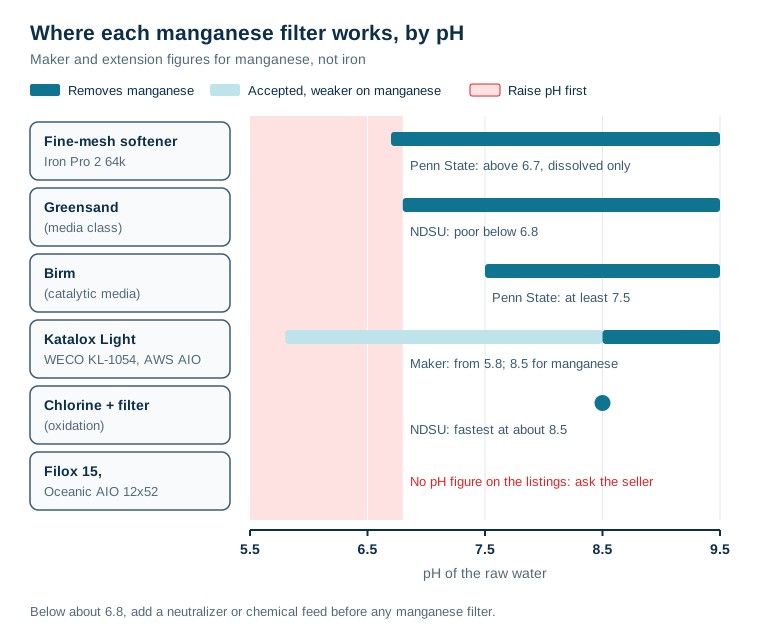
Iron oxidizes readily at ordinary well pH. Manganese resists, and every oxidizing method needs the same or a higher pH to remove it. The figures we could confirm:
| Media or method | pH guidance for manganese | Source |
|---|---|---|
| Softening resin | pH above 6.7 (Penn State's condition for iron softening; manganese behaves alike) | Penn State Extension |
| Manganese greensand | poor below pH 6.8 | NDSU Extension |
| Birm | at least pH 7.5 for manganese (6.8 for iron) | Penn State Extension |
| Katalox Light | inlet pH 5.8 to 10.5 accepted; 8.5 recommended for manganese | Watch Water, the media maker |
| Chlorine oxidation | fastest at about pH 8.5 (8.0 for iron) | NDSU Extension |
| Filox (manganese dioxide) | no figure on the seller's pages we checked | AFWFilters |
Watch Water's Katalox Light page is unusually direct. Its capacity figures are "based on raw water pH 7.5 for iron removal and 8.5 for manganese removal," and below those levels it recommends raising the pH with sodium hydroxide. It also says to "maintain a feed-water pH of around 8.5 to ensure reliable manganese oxidation." The media accepts water from pH 5.8, so it will run at 7. It just will not remove manganese as well there.
That gives three groups of wells:
| Your raw water pH | What it means for a manganese filter |
|---|---|
| Below about 6.8 | Correct pH first. Most oxidizing media struggle with manganese, and a softener is outside Penn State's conditions |
| About 6.8 to 7.5 | Greensand-type and manganese dioxide media; a softener for low, dissolved manganese. Birm is not suitable yet |
| About 7.5 and above | All the media listed work; Katalox Light reaches its recommended manganese conditions at 8.5 |
The Best Manganese Filters for Well Water, by pH
WECO KL-1054 Katalox Light: best at pH 8.5, or with pH correction
- Media: Katalox Light, a manganese dioxide coated media; Watch Water lists more than 10% MnO2 and certification to NSF/ANSI/CAN 61 and 372
- Tank: 10 x 54 in, the WECO model code
- Backwash: Watch Water gives 10 to 12 gpm per square foot. On a 10-inch tank that works out at roughly 5.5 to 6.5 gpm, so check your well pump
- Oxidant: none required where the water has enough oxidation potential. The maker lists hydrogen peroxide, chlorine or potassium permanganate as options for very high levels
- Other sizes: WECO's Katalox Light page also lists 9-, 12-, 13-, 14- and 16-inch tanks and ozone versions
This is the only pick whose media maker publishes a pH for manganese. That makes it the safest choice when you can meet that pH. On a well already near pH 8, it is the strongest filter here. On a well at pH 7, pair it with pH correction, or choose a media that does not depend on a high pH.
Wrong for: wells that cannot supply about 6 gpm of backwash, and owners who are not prepared to raise the pH on water that starts below about 7.5.
American Water Solutions AIO Heavy Weight: Katalox Light with air injection
- What it is: an air injection oxidizing filter on a Fleck 2510SXT valve. Our research record lists Katalox Light media, and the Amazon title states an extended 10-year warranty
- Stated ratings (as recorded 29 September 2026): iron and hydrogen sulfide up to 15 ppm, manganese up to 5 ppm
Air injection adds oxygen ahead of the media, which helps with iron and sulfide. It does not add the pH that manganese needs. Read this pick through the Katalox Light guidance above: strongest at pH 8.5, weaker on manganese at 7.
Wrong for: anyone who needs a warranty document before ordering. Ask the seller for it, and for the pH the 5 ppm figure assumes.
AFWFilters Filox 15: best for pH 6.8 to 7.5
- Media: 1.5 cu ft of Filox, a manganese dioxide media, in a 10 x 54 in tank on a Fleck 2510 valve (SXT or Wi-Fi AiQ)
- Stated ratings (seller): iron up to 15 ppm, hydrogen sulfide up to 7 ppm, manganese up to 3 ppm; sold as "chemical free iron removal"
- Backwash: 6.5 gpm, per AFWFilters
- Smaller size: AFWFilters also sells a 1.0 cu ft Filox 10
Manganese dioxide media is the usual dealer choice for mid-range pH wells, and Filox carries a clear manganese rating. Its weakness on paper is that AFWFilters' product pages give no pH condition for that 3 ppm figure. Ask for it, and for the installation manual, before you buy if your pH is near 6.8.
Wrong for: manganese above 3 ppm, and wells that cannot hold 6.5 gpm for the whole backwash.
Oceanic AIO 12x52: the highest rating, with questions
- What it is: an air injection oxidizing filter in a 12 x 52 in tank, sold by Oceanic Water Systems for iron, sulfur and manganese
- Stated ratings (as recorded 29 September 2026): iron up to 27 ppm, hydrogen sulfide up to 17 ppm, manganese up to 11 ppm, with a 10 gpm minimum backwash
An 11 ppm manganese rating is the highest we found on any listing. Penn State Extension places oxidizing filters at 3 to 10 mg/L of combined iron and manganese, so treat 11 ppm of manganese alone as a ceiling to confirm. Ask what media is in the tank and what pH the figure assumes.
Wrong for: most private wells' pumps. A 10 gpm backwash is beyond many residential pumps, especially while the house is drawing water.
AFWFilters Iron Pro 2 64k: best for trace manganese on a softener
- What it is: 2.0 cu ft of fine-mesh softening resin on a Fleck 5600SXT, sized to carry iron and manganese alongside hardness
- Stated rating (seller): ferrous iron up to 6 ppm; AFWFilters adds 4 gpg of compensated hardness per ppm of iron and manganese when sizing
- Versions: AFWFilters sells a Pentair-tank version
Choose it only when manganese is low, fully dissolved and the pH is above 6.7. In that case one tank handles hardness and manganese together. If black particles already show in the raw water, it is the wrong tool. The sizing method, with worked examples, is in test iron and manganese before sizing a softener.
Wrong for: any manganese level you are treating as a health issue. A softener's manganese removal drifts as the resin loads, so it needs regular confirmation at the tap.
Pairing a Filter With pH Correction
On a well below about 6.8, the filter choice depends on the pH correction you add, so plan both together.
- A calcite neutralizer dissolves calcium into the water as it raises pH. It usually brings acidic water up to around neutral, which suits greensand-type and manganese dioxide media. It also adds hardness, so the softener after it must be sized for the extra.
- Chemical feed of soda ash or sodium hydroxide can push pH higher, toward the 8.5 Katalox Light's maker recommends for manganese. It is a metering pump and a chemical tank to keep stocked.
- Plumbing order: pH correction first, then the manganese filter, then the softener. The filter needs the corrected pH, and the softener needs the manganese gone.
If you have iron bacteria as well, a chlorine feed ahead of the filter handles both. Penn State notes, though, that chlorine is "not recommended" for very high manganese, because a very high pH is needed to oxidize it completely.
Health Levels Change How You Verify
Manganese is more than a staining problem. Penn State Extension cites a recommended standard of less than 0.05 mg/L for staining and taste, and EPA's health advisory of 0.3 mg/L because of neurological effects from regular drinking above that level.
- Under 0.3 mg/L, the goal is stopping the black stains, and any pick here that suits your pH will do.
- Above 0.3 mg/L, or above 0.1 mg/L with an infant on the water, test the treated water at the tap within a month of installation and after any change in the well.
How the well test should be ordered, including total versus dissolved results, is set out in water softener for well water.
Who Should Buy None of These
- Manganese at or below 0.05 mg/L. The black specks are probably coming from the plumbing or the softener itself, not the well.
- pH below about 6.8 with no plan to correct it. Buy the pH correction first, then retest manganese.
- Iron bacteria slime in the toilet tank. Disinfection comes before any filter, or the media fouls.
- A low-yield well. Every backwashing pick here needs about 5.5 to 10 gpm of backwash. If the pump cannot supply it, ask about a smaller tank or a different method before buying.
- Drinking water is the only concern. A point-of-use reverse osmosis unit at the kitchen tap is cheaper than a whole-house filter.
Test pH alongside manganese, then buy the media that works at that pH. For a high-pH well, the WECO KL-1054. For pH 6.8 to 7.5, the Filox 15. For trace, dissolved manganese above pH 6.7, a fine-mesh softener. And on an acidic well, correct the pH before buying any of them.
Frequently Asked Questions
What is the best filter for manganese in well water?
It depends on your pH. For wells at about pH 8.5 or higher, or where pH can be raised to it, a Katalox Light filter such as the WECO KL-1054 is the strongest choice; Watch Water, which makes the media, recommends pH 8.5 for manganese. Between pH 6.8 and 7.5, a manganese dioxide or greensand-type filter is the better fit. For low levels of dissolved manganese with pH above 6.7, a fine-mesh softener can carry it.
What pH is needed to remove manganese from water?
Higher than for iron. Penn State Extension puts Birm's floor at pH 7.5 for manganese against 6.8 for iron. NDSU Extension says greensand performs poorly below 6.8 and that chlorine oxidizes manganese fastest at about 8.5. Watch Water recommends pH 8.5 for manganese on Katalox Light. Below about 6.8, plan on raising the pH before any manganese filter.
Can a water softener remove manganese?
Some, if it is dissolved and the conditions are right. Penn State Extension recommends softening for iron only above pH 6.7 and below 5 mg/L of dissolved iron, and manganese loads the resin the same way. Once manganese arrives as black particles, or at more than a trace, an oxidizing filter ahead of the softener is the dependable fix.
How much manganese is too much in well water?
Above 0.05 mg/L it can stain fixtures and laundry black, which is the recommended drinking water standard Penn State Extension cites. EPA's health advisory is 0.3 mg/L, because of neurological effects from regular drinking above that level. If an infant drinks the water or formula is made with it, treat it as a health issue and confirm removal with a test at the tap.
Does an air injection iron filter remove manganese?
Often, up to its stated rating, but manganese is slower to oxidize than iron and needs a higher pH. Air injection filters that list manganese ratings, such as 2 to 11 ppm on the units in this guide, rarely say what pH the rating assumes. Ask the seller before relying on the manganese figure, especially if your pH is below 7.5.
