
Can a Water Softener Remove Manganese?
Can a water softener remove manganese? Yes, if the manganese is still dissolved when it reaches the resin, the pH is above 6.7, and there is not much of it. The softener exchanges dissolved manganese like hardness. Black or brown-black staining is the warning sign: it means some manganese has oxidized into particles, which a softener cannot exchange and which foul the resin.
So start with the stain, because the color tells you more than most test strips do. Then decide whether the softener can carry the manganese or needs help ahead of it.
Read the Stain First: Black Means Manganese
Iron and manganese travel together in groundwater and get blamed for each other constantly. Their stains are the quickest way to separate them. Penn State Extension describes manganese as leaving "a dense black stain or solid." NDSU Extension calls it a brownish-black stain, and the Minnesota Department of Health lists brownish-black or black stains on toilets, showers, tubs and sinks.
| What you see | Most likely cause | Where it shows first |
|---|---|---|
| Orange, red-brown or rust-yellow | Iron | Toilet bowl, laundry, sink drains |
| Black or brown-black film or specks | Manganese | Toilet tank, dishwasher interior, laundry |
| Orange staining with black streaks | Iron and manganese together | Toilet bowl water line |
| Orange slime you can wipe off | Iron bacteria | Toilet tank walls |
| Blue-green | Copper from corroding pipes, not the well | Under faucets, tub drains |
Where manganese stains show matters too. Iron stains usually appear where water first meets air: the bowl, the sink, the laundry. Manganese oxidizes more slowly, so its black film often builds up in places where water sits or is heated: the toilet tank, the dishwasher, the water heater. A ring in the toilet that is dark rather than white or orange is manganese territory. Mineral rings in general are covered in what causes a hard water ring in the toilet.
Rule out look-alikes before testing. Black specks in the water, rather than a film on surfaces, can also be crushed resin or pieces of a failing valve seal. The one-minute rub test that separates them is in what causes black specks after a water softener.
Can a Water Softener Remove Manganese? What the Evidence Says
Dissolved manganese carries a double positive charge, just like calcium and ferrous iron. A softener's resin exchanges it on the same sites and releases it in regeneration. That is not in dispute, and there is direct evidence it works in homes: the Minnesota Department of Health reports that its study in Dakota County "found that water softeners can be an effective way to reduce the level of manganese in drinking water."
The conditions are what decide whether it works on your well:
- The manganese has to be dissolved. Oxidized manganese is a particle of manganese dioxide. It cannot exchange. It sits in the bed, coats the beads, and sheds as black specks.
- The pH has to be right. Penn State's conditions for using a softener on iron and manganese include pH above 6.7 and hardness between 3 and 20 grains per gallon.
- Nothing upstream can oxidize it. Air injection, chlorine, or an air-over-water pressure tank all start the oxidation before the resin sees the water.
- The softener has to regenerate often enough. Manganese uses up exchange capacity alongside hardness and iron, so a softener sized on hardness alone regenerates too late and manganese breaks through first.
There is no single published manganese ceiling for residential softeners to compare against, as there is for iron. That makes testing the softened water, not just the well, the only way to know the softener is doing the job.
Why Black Stains Usually Mean the Softener Is Losing
The EPA set manganese's secondary standard at 0.05 mg/L because it stains and changes taste at that level, as its secondary drinking water standards guidance lists. Staining at the taps after the softener therefore means manganese is reaching them, in one of three ways:
- It is passing through the softener dissolved because the bed is exhausted before it regenerates. Hardness usually breaks through at the same time, so a hardness test at the tap is a useful cross-check.
- It arrives already oxidized. The resin catches some particles, the rest go through, and the bed slowly fouls.
- It is coming back out. Manganese that built up in the bed or in older pipes is released in bursts, often right after a regeneration or after a change in water chemistry.
In all three cases the stain is evidence of a softener working at or past its limit. A resin cleaner can help with the first and third, but it cannot help with the second.
The pH Problem: Why Manganese Is Harder Than Iron
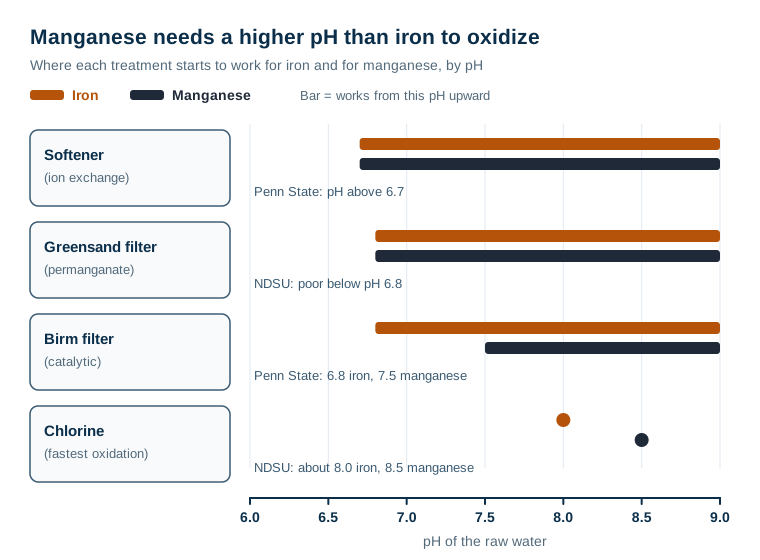
Manganese is not just "iron that stains black." Chemically it resists oxidation more strongly, and every treatment that depends on oxidizing it needs a higher pH to work:
| Treatment | Iron | Manganese | Source |
|---|---|---|---|
| Birm catalytic filter | pH at least 6.8 | pH at least 7.5 | Penn State Extension |
| Chlorine, fastest oxidation | About pH 8.0 | About pH 8.5 | NDSU Extension |
| Chlorine at very high manganese | Works | "Not recommended," because a very high pH is needed | Penn State Extension |
| Manganese greensand | Poor below pH 6.8 | Poor below pH 6.8 | NDSU Extension |
Two practical consequences follow:
- At ordinary well pH, iron drops out quickly and manganese lingers. Water can look clear and pass a glass test for iron, then deposit black film days later in a toilet tank or water heater. That delay is why manganese is so often misdiagnosed.
- Low-pH wells make everything harder. Below about 6.8, most oxidizing filters struggle with manganese and a softener is outside Penn State's conditions. Correcting the pH first is covered in why low-pH well water needs separate treatment.
The Health Numbers Change the Question
For iron, the question is mostly about stains and equipment. For manganese, it is also about what you drink, and the thresholds sit close to the staining range:
| Level | What it means | Source |
|---|---|---|
| 0.05 mg/L | Secondary standard: staining and taste | EPA |
| 0.1 mg/L | Safe level for infants drinking tap water or formula made with it | Minnesota Department of Health |
| 0.3 mg/L | Lifetime health advisory; also used for short exposures in infants under 6 months | EPA drinking water health advisory for manganese |
| 0.3 mg/L | Safe level for children over one year and adults | Minnesota Department of Health |
If your well is above 0.1 mg/L and a baby in the house drinks the water or formula made with it, the softener is on trial. A softener that works most of the time and lets manganese through before each regeneration is not good enough for that use. Test the treated tap water, ideally late in the regeneration cycle when the bed is closest to exhausted. If the result is not reliably below the guidance level, use a treatment you can verify, or another water source for the baby, while you fix the system.
Why Greensand Is Usually the Real Answer
Once manganese is above a trace, or arriving partly oxidized, the dependable fix is to remove it before the softener. For most wells that means an oxidizing filter.
- Manganese greensand is filter media with a potassium permanganate coating that oxidizes dissolved iron and manganese and traps the particles, as Penn State describes. NDSU notes that it "must be regenerated periodically with a potassium permanganate solution" and will probably not filter iron and manganese adequately below pH 6.8.
- Birm and other catalytic media need no chemical regenerant, but Penn State puts the pH floor for manganese at 7.5, which rules out many wells without pH correction.
- Chlorination and filtration works well for iron and for moderate manganese, needs contact time, and struggles at very high manganese unless the pH is raised.
Whatever filter you choose goes ahead of the softener, so the resin sees water that has already lost its manganese. Placement and backwash sharing are set out in pretreatment order: sediment and iron filters before a softener. Once the filter is doing the heavy lifting, the softener can be sized on hardness and whatever iron and manganese remain.
From a Black Stain to the Right Equipment
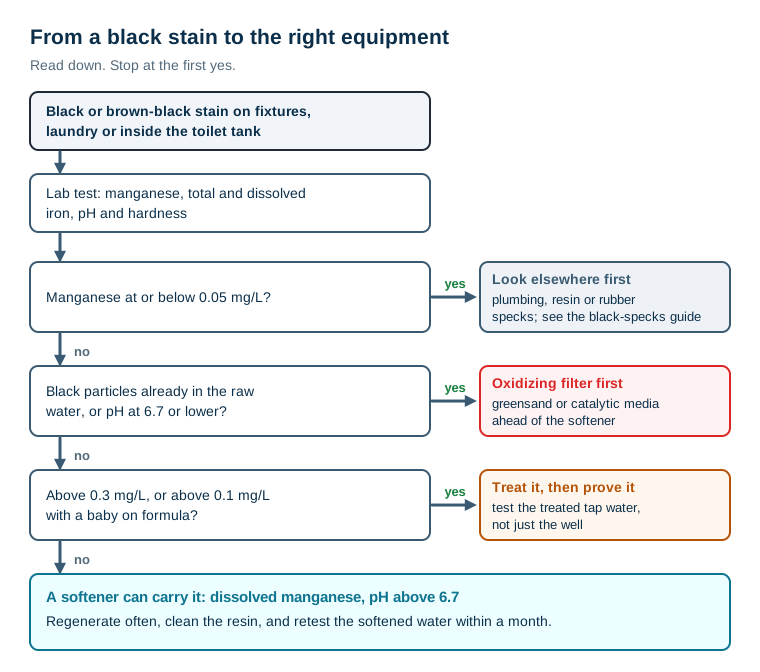
Work down the questions in order and stop at the first yes:
- Manganese at or below 0.05 mg/L? The stain probably is not coming from the source water. Look at the plumbing, the softener's own parts and the specks guide.
- Black particles already in the raw water, or pH at 6.7 or below? A softener cannot exchange particles and is outside its pH conditions. An oxidizing filter goes first, with pH correction if needed.
- Above 0.3 mg/L, or above 0.1 mg/L with an infant on tap water or formula? Treatment has to be proven at the tap, not assumed.
- Otherwise, a softener can carry the manganese. Regenerate often, clean the resin periodically, and retest the softened water within a month of any change.
What to order from the lab, and how manganese changes softener sizing, is in test iron and manganese before sizing a softener.
Getting More From the Softener You Already Have
If the numbers say your softener can carry the manganese, a few settings decide whether it actually does. None of them needs new equipment.
- Count manganese in the capacity. Manganese occupies exchange sites alongside hardness and iron. A softener programmed on hardness alone runs longer between regenerations than it should, and manganese is among the first things to break through. Ask your installer or check the manual for how your valve wants iron and manganese entered.
- Shorten the interval. A bed that regenerates before it is fully loaded gives manganese less time to sit in the resin and oxidize there. Many manuals include a maximum days-between-regenerations setting for exactly this.
- Keep air and chlorine out of the inlet. A leaking air check, an old air-over-water pressure tank or leftover chlorine after a shock all oxidize manganese before it reaches the resin.
- Clean the resin on a schedule. A cleaner labelled for iron and manganese, dosed down the brine well before a regeneration, removes early deposits before they harden.
- Test at the right moment. Sample softened water late in the cycle, just before a regeneration is due. That is when breakthrough shows. A sample taken the morning after a regeneration can look perfect on a softener that is failing every week.
Watch for bacterial slime too. NDSU Extension notes that some bacteria feed on dissolved manganese and produce a black-brown slimy material. If the black deposit in the toilet tank wipes off as slime rather than a hard film, treat it as a bacteria problem first.
What a Softener Cannot Do About Manganese
- It cannot exchange oxidized manganese. Black particles are filtered badly, if at all, and they foul the bed.
- It cannot work outside its pH conditions. Below 6.7, a softener is the wrong primary treatment.
- It cannot tell you it is failing. Manganese breakthrough makes no sound and shows no error code. The first sign is usually a black ring.
- It cannot remove stains already present. Existing black film needs cleaning, and it will come back if the source is not fixed.
- It does not replace a health-based test. A working softener on hard water can still pass manganese above infant guidance levels late in a cycle.
What to Do This Week
- Look at the stain color and where it forms. Black and brown-black in tanks and appliances points to manganese.
- Order a lab test for manganese, total and dissolved iron, pH and hardness, from both the raw water and a softened tap.
- Compare the softened result with 0.05, 0.1 and 0.3 mg/L. Staining, infants and lifetime health are three different lines.
- If the softener passes, keep it passing. Tighten the regeneration schedule and add a manganese-rated resin cleaner. When to use one is covered in resin and iron cleaners.
- If it does not, price an oxidizing filter ahead of it, and check the pH floor of whatever media you are quoted. Comparing manganese filters by the pH and oxidation each one needs makes that check easier.
So can a water softener remove manganese? Yes, when it stays dissolved and within what the bed can carry. Black stains are the sign that some of it is not staying dissolved, and at that point greensand or another oxidizing filter is the tool that fixes the problem at its source.
Frequently Asked Questions
Will a water softener remove manganese from well water?
It will remove dissolved manganese, because dissolved manganese is a positively charged ion that the resin exchanges like calcium. A Minnesota Department of Health study in Dakota County found water softeners can be an effective way to reduce manganese in drinking water. It will not reliably remove manganese that has already oxidized into black particles, and those particles foul the resin. Penn State Extension's softener conditions also require pH above 6.7.
What causes black stains in my toilet if I have a water softener?
Usually oxidized manganese. It forms a black or brown-black film at the water line and inside the tank. With a softener installed, it means manganese is getting past the resin, arriving already oxidized, or being released from the bed or the pipes. Crushed resin and pieces of failing valve seals can also look black, so rub a sample between your fingers: manganese smears into a black stain, resin and rubber do not.
What is the best way to remove manganese from well water?
For more than a trace, an oxidizing filter ahead of the softener. Manganese greensand uses a potassium permanganate coating to oxidize and trap iron and manganese, and NDSU Extension notes it works poorly below pH 6.8. Birm needs pH of at least 7.5 for manganese according to Penn State Extension. Chlorination followed by filtration also works, but Penn State does not recommend chlorine for very high manganese because a very high pH is needed.
Is manganese in well water dangerous?
At the level that stains fixtures, 0.05 mg/L, it is an aesthetic problem. At higher levels it is a health question. EPA's lifetime health advisory is 0.3 mg/L, and EPA advises using that figure even for short exposures in infants under six months. The Minnesota Department of Health gives 0.1 mg/L as a safe level for infants drinking tap water or formula made with it, and 0.3 mg/L for everyone else.
Why is manganese harder to remove than iron?
Because it needs more oxidizing push. NDSU Extension puts the fastest chlorine oxidation at about pH 8.0 for iron and 8.5 for manganese, and Penn State gives Birm filters a floor of pH 6.8 for iron but 7.5 for manganese. At typical well pH, iron oxidizes quickly once it meets air while manganese lingers dissolved, then deposits later in plumbing and appliances.
Can I use a resin cleaner for manganese?
Yes, as maintenance. Many softener resin cleaners are sold for iron and manganese fouling, and they help a softener that is carrying a little dissolved manganese. They do not fix a supply where manganese arrives already oxidized or above what the softener can handle. If you need a cleaner every month to keep the stains away, the manganese belongs in a filter ahead of the softener.
