
Best Salt-Free Water Softener for Well Water, and the Pretreatment Each Needs

The best salt free water softener for well water is really a treatment train, because no mainstream salt-free conditioner is rated for raw well water with iron, manganese or sulfur. For most wells, that train is the SpringWell WSSF combo: an air-injection iron filter ahead of the FutureSoft conditioner. For iron up to 10 ppm, an AFWFilters AIS10 ahead of a FutureSoft costs less. For a well that is already clean but needs disinfection, the Aquasana Rhino well system with UV fits.
The conditioner is the cheaper half of every one of these. On a well, most of the money goes on the filter in front of it.
Disclosure: Hard Water Solved may earn a commission if you buy through links on this page, at no extra cost to you. It does not change which products we include or how we rank them. Read our disclaimer.
The Exclusion List: Every Mainstream Unit's Well Water Limits
Start here, because this table rules out almost every salt-free conditioner on its own. Each limit is quoted from the maker's own specification, manual or product page.
| Salt-free conditioner | Iron limit | Manganese limit | Hydrogen sulfide | Other well-relevant limits |
|---|---|---|---|---|
| SpringWell FutureSoft | 0 ppm | 0 ppm | 0 ppm | pH 7.0 to 9.5; copper and oil 0 ppm; "do not install" on well water without first speaking to SpringWell |
| Watts OneFlow and OneFlow Plus | 0.3 ppm | 0.05 ppm | Must be removed first | pH 6.5 to 8.5; copper 1.3 ppm; oil removed first |
| Aquasana salt-free conditioner | under 0.3 ppm | Not stated | Not stated | Hardness under 15 gpg; pH under 8.3; alkalinity under 250 mg/L |
| Next ScaleStop | 0.3 ppm | 0.05 ppm | Must be removed first | Chlorine 0.5 ppm on the media warranty |
| Pelican NaturSoft | Must be removed | Must be removed | Must be removed | Tannins also removed first |
| NuvoH2O | Separate treatment needed | Not stated | Separate treatment needed | Not recommended below pH 7.3 |
Watts states the well rule plainly in its OneFlow Plus engineering specification: public supplies rarely present a problem, but on a private well, confirm that iron and manganese are under 0.3 and 0.05 ppm. SpringWell's FutureSoft installation instructions go further and say not to install on well water without contacting SpringWell first.
Those two metals are the usual problem. Penn State Extension's guide to iron and manganese in private water systems explains why. Well water carrying them often looks clear at the tap, then throws orange-brown or black particles once it meets oxygen, which happens inside your plumbing. The same deposit forms on conditioner media. Why that switches the media off, and why it happens silently, is covered in salt-free conditioners on city vs well water.
How We Chose
Methodology. Nothing on this page was physically tested. Limits are quoted from the makers' specifications, manuals and product pages.
- Included: complete setups, or two-unit builds, sold on Amazon.com, in which a salt-free conditioner sits behind pretreatment rated for the well conditions it is sold for.
- Ranked on: how much iron, manganese and sulfur the pretreatment is rated to remove, how far that pretreatment's output is from the conditioner's limits, flow, and total equipment cost.
- Excluded: salt-free conditioners sold alone for well use, magnetic and electronic descalers, and any setup without a stated iron or sulfur rating ahead of the media.
- Prices are not listed here because they change often. Use the buttons to see the current price on Amazon.
The Train That Makes a Pick Viable
Every pick below follows the same order. The reasons for it are set out in well water treatment train order.
- Sediment filter. First, always. It protects the iron filter as well as the conditioner.
- Iron, manganese and sulfur removal. Usually an oxidising filter, such as air injection.
- pH correction, if needed. A neutraliser for acidic wells, because every conditioner has a pH floor.
- UV, where the well needs disinfection.
- The conditioner, last. Watts says nothing may be installed after its media except point-of-use filters.
Steps 2 and 3 decide whether a salt-free system works on your well. The conditioner itself is the simplest part.
What Each Setup Includes
| Setup | Iron and sulfur stage | Conditioner | Water test |
|---|---|---|---|
| SpringWell WSSF-1 combo (up to 3 baths) | included | included | required by SpringWell before shipping |
| SpringWell WSSF-4 combo (4+ baths) | included | included | required by SpringWell before shipping |
| SpringWell WS1 + FutureSoft FS1, bought separately | separate unit | separate unit | required by SpringWell before shipping |
| AFWFilters AIS10 + FutureSoft FS1 | separate unit | separate unit | your own lab test |
| Aquasana Rhino well with UV and conditioner | none | included | your own lab test |
Installation, a sediment pre-filter, a neutraliser if needed, and electrical and drain work are not included in any of these.
Two things stand out. The SpringWell combo usually costs less than the same two units bought separately. And the AFWFilters build is usually the lowest-cost route that removes iron, but it leaves the water test, the sediment filter and the compatibility check to you.
1. SpringWell WSSF Combo: Best Salt-Free Setup for Most Wells
The Amazon listing is the SpringWell well water filter + FutureSoft combo. The Amazon page did not load for our check, so confirm the model and size on the listing.
- Iron and sulfur stage: SpringWell's air-injection oxidation filter, rated for iron up to 7 ppm, hydrogen sulfide up to 8 ppm and manganese up to 1 ppm
- Conditioner: FutureSoft TAC media
- Flow: 12 gpm (WSSF-1, up to 3 bathrooms) or 20 gpm (WSSF-4, 4 or more)
- Pressure: 25 to 80 psi
- Warranty: lifetime against defects, with a 6-month money-back guarantee, per SpringWell
- Required: a paid Level 1 plus bacteria water test before SpringWell ships
Why it ranks first. It is the only pick sold as one matched system, with a water test the maker insists on before shipping. That test is the step most well owners skip, and it is the one that decides whether any salt-free setup survives. The iron filter's ratings also cover more wells than any other pick on hydrogen sulfide.
The gap to check. The iron filter is rated to remove up to 7 ppm of iron. FutureSoft's own specification table allows 0 ppm. Removal is never perfect, so test the water after the iron filter, not just at the well, and repeat it every year. SpringWell's combo page gives a pH range of 6.5 to 10, but the FutureSoft table gives 7.0 to 9.5. Use the narrower figure.
Watch for: the drain and power. SpringWell's iron filter page describes an automated nightly backwash. Plan for a drain line and an outlet, even though the conditioner half needs neither. On a low-yield well, ask how much water each backwash uses.
2. AFWFilters AIS10 + FutureSoft: Best for Higher Iron, at the Lowest Cost
The two units are sold on Amazon as separate listings:
-
AFWFilters AIS10 air injection filter: Check price on Amazon
-
SpringWell FutureSoft conditioner: Check price on Amazon
-
Iron and sulfur stage: AFWFilters rates it for iron up to 10 ppm, manganese up to 2 ppm and hydrogen sulfide up to 4 ppm
-
Media and tank: 1 cubic foot of Filter-Ag Plus on gravel, in a 10 × 54 inch tank
-
Valve: Fleck 2510 AiQ air-injection head, formerly the 2510SXT. The Amazon listing still uses the older AIS10-25SXT name
-
Flow: 10 gpm recommended peak
-
Conditioner: FutureSoft FS1, the same media as the SpringWell combo
Why it ranks second. It handles more iron and manganese than the SpringWell filter, and usually costs less than the WSSF-1, even before you add a water test. For a well with 7 to 10 ppm of iron and little sulfur, it is the only pick here rated for the job.
What you take on. Two makers, two warranties, and nobody checking that the units suit each other. SpringWell's instructions say to contact it before installing FutureSoft on well water. Do that, with your lab results and the AIS10 specification in hand. You also arrange your own lab test and sediment filter.
Watch for: the 10 gpm peak. The AIS10 sets the flow limit for the whole train, below the 12 gpm SpringWell quotes for its own setup. That suits most homes with up to about three bathrooms. Peak flow is worked out the same way as for a softener, in step 6 of how to size a water softener. And its hydrogen sulfide rating, 4 ppm, is half SpringWell's. A strong rotten-egg well points back to pick 1.

3. Aquasana Rhino Well With UV: Best for Clean Wells That Need Disinfection
The Amazon listing is the Aquasana Whole House Well Water Filter with UV and salt-free scale control, model WH-Well-CT-UVS-B, a 500,000-gallon, 14.7 gpm version with a 5-year warranty.
- Stages: sediment pre-filter, carbon and KDF tank, UV and Aquasana's salt-free conditioner
- UV: Aquasana's data sheet reports testing to NSF/ANSI 55 for 99.99 percent of bacteria and viruses; the lamp is rated for 12 months
- Conditioner limits: iron under 0.3 ppm, hardness under 15 gpg, pH under 8.3, alkalinity under 250 mg/L
- Iron removal: none
Why it is here. Some wells are low in iron and manganese but test positive for bacteria, or sit where the owner wants disinfection as a precaution. For those wells it is the only pick with a UV stage built in.
Why it ranks third. It removes no iron, manganese or sulfur, so it only suits wells that already pass the exclusion table above. Its 15 gpg hardness ceiling also rules out many hard wells.
Watch for: the model on the listing. Aquasana sells several well variants, with different gallon ratings and warranty lengths. Check that the one you buy includes both the UV and the conditioner.
Which Setup for Your Well Test
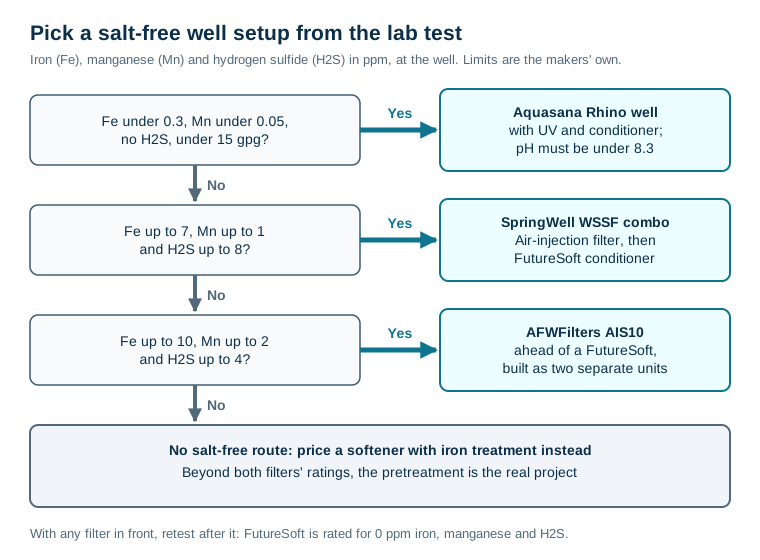
Use a lab panel, not strips. It needs iron, manganese, hydrogen sulfide, pH, hardness and bacteria at least. Then read the chart from the top. The first box your results fit is the setup to price.
If your well falls through to the bottom box, the job is the pretreatment, not the conditioner. That usually means a more specialised iron or sulfur system, chosen from the full test.
When a Softener Is the Cheaper Answer
This page answers which salt-free setup to buy. Before buying any of them, price a softener for the same water. Our guide to salt-free conditioners on city vs well water sets out where the crossover falls. In short:
- Low dissolved iron that a softener can take. A properly set-up softener may handle it alone. The salt-free route adds a whole iron filter to do the same job, so the softener usually wins on cost.
- High iron, oxidised iron, manganese or sulfur. An iron filter is needed either way. The costs even out, and the choice comes down to whether you want soft water.
- You want soft water. Better lather, no spotting, slick-feeling showers. Only a softener does that. A conditioner leaves the hardness reading unchanged.
Who Should Buy None of These
- Wells below pH 6.5. That is outside every conditioner's rating and below the 6.5 floor SpringWell gives for its combo. Fit a neutraliser first and retest.
- Wells with tannins. Pelican lists tannins among the things that must be removed. None of these trains is built for them.
- Wells over about 10 ppm iron or 8 ppm hydrogen sulfide. Beyond every rating here.
- Wells with iron bacteria. Slime in the toilet tank and a swampy smell mean the well itself needs treatment. An air-injection filter alone may foul.
- Untested wells. Do not buy any of these without a lab panel. The limits are too tight to guess.
- Very hard wells where spotting matters. Conditioned water still spots, more so the harder it is, and only a softener prevents that.
On a well, buy the filter first and treat the conditioner as the last, easy step. For most wells with iron or sulfur, the SpringWell WSSF combo is the best salt-free water softener for well water, because it arrives as a matched train after a required test. For higher iron at a lower price, the AFWFilters AIS10 ahead of a FutureSoft does the same job, if you do the checking. And if your well is already clean, the Aquasana Rhino well system adds disinfection to the scale control.
Frequently Asked Questions
Does a salt-free water softener work on well water?
Only after pretreatment. Every mainstream salt-free conditioner limits iron, manganese and hydrogen sulfide. Watts caps iron at 0.3 ppm and manganese at 0.05 ppm, and SpringWell lists 0 ppm for both on its FutureSoft. Many wells exceed those. With a sediment filter and an iron and sulfur filter in front, a conditioner can work on a well. Without them, the media coats over and stops working.
What is the best salt-free water softener for well water?
For most wells with iron or sulfur, the SpringWell WSSF combo, which puts an air-injection iron filter rated for up to 7 ppm iron, 1 ppm manganese and 8 ppm hydrogen sulfide ahead of its FutureSoft conditioner. For iron up to 10 ppm, an AFWFilters AIS10 ahead of a FutureSoft. For a well that is already clean but needs disinfection, the Aquasana Rhino well system with UV.
How much does a salt-free system for well water cost?
More than the conditioner alone. On a well you also pay for the iron and sulfur filter in front of it, and SpringWell's combo requires a paid water test before it ships. Aquasana's well system with UV and conditioner skips the iron filter, but it removes no iron. Installation and a sediment filter are extra. Prices change often, so check the current price of each part before you buy.
Do salt-free conditioners remove iron from well water?
No. They do not remove anything. Iron is one of the things that stops them working, because it oxidises onto the media surface. Iron, manganese and hydrogen sulfide have to be taken out by a separate filter before the water reaches the conditioner. Test after that filter, not at the well, because the conditioner only sees what the filter lets through.
Is a salt-free conditioner or a water softener better for well water?
It depends on what the well needs and what you want from the water. If an iron filter is needed either way, the two cost about the same to set up, and the choice comes down to whether you want soft water. A softener changes how soap behaves and stops spotting; a conditioner does neither. If a softener alone could handle your iron, it is usually the cheaper route.
