
Salt-Free Conditioners on City vs Well Water

A salt free conditioner on well water is usually a bad fit. Iron, manganese, sediment and hydrogen sulfide coat the media and switch it off, often within months. On city water the same system generally works, because the utility has already removed most of those. What remains is a prefilter and a check of your chlorine and phosphate levels against the media's limits.
That difference comes down to how the media works, and it explains why two neighbours can have opposite experiences with the same product. Below: the mechanism, the published thresholds, what each source actually needs, and the point at which well pretreatment makes a softener the cheaper option.
Why a Salt-Free Conditioner on Well Water Fails Without Pretreatment
A template-assisted crystallization (TAC) conditioner is a tank of small polymer beads. Their surfaces carry sites where dissolved calcium carbonate is nudged into forming microscopic crystals. Those crystals travel on with the water instead of growing on the heating element of your water heater. Nothing is removed, and there is no regeneration. The whole process happens at the bead surface, and it lasts only as long as that surface stays clean.
Well water attacks that surface in three ways:
- Iron and manganese oxidise onto it. Dissolved (ferrous) iron and manganese turn into insoluble oxides when they meet oxygen, and they deposit on whatever they touch. A bead wrapped in rust-brown iron oxide or black manganese oxide has no open sites left.
- Sediment settles on it. Silt, sand and pipe scale from a well pump physically blanket the bed.
- Hydrogen sulfide and oils foul it. Every media maker lists these as "must be removed", with no tolerance at all.
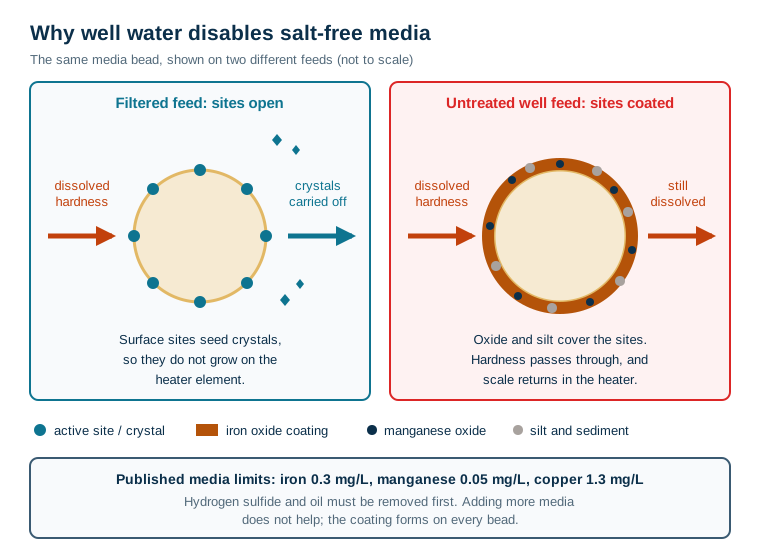
The failure is quiet. A fouled conditioner does not leak, beep or show a fault. Your hardness test would read the same either way, because a working TAC system does not lower hardness either. The first sign is usually scale reappearing in the water heater or on a tankless heat exchanger, months after the media has already stopped working.
The Thresholds That Matter, and Where Each Source Usually Sits
The published limits are consistent across the main TAC products. Watts prints them in its OneFlow engineering specification with a direct instruction: "if the water supply is from a private well, confirm that the levels of iron (Fe) and manganese (Mn) are less than 0.3 mg/L and 0.05 mg/L, respectively."
| Contaminant | Media limit (Watts OneFlow) | Private well | City supply |
|---|---|---|---|
| Iron | 0.3 mg/L | Often over. Common in groundwater, and not treated before it reaches you | Rarely an issue at the tap |
| Manganese | 0.05 mg/L | Often over. The strictest number on the sheet | Rarely an issue |
| Hydrogen sulfide | Must be removed | Present in some wells (rotten-egg odour) | Not normally present |
| Sediment | Not rated. Prefilter recommended | Common, especially after pump work | Low, with occasional main-break events |
| Free chlorine | Under 2 ppm (ScaleStop warranty: 0.5 ppm) | None, unless you chlorinate | Present as a disinfectant residual |
| Total phosphates | Under 3.0 ppm | Only if you add a feeder | Some utilities dose it for corrosion control |
| pH | 6.5 to 8.5 | Acidic wells fall below | Usually adjusted into range |
| Copper | 1.3 mg/L | Can be high with acidic water on copper pipe | Low unless plumbing is new |
Penn State Extension's guide to iron and manganese in private water systems explains why these two metals cause so much trouble in wells. Well water carrying them often looks clear at first, then throws orange-brown or black particles once it meets oxygen. That happens inside your plumbing, which is exactly where a conditioner sits. The same guide recommends no more than 0.3 mg/L iron and under 0.05 mg/L manganese in drinking water, the same figures the media makers use. The manganese line catches more wells than people expect. At 0.05 mg/L, it is one-sixth of the iron limit, and many basic well panels do not test for it at all.
City Water: What Actually Needs Checking
On a municipal supply, the utility has done most of the protective work already. Here is what is left to confirm.
1. Chlorine against the specific media. Media tolerance varies enough to matter. OneFlow allows free chlorine under 2 ppm. Watch Water rates its Filtersorb SP3 cartridge to 3 ppm. Next's residential ScaleStop manual makes the media warranty conditional on the supply not exceeding 0.5 ppm chlorine, with pretreatment required above it. Your utility's annual water quality report gives the disinfectant residual. If it is above your media's figure, a carbon filter goes first. If your utility uses chloramine rather than free chlorine, ask the conditioner maker directly, since the sheets are written around free chlorine.
2. Phosphate. This one catches careful buyers out. Some utilities add orthophosphate or blended phosphate to protect pipes from corrosion. TAC media makers do not want phosphate in the feed: Watts caps total phosphates at 3.0 ppm, and Next says not to apply phosphate or any other antiscalant before or after the media. If your utility lists phosphate in its report, compare the number. The same rule rules out bolting a polyphosphate cartridge onto the same line.
3. Sediment. City water is low in it most of the time, but main repairs and hydrant flushing send pulses of rust and grit through. A sediment cartridge ahead of the conditioner costs little and keeps those events out of the media.
4. New copper pipe. After a repipe, Watts asks for new copper lines to be passivated for at least four weeks before the conditioner is put into service, because fresh copper can foul the media.
Well Water: The Pretreatment That Makes It Workable
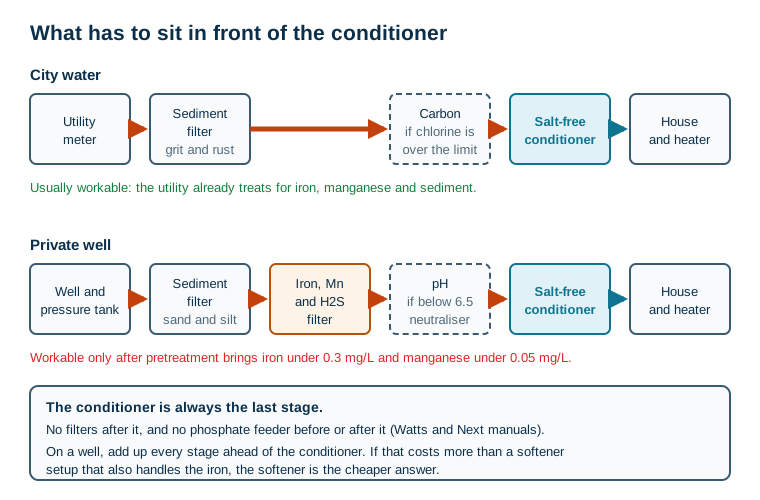
A salt-free conditioner can work on a well. It just cannot be the first thing the water meets. The train in order:
- Sediment filter. First, always. It protects everything downstream, including the iron filter.
- Iron, manganese and hydrogen sulfide removal. Usually a single oxidising filter, such as air injection or a catalytic media, sized for your iron and manganese levels together. It has to bring manganese under 0.05 mg/L, not just iron under 0.3. Some iron filters do the first job well and the second poorly, so ask for the manganese performance specifically.
- pH correction, if needed. Acidic water below 6.5 is outside every TAC rating and also dissolves copper, which then becomes its own problem. A neutraliser comes before the conditioner.
- The conditioner, last. Nothing after it except point-of-use drinking water filters.
Two well-specific operating rules follow from this.
Bypass the conditioner during shock chlorination. Well disinfection uses chlorine at concentrations far above any media's tolerance. Put the conditioner in bypass, chlorinate and flush the system as you would with a softener, and bring it back online only once the chlorine smell has gone.
Retest after the pretreatment is running. Test for iron and manganese at a tap after the iron filter, not at the well. The number that matters is what reaches the conditioner. Recheck it every year, because iron filters lose performance gradually and wells change with the seasons.
The Crossover: When Pretreatment Makes a Softener the Cheaper Answer
This is the calculation almost nobody does before buying. The right comparison is not "conditioner versus softener". It is the whole setup each one needs on your specific well.
A softener and a conditioner treat iron very differently. A salt-free conditioner needs iron and manganese taken all the way down to 0.3 and 0.05 mg/L by a separate filter. A softener exchanges dissolved ferrous iron along with calcium and magnesium, within limits. How much iron a softener can actually handle depends on the iron's form, the resin and the regeneration settings. That produces three bands.
| Well iron / manganese | Salt-free setup | Softener setup | Usually cheaper |
|---|---|---|---|
| Under 0.3 / under 0.05 mg/L | Sediment + conditioner | Sediment + softener | Conditioner: less to buy, no salt |
| Low levels of dissolved iron a softener can take | Sediment + iron filter + conditioner | Sediment + softener, set up for iron | Softener. The conditioner route adds a whole filter |
| High iron, oxidised iron, manganese or H₂S | Sediment + iron filter + conditioner | Sediment + iron filter + softener | Close. Decide on the soft-water outcome, not price |
The middle row is where most well owners get caught. Hardness and iron are both moderate, a salt-free system is sold as the low-maintenance choice, and an iron filter gets added to make it work. The final bill is a filter plus a conditioner, doing a job one properly set-up softener might have handled. The filter also has its own servicing, and the conditioner's media life depends on the filter doing its job.
In the bottom row, the iron filter is needed whatever you choose, so the comparison evens out. There, the deciding factor is what you want from the water. A softener changes how soap behaves and stops spotting. A conditioner does neither. The ongoing cost of each route is covered in what maintenance a salt-free system needs.
What Changes Between Sources, and What Doesn't
Some things are the same on any supply. A salt-free conditioner never lowers the hardness reading, never makes water feel slippery, and never removes anything. On a well that matters more than on city water, because a well owner's test panel often has several red lines, and none of them are fixed by a conditioner.
The source changes the size of the job. On city water you are protecting the media from occasional events: a chlorine spike, a sediment pulse, a repipe. On a well you are protecting it from the water itself, every day. That is why the hardness limit is rarely what decides suitability. A 12-grain well with 1.5 mg/L iron is a far worse candidate than a 25-grain city supply.
The practical sequence for a well owner:
- Get a lab panel that includes iron, manganese, pH, hydrogen sulfide and hardness. Not strips.
- Compare it with the limits of the specific media you are quoting.
- If anything is over, price the pretreatment first, then the conditioner, ideally as a complete salt-free setup matched to well water.
- Price a softener setup for the same water, including any iron handling it needs.
- Choose on total cost plus the outcome you actually want. For many wells, that is soft water, not conditioned water.
Frequently Asked Questions
Can you use a salt-free water conditioner on well water?
Only after the water has been pretreated to the media maker's limits. Watts and Next both cap iron at 0.3 mg/L and manganese at 0.05 mg/L, and require hydrogen sulfide and oil to be removed first. Many private wells exceed at least one of those, and sediment is common too. With a sediment filter and an iron and manganese filter in front, a conditioner can work on a well. Without them, the media coats over and stops working, often within months.
Why do salt-free conditioners fail on well water?
Because the media works through its surface. Template-assisted crystallization beads carry sites where dissolved calcium carbonate seeds into microscopic crystals. Iron and manganese oxidise into a coating on those surfaces, and silt settles on them. Once the sites are covered, hardness passes through still dissolved, and scale forms in the water heater as if nothing were installed. Adding more media does not help, because the coating forms on every bead.
Is a salt-free conditioner good for city water?
City water is where salt-free conditioners fit best, because the utility already keeps iron, manganese and sediment low. The two things to check are chlorine and phosphate. Chlorine limits range from 0.5 ppm on Next ScaleStop to under 2 ppm on Watts OneFlow, so some installations need a carbon filter first. Some utilities also add phosphate for corrosion control, and Watts caps total phosphates below 3.0 ppm.
Do I need a prefilter before a salt-free system?
On almost any supply, yes. A sediment filter protects the media from grit and rust flakes, which is cheap insurance on city water and essential on a well. On chlorinated city water, a carbon filter may also be needed, depending on the media's chlorine limit. The conditioner must be the last stage. Both Watts and Next say not to install filters after it, apart from point-of-use drinking water filters.
Should I get a water softener or a salt-free conditioner for well water?
If your well has iron or manganese above the media limits, price both complete setups before you decide. A softener can remove some dissolved ferrous iron along with hardness, while a salt-free conditioner needs every bit of it removed first by a separate filter. Once an iron filter is required either way, the choice is conditioner versus softener on equal terms. When a softener alone would have handled the iron, the softener is usually cheaper.
Can I shock chlorinate a well with a salt-free conditioner installed?
Put the conditioner in bypass first. Shock chlorination uses chlorine at concentrations far above any media's tolerance, which is under 2 ppm for OneFlow and 0.5 ppm on the ScaleStop warranty. Run the chlorinated water through the bypass, flush the system until the chlorine is gone, then return the conditioner to service. The same applies to any iron-bacteria treatment that uses an oxidiser.
