
Best Tankless Reverse Osmosis Systems for Hard Water
The best tankless reverse osmosis system for a hard-water home is the Waterdrop G3P600 for most kitchens. It is certified by IAPMO to NSF/ANSI 42, 53, 58 and 372, sends one gallon to drain for every two it makes, and has a moderate yearly filter cost. The Waterdrop G3P800 wastes less and adds UV, at a higher price. The iSpring RO500 is the simplest unit to maintain. The Waterdrop X12 is for households that draw a lot of water.
On hard water, the choice matters less than the feed. Waterdrop's manuals set a feed limit of 7 grains per gallon, and the rated membrane life assumes you stay under it. A softener upstream keeps you there.
Disclosure: Hard Water Solved may earn a commission if you buy through links on this page, at no extra cost to you. It does not change which products we include or how we rank them. Read our disclaimer.
How We Picked: Membrane Life, Filter Life and Drain Ratio
Method. Each system was compared on its maker's rated filter and membrane life, its published feed water limits, how often its cartridges need replacing, its pure-to-drain ratio, and the certifications listed for it. Evidence comes from product pages, manuals and certification listings. Nothing was physically tested.
Included: tankless under-sink RO systems sold on Amazon.com, with a published membrane life and a certification for TDS reduction under NSF/ANSI 58.
Excluded: tank-based systems, countertop units, and any system whose price or certification we could not confirm.
Prices are not listed here because they change often. Use the buttons to see the current price on Amazon.
Who should buy none of these: anyone without an outlet under the sink, anyone on untreated well water, and renters who cannot drill a faucet hole. Those cases are covered at the end.
Best Tankless Reverse Osmosis Systems Compared
| Waterdrop G3P600 | Waterdrop G3P800 | iSpring RO500 | Waterdrop X12 | |
|---|---|---|---|---|
| Rated output | 600 GPD | 800 GPD | 500 GPD | 1,200 GPD |
| Pure-to-drain | 2:1 | 3:1 | 2:1 | 3:1 |
| Drain per 100 gal made | about 50 gal | about 33 gal | about 50 gal | about 33 gal |
| Certification | NSF/ANSI 42, 53, 58, 372 (IAPMO) | NSF/ANSI 42, 53, 58, 372 (IAPMO) | NSF/ANSI 58, TDS reduction | NSF/ANSI 42, 58 (IAPMO); 372 per listing title |
| Rated membrane life | 24 months or 2,200 gal | 24 months | 24 to 36 months | 24 months or 2,200 gal |
| Extras | TDS faucet | UV LED, TDS faucet | Auto-flush | Mineral stage, TDS faucet |
| Amazon | Check price on Amazon | Check price on Amazon | Check price on Amazon | Check price on Amazon |
Waterdrop's combo filter sets and subscriptions cost less than buying single cartridges. IAPMO listing details from a third-party directory check dated August 2026.
Why Hard Water Matters More to a Tankless RO Membrane
A tankless unit concentrates salts at the membrane surface just as a tank system does. It also works at a tighter drain ratio. Less reject water means the calcium leaves in less water, so it is more concentrated, and closer to the point where it comes out of solution as scale. How reverse osmosis and a water softener work together works through that concentration effect with EPA's reject figures.
The manufacturers do not publish membrane life on hard feed. They publish one rated life and a set of feed conditions:
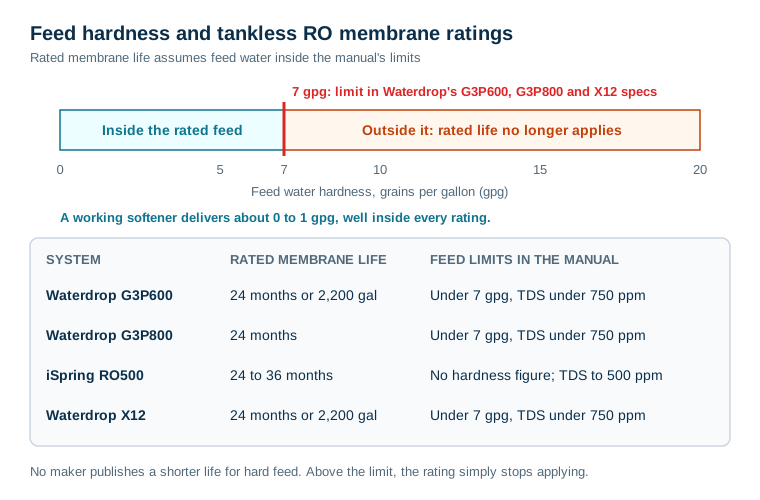
What that means for how often you buy a membrane:
| System | Rated membrane life | If hard feed halved its life (illustration) |
|---|---|---|
| Waterdrop G3P600 | 24 months | about 12 months |
| Waterdrop G3P800 | 24 months | about 12 months |
| iSpring RO500 | 24 to 36 months | about 12 to 18 months |
| Waterdrop X12 | 24 months | about 12 months |
The last column is illustrative, not a published figure. No maker states how much hard feed shortens its membrane. It shows what is at stake if the membrane wears out in half its rated time: buying membranes twice as often.
The other cost is the warranty. Waterdrop lists feed hardness under 7 gpg, alongside pH, TDS and turbidity limits, as conditions in its manuals. A membrane that fails early on 15 gpg feed is outside those conditions. If your water is harder than 7 gpg and you have no softener, a tankless RO unit can still be worth buying. Expect to replace the membrane on its condition rather than on its schedule. Log tap TDS and RO TDS from day one, and change the membrane when rejection slips.
If you are still deciding whether you need a softener, an RO unit, or both, water softener vs reverse osmosis maps which one treats which problem in the house.
1. Waterdrop G3P600: Best Tankless RO for Most Kitchens
The G3P600 is an 8-stage system in three cartridges: a composite sediment and carbon pre-filter, the RO membrane, and a carbon block post-filter. Waterdrop's G3P600 product page rates it at 600 GPD, or 0.42 gpm, with a 2:1 pure-to-drain ratio. It lists filter lives of 6 months or 550 gallons for the pre-filter, 12 months or 1,100 gallons for the carbon filter, and 24 months or 2,200 gallons for the membrane. It needs 14.5 to 87 psi and an outlet for its pump.
Certification. The Amazon listing and Waterdrop's page cite NSF/ANSI 42, 53, 58 and 372. A third-party directory check in August 2026 found active IAPMO R&T listings for all four. The NSF/ANSI 58 claims include TDS, fluoride, lead, barium, cadmium and radium. IAPMO is an accredited certifier, so this carries the same weight as an NSF or WQA listing.
On hard water. The manual's feed limits are under 7 gpg hardness and under 750 ppm TDS, with municipal tap water as the stated source. On softened city water it is inside every limit.
What it skimps on. Membrane volume. The membrane's 2,200-gallon cap is about 3 gallons a day over two years, so a household that cooks with RO water may reach the gallon limit before the date.
Buy it if you are on city water, softened or under 7 gpg, and want the best-documented certification at a mid-range price.
2. Waterdrop G3P800: Lowest Waste, With UV
The G3P800 raises output to 800 GPD and the pure-to-drain ratio to 3:1. It also adds a UV LED. It uses the same pre-filter and carbon cartridges as the G3P600, with a different membrane. Waterdrop rates the pre-filter at 6 months, the carbon at 12 and the membrane at 24. Feed limits are the same as the G3P600's: 14.5 to 87 psi, 41 to 100°F, municipal water, hardness under 7 gpg and TDS under 750 ppm.
Certification. Waterdrop's page lists NSF/ANSI 58 and 372, and the Amazon title adds 42 and 53. The same third-party directory check found IAPMO listings under 42 (chlorine), 53 (PFOA/PFOS) and 58 (TDS, fluoride, cadmium, hexavalent chromium, selenium, barium, radium). Lead appears in Waterdrop's marketing for this model but was not among the certified claims found. If lead is your reason for buying, the G3P600's listing covers it and this one, as found, does not.
What it skimps on. Price. It costs considerably more than the G3P600 for a third less drain water and a UV lamp. The UV light does not make it a disinfection system for unsafe water.
Buy it if water use matters to you, for example on a metered supply, or you want UV at the tap and will pay for it.
3. iSpring RO500: Simplest to Maintain
The RO500 has three stages: a composite sediment and carbon block filter, the membrane, and a carbon block post-filter. iSpring's RO500 product page gives 500 GPD, 0.4 gpm and a 2:1 ratio. Pre- and post-filters are rated at 6 months and the membrane at 24 to 36 months. The unit plugs into a standard outlet on a cable of about 3 feet, has auto-flush, and comes with a 1-year warranty, a 30-day money-back guarantee and optional extended warranties.
Certification. iSpring states NSF/ANSI 58 certification for TDS reduction. The marketing lists lead, fluoride, arsenic and more, but the certification iSpring cites is for TDS. Treat the rest as unverified.
On hard water. The RO500-series manual lists municipal water and TDS up to 500 ppm, with performance and filter life falling above that. It gives no hardness figure, which is not the same as tolerating hard water. iSpring's older tank-system manual makes feed hardness of 7 gpg or less a warranty condition, so the same chemistry applies here.
What it skimps on. Its certification is the narrowest of the four, and its list price is high for a 3-stage unit. Its yearly filter cost sits at the low end of the four, depending on how long the membrane lasts.
Buy it if you want the fewest cartridges to change and a long-rated membrane, and you only need TDS reduction to be certified. An alkaline version, the RO500AK, swaps the post-filter for a carbon alkaline cartridge.
4. Waterdrop X12: Highest Output
The X12 is rated at 1,200 GPD with a 3:1 ratio. It uses an 11-stage design with a mineral stage that Waterdrop says adds calcium and magnesium and adjusts pH to about 7.5. Its filters are rated at 6 months or 550 gallons (F2), 12 months or 1,100 gallons (F1A), and 24 months or 2,200 gallons (the F3 RO cartridge).
Certification. The Amazon listing cites NSF/ANSI 42, 58 and 372. The same third-party directory check found IAPMO listings under NSF/ANSI 58 for TDS reduction and 42 for chlorine, taste and odour. No specific health contaminant was among the listed claims, so do not buy it for lead or PFAS on the strength of the listing.
On hard water. Its published feed limits match the G3P series: municipal water, hardness under 7 gpg and TDS under 750 ppm. The directory record also gives a 2-year manufacturer warranty.
What it skimps on. Value per gallon of need. Few kitchens need 1,200 GPD. The extra speed helps when filling pots and large bottles, not when filling glasses. It also carries the highest filter cost of the four.
Buy it if your kitchen draws a lot of drinking and cooking water and you want mineralised water without a separate stage.
Before You Buy: Three Things That Rule a Unit Out
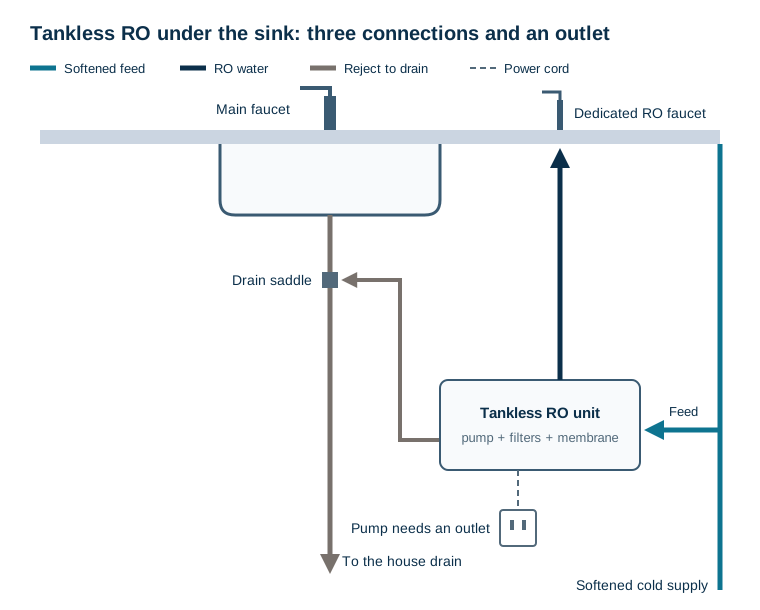
- No outlet in the sink cabinet. Every tankless unit has a pump. If the nearest outlet is outside the cabinet, plan to have one added before you buy, or choose a tank system.
- Feed water outside the manual. Check hardness, TDS and pH against the manual. Waterdrop's limits are under 7 gpg, under 750 ppm TDS and pH 6.5 to 8.5. iSpring's are TDS up to 500 ppm. A softener handles the hardness. It does not lower TDS, because it swaps calcium for sodium rather than removing salts.
- Well water. Both makers list municipal water as the intended feed. Treat iron, sediment and bacteria on a well before any RO unit sees the water.
If you add a softener to protect the membrane, size it for the whole house, not the RO. How to size a water softener works through the calculation.
How Much Water a Tankless RO System Sends to Drain
EPA's WaterSense page on point-of-use RO systems says a typical under-sink unit sends five gallons or more to drain for each gallon of treated water, and a WaterSense-labeled unit sends 2.3 gallons or less. All four tankless systems here claim much less:
| For every 100 gallons of RO water | Sent to drain |
|---|---|
| Typical under-sink RO (EPA) | 500 gallons or more |
| WaterSense-labeled RO (EPA ceiling) | 230 gallons or less |
| 2:1 tankless (G3P600, RO500) | about 50 gallons |
| 3:1 tankless (G3P800, X12) | about 33 gallons |
On softened water, every gallon of reject has already been through the softener, so tighter ratios also save a little salt. At 3 gallons of RO water a day on 20 gpg water, a 2:1 unit rejects about 550 gallons a year. That carries roughly 11,000 grains of hardness the softener already removed, or about 3 lb of salt. That is small enough to ignore.
Who Should Buy None of These
- Renters who cannot drill a faucet hole or run a drain saddle. A countertop RO unit that needs no plumbing is the better fit.
- Homes with no outlet under the sink and no plan to add one. A conventional tank RO unit needs no power.
- Untreated well water, especially with iron or bacteria. Treat the well first.
- Anyone who mainly wants softer showers or less scale. An RO unit treats one tap. Scale in the water heater and on fixtures is a whole-house problem.
- Anyone buying for a contaminant the listing does not cover. Look up the model and the specific claim before you buy.
For a softened city-water kitchen, any of the four does the job. The G3P600 is the one we would start with, because its certification is the broadest documented here and its running cost is moderate. Its membrane rating holds as long as the softener keeps the feed under 7 gpg.
Frequently Asked Questions
Is a tankless reverse osmosis system better than one with a tank?
For most kitchens it is more convenient. A tankless unit makes water on demand with a built-in pump, so there is no tank to take up cabinet space or to sit stagnant. The four systems on this page send one gallon to drain for every two or three they make, against five or more on a typical tank system, according to EPA. The trade-offs are a higher price and the need for an outlet under the sink.
Does a tankless reverse osmosis system need electricity?
Yes. Tankless units use an electric booster pump to push water through the membrane fast enough to fill a glass on demand. Every system on this page needs a standard outlet in or near the sink cabinet. iSpring lists a power cable of about 3 feet on its RO500, so the outlet has to be close.
Do I need a water softener before a tankless RO system?
On hard water, it helps and can matter for the warranty. Waterdrop's G3P600, G3P800 and X12 specifications list feed water hardness under 7 grains per gallon. Above that, calcium concentrates at the membrane surface and can scale it. A softener ahead of the RO keeps feed hardness near zero, well inside that limit.
How often do tankless RO filters need changing?
Pre-filters typically every 6 months, carbon post-filters every 12 months, and the RO membrane every 24 months, or 24 to 36 months on the iSpring RO500. Waterdrop also gives gallon limits, such as 2,200 gallons for the G3P600 membrane, so heavy use shortens the interval. Smart faucets on the Waterdrop units show remaining filter life.
How much water does a tankless RO system waste?
Less than older systems. A 2:1 unit such as the Waterdrop G3P600 or iSpring RO500 sends about 50 gallons to drain for every 100 gallons of drinking water. A 3:1 unit such as the G3P800 or X12 sends about 33 gallons. EPA says a typical under-sink RO unit sends five gallons or more to drain per gallon made.
Can I use a tankless RO system on well water?
Check the manual first. Waterdrop lists municipal tap water as the feed requirement for the G3P600 and G3P800 and says well water needs pre-treatment. iSpring's manual for the RO500 series lists municipal water as the applicable water quality. Iron, sediment and bacteria need treating ahead of any RO unit.
