
Water Softener vs Reverse Osmosis System
Water softener vs reverse osmosis is a question of scope, not quality. A reverse osmosis (RO) system makes very clean drinking water, usually at one kitchen tap. A water softener removes only hardness, but it treats every gallon entering the house, which is what protects the water heater, fixtures and appliances from scale. They solve different problems, and many homes with hard water end up with both.
The rest of this page shows what each one changes in the water, the wastewater figures in gallons, and the question few comparison pages answer straight: why you almost never replace a softener with whole-house RO.
Water Softener vs Reverse Osmosis: Whole House or One Tap
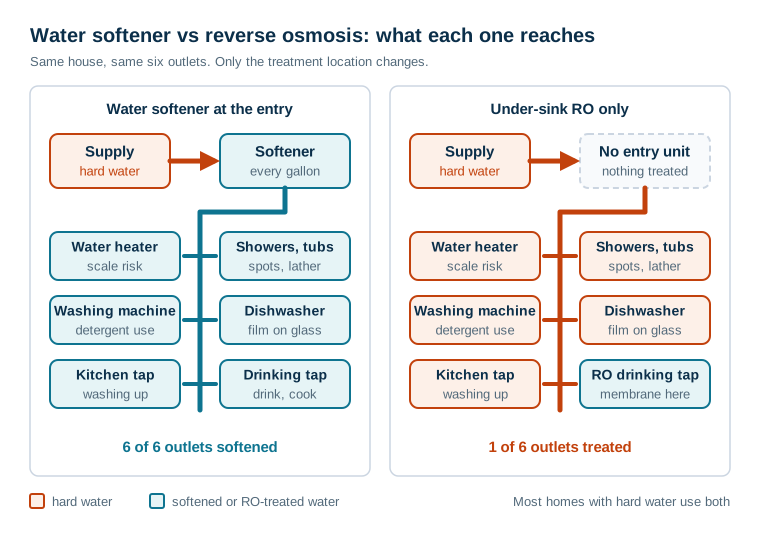
Picture where the water goes after it enters the house. Most of it heats up, runs through showers, dishwashers, washing machines and toilets, and then goes down the drain. A small share, a gallon or two per person per day, is drunk or cooked with.
- A softener sits at the point of entry. Every gallon passes through it, so every fixture gets soft water. That is where scale does its damage: in the water heater, on shower glass, in dishwasher elements and aerators.
- An RO system sits at the point of use, almost always under the kitchen sink with its own small faucet. It treats only the water you drink and cook with, which is the only water where most of what RO removes matters.
Nebraska Extension's guide to drinking water treatment by reverse osmosis describes the same split: most household RO systems are point-of-use units under the sink or on the counter, and point-of-entry RO units "are more costly to purchase, install and operate." The scope difference drives the rest of the comparison. If you want the general version of this choice, which also covers other devices, see point-of-entry vs point-of-use water softening.
What Each One Actually Changes in the Water
| Water softener | Under-sink reverse osmosis | |
|---|---|---|
| How it works | Ion exchange. Resin trades sodium (or potassium) for calcium and magnesium | Pressure pushes water through a membrane that holds back most dissolved salts |
| Where it treats | Whole house | One tap, sometimes also the fridge line |
| Hardness | Removes it, close to 0 gpg when working | Removes it at that tap, but hard feed water scales the membrane |
| Sodium | Adds about 7.9 mg/L for every grain per gallon removed | Removes most of it |
| Total dissolved solids (TDS) | Unchanged or slightly higher, because sodium replaces calcium | Cut sharply. That is the main thing RO does |
| Chlorine taste | No effect, and chlorine slowly damages the resin | Removed by the carbon prefilter |
| Lead, arsenic, nitrate, fluoride, PFAS | Not a treatment for any of them | Can reduce them, but only claim by claim on NSF/ANSI 58 certification |
| Bacteria and viruses | No | No. Nebraska Extension says RO is not recommended for that use and should be fed coliform-free water |
| Water to drain | Regeneration: EPA puts it at 25 gallons or more a day | Reject water: five gallons or more per gallon made on a typical unit |
| Routine upkeep | Salt, and occasional cleaning | Prefilters about every 6 to 12 months, membrane every few years |
Two rows deserve a second look. The TDS row is why people who test their softened water with a TDS pen think the softener is broken: it removes hardness without lowering TDS at all. And the contaminant row is where RO's advantage is real but conditional. A particular RO model reduces a particular contaminant only if it is certified for that claim. The softener side of this is covered claim by claim in what a water softener does not remove.
The Wastewater Ratio, in Gallons You Will Recognize
An RO membrane needs a constant flow across its surface to carry away the salts it rejects. That flow goes down the drain. EPA's WaterSense page on point-of-use RO systems says a typical system sends five gallons or more to drain for every gallon of treated water. A WaterSense-labeled system sends 2.3 gallons or less. Nebraska Extension gives a design recovery of 20 to 30 percent for most household units, which is the same range expressed differently.
What that means per day, for a household that draws 2 gallons of RO water:
| RO unit | Drain water per gallon made | Drain water per day | Per year |
|---|---|---|---|
| Typical under-sink unit | 5 gallons | about 10 gallons | about 3,650 gallons |
| WaterSense-labeled unit | 2.3 gallons | about 4.6 gallons | about 1,700 gallons |
Worked from EPA's per-gallon figures. Your draw will differ, so multiply by your own daily use.
Now the softener. EPA's page on cation exchange water softeners says regeneration "can use 25 gallons of water or more per day, or up to 10,000 gallons per year." So a common assumption is backwards: per year, an under-sink RO often sends less water to drain than the softener does. The RO wastes a lot per gallon, but it only makes a few gallons. The softener wastes a little per gallon, but it treats all of them.
That arithmetic flips completely the moment RO is asked to treat the whole house, which is the next section.
Why Whole-House RO Is Almost Never Right for a Home
Some sellers offer whole-house RO as the premium alternative to a softener: "why soften when you can purify everything?" For a normal home the honest answer is that it creates more problems than it solves.
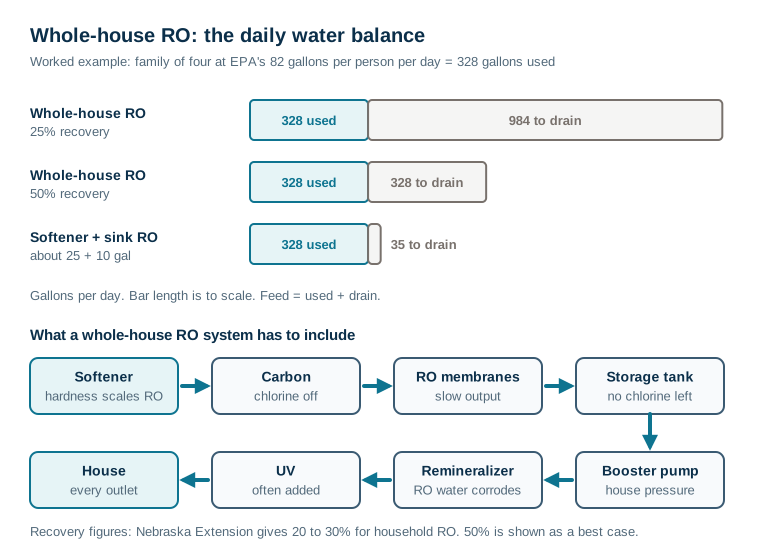
1. The drain volume becomes the size of a second household. EPA's WaterSense figures put average home use at about 82 gallons per person per day, so about 328 gallons for a family of four. At 25 percent recovery, making 328 gallons takes about 1,312 gallons of feed and sends about 984 gallons to drain. Even at 50 percent, a high figure for home equipment, 328 gallons go to drain every day. On a well, the pump and the well's yield have to supply all of it. On a septic system, all of it goes into the tank and drainfield. Compare that with a softener plus an under-sink RO: about 25 gallons of regeneration water and 10 gallons of RO reject, roughly 35 gallons a day.
2. The membrane still needs soft water. Hardness scales an RO membrane, and a whole-house unit concentrates it just as an under-sink one does. Nebraska Extension notes that on relatively hard water, a softener ahead of the RO "can increase the life of the membrane." So whole-house RO on hard water usually means a softener anyway, plus the RO.
3. It cannot deliver water at house pressure. Membranes produce water slowly. A whole-house system fills an atmospheric storage tank and uses a second pump to repressurize the house. That is two more machines, a tank that holds treated water with no chlorine residual, and one more thing to fail on a Saturday.
4. The water it makes is aggressive. With most minerals removed, RO water pulls metal from pipes. Nebraska Extension states plainly that RO water "can be more corrosive than untreated water," which is why even under-sink units use plastic tubing and dedicated faucets. For a whole house you add a remineralizing or pH-correcting stage after the RO, or accept the risk to copper plumbing and water heaters.
5. Chlorine is gone, and so is its protection. A city supply's disinfectant residual is removed by the carbon prefilter that protects the membrane. Water then sits in a storage tank with nothing to stop bacterial growth, so many designs add UV disinfection after the tank.
Add it up and a whole-house RO system is a small treatment plant: softener, carbon, membranes, storage, booster pump, remineralizer, possibly UV. It makes sense when the whole-house water has a problem only RO can fix, most often very high dissolved solids or a salty well that a softener cannot improve. That is a design job built on a lab test, not a product swap. For a home whose problem is hardness, a softener does the whole-house job and an under-sink RO polishes the drinking water.
Which Problem Do You Actually Have?
Start from the symptom, not the equipment:
| What you see or measured | What causes it | What treats it |
|---|---|---|
| White scale on fixtures, spotty glasses, poor soap lather | Calcium and magnesium hardness | Softener |
| Scale in the water heater or tankless unit | Hardness | Softener. RO at the sink never reaches it |
| Salty or bitter taste, TDS above about 500 mg/L | High dissolved solids such as sodium, chloride or sulfate | RO at the drinking tap |
| Lead, arsenic, nitrate or fluoride on a lab report | That contaminant | RO certified for that claim, or another certified device |
| Chlorine taste or smell | Disinfectant in city water | Carbon filter. Neither a softener nor the RO membrane is the right tool |
| Orange stains, metallic taste | Iron | Iron filter ahead of the softener, depending on type and level |
| Positive coliform test | Bacteria | Disinfection. Neither unit is a disinfection device |
EPA's secondary standard for total dissolved solids is 500 mg/L, a guideline based on taste and staining rather than health. If your hardness is high but your TDS is otherwise ordinary, a softener is the answer and RO is optional. If your hardness is fine but the water tastes salty, a softener will make it worse, and RO is the answer.
What a Softener Cannot Do, and What RO Cannot Do
Reader trust comes from the limits, so here they are side by side.
A water softener cannot:
- lower total dissolved solids, improve a salty taste or remove sodium
- remove chlorine, chloramine, lead, arsenic, nitrate, PFAS or bacteria
- make water safe to drink if it was unsafe before
- fix low-pH corrosive water; a softener does not raise pH
An under-sink RO system cannot:
- protect anything except the tap it feeds
- tolerate chlorine at the membrane without its carbon prefilter; thin-film membranes "deteriorate in chlorinated water," in Nebraska Extension's words
- disinfect water; the feed should already be bacteriologically safe
- keep working at full rejection forever; the membrane slowly loses performance and prefilters clog
Neither one does the other's job. That is the main point of this whole comparison.
Cost and Upkeep Side by Side
Prices vary by region and brand, so treat these as typical ranges rather than quotes.
| Water softener | Under-sink RO | |
|---|---|---|
| Equipment | Several hundred to a few thousand dollars, plus installation at the main line and a drain | A few hundred dollars; many owners install it themselves |
| Running cost | Salt, some water and a little electricity | Prefilters and a membrane every few years, plus reject water |
| What happens if you skip upkeep | Salt runs out, hardness returns, resin slowly fouls | Chlorine reaches the membrane, rejection drops, bacteria can grow in a neglected unit |
| Useful life | Many years for the valve and tank; resin eventually wears | Housing and tank last years; membrane is a consumable |
The real cost question is whole-house RO versus softener plus under-sink RO. The combination costs less to buy and far less to run, and it wastes a fraction of the water.
When the Answer Is Both
Hard water with a drinking-water concern is the most common case, and the pair works well. The softener goes first and protects the whole house, including the RO membrane. Some RO makers write that into the warranty, as the Waterdrop G3P600's 7 gpg feed limit shows. The RO under the sink then removes most of the sodium the softener added, along with dissolved solids and any contaminant it is certified for. The plumbing, the membrane figures and the sodium arithmetic are in how reverse osmosis and a water softener work together. For the under-sink unit itself, comparing tankless RO systems on waste ratio and feed-water limits covers the current options.
If you are still deciding, get two numbers first: hardness in grains per gallon and TDS in mg/L, plus any contaminant a lab flags. Hardness decides the softener. TDS and the lab report decide the RO. If you want to understand what the softener is doing to your water before you buy one, how a whole-house water softener works follows a gallon through the system.
Frequently Asked Questions
Is reverse osmosis better than a water softener?
Neither is better in general, because they do different jobs. Reverse osmosis produces much cleaner drinking water, but usually at one tap. A softener removes only hardness, but it does it for every pipe, fixture and appliance in the house. If your problem is scale, spots and poor lather, RO at the sink will not fix it. If your problem is taste, dissolved solids or a specific contaminant in drinking water, a softener will not fix that.
Does reverse osmosis soften water?
The water that comes out of an RO faucet is soft, because the membrane rejects calcium and magnesium along with most other dissolved salts. But only that faucet gets it. The rest of the house still receives hard water, and hard feed water shortens the membrane's life. Nebraska Extension notes that softening ahead of an RO unit can extend membrane life on relatively hard water.
Can I use a reverse osmosis system instead of a water softener?
Only if you do not care about scale anywhere except your drinking water. An under-sink RO unit leaves the water heater, showers, dishwasher and washing machine on hard water. Replacing the softener with a whole-house RO system is technically possible, but it needs a storage tank, a booster pump, corrosion control and usually a softener in front of the membrane anyway.
Do I need a water softener if I have a reverse osmosis system?
If your water is hard and you want to protect the plumbing and appliances, yes. RO covers drinking and cooking water at one tap. Many RO manufacturers also set a maximum feed hardness, often around 7 grains per gallon, so a softener ahead of the RO protects the membrane as well.
Is whole-house reverse osmosis worth it?
For most homes, no. At the 20 to 30 percent recovery that Nebraska Extension gives for household RO, a family of four using about 330 gallons a day would send roughly 770 to 1,300 gallons a day to drain. Even high-recovery whole-house designs need a storage tank, a repressurizing pump and remineralization, because RO water can be corrosive. It is reserved for wells with problems a softener and filters cannot handle, such as very high dissolved solids.
Which wastes more water, a softener or a reverse osmosis system?
It depends on how much RO water you draw. EPA says softener regeneration can use 25 gallons or more a day, up to 10,000 gallons a year. A typical under-sink RO sends five gallons or more to drain per gallon made, so a household drawing 2 gallons a day wastes about 10 gallons a day. A WaterSense-labeled RO unit sends 2.3 gallons or less to drain per gallon, which roughly halves that.
