
How Reverse Osmosis and a Water Softener Work Together
Reverse osmosis and water softener systems are one of the few pairings where each unit fixes the other's weak spot. The softener, at the point of entry, removes the calcium and magnesium that would scale the RO membrane. The RO unit, at the kitchen tap, strips out most of the sodium the softener added, along with contaminants the softener cannot touch. The softener always goes first.
That solves two objections at once. People worry that softened water is too salty to drink, and they worry that hard water wrecks RO membranes. Put the two units in the right order and neither worry applies. The rest of this page covers the plumbing, the published membrane figures, the sodium arithmetic, and six setup rules.
Reverse Osmosis and Water Softener: Who Does Which Job
| Job | Water softener | Under-sink RO |
|---|---|---|
| Where it treats | Whole house (point of entry) | One tap, usually the kitchen (point of use) |
| Hardness | Removes it. That is its job | Removes it, but scales the membrane doing so |
| Sodium | Adds about 7.9 mg/L per grain of hardness removed | Removes most of it |
| Chlorine | Does not remove it, and is damaged by it | Removed by the carbon prefilter; the membrane itself cannot tolerate it |
| Lead, nitrate, arsenic, fluoride, PFAS | Does not remove them | Can reduce them, if the model is certified to NSF/ANSI 58 for that claim |
| Bacteria | No | No. RO units are not disinfection devices |
| Waste water | Regeneration backwash and brine | Reject water: five gallons or more per gallon made, on a typical unit |
The certification rows matter. The full list of what ion exchange leaves behind, and which NSF/ANSI claim covers each contaminant, is in what a water softener does not remove.
The Layout: Softener at the Entry, RO Under the Sink
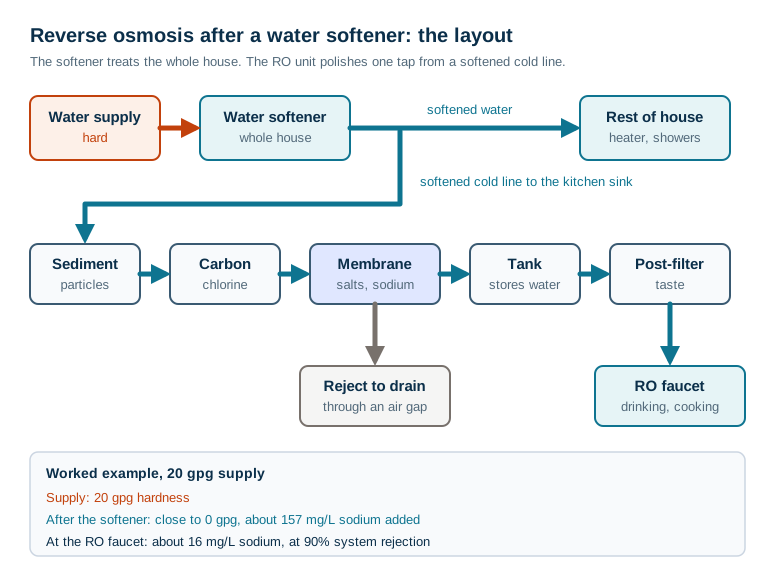
A standard under-sink system has five parts after the feed valve:
- Sediment prefilter, which catches particles before they reach the carbon or membrane.
- Carbon prefilter, which removes chlorine. DuPont's data sheets for FilmTec residential elements give a free chlorine tolerance of less than 0.1 ppm, and state that oxidation damage is not covered under warranty.
- Membrane, which rejects dissolved salts, including the hardness, sodium and chloride.
- Storage tank, which holds treated water so the faucet runs at a useful rate.
- Post-filter and a dedicated faucet.
A reject line carries the concentrate to the sink drain through an air gap.
The feed has to come from a softened cold line. Most kitchen cold taps in a softened house are softened. Some installers leave the kitchen cold line hard on purpose, so the family drinks unsoftened water. If yours is plumbed that way, the RO is getting hard water. You then have two choices: move the RO feed to a softened line, or accept a shorter membrane life. Why only some faucets have soft water shows how to find out which lines are softened.
What Hardness Does to an RO Membrane
An RO membrane lets water through and holds dissolved salts back. The salts it holds back are concentrated in the water flowing across the membrane surface, and then leave in the reject stream. Calcium carbonate is only slightly soluble. Once it is concentrated past its limit, it comes out of solution as scale on the membrane. The scale blocks flow, production drops, and rejection slips.
One RO manufacturer's installation manual puts it plainly: softening "is the preferred method of controlling hardness scale," and scaling potential, measured by the Langelier Saturation Index, should be zero or negative throughout the unit unless an approved antiscalant is used.
Why efficient RO units need softening more, not less. EPA's WaterSense page on point-of-use RO systems notes that a typical unit sends five gallons or more to drain for every gallon of treated water. A WaterSense-labeled unit sends 2.3 gallons or less. Less reject water means the salts leave in less water, so they are more concentrated:
| Unit | Reject per gallon made | Recovery | Hardness in the reject vs. the feed |
|---|---|---|---|
| Typical under-sink RO | 5 gallons | about 17% | about 1.2 times |
| WaterSense-labeled RO | 2.3 gallons | about 30% | about 1.4 times |
Worked from EPA's reject figures, assuming the membrane holds back essentially all of the hardness. Concentration right at the membrane surface runs higher than in the reject stream.
A water-efficient RO on hard water is working closer to the point where scale forms. Feed it softened water and the problem goes away, because there is little calcium left to concentrate.
Membrane Life With and Without Softening: What Is Actually Published
This is where the claim that softening "doubles membrane life" usually appears. We could not find a manufacturer or a published study that gives side-by-side membrane life figures for the same residential unit on hard and on softened water. This is what manufacturers do publish:
| Source | What it states |
|---|---|
| DuPont FilmTec BW60-1812-75 data sheet | Performance rated on "250 ppm softened tap water." Typical stabilized salt rejection 99%, minimum 96%. The newer chemistry is marketed for "even longer lifetimes on high hardness water applications." No year figures given |
| DuPont FilmTec TW30-1812-100HR data sheet | Same softened-water test conditions. Typical stabilized salt rejection 98%, minimum 96% |
| APEC Water FAQ | Its membranes "routinely last from 3-5 years between replacements" |
| iSpring RO user's manual | Warranty condition: feed hardness "cannot exceed 7 grains per gallon or 120 ppm." The service record lists the membrane at 2 years |
| Express Water hard-water guide | "Hard water (above 7 grains of hardness) will shorten the life of the RO Membrane" |
| EPA WaterSense RO specification | The labeling test includes a membrane life test simulating at least one year of use |
Three things are consistent across those sources. Membranes are rated on softened water. About 7 gpg is the common ceiling manufacturers set. Hardness above that shortens membrane life by an amount nobody quantifies publicly.
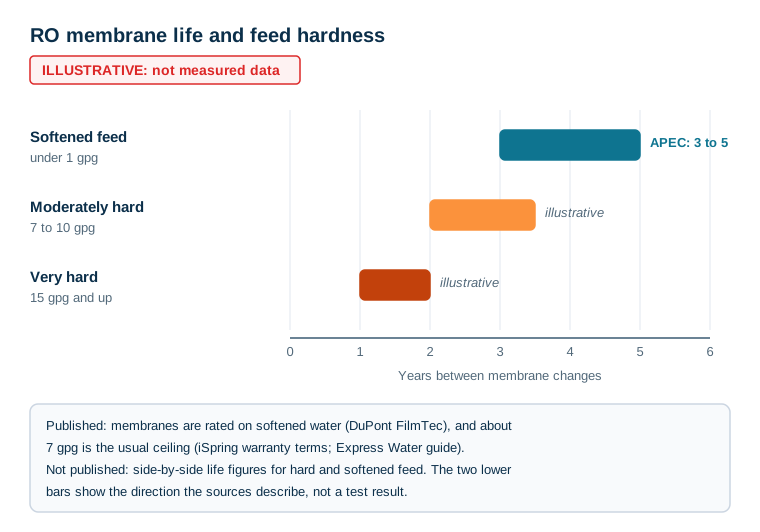
The chart above is illustrative, not measured data. The softened-feed range matches APEC's published 3 to 5 years. The hard-water ranges are there to show the direction and rough scale the sources describe, not a result from any test. Your own membrane's life depends on hardness, chlorine, sediment, how much water you draw and how often the prefilters are changed.
The number that matters is your own. A $15 TDS meter tells you when your membrane is slipping. Measure the tap water feeding the RO, then the RO faucet. Rejection is 1 minus (RO TDS ÷ tap TDS). If it falls well below where it started, replace the membrane, or check the prefilters first if production has dropped too.
The Sodium Question, With the Arithmetic
A softener swaps each calcium or magnesium ion for sodium, two sodium ions for every calcium. By the equivalent weights, that works out to about 7.9 mg/L of sodium for every grain per gallon of hardness removed.
Worked example: 20 gpg well water
| Step | Sodium |
|---|---|
| Added by the softener: 20 × 7.9 | about 157 mg/L |
| In an 8 oz glass of softened water | about 37 mg |
| After an RO system rejecting 90% of dissolved solids | about 16 mg/L |
| After an RO system rejecting 95% | about 8 mg/L |
Example figures. The 85 to 95% system range comes from the iSpring manual's stated rejection rate. The FilmTec element ratings of 96 to 99% are for the membrane alone, under test conditions. Complete systems usually do a little worse.
That is the second half of the pairing. The softener's added sodium is what makes some people, and some doctors, uneasy about drinking softened water. A kitchen RO unit removes most of it at the one tap that matters for drinking and cooking. If the water tastes salty even at an ordinary tap, that is a softener fault, not a sodium-per-grain issue. Why softened water tastes salty covers the causes.
Potassium chloride in the brine tank swaps the sodium for potassium. It costs more, and the RO removes most of the potassium in the same way.
What Neither Unit Handles Alone
- Chlorine and chloramine. The softener does not remove them, and the RO's carbon prefilter only protects that one tap. Many standard carbon prefilters are sized for chlorine. Chloramine usually needs catalytic carbon. How chloramine affects a water softener covers the resin side.
- Bacteria. Neither is a disinfection device. One RO manual opens with a warning not to use the unit where water is microbiologically unsafe. A well with a positive bacteria test needs disinfection before either unit.
- Iron and sediment. Both foul a membrane as readily as they foul resin. They are treated ahead of the softener, not at the sink.
- Whole-house contaminants. Radon and chlorine in shower water, for example, are not reached by an RO unit under the kitchen sink.
Six Setup Rules
- Softener first, always. Feed the RO from a softened cold line. If the kitchen cold line is hard by design, run a softened feed to the RO or accept shorter membrane life.
- Keep the carbon prefilter on schedule. The softener does nothing for chlorine. The iSpring schedule lists the sediment and carbon prefilters at 6 months, and a spent carbon filter lets chlorine reach the membrane.
- Never feed the RO from the hot line. Membranes have temperature limits. FilmTec rates its residential elements for a maximum of 113°F, and a water heater can run hotter than that.
- Fix brine carryover before blaming the RO. A softener that leaves brine in the line raises the RO's feed TDS, so the RO water tastes off and the TDS reading looks bad. The problem is upstream.
- Pick a WaterSense-labeled RO if you can. It sends 2.3 gallons or less to drain per gallon made, instead of five or more. On softened water, that reject has already cost you salt. Tankless units with a built-in pump often waste less again, and comparing tankless RO systems on drain ratio, filter cost and feed-water hardness limits shows what they ask of the softener in return.
- Log TDS from day one. Tap and RO readings in the first week give you the baseline. Every later reading is compared against it.
The salt cost of RO reject water, worked out. A household drinking 2 gallons a day of RO water from a typical unit sends about 10 gallons of softened water down the drain each day. At 20 gpg, that is 200 grains a day, about 73,000 grains a year. At 4,000 grains per pound of salt, the California efficiency figure that NSF/ANSI 44 testing can verify, that is roughly 18 lb of salt a year. A less efficient softener uses more. A WaterSense unit cuts it to about 8 lb. It is a small cost, but a real one.
Is the Pair Worth It?
For a house on hard water where the family drinks from the tap, a reverse osmosis and water softener pair is the standard answer. The softener protects the plumbing, water heater and membrane. The RO gives you drinking water with most of the sodium, and much else, taken out. If the softener is already in, choosing an NSF/ANSI 58 certified RO to go under the sink is the remaining step. If you are buying both at once, pricing softener and RO bundles against their two halves bought separately shows how much the bundle actually saves. Whether you also need a whole-house filter is a separate question, taken up in water softener vs whole-house water filter. If you are on city water and unsure a softener is needed at all, do you need a water softener on city water starts from your utility's hardness figure.
Frequently Asked Questions
Should a reverse osmosis system go before or after a water softener?
After. The softener treats all the water entering the house, and the RO unit sits under the kitchen sink on a softened cold line. That way the membrane sees water with the calcium and magnesium already removed. RO manufacturers commonly ask for feed hardness at or below about 7 grains per gallon, and some make it a warranty condition.
Do I need a water softener if I have a reverse osmosis system?
If your water is hard, usually yes. An under-sink RO unit treats one tap, so the showers, water heater, dishwasher and fixtures still get hard water. Hard feed water also shortens the membrane's life. On water under about 3 to 7 grains per gallon, an RO unit alone can be reasonable, especially with a manufacturer's hard-water membrane.
Does reverse osmosis remove the sodium from softened water?
Most of it. FilmTec's residential membrane elements are rated at 96% minimum and 98 to 99% typical salt rejection under test conditions, and complete household systems are often rated lower, around 85 to 95% of dissolved solids. At 90%, the roughly 157 mg/L of sodium a softener adds to 20 gpg water drops to about 16 mg/L.
Does softened water damage an RO membrane?
No. Softened water is what membrane makers prefer. DuPont rates its FilmTec residential elements on softened tap water, and one RO manual calls softening the preferred method of controlling hardness scale. What damages a membrane is chlorine, which a softener does not remove. That is the job of the RO unit's carbon prefilter.
How long does an RO membrane last on softened water?
Manufacturers commonly quote a few years. APEC says its membranes routinely last 3 to 5 years, and one manufacturer's service schedule lists the membrane at 2 years. No manufacturer publishes side-by-side life figures for hard versus softened feed water, so treat any exact number with caution. A TDS meter reading of tap versus RO water tells you when your own membrane is slipping.
Does an RO system waste softened water and salt?
A little. EPA says a typical under-sink RO unit sends five gallons or more down the drain for every gallon it makes, and that reject water has already been softened. For a household drinking 2 gallons a day of 20 gpg water, that is roughly 18 lb of salt a year at 4,000 grains per pound. A WaterSense-labeled RO unit sends 2.3 gallons or less to drain per gallon, which cuts that by more than half.
