
Best Water Softener for Hair and Skin: 3 Setups Matched to the Cause
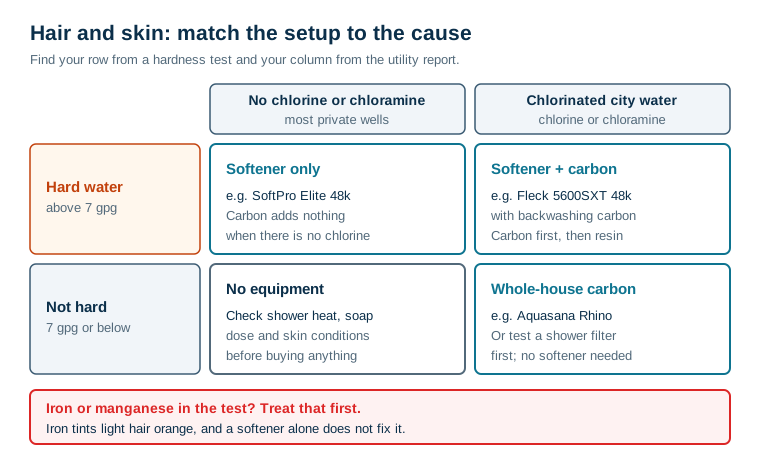
The best water softener for hair and skin depends on which problem your water actually has. If it is hard but not chlorinated, as on most private wells, a softener alone covers it: our pick is the SoftPro Elite 48k. If it is hard and chlorinated, as on most city supplies, pair the softener with a carbon tank, as the AFWFilters Fleck 5600SXT 48k with backwashing carbon does. If it is chlorinated but not hard, you need no softener at all. A whole-house carbon filter such as the Aquasana Rhino is the right tool.
The research supports a narrow claim. Hard water leaves soap and shampoo residue on skin and hair, and softening reduces it. It does not support softeners as an eczema treatment, and it says little about chlorine at tap-water levels. The cause table below keeps the two apart, so you buy the equipment for the problem you have.
Disclosure: Hard Water Solved may earn a commission if you buy through links on this page, at no extra cost to you. It does not change which products we include or how we rank them. Read our disclaimer.
Best Water Softeners for Hair and Skin at a Glance
| Pick | Best for | What it removes | Amazon |
|---|---|---|---|
| SoftPro Elite 48k | Hard water with no chlorine (most wells) | Hardness | Check price on Amazon |
| AFWFilters Fleck 5600SXT 48k + backwashing carbon | Hard, chlorinated city water | Hardness and chlorine | Check price on Amazon |
| Aquasana Rhino whole-house filter | Chlorinated water that is not hard | Chlorine (no hardness) | Check price on Amazon |
How We Chose
Methodology. Nothing on this page was physically tested. The picks are matched to a cause, hardness, chlorine or both, rather than ranked on a single score. Specifications come from the makers' product pages, warranty documents and published performance data.
- Included: whole-house equipment sold on Amazon.com, where each stage addresses a cause in the table below.
- Excluded: the SoftPro Elite Plus with KDF-55 media, which showed as currently unavailable on Amazon on 1 October 2026 and would not load for our check on 2 October. The EcoPure EPHS hybrid, because its carbon is sealed inside the softener cabinet and, in the maker's words, "never needs replacing", and Amazon showed it as unavailable on 1 October. Shower filters, because almost none soften (see below).
- No health claims are made here without a cited study.
- Prices are not listed here because they change often. Use the buttons to see the current price on Amazon.
Hardness or Chlorine? The Cause Table
Dry skin, dull hair and itching get blamed on "the water". Two different things in the water are usually meant, and they are removed by different equipment.
| What you notice | How hardness causes it | How chlorine might cause it | Fixed by |
|---|---|---|---|
| Waxy, heavy or tangled hair | Calcium and magnesium bind to the hair and form a soap curd film with shampoo | Not the usual cause | A softener |
| Dull hair, colour fading or going brassy | Mineral film scatters light and interferes with colour | Often blamed; most of what is known about chlorine and hair comes from pool water, which carries more than a tap | A softener first; carbon if chlorinated |
| Tight, dry skin after a shower | Soap and surfactant react with calcium and stay on the skin | Reported by some people; one study found no clear effect at the levels it tested | A softener for the residue; heat and soap dose matter more |
| Soap that will not lather, film on the skin | Hardness uses up soap before it cleans | No effect | A softener |
| Chlorine smell on skin and hair after showering | No effect | Free chlorine or chloramine in the supply | Carbon, catalytic carbon for chloramine |
| Orange tint on light hair | No effect | No effect | Neither: this is usually iron, which needs its own treatment |
Find your row from a hardness test and your utility's annual water quality report, which says whether it adds chlorine or chloramine. Then use the matrix.
The mechanism behind the hardness rows, the calcium-soap film on skin and the mineral coating on hair, is covered in why hair feels waxy or dull in hard water. This page assumes you have read it or have already confirmed hardness with a test.
What the Evidence Supports, and What It Does Not
Three studies set the limits on what a softener can be expected to do for hair and skin.
- Hard water leaves more surfactant on skin. In a 2018 study of 80 people in the Journal of Investigative Dermatology, sites washed in hard water held significantly more sodium lauryl sulfate, the common foaming agent, and that residue increased water loss through the skin and irritation. People with atopic dermatitis and a filaggrin gene mutation were most affected. Removing the calcium and magnesium with an ion exchange softener reduced the effect (Danby et al., 2018). The same study did not find a clear effect from the chlorine levels it tested.
- A softener did not treat eczema in a trial. The SOFTEST trial installed ion exchange softeners in the homes of 336 children with moderate to severe eczema. After 12 weeks, eczema severity improved by about the same amount in the softener group and the usual-care group, and the difference was not significant (Thomas et al., PLoS Medicine, 2011). The authors could not recommend softeners as an eczema treatment.
- Hard water coats hair, but structural damage is unproven. A scanning electron microscopy study of hair from 20 volunteers found more magnesium on hair washed in hard water, but no significant difference in surface damage (Indian Journal of Dermatology, Venereology and Leprology).
So the honest promise is this. A softener removes the mineral film and the extra soap residue that hard water leaves. It lets you use much less product. It does not treat skin conditions, and if your skin stays dry, look at temperature, soap and humidity first. That list is worked through in why dry skin can continue after installing a softener.
1. SoftPro Elite 48k: Best for Hard Water Without Chlorine
Buy it on Amazon: the SoftPro Elite 48,000 grain. SoftPro sells city-water and well-water versions from its own store.
This is the pick for most private wells and any supply that is hard but not chlorinated. Here the softener is the whole fix, and a carbon stage adds nothing for hair or skin.
- Type: salt-based ion exchange with upflow (counter-current) brining, metered and demand-initiated.
- Resin: 10% crosslink.
- Warranty, per SoftPro's warranty page: lifetime on tanks and valve, 7 years on electronics, a 10-year prorated resin warranty on city-water systems only, and 5 years on the piston, seals and spacers for city water.
Why it is here. Upflow brining gets usable capacity from a low salt dose. On a well where the softener is the only treatment, that keeps salt use down for the same soft water at the shower. Any correctly sized softener removes hardness equally well for hair and skin. The Elite's case is the warranty and low salt use, not a different kind of soft water. If you want the same result for less money, look at an AFWFilters Fleck 5600SXT 48k with 10% resin.
Check before buying. SoftPro's warranty conditions allow up to 2.0 ppm of dissolved iron, and on well systems the piston, seals and spacers count as maintenance parts. We found no NSF/ANSI 44 listing under the SoftPro name. Independent reviewers say the valve and system maker, Canature, holds it. Ask SoftPro for the listing and model number. Size it from your hardness and water use as set out in how to size a water softener, not from the 48k on the box.
Skip it if your well has iron above about 2 ppm, manganese or sediment you have not treated. Treat that first.
2. AFWFilters Fleck 5600SXT 48k + Backwashing Carbon: Best for Hard, Chlorinated City Water
Buy it on Amazon: the Combo Package Fleck 5600SXT 48,000 Grain Water Softener and Backwashing Carbon Filter, sold on Amazon through the AFWFilters store.
This is the only setup on the page that deals with both causes. Most city water in hard-water regions is both hard and chlorinated, so for many readers this is the default answer.
- Carbon stage: a 10 x 54 in tank with 1.5 cu ft of activated carbon, which AFWFilters says reduces chlorine and taste and odour chemicals.
- Softener stage: a second 10 x 54 in tank with 1.5 cu ft of 10% crosslink resin under a metered Fleck 5600SXT valve.
- Order: carbon first, then the softener. The resin never sees chlorine, which also protects it.
- Warranty: AFWFilters lists five years on the Fleck controls and ten years on its standard tanks.
Why it ranks above a softener alone on city water. A softener removes hardness and leaves chlorine in the water. If the chlorine smell on your hair after a shower bothers you, a softener alone will not change it. The carbon tank does. Each tank has its own valve, so the carbon can be serviced without touching the softener.
Check before buying. Two backwashing tanks need two drain connections and two outlets. If your utility uses chloramine, standard carbon removes it slowly. AFWFilters sells a catalytic carbon version from its own store, which we could not confirm on Amazon.
Skip it if you already own a working softener. Add a carbon tank ahead of it instead of replacing both.
3. Aquasana Rhino: Best When the Water Is Chlorinated but Not Hard
Buy it on Amazon: the Aquasana Whole House Water Filter System, EQ-1000. The Amazon listing uses the older EQ-1000 name, so check that what ships is the current Rhino.
This is not a softener, and that is the point. If your water tests under about 7 gpg but smells of chlorine, a softener spends salt to fix a problem you do not have. Whole-house carbon targets the one you do.
- Media: carbon and KDF, with a pre-filter.
- Rated life: 1,000,000 gallons or 10 years.
- Evidence: Aquasana's performance data sheet says the Rhino was independently tested to NSF/ANSI 42 and cut free chlorine by more than 97.4% across its full rated capacity. The tank's WQA certification covers materials safety only, not contaminant reduction.
- Warranty: a 10-year limited warranty and a 90-day satisfaction guarantee, per Aquasana's product page.
Check before buying. The data sheet covers free chlorine. If your utility uses chloramine, ask Aquasana what the Rhino is rated for before buying.
Skip it if your water is also hard. The Rhino does nothing to calcium and magnesium, so the soap film on hair and skin stays.
Why Shower Filters Are Not on This List

Shower filters are the most common purchase for hair and skin, but they are not whole-house equipment, and there is a technical reason too. Almost all of them use KDF media, carbon or vitamin C. Those treat chlorine, not hardness. Removing calcium and magnesium needs ion exchange resin, contact time and regular regeneration. A cartridge at 2 gallons a minute on a shower arm has none of the three. The few "softening" shower filters that contain resin run out quickly at shower volumes.
A shower filter still has one good use: a cheap test. If your water is chlorinated and not very hard, fit one for two weeks. If your hair and skin improve, chlorine was the cause, and a whole-house carbon filter is the larger version of the same fix. NSF certifies shower filters for chlorine reduction under NSF/ANSI 177, so look for that listing.
Two Weeks of Tests Before You Spend Big
The equipment on this page is a major purchase. These free or cheap tests tell you whether you need it:
- Get the two numbers. A hardness test at the tap, and your utility's annual report for chlorine or chloramine. On a well, a lab panel that includes iron.
- Run the two-wash test on hair. A clarifying shampoo first, then a chelating shampoo on another day. If only the chelating wash clears the waxiness, the cause is minerals. The method is in why hair feels waxy or dull in hard water.
- Change shower habits for skin. Warm, not hot, water, five-minute showers and half your usual body wash. Change one at a time. If the skin improves, the water was not the main cause.
- Try a shower filter if the water is chlorinated. Two weeks, nothing else changed.
What Changes After a Softener Goes In
Expect a few weeks of adjustment. The water heater may still hold hard water for a week or more, so early showers are not a fair test. Hair keeps its old mineral coating until a chelating wash or a few weeks of normal washing removes it.
Then the product doses need cutting. Soft water lathers far more, so most people need about half the shampoo and body wash they used before. The slippery feel while rinsing is the absence of the old soap curd, not shampoo left behind. Starting doses product by product, and a three-week timeline for hair, are in how soft water changes hair and skin washing.
Who Should Buy None of These
- Anyone buying to treat eczema or another skin condition. The trial evidence does not support it. See a clinician first, and treat the softener as a plumbing appliance.
- Homes on water under about 3.5 gpg with no chlorine. There is little in the water to remove. Look at shower temperature, soap and humidity instead.
- Wells with iron, manganese or sulfur. An orange tint on light hair is usually iron. Treat it first, with the equipment your test calls for.
- Renters and anyone who cannot plumb in whole-house equipment. A shower filter is the realistic option for chlorine. For hardness, there is no small fix that works well.
- Anyone whose only complaint is hair. Hair alone rarely justifies a whole-house purchase. If scale, spotting and soap use are problems too, the case is stronger.
The best water softener for hair and skin is the setup that matches the cause in your water. Test hardness and check for chlorine. Then buy a softener, carbon, or both, and expect to use less shampoo than before.
Frequently Asked Questions
Is a water softener good for hair and skin?
It can help with the part of the problem that hardness causes. In hard water, calcium and magnesium react with soap and shampoo to leave a film on skin and hair. A 2018 study in the Journal of Investigative Dermatology found that washing in hard water left more surfactant on the skin, and that softened water reduced it. A softener does nothing about water temperature, chlorine, soap choice or skin conditions, which are often bigger causes of dryness.
Does a water softener help with eczema?
The best trial evidence says not as a treatment. A randomised trial of 336 children with moderate to severe eczema, published in PLoS Medicine in 2011, found no significant difference in eczema severity after 12 weeks between homes given an ion exchange softener and homes on usual care. Some families report improvement, but a softener should not replace medical treatment.
Do I need a softener or a chlorine filter for dry hair?
Test both causes. A hardness test kit gives the hardness, and your utility's annual water quality report says whether it adds chlorine or chloramine. Hard water with no chlorine points to a softener alone. Chlorinated water that is not hard points to a carbon filter. If you have both, a softener with a carbon tank ahead of it covers both.
Will a shower filter soften my water?
Almost never. Most shower filters use KDF media, activated carbon or vitamin C, which target chlorine, not hardness. Removing calcium and magnesium needs ion exchange resin with contact time and regeneration, which a cartridge on a shower arm cannot provide. A shower filter is a cheap way to test whether chlorine is your problem.
How long does it take for hair to change after installing a softener?
Usually a few weeks. Hair already carries a mineral coating, and the water heater can hold hard water for a while after installation. A chelating shampoo removes the old coating in one wash. Most people also need to cut their shampoo and body wash dose by about half, because soft water lathers far more.
