
Best Whole-House Filter for Hard Water: 5 With a Real Scale Stage
The best whole-house filter for hard water is one with a real scale-control stage. For most city homes that is the Watts OneFlow Plus, rated up to 30 gpg. Under 15 gpg, where chlorine taste is the bigger complaint, it is the Aquasana Rhino with its salt-free conditioner. Most whole-house filters sold for "hard water" have no such stage. Sediment, carbon and KDF media trap grit and chlorine. Calcium and magnesium pass straight through them.
So this page starts by narrowing the field. Only systems with a stage that acts on scale are listed, and each is marked with the mechanism it uses. None of them removes hardness. If you want water that feels soft and leaves no spots, skip to the end: you need a softener, and no filter on this page will do that job.
Disclosure: Hard Water Solved may earn a commission if you buy through links on this page, at no extra cost to you. It does not change which products we include or how we rank them. Read our disclaimer.
How We Chose
Methodology. Nothing on this page was physically tested. Limits, flow rates and cartridge lives come from the makers' engineering specifications, performance data sheets and product pages. Each pick is marked with the scale mechanism it uses and the hardness ceiling its maker publishes.
- Included: whole-house filter systems sold on Amazon.com that contain a dedicated scale-control stage (TAC-type media, polyphosphate or citric acid) alongside sediment or carbon filtration.
- Ranked on: the published hardness ceiling, the completeness of the published water limits, documented filtration performance and flow.
- Excluded: sediment, carbon and KDF systems with no scale stage, however they are named; single-housing polyphosphate cartridges; magnetic and electronic descalers, which are not filters; and salt-based softeners, which are the alternative this page sends you to.
- Prices are not listed here because they change often. Use the buttons to see the current price on Amazon.
Why a plain filter cannot touch hardness is covered in water softener vs whole-house water filter. The short version: a filter catches things that are suspended or that stick to carbon. Hardness minerals are dissolved ions, and they stay dissolved.
Best Whole-House Filters for Hard Water at a Glance
| Pick | Scale mechanism | Maker's hardness limit | Filtration stages | Flow | Amazon |
|---|---|---|---|---|---|
| Watts OneFlow Plus (OFPSYS) | Media-assisted crystallisation (TAC-type) | 30 gpg | 20-micron carbon block | 10 gpm peak | Check price on Amazon |
| Aquasana Rhino with salt-free conditioner (EQ-1000-AST) | Scale control media (crystal-forming) | under 15 gpg | Sediment pre-filter, carbon and KDF tank | not compared here | Check price on Amazon |
| NuvoH2O Home Duo | Citric acid chelation | 25 gpg | 10-micron carbon | 15 to 18 gpm | Check price on Amazon |
| iSpring WGB32B-DS | Polyphosphate sequestration | none published | Sediment, carbon block | 15 gpm | Check price on Amazon |
| Express Water WH300SCPS | Polyphosphate sequestration | none published | Sediment, activated carbon block | about 15 gpm | Check price on Amazon |
What Each Scale Mechanism Does, and Does Not Do
The three mechanisms on this page work in different ways, and they fail in different ways. That matters more than the brand.
| Mechanism | What happens to calcium | Hardness test afterwards | Adds anything? | Main weak point |
|---|---|---|---|---|
| TAC-type media (Watts, Aquasana) | Nudged into microscopic crystals that travel on with the water | Unchanged | No | Iron, manganese, sulfide and phosphate coat or block the media |
| Polyphosphate (iSpring, Express Water) | Held in solution by a phosphate additive | Unchanged | Yes, phosphate | Less dependable in hot water; dose depends on flow |
| Citric acid (NuvoH2O) | Bound as calcium citrate; pH pulled down toward neutral | Unchanged | Yes, citric acid | Lowers pH, so check copper plumbing |
| Ion exchange (a softener, for comparison) | Removed and replaced with sodium or potassium | Near zero | Sodium or potassium | Needs salt, a drain and an outlet |
Two practical rules follow from the table.
You cannot judge any of these with a test strip. A conditioner that is working and one that has stopped both read the same. You judge them by the kettle, the shower glass and the water heater. Our page on whether boiling or filtering softens water explains why the hardness number does not move.
Do not stack them. Watts's OneFlow Plus engineering specification says not to apply any other antiscalant before or after its media, and caps total phosphates at 3.0 ppm. A polyphosphate cartridge in front of a TAC tank works against it.
1. Watts OneFlow Plus: Best Scale Control in a Whole-House Filter
- Mechanism: media-assisted crystallisation, Watts's name for its TAC-type media
- Filtration: 20-micron radial-flow carbon block for sediment and chlorine taste and odour
- Hardness limit: 30 gpg (513 ppm as calcium carbonate), recommended maximum
- Flow: up to 10 gpm peak; Watts says exceeding it can reduce effectiveness and void the warranty
- Cartridge life: carbon block 50,000 gallons, changed at least yearly; scale cartridge 250,000 gallons or 3 years, whichever comes first
- Needs: 10 to 90 psi, no drain, no electricity, 1-inch MNPT connections
Why it ranks first. It has the highest hardness ceiling of any filter here, and Watts publishes the whole feed-water table rather than a single headline number. That table is the reason to trust it. pH must sit between 6.5 and 8.5. Free chlorine must be under 2 ppm, iron under 0.3 ppm, manganese under 0.05 ppm and copper under 1.3 ppm. Oil and hydrogen sulfide must be removed first. Total phosphates must stay under 3.0 ppm, silica under 20 ppm and TDS under 1,500 mg/L.
What the 30 gpg figure means. Watts says its media controls scale inside the plumbing up to 30 gpg. It sets that as the recommended maximum because of soft-scale spotting outside the plumbing. It also says spotting may occur on fixtures at any hardness, and that a point-of-use softener should be used where spot-free results are mandatory. In other words, the heater and pipes are protected, and the shower glass may still need wiping.
Certification. The system is certified by WQA to NSF/ANSI/CAN 372 for lead-free materials. Watts's own footnote says the contaminant reductions are not tested or certified by WQA. That is honest, and it is typical of this category.
Watch for: the 10 gpm peak. A house with three bathrooms running at once can exceed it. And OneFlow must be the last stage. Watts says not to install filters after it, apart from point-of-use carbon, RO or UV units.
2. Aquasana Rhino With Salt-Free Conditioner: Best for Chlorine Plus Scale
The Amazon listing uses Aquasana's older EQ-1000 model name, so check that what ships is the current Rhino with the conditioner.
- Mechanism: Aquasana's Scale Control Media, which it says forms inactive microscopic crystal particles
- Filtration: sediment pre-filter, then a carbon and KDF tank
- Hardness limit: under 15 gpg, with pH under 8.3, iron under 0.3 ppm and alkalinity under 250 mg/L
- Rated life: 1,000,000 gallons or 10 years for the filter tank and the conditioner
- Warranty: 10-year limited, per Aquasana's product pages
Why it ranks second. The filtration half is the best documented on this page. Aquasana's Rhino performance data sheet reports testing to NSF/ANSI 42 for free chlorine, with more than 97 percent reduction across the full gallon rating. If chlorine taste and smell are what you notice most, this is the filter to buy.
Why not first. Its scale ceiling is half the Watts figure. At 15 gpg it rules out many hard-water homes. The scale claim is also thinner. Aquasana says the conditioner is independently tested, but names no standard, laboratory or result.
Watch for: the price. You are paying mainly for a long-life carbon tank. If your water is 15 to 30 gpg, the Watts unit fits the hardness better at a much lower price.
3. NuvoH2O Home Duo: Best Compact Option With Wide Hardness Range
- Mechanism: citric acid chelation. A cartridge doses citric acid, which binds calcium as calcium citrate and lowers pH toward neutral
- Filtration: a 10-micron carbon stage
- Hardness limit: 25 gpg
- Flow: 15 to 18 gpm, up to 120 psi
- Cartridge life: up to about 6 months, or about 20,000 gallons on the Home cartridge
- Sized for: homes of 1,500 square feet or less
Why it is here. It covers more hardness than the Rhino at a lower price. It is also short and wall-mounted, which helps in a tight utility space.
What it costs to run. The cartridge is the catch. At about 20,000 gallons, a family of four using 70 gallons a head each day passes a cartridge every 10 weeks or so, not every 6 months. Budget for about five cartridges a year at that use.
Watch for: pH. NuvoH2O does not recommend its systems for water below pH 7.3. Lower pH makes water more aggressive toward copper. If your plumbing is copper and your raw pH is close to 7.3, test pH after the system and watch for blue-green staining. NuvoH2O also says its systems are for scale only. Iron, sulfur and bacteria need separate treatment.
4. iSpring WGB32B-DS: Best Budget Scale Stage
- Mechanism: polyphosphate. iSpring says the media sequesters calcium and magnesium and also coats pipe surfaces to inhibit corrosion
- Filtration: sediment and carbon block stages, in standard 20-inch big-housing cartridges
- Hardness limit: none published
- Flow: 15 gpm with 1-inch ports
- Cartridge life: up to 12 months or 250,000 gallons, per the listing
Why it is here. It is the cheapest way to add a scale stage to a whole-house filter that also removes sediment and chlorine. The housings take standard-size cartridges, so they stay useful if you change media later.
What polyphosphate is good at. It works on cold-water fixtures, washing machines and pipes at moderate hardness. It is generally less dependable inside a water heater. Heat breaks polyphosphate down to orthophosphate, which does not hold calcium the same way, so tank heaters and tankless heat exchangers get less protection than the label suggests.
Watch for: the missing hardness ceiling. iSpring does not publish one, so you cannot check your water against it. Treat it as a moderate-hardness product. It also adds phosphate to the water, which rules it out ahead of any TAC conditioner.
5. Express Water WH300SCPS: Polyphosphate Alternative With Brand-Store Support
The Amazon page did not load for our check, so confirm that the listing shows model WH300SCPS before buying.
- Mechanism: polyphosphate
- Filtration: sediment and activated carbon block
- Flow: Express Water quotes up to 0.25 gallons per second, about 15 gpm
- Cartridge life: up to 100,000 gallons or 6 to 12 months, depending on water quality
- Needs: 40 to 80 psi, 40 to 100°F
- Warranty: 1-year limited
How it compares with the iSpring. The same mechanism and a similar layout, at a slightly higher price. Its cartridge rating is lower, 100,000 gallons against iSpring's 250,000, so a large household will change cartridges more often. Buy it if you prefer Express Water's store and support, or the iSpring is out of stock.
Watch for: the same limits as any polyphosphate unit. There is no published hardness ceiling, and hot-water protection is weaker than cold.
Which Pick for Your Water Test
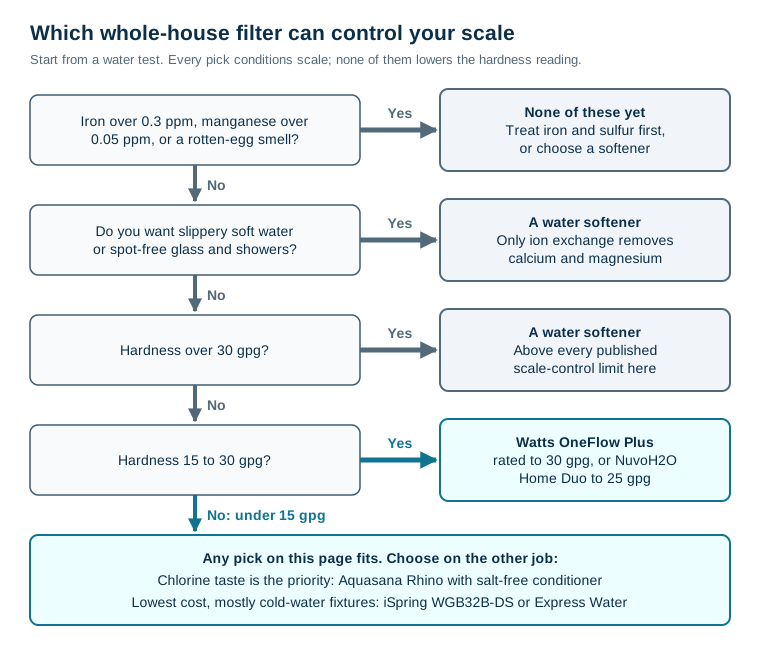
Work down the chart with a real test result, not a city average. Hardness from a test strip is fine for the hardness step. Iron, manganese and pH need a lab test or a proper kit, because those three decide whether a conditioner's media survives.
Three points the chart does not show:
- Flow matters as much as hardness. The Watts unit peaks at 10 gpm. In a large house with several showers running, the 15 gpm polyphosphate units or a softener cope better.
- Hot water is where scale costs money. If your main worry is a water heater or a tankless heater, favour the TAC-type picks over polyphosphate.
- Chloramine needs checking. If your utility uses chloramine rather than chlorine, ask whether the carbon stage is rated for it. Standard carbon handles chloramine slowly.
When a Softener Is the Better Buy
Some readers arrive here because they assumed a filter would fix hard water. For many of them, the right answer is a softener. Buy one instead of anything above if:
- You want soft-feeling water. Better lather, no squeaky skin, no film on glass. Only ion exchange changes how soap behaves.
- You want spot-free glass and shower screens. Even Watts says spotting can occur and recommends a point-of-use softener where spot-free results are mandatory.
- Your water is over 25 to 30 gpg. Every scale stage here is outside its rated range.
- You are on a well with iron, manganese or sulfur. Conditioner media coats over. A softener can take a little dissolved iron, and an iron filter handles more.
- You want a result you can test. A softener drops the hardness reading to near zero, so you know it is working.
If you go that way, size the softener from your own hardness and water use. The method is in how to size a water softener. Many homes still put a plain sediment and carbon filter ahead of the softener. In that case buy a filter without a scale stage. The softener already does that job.
Who Should Buy None of These
- Homes that already have a working softener. A scale stage adds nothing on softened water. A plain carbon filter is all you need for chlorine.
- Anyone with well water that has not been tested. Iron, manganese, low pH and sulfur all fall outside the media limits, and the failure is silent.
- Buyers who need to treat a health contaminant. Lead, arsenic, nitrate and bacteria need treatment chosen and certified for that contaminant. None of these systems is sold for that.
- Very hard water, over 30 gpg. Nothing on this page is rated for it.
For city water under 30 gpg where the aim is to protect the water heater and the pipes, the Watts OneFlow Plus is the best whole-house filter for hard water on published evidence. Under 15 gpg, the Aquasana Rhino with its conditioner buys you better chlorine removal at a higher price. If what you really want is soft water, the honest pick is not a filter at all.
Frequently Asked Questions
Will a whole-house water filter remove hardness?
No. Sediment, carbon and KDF stages trap particles and chemicals such as chlorine. Calcium and magnesium are dissolved minerals that pass straight through them. A whole-house filter only helps with hardness if it has a separate scale-control stage, such as a TAC cartridge, a polyphosphate cartridge or citric acid. Even then the hardness stays in the water and a test strip reads the same. Only an ion-exchange softener removes it.
What is the best whole-house filter for hard water?
For most city homes up to 30 grains per gallon, the Watts OneFlow Plus. It pairs a 20-micron carbon block with a scale-prevention cartridge, and Watts publishes its full feed-water limits. Under 15 gpg, where chlorine taste is the main complaint, the Aquasana Rhino with its salt-free conditioner is the stronger filter. If you want soft-feeling water or spot-free glass, no filter will do it. Buy a softener.
Do polyphosphate whole-house filters work on hard water?
They reduce scale rather than hardness. The cartridge releases a small amount of polyphosphate that binds calcium and magnesium so they are less likely to deposit. It works best on cold-water fixtures and moderate hardness, and is generally less reliable inside a water heater. It adds phosphate to your water, so do not combine it with a TAC conditioner. Watts says no other antiscalant may be used before or after its media.
Can I use a whole-house filter and a water softener together?
Yes, and many homes do. A sediment and carbon filter goes ahead of the softener, which protects the resin from grit and chlorine. In that setup you would buy a plain filter without a scale stage, because the softener already handles hardness. Do not put a polyphosphate or TAC cartridge in front of a softener. It adds nothing and makes the system harder to service.
Is a whole-house filter for hard water cheaper than a softener?
Upfront, often. The polyphosphate picks are the least expensive systems on this page, and a good installed softener usually costs more. Over time, filters need cartridges and softeners need salt, so the gap narrows. Above about 25 to 30 gpg, the filter's scale stage is outside its rated range and the cheaper option stops working.
