
Do Boiling, Filters or Water Heaters Soften Water?
Does boiling water remove hardness? Partly. Boiling turns some of the temporary (bicarbonate) hardness into calcium carbonate scale, so the water can test a little softer once the sediment settles. It does nothing to permanent hardness. Pitcher filters remove little or none, and a water heater only moves the hardness onto its own element.
All three claims come up whenever someone looks for an alternative to a softener, and each has some truth in it. Below, each one is worked through with numbers from the chemistry, with a kitchen test to measure your own water rather than taking anyone's word for it. There is also an honest list of what does work for each job.
The Three Claims at a Glance
| Claim | What actually happens | Best case on hard, high-alkalinity water | On low-alkalinity water | Whole-house fix? |
|---|---|---|---|---|
| Boiling softens water | Part of the calcium bicarbonate drops out as scale | Large drop, but magnesium and permanent hardness stay | Very little change | No |
| A pitcher filter softens water | Carbon removes chlorine and taste, not calcium | Near zero, unless the cartridge contains ion exchange resin | Near zero | No |
| The water heater softens water | Hardness is deposited inside the heater | Hot tap may read a few grains lower | Little difference | No, it is the damage |
The pattern behind all three: anything that relies on heat only works on temporary hardness, and anything that relies on carbon does not touch hardness at all. How much of your water is temporary depends on its alkalinity, which is explained in temporary vs permanent hardness.
Claim 1: Does Boiling Water Remove Hardness?
The chemistry is real. Calcium in hard water mostly travels with bicarbonate, held in solution by dissolved carbon dioxide. Boiling drives the carbon dioxide out, the bicarbonate turns into carbonate, and calcium carbonate settles as a white solid. That is the fur in a kettle.
Three things limit how far it goes:
- It only touches the bicarbonate share. The most boiling can remove is roughly the smaller of your calcium hardness and your alkalinity, both expressed as calcium carbonate. Calcium paired with sulfate or chloride stays dissolved.
- Magnesium mostly stays. Magnesium carbonate is far more soluble than calcium carbonate, so ordinary boiling leaves most magnesium hardness in the water.
- Some calcium carbonate stays dissolved even at boiling point, and evaporation concentrates what is left. Boil off a tenth of the pot and everything remaining is about 11% more concentrated.
What the numbers look like
Here are two waters, both at 300 mg/L (17.5 gpg), with 220 mg/L of the hardness from calcium and 80 mg/L from magnesium. The only difference is alkalinity. The "after" figures are the calculated best case, not lab measurements. Real results come out higher because of the residual solubility and evaporation described above.
| Water A: limestone well | Water B: low-alkalinity supply | |
|---|---|---|
| Total hardness before | 300 mg/L (17.5 gpg) | 300 mg/L (17.5 gpg) |
| Alkalinity | 250 mg/L | 80 mg/L |
| Most boiling can remove (lesser of calcium hardness and alkalinity) | 220 mg/L | 80 mg/L |
| Best-case hardness after boiling and settling | 80 mg/L (4.7 gpg) | 220 mg/L (12.9 gpg) |
| Still hard enough to spot glass and resist soap? | Moderately hard | Hard |
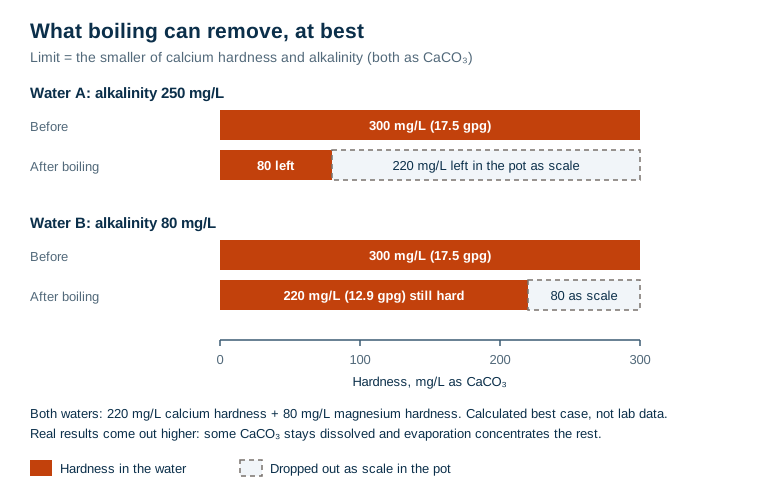
Even Water A, which responds as well as any water can, is still moderately hard afterward. It has also left 220 mg/L worth of scale in the pot, which is exactly the problem you were trying to avoid in your appliances.
The kitchen test: measure it yourself
You need a hardness drop test kit or test strips, and ideally an alkalinity strip.
- Test the cold tap water for hardness and alkalinity. Write both down.
- Bring one quart to a rolling boil in a clean pan and hold it there for 15 minutes with the lid off.
- Let it cool completely, undisturbed, for at least an hour so the particles settle.
- Pour off the clear water carefully, or pour it through a coffee filter, leaving the sediment behind.
- Top the cooled water back up to its starting level with distilled water, so evaporation does not skew the result.
- Test the hardness again.
If the drop is close to your alkalinity figure, your hardness is mostly temporary. If it barely moved, it is mostly permanent, and no amount of boiling will help.
Claim 2: A Pitcher Filter Softens Water
Most pitcher and faucet-mount filters use activated carbon. Carbon adsorbs chlorine, many organic compounds and taste and odor. It does not hold dissolved calcium or magnesium ions, so it does not soften water. Run hard water through a carbon-only pitcher and the hardness test before and after should read the same, within the error of the test.
The partial truth is that some cartridges also contain ion exchange resin. These are sold mainly as reducing limescale in kettles and coffee machines. Their resin removes carbonate hardness until it is used up, and there is only a few tablespoons of it. On hard water their rated capacity runs out quickly, and they are not regenerated, so the cartridge simply stops softening while still passing water.
How to tell what you have:
- Read the performance data sheet that comes with the cartridge or is on the maker's website. If hardness or "scale reduction" is not listed with a capacity in gallons or liters, assume it does nothing for hardness.
- Test before and after with a strip on a new cartridge and again halfway through its life. Resin cartridges show a drop at first that fades.
- Watch the kettle. If it still furs up at the same rate on filtered water, the filter is not doing anything useful for hardness.
The CDC's overview of home water treatment systems sets out the division: filters remove particles and some chemicals, while water softeners are the systems that "remove minerals, primarily calcium and magnesium, from water". A pitcher is also a point-of-use device. Even one that softens does nothing for the shower, the laundry or the water heater. Whole-house filters mostly share the same limit, so checking whether a whole-house filter has a genuine scale-control stage matters before you buy one for hard water.
Claim 3: My Water Heater Softens the Water
This one sounds convincing because it can come with a test result. People test the hot tap, get a lower number than the cold tap, and conclude the heater is softening the water.
It is not softening anything. The hot water reads lower because part of its temporary hardness came out inside the heater as scale. The difference between cold and hot readings is a direct measure of what the heater is collecting.
The arithmetic makes the point. There are 7,000 grains in a pound. Say the cold tap reads 17.5 gpg and the hot tap reads 14 gpg:
- 3.5 grains are left behind in the heater for every gallon.
- Every 1,000 gallons of hot water deposits 3,500 grains, which is half a pound of scale.
- A household running 60–70 gallons of hot water a day uses roughly 22,000–25,000 gallons a year, which works out to around 11–12 pounds of scale a year in this example.
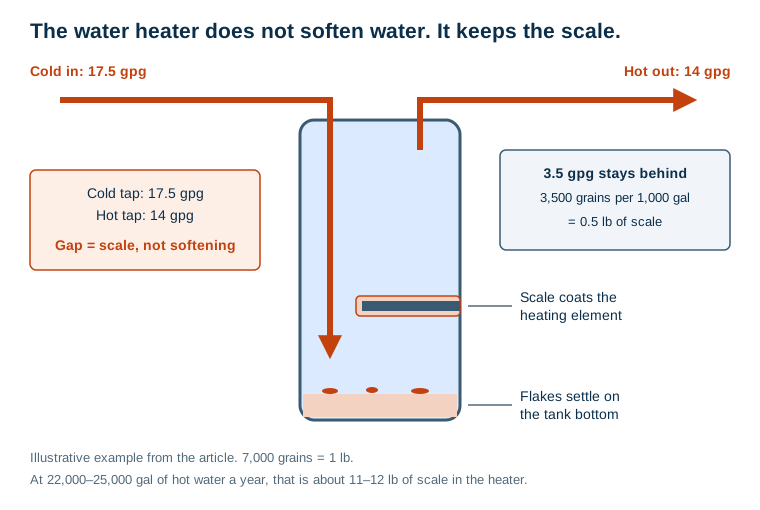
That deposit sits on the element sheath of an electric tank, the bottom above the burner of a gas tank, or the heat exchanger walls of a tankless unit. It insulates the heating surface, costs energy, and causes the rumbling and popping described in hard water sediment in a storage water heater.
Two more points often get missed:
- Hot water testing lower is a warning, not good news. It also means you should always test hardness on the cold side.
- Turning the heater up makes the "softening" look better because more scale drops out. That is the opposite of what you want.
Other Free Tricks People Try
Boiling, filters and the water heater are the big three. A few other kitchen methods come up often too, and none of them soften a water supply.
- Letting water stand in a jug. Chlorine gas escapes, which can improve the taste, but calcium and magnesium are dissolved ions and don't leave. The hardness reading is the same the next morning.
- Adding baking soda. Sodium bicarbonate raises alkalinity. It does not remove calcium, and in a kettle it can make scale form faster by pushing more calcium toward carbonate.
- Adding vinegar or lemon juice to the water. Acid keeps calcium carbonate dissolved, so it can stop a film forming in a glass of tea. The calcium is still there, and acid is for descaling equipment, not for treating water you plumb through the house.
- Freezing. Partly frozen water pushes dissolved minerals into the last part to freeze, so ice made slowly can be clearer. The water as a whole is no softer, and nobody runs a house on melted ice.
- Collecting rainwater. Rain is naturally very low in hardness, so this is the one method that genuinely gives soft water. It needs its own storage, filtration and disinfection before anyone drinks it. For most homes it is a garden supply, not a household one.
What Actually Works, Matched to the Job
Cheap methods do have a place, as long as each one is matched to a single job and not expected to soften the whole house.
| Job | What works | Why it works | Limit |
|---|---|---|---|
| Descaling a kettle or coffee maker | White vinegar or citric acid | Acid dissolves calcium carbonate | Treats the scale after it forms. Repeat as needed |
| Laundry on hard water | More detergent, a booster, or washing soda | Ties up calcium in the wash water | Only works inside the machine |
| Steam iron, humidifier, CPAP | Distilled water | No minerals to leave behind | You buy or make it for each use |
| Drinking and cooking water | Reverse osmosis at one tap | The membrane removes most dissolved minerals, hardness included | One tap. Wastes some water. Membrane scales faster on very hard water |
| Whole house: heater, pipes, showers, fixtures | Ion exchange softener | Swaps calcium and magnesium for sodium or potassium | Needs salt, a drain and maintenance. Does not remove other contaminants |
The EPA's WaterSense program describes the last row plainly: cation exchange softeners remove calcium and magnesium by exchanging them for sodium or potassium. That is the only one of these methods that stops scale forming in the water heater instead of cleaning it up afterward.
What a Softener Cannot Do Either
To keep this fair: a softener is not a cure-all.
- It does not remove existing scale. Descale the kettle and flush the heater once after installation.
- It adds sodium in proportion to the hardness removed. Penn State Extension puts it at 7.5 mg per quart for each grain per gallon removed.
- It does not remove bacteria, nitrate, most chemicals, or silica deposits.
- It does not make sense everywhere. Moderately hard water with a few annoyances may be handled more cheaply with the targeted methods above.
Whether your water and household justify one is worked through in do you actually need a whole-house water softener.
What to Do Next
- Test cold-tap hardness and alkalinity. Together they tell you how much boiling could ever achieve.
- Run the kitchen boil test if you want to see it for yourself.
- Test cold and hot taps on the same day. The gap is roughly what your heater is collecting.
- Use targeted fixes for single jobs, and do not expect a pitcher, a pot or the heater to protect the house.
- If the heater, showers and fixtures are the problem, size a softener to your cold-tap hardness.
Frequently Asked Questions
Does boiling water get rid of hard water?
Only partly. Boiling drives carbon dioxide out and turns some calcium bicarbonate into calcium carbonate, which settles out as scale. That removes part of the temporary hardness. Permanent hardness, meaning calcium and magnesium paired with sulfate or chloride, stays dissolved, and most of the magnesium stays too. On water with low alkalinity, boiling barely changes the hardness at all.
How long do you have to boil water to reduce hardness?
A rolling boil for around 15 minutes gets most of the achievable drop, but the time matters less than what you do next. Let the water cool and settle, then pour it off the sediment or filter it. If you stir the white particles back in, a hardness test may still count some of them. Boiling longer also evaporates water and concentrates whatever hardness remains.
Do Brita or pitcher filters remove hardness?
A carbon-only pitcher filter removes essentially no hardness, because carbon adsorbs chlorine and organic compounds, not calcium ions. Some cartridges contain a small amount of ion exchange resin and are sold as reducing limescale. They cut carbonate hardness for a limited volume and then stop. Check the cartridge's performance data sheet: if hardness or limescale reduction is not listed with a capacity, assume it does not soften.
Is boiled hard water safe to drink?
Hardness itself is not a health concern at household levels, and boiling does not make hard water unsafe. The white flakes in a kettle are calcium carbonate. Boiling does concentrate everything dissolved in the water slightly as some evaporates, so it is not a way to reduce any other contaminant, and it does not remove nitrate, lead or dissolved salts.
Does a water heater soften water?
No, though it can look that way. Water from the hot tap sometimes tests a few grains softer than the cold tap because part of the temporary hardness has come out as scale inside the tank or heat exchanger. The hardness has not left the house. It is sitting on the element, the tank bottom or the exchanger walls.
What is the cheapest way to soften hard water?
For one use, the cheapest option is targeted: vinegar to descale a kettle, a detergent booster or washing soda in the laundry, or distilled water in an iron or humidifier. For drinking water, a reverse osmosis unit at one tap removes hardness along with other dissolved solids. For the whole house, including the water heater, pipes and showers, only an ion exchange softener actually removes the hardness.
