
Hardness Test Strips vs Drop Test Kits
The hardness test strips vs drop test kit question has a short answer: strips tell you which band your water falls in, and a drop test kit tells you the number. Strips are faster and good enough to screen. A titration drop kit resolves single grains per gallon, and you need that when you are sizing or programming a softener. Use strips to screen, titration to size, and a lab to decide.
The detail that matters is how wide a strip's bands are. A common hardness strip has only six colour blocks to cover everything from soft to very hard water. At the hard end, one band spans ten grains per gallon, and that is exactly the range where softener decisions get made.
Hands-on technique (flushing the line, where to draw the sample, how to read a vial) is covered in our step-by-step guide to testing water hardness at home. This page is the comparison: what each format can and cannot tell you, and a protocol for proving it on your own water.
Hardness Test Strips vs Drop Test Kit at a Glance
| Test strips | Titration drop kit | |
|---|---|---|
| How it reads | Colour of a reagent pad matched to a printed chart | Count of drops until the sample flips colour |
| Smallest step | Colour blocks, e.g. 0, 1.5, 3, 7, 15, 25 gpg | One drop, commonly 1 gpg (17.1 ppm) or 10 ppm |
| Top of range | Around 25 gpg (425 ppm) on common strips | 30 gpg on a typical kit; more if you dilute |
| Time per test | Under a minute | A few minutes |
| Main source of error | Colour judgement, lighting, timing, pack age | Drop size, missing the colour change |
| Drifts with storage | Yes: humidity weakens colour development | Reagents expire, but no gradual colour bias |
| Best job | Screening, a quick yes/no on a softener | Sizing, programming, settling a borderline reading |
The first two rows explain most of this article. A strip result is a range between two blocks. A drop result is a count, and you can't report less than one drop, so a titration lands within one increment of the true value. That comes from how each format works, not from brand quality.
Why Strips Read in Bands, Not Numbers
A hardness strip pad contains a dye that changes colour as it binds calcium and magnesium. There's no counting and no endpoint: the colour stops wherever it stops, and you match it against a handful of printed blocks.
Hach's total hardness strips are a useful reference because the manufacturer publishes the steps. Hach lists the colour blocks at 0, 25, 50, 120, 250 and 425 ppm, which it states as 0, 1.5, 3, 7, 15 and 25 gpg. Most consumer strips use the same or similar steps.
Look at the gaps between those blocks:
| Between blocks | Width of the gap | What sits inside it |
|---|---|---|
| 0 → 1.5 gpg | 1.5 gpg | Softened water, and a softener leaking slightly |
| 1.5 → 3 gpg | 1.5 gpg | Soft to slightly hard |
| 3 → 7 gpg | 4 gpg | Most of "moderately hard" |
| 7 → 15 gpg | 8 gpg | Hard, plus the start of very hard |
| 15 → 25 gpg | 10 gpg | Most very hard wells |
Resolution is fine where you care least, near zero, and coarsest where you care most. The 7-to-15 gap crosses the 10.5 gpg line where water moves from "hard" to "very hard". A strip whose pad lands halfway between those two blocks is telling you "somewhere in the hard range." It can't tell you which side of the treatment threshold you're on.
Interpolating (calling a colour "about halfway, so 11") is where readers disagree. Two people can read the same pad a full band apart, and warm indoor light makes it worse. Hach's own chart gives you a range, and it's better to treat the result as a range than to invent precision the chart doesn't have.

Why Titration Resolves Single Grains
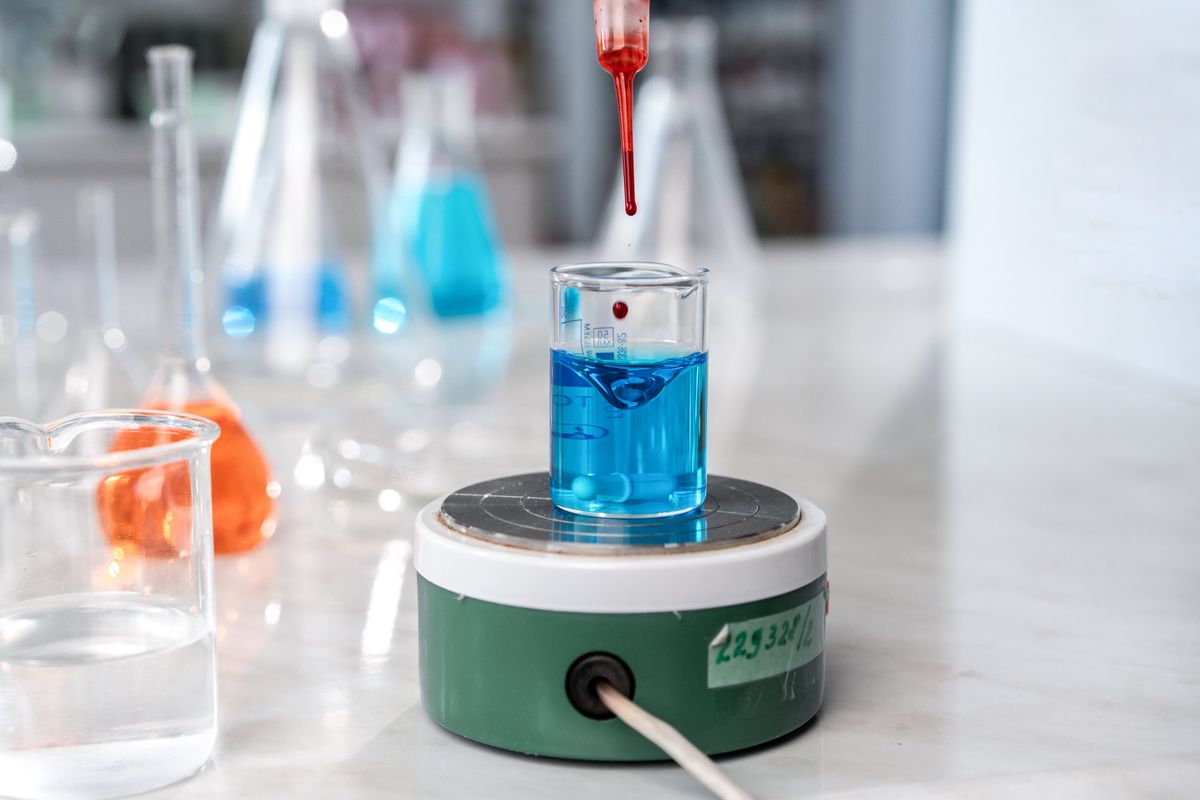
A drop kit is a scaled-down version of the EDTA titration that labs used for decades as the standard hardness method.
It works in two steps. First, an indicator turns the sample red or pink while calcium and magnesium are free in solution. Then you add EDTA titrant a drop at a time. EDTA binds calcium and magnesium more strongly than the indicator does, so each drop takes a fixed amount of hardness out of play. When the last of it is bound, the indicator has nothing left to hold and the sample flips to blue.
Because each drop removes a fixed amount of hardness, the drop count is the measurement. Manufacturers set the titrant strength and sample volume so the arithmetic is easy:
- Hach Model 5-B: 1 drop = 1 gpg (17.1 mg/L as CaCO₃), range 1–30 gpg, EDTA-based, about 100 tests per kit.
- LaMotte 4482 (dropper bottle method): LaMotte specifies 1 drop = 10 ppm or 1 gpg as CaCO₃, depending on which procedure you follow.
- Taylor K-1722: a 25 mL sample, red-to-blue endpoint, and each drop multiplied by 10 to give ppm. The same kit also separates calcium hardness from magnesium hardness.
At 10 ppm per drop, the Taylor procedure resolves steps of about 0.6 gpg, finer than a 1 gpg kit. LaMotte also sells kits where you choose the sensitivity (2, 5 or 10 ppm per drop) by changing the sample size. A bigger sample means more drops for the same hardness, and so finer steps.
Titration has limits too. Drop size depends on how you hold the bottle, and it's easy to add one drop past the endpoint. Water with visible rust or strong colour can make the red-to-blue change harder to see. But none of those errors grow with the hardness. A careful titration of 20 gpg water is as tight as a careful titration of 5 gpg water. A strip gets vaguer the harder your water is.
A Five-Sample Comparison Protocol You Can Repeat
The fairest way to compare the two formats is to run both on the same water, side by side. Most of the kit is already in your kitchen, and you don't need five sources of water to do it.
You'll need:
- A fresh, sealed pack of hardness strips
- An older opened pack, ideally one that has lived somewhere humid (this is your drift check)
- A titration drop kit, checking the reagent expiry dates
- A gallon of distilled water from the supermarket
- Six clean, labelled glasses and a measuring cup
- Daylight, or a daylight-balanced bulb, for reading pads
Steps:
- Run a zero check first. Test distilled water with both formats. The fresh strip should match the 0 block. On a Hach 5-B, a sample that turns blue straight away means under 1 gpg. If either format fails on distilled water, stop: nothing it tells you afterwards is reliable.
- Collect the samples on the same day. Draw untreated cold water, and softened water too if you have a softener. The five sample types below are the full set. Most households can cover two or three from their own taps and make the rest by dilution.
- Make the missing samples by dilution. Mixing hard water 1:1 with distilled water halves the hardness. If your untreated water titrates at 22 gpg, a 1:1 mix gives you an 11 gpg "boundary" sample and a 1:3 mix gives you a moderately hard 5.5 gpg. Dilution is also the standard fix when a sample tops out a kit's range: titrate the diluted sample and multiply by the dilution factor.
- Titrate every sample first. This is your reference number. Do each one twice. If the two counts differ by more than a drop, do a third.
- Strip every sample with the fresh pack. Record the two blocks the pad sits between, not a single number. If someone else is home, have them read the same pads independently.
- Repeat step 5 with the old pack. Same samples, same timing, same light.
- Fill in the table below with your own numbers.
What Each Format Can Report on Five Sample Types
The table below doesn't come from our own measurements. It shows what each format can report at the resolution the manufacturers publish: Hach's strip blocks, and a 1-drop-per-grain titration kit. Each row starts from an illustrative true hardness and shows the result each format would give. Your own run of the protocol replaces these with real numbers.
| Sample | Illustrative true hardness | Fresh strip reports | Titration reports | Does the difference change the decision? |
|---|---|---|---|---|
| 1. Soft city water | ~1 gpg (17 ppm) | Between 0 and 1.5 gpg | 1 drop: 1 gpg | No. Both say soft, nothing to do |
| 2. Moderately hard city water | ~5 gpg (86 ppm) | Between 3 and 7 gpg | 5 drops: 5 gpg | Rarely. Both put you below the usual treatment line |
| 3. Very hard well water | ~20 gpg (342 ppm) | Between 15 and 25 gpg | 20 drops: 20 gpg | Yes, for sizing. See below |
| 4. Softener output | Under 1 gpg, or leaking 1–2 | 0 block in both cases | Blue at once (under 1) or 1–2 drops | Yes, for diagnosis. Only titration sees a small leak |
| 5. Near a band boundary | ~11 gpg (188 ppm) | Between 7 and 15 gpg, and readers split | 11 drops: 11 gpg | Yes. The band straddles the hard / very hard line |
| 3 again, humid-stored pack | ~20 gpg | Weaker colour, can fall a block low, into 7–15 | Unaffected by strip storage | Yes. A drifted strip can make very hard water look merely hard |
Sample 3 is where a band costs real money. In a home using around 300 gallons a day, 15 gpg means 4,500 grains of hardness to remove per day. At 25 gpg it's 7,500. Both answers fit the same strip reading, and they point to different softener capacities and a different yearly salt bill.
Sample 4 is the reason softener owners should keep a drop kit in the cupboard. A softener that has failed completely lets through close to raw hardness, and any strip will catch that. A softener that has started slipping, because of a tired resin bed or a regeneration setting that's slightly off, lets through a grain or two, and that falls inside the strip's lowest block.
Sample 5 is the case that sends people to a second test anyway. If your strip lands between 7 and 15 gpg, you don't yet know which side of the treatment threshold you're on. Where that threshold actually sits depends on what you're protecting, but you'll need a number, not a band, to apply it.
Above 25 gpg, both formats run out of chart. Hach's strips stop at 425 ppm and the 5-B stops at 30 gpg. The titration has a way round this and the strip doesn't: dilute 1:1 with distilled water, titrate, and double the count.
How a Strip Pack Drifts, and How to Catch It
Test strips are dry reagent pads, and moisture from the air reacts with them slowly. Each time the bottle is opened, a little humid air gets in. Wet fingers do far more damage, because the pads react to any water they touch. Varify's guidance is typical: store strips indoors away from sunlight, heat and humidity, seal the cap straight after taking one out, and use an opened pack within six months even if the printed expiry is later.
The practical effect is weaker colour development. The pad doesn't turn as far as it should for the hardness present, so an aged pack tends to read low. That's the worst direction for this job, because it makes hard water look acceptable. How much it drifts isn't predictable. It depends on how often the bottle was opened and how humid the air was, which is exactly why you check it rather than guess.
The one-minute drift check: titrate your tap water once, then dip a strip from the pack. If the pad falls in the band that contains the titration result, the pack is fine. If it reads a band low, retire the pack. Do this whenever you open a new bottle and again every few months, and your strips keep their value as a quick monitor between titrations.
Drop kits age differently. The reagents have expiry dates and should be replaced by them, but an old reagent doesn't produce a slow, invisible bias in the same way. Failure tends to be obvious: a muddy or gradual endpoint instead of a clean flip to blue. If you can't tell when the sample changed colour, don't trust the count.
Strips to Screen, Titration to Size, Lab to Decide
Here is the whole decision as a rule of thumb:
| Your situation | Use | Why |
|---|---|---|
| "Do I even have hard water?" | Strips | Any band above 7 gpg answers the question |
| Monitoring a working softener monthly | Strips, plus a drop-kit check each quarter | Strips catch a failed softener; titration catches a leaking one |
| Programming a softener's hardness setting | Titration | The control valve wants a whole number in gpg |
| Sizing a new softener | Titration, twice, on different days | A band 8–10 gpg wide can move you a capacity size |
| Strip lands between 7 and 15 gpg | Titration | The band straddles the treatment threshold |
| Buying equipment for a private well | Certified lab | Iron, manganese and pH change what equipment you need |
| A result you're going to argue with a contractor about | Certified lab | A dated lab report settles it |
The lab tier deserves a word. Neither home format tells you anything except calcium plus magnesium. On a private well, the things that decide which equipment works (iron, manganese, pH, sometimes hydrogen sulphide) are separate tests. That's where a home test stops and a certified lab starts, and it's the right call before spending four figures on treatment.
One tool that doesn't appear in the table is the TDS meter. It measures total dissolved solids, not hardness, and it can't substitute for either format here.
What to Do Next
- If you have never tested: buy strips and read the result as a band. If it lands at or below 7 gpg, you're done for now.
- If the strip lands above 7 gpg, or you're shopping for a softener: buy a titration kit. This is where the hardness test strips vs drop test kit choice really matters, because the extra precision changes what you do next.
- If you already own both: run the distilled-water zero check and the one-minute drift check today. Retire any strip pack that reads a band low.
- If you're on a private well and about to buy equipment: send a sample to a certified lab first, and use your titration result to check the lab's hardness figure.
Frequently Asked Questions
Why do my test strips and drop test give different results?
Usually because they are reporting different things. A strip reports the two colour blocks your pad falls between, so a reading of 7 to 15 gpg and a titration of 11 gpg agree perfectly. Genuine disagreement, where the titration falls outside the strip's band, most often comes from an old or humid-stored strip pack, reading the pad after the stated wait time, or matching the colour under warm indoor light. Run both on distilled water: the strip should read zero and the titration should turn blue on the first drop. Whichever fails that check is the one to distrust.
Can I use test strips to check if my water softener is working?
For a yes-or-no answer, yes. A softener that has run out of capacity lets through something close to raw hardness, and a strip shows the jump from its zero block to a high block unmistakably. What a strip cannot do is catch a softener leaking one or two grains, because common strips have no block between 0 and about 1.5 gpg. If you want to know whether the softener is quietly slipping, use a titration kit on the softened water: a sample that turns blue on the first drop is under 1 gpg.
Do water hardness test strips expire?
Yes. Every bottle carries an expiry date, and the date assumes the strips have been kept sealed and dry. Once a bottle is opened, each exposure to room air lets in moisture that the pads react with, and the colour development weakens. Varify, for example, advises using its strips within six months of opening and keeping them indoors away from heat, sunlight and humidity. A pack that has lived in a bathroom cabinet can read a band low long before its printed date.
Is a drop test kit accurate enough to set a water softener?
Yes, and it is the standard tool for the job. Hach's Model 5-B, a typical example, reads 1 to 30 gpg in 1 gpg steps, which is the same unit a softener control valve asks for. Take two titrations on different days from an untreated cold tap and program the higher figure, rounded up. A certified lab adds value when you are buying equipment for a private well, because a lab report also covers iron, manganese and other things a softener has to cope with.
Can a TDS meter replace a hardness test kit?
No. A TDS meter measures electrical conductivity and converts it to an estimate of all dissolved solids combined, including sodium, chloride, sulphate and bicarbonate. Hardness is only calcium and magnesium. Two waters with the same TDS reading can have very different hardness, and softened water often reads about the same TDS as the hard water it came from, because ion exchange swaps minerals rather than removing them. Use strips or titration for hardness.