
How to Interpret pH and Hardness Together
Reading pH and water hardness together is what tells you whether your water will scale your appliances, corrode your plumbing, or manage both at once. Hardness alone predicts scale. pH alone predicts corrosion. The combination predicts what actually happens, and the combination is why hard water at low pH still eats copper — and why softening that water without neutralising it first can make the pitting worse rather than better.
If you take one thing from this page: on acidic water, the neutraliser goes upstream of the softener, not after it, and not instead of it. The sections below show why, with the arithmetic worked out rather than asserted.
Why pH and Water Hardness Have to Be Read Together
Hardness and pH describe different things, which is why a report can carry a scary hardness figure and a scary pH figure and offer no obvious course of action.
Hardness is the concentration of dissolved calcium and magnesium. It predicts how much calcium carbonate is available to come out of solution and stick to things when water is heated or evaporates. High hardness means scale.
pH is how acidic the water is. Below neutral, water is short of the carbonate it needs to stay in equilibrium with calcium carbonate, so it tends to dissolve calcium carbonate rather than deposit it — including the thin protective film that copper plumbing relies on. Low pH means corrosion.
The contradiction is that both can be true in the same water. Calcium comes from the aquifer rock. Acidity comes largely from carbon dioxide dissolved out of soil and decaying organic matter on the way down. A well can collect both. The result is water that scales a water heater because it is hot there, and pits a cold-water copper run because it is aggressive everywhere else.
What resolves the contradiction is a third number that most people never look at: alkalinity. Alkalinity is the water's capacity to resist pH change — essentially how much bicarbonate is available to buffer it. Water at pH 6.5 with decent alkalinity behaves very differently from water at pH 6.5 with almost none. This is why a pH reading on its own is close to useless for corrosion decisions, and why any lab panel worth ordering reports pH and alkalinity as a pair. How to find both on a report is covered in how to read your water hardness report.
The Four Risk Zones of pH and Water Hardness Together
Cross hardness against pH and you get four combinations, each with a different treatment order. This is the fastest way to place your own water.
| Zone | Hardness | pH | What it does | Correct treatment order |
|---|---|---|---|---|
| 1. Hard and alkaline | Above ~7 gpg | Above ~7.5 | Scales heaters, appliances and fixtures. Plumbing generally protected by the film it deposits | Softener alone. This is the textbook case |
| 2. Hard and acidic | Above ~7 gpg | Below ~6.8 | Scales the hot side and pits copper on the cold side. The confusing one | Neutraliser first, then softener sized for the raised hardness |
| 3. Soft and acidic | Below ~3 gpg | Below ~6.8 | Aggressive. Blue-green staining, pinhole leaks, metallic taste. No scale to hide behind | Neutraliser. A softener here solves nothing and makes the water more aggressive |
| 4. Soft and alkaline | Below ~3 gpg | Above ~7.5 | Generally benign. Slippery feel, possible sodium taste on naturally soft supplies | Usually nothing |
Zone 2 is where the expensive mistakes happen, because the visible symptom is scale and the invisible one is pitting. A household sees limescale, buys a softener, and unintentionally removes the calcium that was partly offsetting the acidity. Zone 3 is where the mistake is different: the water is already soft, so a softener is sold on the strength of some other symptom and does nothing about the actual problem.
Penn State Extension's page on corrosive water problems and Montana State University Extension's corrosivity fact sheet both treat pH, alkalinity and hardness as a set for exactly this reason.
The Langelier Saturation Index, Worked by Hand
The index that ties the numbers together is the Langelier Saturation Index. It answers one question: is this water saturated with calcium carbonate, undersaturated, or oversaturated? Undersaturated water dissolves calcium carbonate. Oversaturated water deposits it.
LSI = pH − pHs, where pHs is the pH at which the water would be exactly in balance:
pHs = (9.3 + A + B) − (C + D)
- A = (log₁₀[total dissolved solids in mg/L] − 1) ÷ 10
- B = −13.12 × log₁₀(temperature in °C + 273) + 34.55
- C = log₁₀[calcium hardness as mg/L CaCO₃] − 0.4
- D = log₁₀[alkalinity as mg/L CaCO₃]
Take a well at pH 6.5, TDS 200 mg/L, 25 °C, calcium hardness 150 mg/L as CaCO₃ (about 8.8 gpg), alkalinity 120 mg/L as CaCO₃:
- A = (2.301 − 1) ÷ 10 = 0.130
- B = −13.12 × 2.474 + 34.55 = 2.088
- C = 2.176 − 0.4 = 1.776
- D = 2.079
- pHs = (9.3 + 0.130 + 2.088) − (1.776 + 2.079) = 11.518 − 3.855 = 7.66
- LSI = 6.5 − 7.66 = −1.16
That is strongly undersaturated. This water dissolves calcium carbonate, which means it will keep stripping any protective film from a copper pipe wall.
Now soften it. Ion exchange takes the calcium hardness down to roughly 5 mg/L as CaCO₃ and leaves alkalinity essentially unchanged:
- C = 0.699 − 0.4 = 0.299
- pHs = 11.518 − (0.299 + 2.079) = 9.14
- LSI = 6.5 − 9.14 = −2.64
The water was aggressive. Softening it made it more than twice as aggressive on the index, without changing the pH at all. Nothing was done wrong mechanically; the softener did exactly what it is supposed to do. The problem is that it was the only thing installed.
Finally, neutralise first. A calcite bed raises pH to 7.5 and, in doing so, adds hardness and alkalinity — say calcium hardness 220 mg/L as CaCO₃, alkalinity 200 mg/L, TDS 260 mg/L:
- A = 0.142, B = 2.088, C = 2.342 − 0.4 = 1.942, D = 2.301
- pHs = (9.3 + 0.142 + 2.088) − (1.942 + 2.301) = 11.530 − 4.243 = 7.29
- LSI = 7.5 − 7.29 = +0.21
Balanced. And the softener now has a defined, measurable hardness to remove downstream. Hach publishes the Langelier and Aggressive indices method with the same terms if you want the reference procedure.
One honest caveat, because the index is routinely oversold: LSI describes calcium carbonate saturation, not corrosion. A negative index means the water will not form a protective carbonate film, which is a strong risk factor for corrosion — it is not a measurement of corrosion, and it says nothing about velocity, workmanship, stray current or particulate scouring. Treat a negative LSI as a reason to investigate, not as a diagnosis.
Why Softening Acidic Water Accelerates Pinhole Leaks
The mechanism is worth being precise about, because "softened water corrodes pipes" is one of those half-truths that gets repeated in both directions.
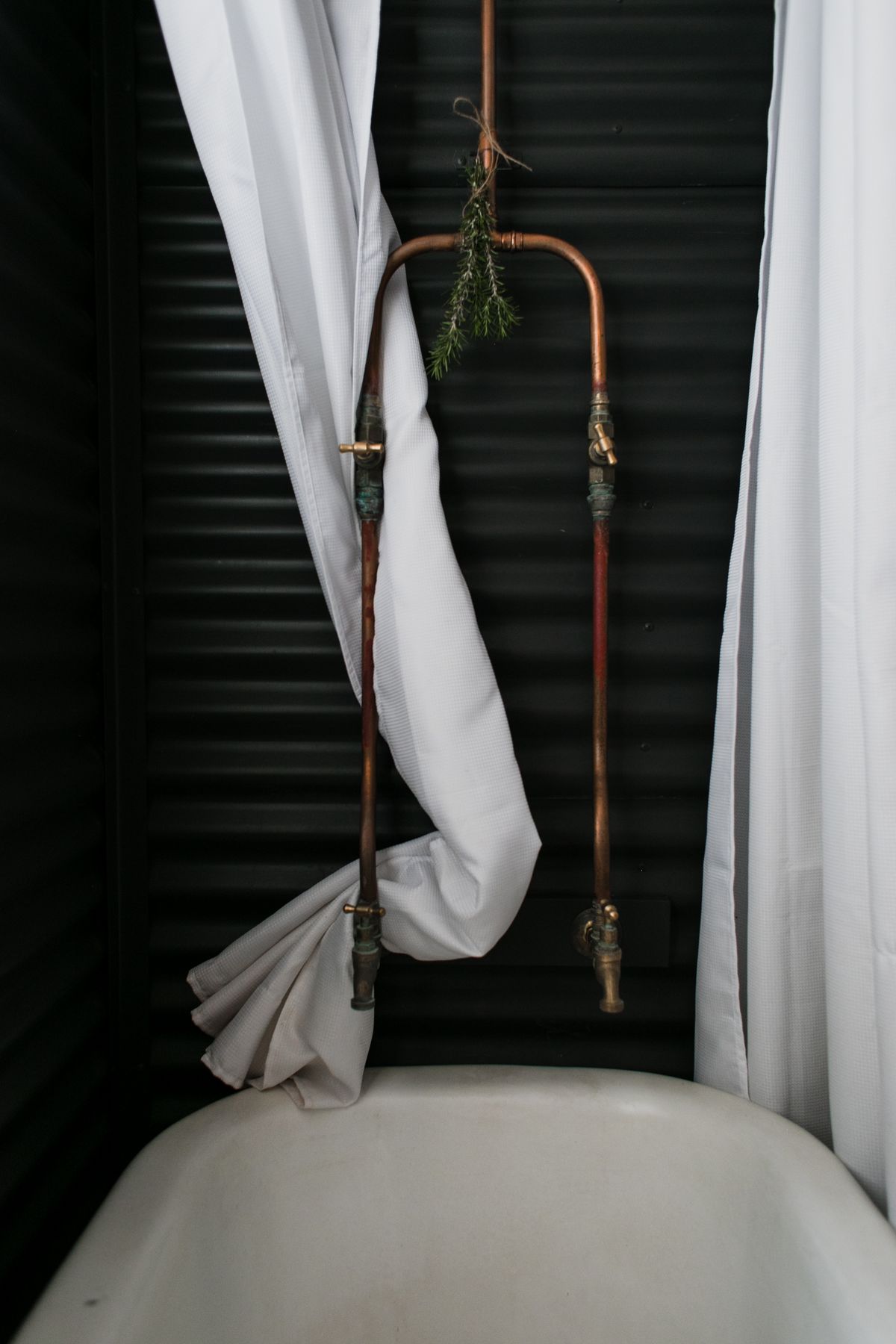
Copper does not rely on being inert. It relies on a stable, adherent layer on the inside of the pipe — a mix of copper oxides and carbonates, helped along by calcium carbonate deposited from the water. That layer is what separates water from metal. Where the water is balanced, the layer is continuous and corrosion is slow and even.
Aggressive water keeps partly dissolving that layer. Where it succeeds, bare metal is exposed in small patches next to protected metal, and the resulting difference in electrical potential drives corrosion at those points rather than across the whole surface. That is pitting, and pitting is what produces a pinhole: a tiny perforation in a pipe wall that is otherwise still thick.
Softening does not add acid. What it does is remove the calcium that was one of the ingredients of the protective layer, at a moment when the water is already short of the carbonate needed to form it. That is the shift the LSI arithmetic above makes visible — the same pH, half the protection.
None of this is an argument against softening. It is an argument about order. On water at neutral or above, softening changes the corrosion picture very little and the scale benefit is real. On acidic water, softening without neutralising removes a defence the plumbing was quietly depending on.
What Your Plumbing Is Already Telling You
Before spending money on a full panel, these signs point toward the acidic side of the map:
- Blue-green staining in sinks, tubs and around fixtures. This is dissolved copper, and it is close to diagnostic on a copper-plumbed house.
- A metallic taste in the first water drawn in the morning, fading after the tap runs.
- Pinhole leaks, especially more than one, especially in horizontal runs and near fittings, in pipe that is not old enough to have worn out.
- Green or blue-green crust at solder joints and around compression fittings.
- Rapidly failing water heater anodes or a heater that needs its anode replaced far sooner than expected.
- Reddish staining on a well alongside any of the above, which points at iron as well and changes the treatment order again — see testing iron and manganese before sizing a softener.
Blue-green staining in particular is worth acting on quickly for reasons beyond the plumbing: it means metal is being dissolved into drinking water. EPA's Lead and Copper Rule material sets out why corrosion control is treated as a public health measure on regulated supplies, and a private well has no such control unless the owner installs it.
Getting the Treatment Order Right
For water in Zone 2 or Zone 3, the sequence runs like this, and each step exists because of the one before it.
1. Measure pH, alkalinity, hardness, calcium hardness and TDS from the same sample. You cannot calculate an index or size a neutraliser from pH alone. On a well, add iron and manganese, because those change the order again and the arithmetic in the softener sizing. The sampling method matters — see how to test hardness in private well water.
2. Neutralise, if pH is below roughly 6.8. A calcite bed dissolves calcium carbonate into the water until the acid is consumed. Magnesia-blended media raise pH further where calcite alone is not enough. These are self-regulating in that they dissolve in proportion to the acidity present, but they need backwashing to prevent the bed cementing, and the media is consumed and has to be topped up.
3. Re-measure hardness after the neutraliser, before sizing the softener. This is the step that gets skipped. The neutraliser has added hardness — commonly in the range of 1 to 5 gpg, depending on media, contact time and how acidic the raw water was. Size the softener against the post-neutraliser number, not the raw number, or it will be undersized from the day it is commissioned.
4. Soften. Now the softener is removing both the original hardness and the hardness the neutraliser contributed, and it is doing so to water that is no longer aggressive.
5. Re-check pH and hardness after a month of operation. Neutraliser performance drifts as media depletes and as the raw water's acidity varies seasonally.
Note the ordering consequence for anyone who already owns a softener on acidic water: adding a neutraliser downstream of it does not fix the sequence. The neutraliser has to go in front, which usually means re-plumbing. That is a bad afternoon and a good reason to measure pH before the softener goes in rather than after.
What This Analysis Will Not Settle
Three limits worth stating plainly.
A balanced index does not prove your pipes are safe. Pinhole leaks occur on balanced water through velocity, workmanship, particulates and electrical effects. If you have leaks and your index is near zero, the cause is elsewhere and a water treatment purchase will not help.
pH from a home strip is not accurate enough for this. Strip pH resolves to about half a unit at best, and half a unit swings the LSI by half a point — enough to move water from "investigate" to "fine". Use a lab, or a calibrated meter, for any decision that involves buying equipment.
Hardness and pH both move on a well. A single reading places you in a zone on one day. Seasonal recharge shifts both, and a well that sits at pH 6.9 in winter can read 6.5 after spring melt. Two samples in opposite seasons is the minimum before committing to a treatment train.
Measure the pair, convert the units carefully using the gpg, ppm and mg/L reference, and install in the order the chemistry requires. The cost difference between doing this and not doing it is not the price of a neutraliser — it is the price of re-piping a house.
Frequently Asked Questions
Can water be hard and acidic at the same time?
Yes, and it is more common than people expect on private wells. Hardness measures dissolved calcium and magnesium. pH measures how acidic the water is, which on a well is driven largely by dissolved carbon dioxide and by the alkalinity available to buffer it. Water can pick up calcium from one formation and carbon dioxide from decaying organic matter in the soil above it, arriving at the tap hard, acidic and capable of both scaling a water heater and pitting copper pipe.
Does a water softener lower pH?
A softener does not directly lower pH by much, but it removes the calcium that was buffering the water against the pipe wall. In Langelier terms it drives the index sharply negative, because calcium is one of the terms in the calculation. On water that was already acidic and marginally corrosive, softening can move it from mildly aggressive to strongly aggressive. That is why acidic water should be neutralised upstream of the softener rather than after it.
What causes pinhole leaks in copper pipes?
On private wells the dominant cause is low-pH water pitting the pipe from the inside. Copper relies on a stable film on the pipe wall; acidic, poorly buffered, low-calcium water keeps dissolving that film so corrosion concentrates at points rather than spreading evenly. Other contributors include high water velocity from undersized pipe, particulates scouring the wall, stray electrical currents and poor workmanship, so a pH result alone does not prove the cause. It is just the first thing to measure.
What is a good Langelier Saturation Index for house water?
Most references treat roughly minus 0.3 to plus 0.3 as balanced. Below that the water is undersaturated with calcium carbonate and tends to dissolve any protective film it meets; above it the water tends to deposit scale. The index describes calcium carbonate saturation, not corrosion directly, so it is a screening tool rather than a verdict. Use it to decide whether corrosion is worth investigating, not to conclude that your pipes are fine.
Should I install an acid neutraliser before or after the water softener?
Before. A calcite or calcite-and-magnesia neutraliser raises pH by dissolving alkaline media into the water, which also raises hardness. Putting it upstream means the softener then removes that added hardness and the house gets water that is neither aggressive nor scale-forming. Reversing the order gives you softened water that is still acidic, plus a neutraliser adding hardness back after the only thing that could have removed it.
How much does an acid neutraliser raise water hardness?
It varies with the media, the contact time and how acidic the incoming water is, because the media only dissolves in proportion to the acid it neutralises. A commonly cited range is an increase of roughly 1 to 5 grains per gallon on typical residential systems. The number matters because it is added hardness the softener has to handle, so it belongs in the softener sizing calculation. Measure it after the neutraliser is running rather than estimating.