
Water Softener vs Acid Neutralizer
Water softener vs acid neutralizer is not really a choice between two products. They do different jobs. A softener removes calcium and magnesium. A neutralizer raises pH, and a calcite neutralizer does that by adding calcium. On water that is both acidic and hard you need both, with the neutralizer first. The softener then has to be sized for the hardness leaving the neutralizer, not the raw well number.
Why acidic water needs treating at all, and how to recognize the damage, is covered in why low-pH well water needs separate treatment. This page is the comparison and the two-stage sizing.
Water Softener vs Acid Neutralizer: What Each One Changes
| Water softener | Calcite acid neutralizer | |
|---|---|---|
| Problem it solves | Scale from calcium and magnesium | Corrosion from low pH |
| How it works | Ion exchange: resin swaps sodium for calcium and magnesium | Crushed calcium carbonate dissolves into the water and consumes the acid |
| Effect on pH | Essentially none | Raises it toward neutral |
| Effect on hardness | Lowers it to near zero | Raises it |
| Adds sodium | Yes, in proportion to hardness removed | No |
| Consumable | Salt, every regeneration | The calcite itself, topped up as it dissolves |
| Drain and power | Yes, for regeneration | A backwashing model needs both; an upflow model needs neither |
| When it is needed | Hardness above roughly 7 gpg | pH below about 6.5 to 7, or signs of copper corrosion |
| What it cannot do | Raise pH or stop corrosion | Soften water. It hardens it |
Two rows cause most of the confusion.
A softener does not touch pH. It is often sold to acidic households on the strength of scale or staining. On acidic water it removes the calcium that helps copper pipe keep a protective film, so the water becomes more aggressive, not less. Penn State Extension describes corrosive water as "soft and acidic," and a softener alone produces exactly that.
A neutralizer makes water harder. This is how it works, not a defect. Penn State states that the process "will increase the hardness of the water, but this is necessary for proper corrosion control."
Which One You Need: Read Three Numbers, Not Two
Most guides decide from raw pH and raw hardness. For a calcite neutralizer, a third number matters too: the hardness after the neutralizer.
| Raw pH | Raw hardness | Hardness after neutralizing | What you need |
|---|---|---|---|
| Above about 7.0 | Above about 7 gpg | Not applicable | Softener only |
| Below about 6.8 | Low | Still below about 7 gpg | Neutralizer only |
| Below about 6.8 | Low | Now above about 7 gpg | Both. The softener is needed because of the neutralizer |
| Below about 6.8 | Above about 7 gpg | Higher still | Both, with a larger softener than the raw test suggests |
| Below about 5.3 | Any | Not applicable | Soda ash feed, which adds no hardness, then a softener only if the raw water was hard |
Row three catches people out. A well that tested soft and acidic gets a neutralizer, and a few months later there is scale on the fixtures. The neutralizer is working. It has added enough hardness to push the water over the line. Virginia Cooperative Extension describes these filters as calcite, or calcite mixed with magnesium oxide, that dissolves into the water to raise its pH. Dissolved calcium and magnesium are hardness, so a softener may be needed afterward.
What Each Installation Order Delivers to the Tap
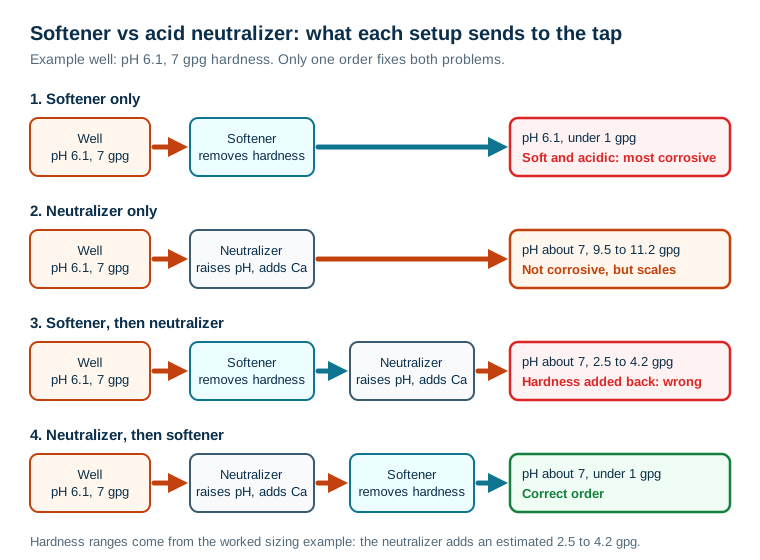
Using the example well below (pH 6.1, 7 gpg), here is what each setup sends to the house:
- Softener only. The water is soft but still at pH 6.1. This is the most corrosive of the four, because the calcium that offered some protection has been removed.
- Neutralizer only. The pH is near neutral, but hardness rises to about 10 to 11 gpg. The water no longer corrodes copper, but it scales the water heater.
- Softener, then neutralizer. The softener removes the hardness, then the neutralizer adds several grains back. Those grains reach the house after the only stage that could remove them. This is the order to avoid. It usually happens when a neutralizer is added to an existing softener in the easiest spot to plumb.
- Neutralizer, then softener. The pH is corrected and the added hardness is removed. This is the correct order.
The same logic sets the neutralizer's place in a longer system. It goes ahead of oxidizing iron filters that need near-neutral pH, as covered in well water treatment train order.
The Interaction Most Sellers Leave Out
Most package listings say the neutralizer "adds some hardness" and move on. How much it adds is set by chemistry.
Acidity in well water is mostly dissolved carbon dioxide. Calcite neutralizes it in this reaction:
CaCO₃ + CO₂ + H₂O → Ca²⁺ + 2HCO₃⁻
Each molecule of carbon dioxide neutralized dissolves one unit of calcium carbonate. Converted to the units a water test uses:
- Each 1 mg/L of CO₂ neutralized adds 2.27 mg/L of hardness as CaCO₃, which is 0.13 gpg.
- The same reaction raises alkalinity by the same 2.27 mg/L. That added alkalinity is what holds the pH up afterward.
So the hardness a neutralizer adds depends on how much carbon dioxide is in your water. Few home test panels report carbon dioxide directly. You can estimate it from pH and alkalinity, which most lab panels do report, using the carbonic acid balance at about 25 °C:
Free CO₂ (mg/L) ≈ 2.0 × alkalinity (mg/L as CaCO₃) × 10^(6.0 − pH)
This is an approximation. Cold groundwater holds its carbon dioxide slightly differently, so treat the result as an estimate to size against, then confirm by measurement.
A Worked Two-Stage Sizing Example
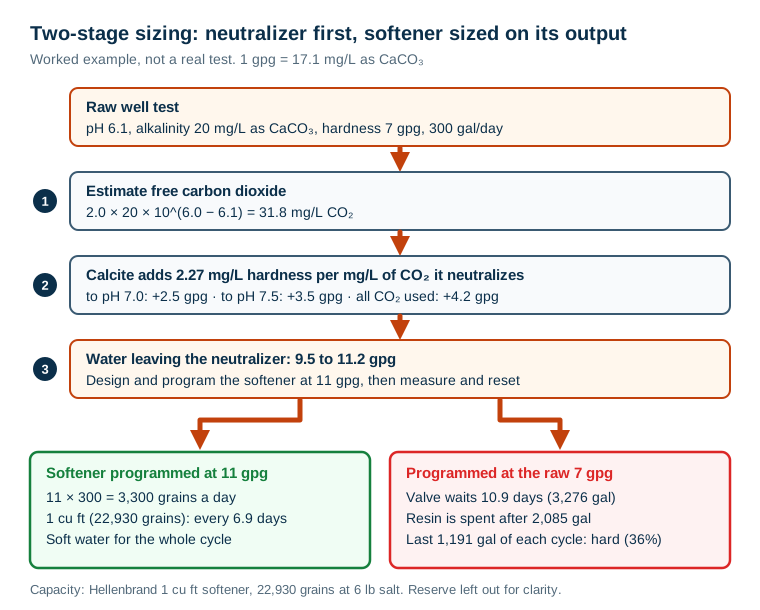
The well (an example, not a real test): pH 6.1, alkalinity 20 mg/L as CaCO₃, hardness 7 gpg, no iron. The household is four people using 300 gallons a day. That is an assumption for the arithmetic, so substitute your own metered use.
Step 1. Estimate the carbon dioxide. 2.0 × 20 × 10^(6.0 − 6.1) = 40 × 0.794 = 31.8 mg/L free CO₂
Step 2. Estimate the added hardness. A calcite bed does not use up every milligram of carbon dioxide. It stops as the water approaches neutral. Working the carbonate balance gives a range:
| If the neutralizer brings the water to | CO₂ consumed | Hardness added | Hardness leaving the neutralizer |
|---|---|---|---|
| pH 7.0 | 19.1 mg/L | 43 mg/L = 2.5 gpg | 9.5 gpg |
| pH 7.5 | 26.7 mg/L | 61 mg/L = 3.5 gpg | 10.5 gpg |
| All CO₂ consumed (ceiling) | 31.8 mg/L | 72 mg/L = 4.2 gpg | 11.2 gpg |
Step 3. Choose the design hardness. Before the system is running, design close to the ceiling, which here means 11 gpg. Undersizing a softener costs you hard water. Oversizing slightly only costs a little extra resin.
Step 4. Size the softener. Use the capacities in the Hellenbrand residential softener manual, which lists 22,930 grains for a 1 cu ft unit at 6 lb of salt and 34,400 grains for 1.5 cu ft at 9 lb. These are the same figures used in how iron changes water softener sizing, so the two examples can be compared directly. Reserve capacity is left out to keep the numbers readable.
| Sized on raw 7 gpg | Sized on 11 gpg after the neutralizer | |
|---|---|---|
| Daily grain load | 2,100 grains | 3,300 grains |
| 1 cu ft at 6 lb: days between regenerations | 10.9 | 6.9 |
| Salt per year, 1 cu ft | about 200 lb | about 315 lb |
| 1.5 cu ft at 9 lb: days between regenerations | 16.4 | 10.4 |
| Salt per year, 1.5 cu ft | about 200 lb | about 315 lb |
Step 5. See what the mistake costs. Suppose the softener is programmed with the raw 7 gpg. The valve expects 22,930 grains to last 3,276 gallons. At 11 gpg, the resin is actually exhausted after 2,085 gallons. The last 1,191 gallons of every cycle, about four days out of eleven and 36% of the water, go to the house unsoftened. The salt bill looks lower, but a third of the water is hard.
The two sizes use the same salt per year here, because the larger tank uses a bigger dose. The larger tank regenerates about 35 times a year instead of 53. On a well, that means fewer backwash draws on the pump. That matters when the well also has to backwash the neutralizer, as covered in how well pump flow limits backwashing.
Step 6. Measure and reset. After the neutralizer has run for two weeks, test hardness at its outlet and program the softener with that figure. If it reads 10 gpg, set 10. Retest after the neutralizer has had its first top-up, because a freshly filled bed and a half-used one do not treat water identically.
Sizing the Neutralizer Itself
The neutralizer is sized on flow and contact time, not grains. The water needs enough time in contact with the calcite at your peak flow. Backwashing models also need enough well flow to lift and rinse the bed. Size it on these checks:
- Peak flow. Pick a tank rated for your highest household flow, not the average.
- Backwash flow. Compare the tank's backwash requirement with a measured pump output, not the nameplate. A larger tank needs more.
- Media consumption. The lower the pH and the higher the water use, the faster the calcite is used up. Check the level a few months after installation to learn your own rate.
A combined single-tank "neutralizing softener" skips this sizing by putting both media in one bed. It saves floor space, but you lose the ability to measure hardness between the stages. Without that measurement, Step 6 is impossible.
When the Pair Misbehaves: Which Stage Is at Fault?
With two stages in series, a symptom at the tap could come from either one. A sample port or tap between the neutralizer and the softener lets you test each stage separately. Without one, you are guessing.
| Symptom at the tap | Test at | What it usually means |
|---|---|---|
| Blue-green staining returns | pH at the neutralizer outlet | Calcite is low or the bed has channeled. Top it up and backwash |
| Scale returns, softener regenerating normally | Hardness at the neutralizer outlet | The neutralizer is adding more hardness than the softener is set for. Reprogram the softener to the new figure |
| Scale appears right after a calcite top-up | Hardness at both outlets | A freshly filled bed dissolves faster at first. Retest in two weeks before changing the settings |
| Slippery or bitter taste, pH well above 8 | pH at the neutralizer outlet | Too much magnesium oxide in the blend, or water standing in the bed overnight. Reduce the magnesia share |
| Cloudy water after the neutralizer backwashes | Turbidity after flushing | Fine calcite dust from new or topped-up media. It should clear after a few backwashes |
| Hard water only in the last days before regeneration | Hardness at the softener outlet, day by day | The softener is set to the raw well figure, not the post-neutralizer figure. See Step 5 above |
Two habits prevent most of these problems. Test pH at the neutralizer outlet every few months, because the calcite level drops steadily and the pH drops with it. Re-test hardness between the stages after every top-up, because the softener setting depends on it. A neutralizer that is working properly can still leave the softener undersized as its behavior changes.
What This Pairing Cannot Do
- Neither unit removes iron, manganese or bacteria in any reliable way. The softener takes a little dissolved iron within its rating. The neutralizer does none. Test for both before buying.
- The softener adds sodium in proportion to the hardness it removes. Because the neutralizer adds hardness, the pair adds more sodium than a softener on the raw water would.
- Below about pH 5.3, calcite is the wrong tool. VCE puts that as the practical floor for neutralizing filters. A soda ash feed adds no hardness, and the softener is then sized on the raw number.
- Neither undoes existing corrosion. Pinholes and lead in old solder need their own fixes and a first-draw retest.
The Decision in Short
In the water softener vs acid neutralizer question, the neutralizer handles pH and the softener handles hardness, including the hardness the neutralizer adds. Test pH, alkalinity and hardness. Estimate the added hardness, and size the softener on the higher number. Put the neutralizer first. Then measure between the two stages once the system is running, and program the softener with that result.
Frequently Asked Questions
Do I need a water softener or an acid neutralizer?
Test pH and hardness first. Water below about pH 6.5 to 7 that corrodes copper needs a neutralizer. Water above roughly 7 gpg of hardness needs a softener. Many acidic wells start soft and become hard once a calcite neutralizer is added, so measure hardness again after the neutralizer before deciding on a softener. If the water is both acidic and hard, you need both.
Which goes first, the acid neutralizer or the water softener?
The acid neutralizer goes first. It raises the pH and adds calcium, and the softener downstream removes that calcium along with the original hardness. If the order is reversed, the neutralizer adds new hardness after the softener, and that hardness goes straight to the house.
Does a water softener raise pH?
No. A softener exchanges calcium and magnesium for sodium and leaves the pH essentially unchanged. On acidic water it removes calcium that was helping protect copper plumbing, so a softener alone makes acidic water more corrosive.
How much hardness does an acid neutralizer add?
It depends on how much carbon dioxide the calcite neutralizes. Each mg/L of carbon dioxide neutralized by calcite adds 2.27 mg/L of hardness as calcium carbonate, about 0.13 gpg. On typical mildly acidic wells that works out to a few grains per gallon. The only reliable figure is a hardness test taken after the neutralizer has been running for a couple of weeks.
Can one tank neutralize and soften at the same time?
Some sellers offer a single tank holding both calcite and softening resin. It saves floor space, but the two media share one backwash and regeneration schedule, the calcite is used up on its own timetable, and you cannot test hardness between the two stages. Two tanks are easier to size, service and troubleshoot.
Will a neutralizer and softener together add sodium to my water?
The softener does. It adds sodium in proportion to the hardness it removes, and because the neutralizer adds hardness, the pair adds somewhat more sodium than a softener would on the raw water. A calcite neutralizer adds none itself. Soda ash injection, the alternative for very acidic water, adds sodium directly.
