
Water Softener Quotes: How to Compare Them Line by Line
Water softener quotes can only be compared once they describe the same things. Ask each company to fill in nine lines: capacity at a stated salt dose, resin volume and grade, control valve, certification, installation scope, pretreatment, warranty, service terms and the cash price. Two quotes with the same total often buy very different systems. Then hold each quote against an online benchmark. In October 2026, comparable online 48,000-grain softeners sold for about $630 to $1,370 before installation.
Disclosure: Hard Water Solved may earn a commission if you buy through links on this page, at no extra cost to you. It does not change which products we include or how we rank them. Read our disclaimer.
How this page was built. No softener or installer was tested. The template is built from what manufacturers' spec sheets and warranty documents actually state, and from the line items installers use. The worked example is illustrative. The benchmark range comes from the brands' own stores in October 2026. Prices of individual products are not listed here because they change often. Use the buttons to see the current price on Amazon.
The Water Softener Quotes Comparison Template
Copy this table, or send it to each company and ask them to fill it in. A company that will not put these answers in writing has answered the most important question already.
| # | Line item | What to write down | Quote A | Quote B | Red-flag answer |
|---|---|---|---|---|---|
| 1 | Capacity at a salt dose | Grains removed per regeneration at a stated lb of salt | Only a box rating ("48,000 grain"), no salt dose | ||
| 2 | Resin volume and grade | Cubic feet; 8% or 10% crosslink; resin maker | "High capacity resin", volume not stated | ||
| 3 | Control valve | Make and model, metered or timer | Proprietary valve, parts and service from this dealer only | ||
| 4 | Certification | NSF/ANSI 44 listing for this model, by name | "Certified" with no listing, or "EPA approved" | ||
| 5 | Installation scope | Loop, bypass, drain line with air gap, overflow, outlet, permit, old unit removed | "Standard installation" with nothing listed | ||
| 6 | Pretreatment | Carbon or iron filter, and the water test it is based on | Filter added with no lab or strip test result shown | ||
| 7 | Warranty | Years on tank, resin, valve body, electronics; labor included or not | "Lifetime warranty" that covers parts only, through this dealer only | ||
| 8 | Service terms | Visits included, price per visit after, salt delivery | Paid annual service required to keep the warranty | ||
| 9 | Price and payment | Cash price per item; if financed, the total of all payments | Monthly payment only, or a price that expires today |
Lines 1 to 3 tell you what you are buying. Lines 4 to 8 tell you what is promised around it. Line 9 is the price of all of it. Fill the first eight in before you look at the ninth.
Two Quotes, Same Total, Different Systems
Here is how two quotes for $3,200 can look once the template is filled in. Both are illustrative.
| Line | Quote A: independent installer | Quote B: in-home dealer visit |
|---|---|---|
| Capacity at salt dose | About 30,000 grains at 6 lb/cu ft | "48,000 grain", no dose stated |
| Resin | 1.5 cu ft, 10% crosslink, named maker | Not stated; tank looks like 9 x 48 in, about 1 cu ft |
| Valve | Fleck 5600SXT, metered | Dealer's own valve |
| Certification | Valve and system listed to NSF/ANSI 44 | "Certified", no listing given |
| Install scope | New loop, bypass, drain with air gap, haul-away | "Standard installation" |
| Pretreatment | Whole-house carbon filter for chlorine | None |
| Warranty | Maker's warranty on parts, 1 year on labor | Lifetime on tank and resin, parts only |
| Service | Five annual visits included | First visit free |
| Cash price | $3,200 | $3,200, or $59 a month |
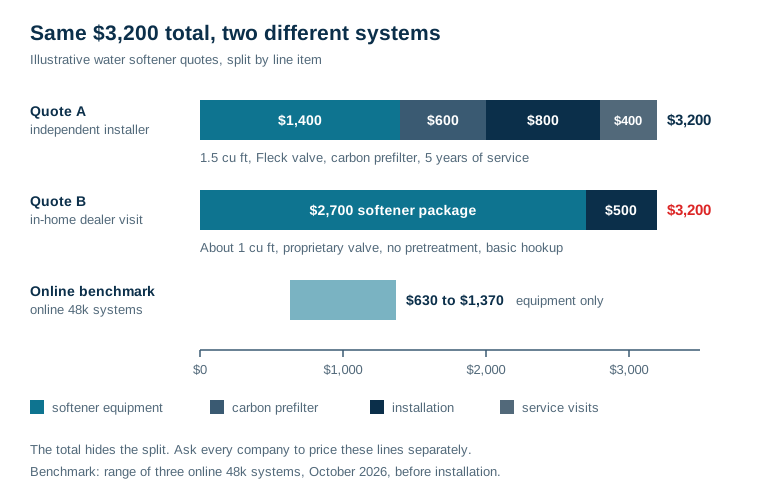
Quote A buys a larger bed, a standard valve any installer can service, chlorine protection for the resin and five years of visits. Quote B buys a smaller bed whose capacity was never stated at a salt dose, a valve only one company can fix, and a basic hookup. Neither number on the bottom line tells you that. The template does.
Quote B is not automatically worse. If the dealer's warranty includes labor, the valve has a long service record locally, and the dealer is responsive, some owners will pay for that. The point is to know what the money buys.
Line 1: The Capacity Line That Sorts Most Quotes
The grain rating on a softener box is a ceiling, not what you get every cycle. It assumes a heavy salt dose. At a moderate 6 lb of salt per cubic foot, standard resin delivers about 20,000 grains per cubic foot, and a resin maker's listing we checked gave 30,000 grains at 15 lb against 20,000 at 6 lb.
That turns a vague line into a checkable one:
- 1 cubic foot of resin gives about 20,000 grains at 6 lb of salt, or roughly 30,000 at 15 lb. A 1 cubic foot unit sold as "48,000 grain" is quoting a number it cannot reach.
- 1.5 cubic feet gives about 30,000 grains at 6 lb, and approaches 45,000 at a heavy dose.
- 2 cubic feet gives about 40,000 grains at 6 lb.
Ask each company: "How many grains does this unit remove per regeneration at the salt setting you will program, and how many pounds of salt is that?" A good installer answers in a sentence. The resin volume is also the honest way to compare a dealer's own model names with a standard system. How to read the rest of a manufacturer's sheet, from service flow to pressure drop, is covered in how to compare water softener spec sheets.
Lines 3 and 4: The Valve and the Listing
The valve decides who can repair the softener for the next 15 years. A Fleck or Clack valve has published service manuals and parts sold by many retailers. Any competent water treatment installer can work on it. A proprietary valve may be excellent, but it ties every future repair to the dealer who sold it, at the dealer's rate.
Certification is checkable in two minutes. NSF keeps a public listing of certified drinking water treatment units, searchable by standard; choose "Cation Exchange Water Softeners (NSF 44)" and look for the brand and model on the quote. WQA keeps a similar Gold Seal listing. "Tested to NSF standards" is not the same as listed.
Watch for an "EPA" or "WaterSense" claim. The EPA states that WaterSense does not label water softeners. It publishes guidance on choosing efficient models, but there is no EPA-approved softener. A salesperson who says otherwise has told you something about the rest of the pitch.
Lines 5 and 6: What the Installation Actually Covers
Installation scope is where honest quotes differ most, because houses differ. A basement with a loop, drain and outlet already in place is a short job. A garage with nothing in place needs a new loop off the main, a drain run with an air gap, an outlet and possibly a permit. The site's breakdown of water softener installation cost prices each of those lines and shows how the same softener can be quoted $950 apart for two houses.
On your template, make every installer answer yes or no to each item:
- New loop or reuse of an existing one
- Bypass valve
- Drain line, and an air gap at the drain
- Brine tank overflow line
- Electrical outlet, and whether an electrician is extra
- Permit and inspection
- Removal and disposal of the old softener
- Startup: hardness test, programming, first regeneration
Pretreatment should follow a water test, not a sales script. On chlorinated city water, a carbon filter protects the resin and is often worth it. On a well, iron or manganese above what a softener handles needs its own treatment. If a filter appears on a quote, ask to see the test result it is based on. An in-home "test" with drops that change colour shows hardness, not what treatment you need.
Lines 7 and 8: Warranty and Service Terms
Read the warranty document, not the brochure. Write down, for each quote:
- Tank and resin: years, and whether chlorine damage is excluded (it often is).
- Valve body and electronics: years for each. Electronics are usually shorter.
- Labor: years, if any. Many long warranties are parts only.
- Who performs warranty work: any installer, or only the selling dealer.
- Conditions: registration, approved salt, required paid service visits.
A "lifetime" warranty that requires a paid annual visit is a service contract with a warranty attached. Price the visits over ten years and add them to the quote before comparing it with a plain equipment-and-labor bid.
Online Benchmarks to Hold Each Quote Against
These three systems are not recommendations for every home. They are 1.5 cubic foot class softeners that, in October 2026, sold online for about $630 to $1,370 before installation, so you can see how much of a quote is equipment.
| Benchmark | What it is | Amazon |
|---|---|---|
| AFWFilters 48k, 10% crosslink | Fleck 5600SXT metered valve, 1.5 cu ft of 10% resin, brine tank and bypass | Check price on Amazon |
| Aquasure Harmony 48,000 (AS-HS48D) | Aquasure's own digital metered head on a 10 x 54 in tank | Check price on Amazon |
| SoftPro Elite 48,000 | 10% crosslink resin, upflow brining | Check price on Amazon |
The Aquasure Harmony listing in our original research is unavailable on Amazon, so the current listing for the same model is shown.
How to use them. Subtract the installation lines from a quote and compare what is left with the current prices of these systems. If an independent installer's equipment line for a 1.5 cubic foot Fleck system is $1,100 to $1,400, that is a normal markup for supplying, warranting and standing behind it. If a dealer's equipment line is $3,500 for a unit with a similar resin volume, ask what the extra $2,000 or more buys. Sometimes it is a long labor warranty and service. Sometimes it is the sales visit.
What they leave out. The online price includes no installation, no warranty labor and no one to call. Add the installation lines from your quotes to the benchmark before you compare totals. An online unit installed by a plumber is a real third option, not just a price check.
Red Flags in the Sales Process
The paperwork is half of a quote. The other half is how it was sold.
- A price that expires today. A real price is still valid next week. "Today only" is designed to stop you collecting the second quote.
- A monthly payment instead of a price. Ask for the cash price of each item and, if you finance, the total of all payments. Financing terms deserve their own comparison before you sign.
- No written specification. If the quote cannot state resin volume and valve model, nothing else on it can be checked.
- A bundled drinking-water system "included free". Ask for the price with and without it.
- No cancellation form. For most sales of $25 or more made in your home, the FTC's Cooling-Off Rule gives you until midnight of the third business day to cancel for a full refund, and the seller must give you cancellation forms with the contract.
Questions to Send Back in Writing
Email works better than a phone call, because the answers come back in writing. Send each company the same message:
- What is the resin volume in cubic feet, the resin grade, and who makes it?
- How many grains does it remove per regeneration at the salt setting you will program?
- What is the control valve make and model, and where can parts be bought?
- Which NSF or WQA listing covers this exact model?
- Which of these are included: new loop, bypass, drain with air gap, overflow, outlet, permit, removal of the old unit?
- What water test is the pretreatment based on? Please send the result.
- What does the warranty cover on each part, for how long, and is labor included?
- Which service visits are included, and what does a visit cost after that?
- What is the cash price of each item, and how long is this price valid?
When the Higher Quote Is the Better Buy
The cheapest total is not the goal. The goal is the lowest price for the system your water needs. A higher quote often wins when it:
- Sizes the resin for your hardness and household at a moderate salt dose, while the cheaper one undersizes it.
- Includes pretreatment your water test shows you need.
- Uses a standard valve, so future repairs can be shopped around.
- Includes labor in the warranty, from an installer with a track record you can check.
Who Should Not Rely on These Benchmarks
- Homes with iron, manganese, sulfur or very hard well water. A 48k city-water softener is the wrong benchmark. Price the treatment train your water test calls for.
- Owners who will never do or arrange their own maintenance. A dealer package with service included may suit you better than the cheaper equipment price suggests. Compare it with another dealer, not with an online box.
- Areas that restrict or ban salt-discharging softeners. Check local rules before you compare any salt-based quote at all.
Collect two or three written quotes, make every company fill in the same nine lines, and compare the first eight before you look at the price. The quote that answers all nine clearly is usually the one worth paying for.
Frequently Asked Questions
How many water softener quotes should I get?
At least two written quotes, and three if one comes from an in-home sales visit. Get one from an independent plumber or water treatment company that installs standard Fleck or Clack valves, and one from a dealer if you want a dealer system. Ask every company to fill in the same lines: capacity at a stated salt dose, resin volume and grade, valve make and model, install scope, warranty and service terms, and the cash price.
What is a fair price for a water softener quote?
Most whole-house installations land between about $1,100 and $3,000 including equipment, with a simple swap into existing plumbing at the low end. In October 2026, comparable online 48,000-grain systems sold for about $630 to $1,370 before installation. A dealer quote far above that should show you what the difference buys: more resin, pretreatment, a longer warranty with labor, or included service.
Why do water softener quotes vary so much?
Because they are rarely quoting the same thing. Resin volume, the valve, whether a carbon or iron prefilter is included, how much plumbing the installer has to build, and whether years of service visits are bundled in can each move the total by hundreds of dollars. Dealer packages also bundle warranty and service that an equipment-plus-labor quote leaves out.
What should a water softener quote include?
The resin volume in cubic feet and its grade, the capacity at a stated salt dose, the control valve make and model, the NSF/ANSI 44 certification for that model, each installation item (loop, bypass, drain with air gap, outlet, permit, removal of the old unit), any pretreatment, the warranty on each part including labor, the service terms, and the cash price before any financing.
Can I cancel a water softener contract signed at home?
Usually yes, within three business days. The FTC's Cooling-Off Rule covers most sales of $25 or more made in your home, and the right to cancel for a full refund lasts until midnight of the third business day after the sale. Saturday counts as a business day; Sundays and federal holidays do not. The seller must give you cancellation forms with the contract.
