
How Much Does Water Softener Installation Cost?
Water softener installation cost is usually about $1,100 to $3,000 for equipment and labor together, with a simple single-tank job at the low end. The softener itself is often less than half of that. What makes two quotes differ is the site work: a new plumbing loop, a drain run, an electrical outlet, a permit, and any prefilter the water needs.
This page breaks an installation into the lines that actually change between quotes, so you can see why two bids differ instead of guessing from a national average.
Water Softener Installation Cost, Line by Line
Fixr's water softener installation cost guide puts the national range at about $1,100 to $3,000 installed. It gives single-tank systems at $650 to $1,500 installed and twin-tank systems at $1,500 to $3,000. Averages hide where the money goes, though. Here is the job split into seven lines:
| Line item | What it covers | Typical range | Varies with |
|---|---|---|---|
| 1. Equipment | Softener, brine tank, bypass valve | $500 to $2,000 for ion exchange units (Fixr) | Resin volume, valve make, single or twin tank |
| 2. Base labor | Setting the unit, connecting to a loop, startup | $150 to $1,000 (Fixr) | How much plumbing the job needs |
| 3. New loop | Cutting into the main, shutoffs, bypass piping | Illustrative $200 to $600 | Pipe material, access, where outdoor taps branch |
| 4. Drain run | Line to a floor drain, standpipe or pump, with air gap | Illustrative $50 to $400 | Distance, lift, whether a pump is needed |
| 5. Electrical | An always-on outlet near the valve | Illustrative $150 to $400 | Panel distance, local electrician rates |
| 6. Permit | Plumbing permit and inspection, where required | $0 to a few hundred dollars | Your town; many charge a flat fee |
| 7. Pretreatment | Sediment prefilter, or iron treatment on well water | Illustrative $100 for a sediment filter, much more for iron | What your water test shows |
The ranges marked "illustrative" are working figures to show how quotes are built. They are not a price survey. Get them priced for your house.
Two extras that often turn up on the invoice: removal of an old softener and first fill of salt. Neither is large, but both are easy to leave off a quote.
Why Two Quotes for the Same Softener Differ
Take one 1 cubic foot metered softener, $900 in equipment, quoted for two houses:
- Quote A: a basement with a softener loop already in the wall. A floor drain is two feet away, there is an outlet on the joist, and the town does not require a permit for a like-for-like connection.
- Quote B: a garage with nothing in place. The main has to be cut and a loop built. The nearest drain is a laundry standpipe across the room, there is no outlet, and the town wants a plumbing permit.
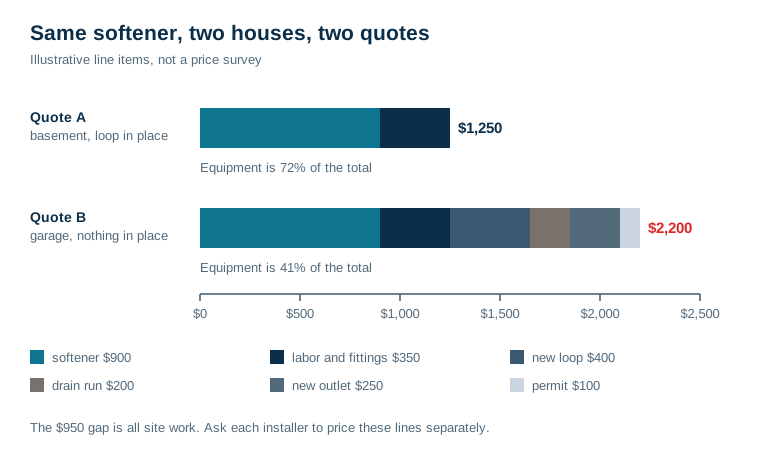
Neither installer is overcharging. In Quote A the equipment is 72 percent of the bill. In Quote B it is 41 percent. This is why national averages are nearly useless for judging a specific bid, and why the first question to ask is which of these lines does my house trigger.
Houses built with a softener loop and drain already in place skip lines 3 and 4 almost entirely. If you are building or remodeling, what a softener loop rough-in should include is the cheapest time to get it.
What the Labor Line Is Paying For
A plumber's labor charge is hours times rate, plus a trip or minimum charge. The US Bureau of Labor Statistics puts the median wage for plumbers, pipefitters and steamfitters at $30.67 an hour in May 2025, in its Occupational Outlook Handbook. What you are billed is well above that. It also covers the company's insurance, vehicle, licensing, travel and time spent on quoting jobs that are never booked.
The hours depend on the job:
- Swap into an existing loop: a couple of hours. Set the tanks, connect the bypass, run a short drain, start up.
- New loop in accessible copper or PEX: half a day or more. That covers shutting down the house, cutting the main, fitting shutoffs, bypass and the outdoor tap split, testing for leaks, and restoring the electrical bonding jumper if metal pipe was cut.
- Awkward sites: finished ceilings, galvanized pipe, a drain that needs a pump, or a softener on well water with an iron filter ahead of it. Budget a full day or more.
The step-by-step work, and which parts are worth handing to a plumber, is in how to install a whole-house water softener.
Equipment: What Changes the Box Price
Within the same brand, three things move the equipment price most:
- Resin volume. A 1.5 cubic foot unit costs more than a 1 cubic foot one. Buy the size your water and household actually need. A bigger bed is not automatically better.
- Single or twin tank. A twin-tank unit keeps soft water flowing during regeneration and costs roughly twice as much. Fixr's installed ranges show the gap.
- Valve. A metered, demand-initiated valve from a mainstream control-valve maker is the sensible default. Proprietary dealer valves often cost more and can be harder to get parts for later.
To price the box itself before any site work, see dated equipment prices for each softener type and size.
Where you buy changes the price more than any of these. Fixr lists retailer installation packages ranging from about $1,000 to $2,800 at one big-box chain up to $4,000 to $6,000 at a warehouse club. Dealer in-home packages that bundle long warranties and service visits can go higher, as what a Culligan quote typically includes shows. Whether that bundle is worth it over a cheaper online unit comes down to weighing a dealer package against buying online and maintaining it yourself. What you should get for the money is a written quote showing the resin volume and valve model, so you can compare like with like.
How to Compare Two Bids
Ask every installer to quote the same way, then check each line:
- Equipment: make, model, resin volume in cubic feet, valve type, and single or twin tank.
- Base labor: what is included in the connection, startup and sanitizing.
- Loop: new or existing? Are the outdoor taps and kitchen cold tap split off before the softener?
- Drain: where it goes, and whether an air gap is included.
- Brine tank overflow: run separately to a drain, not teed into the valve's drain line.
- Electrical: outlet included, or a separate electrician?
- Permit: who pulls it and who is at the inspection. Rules vary by town. Do you need a permit for a water softener covers the one phone call that settles it.
- Warranty: equipment years, and separately, labor years. Labor cover is usually much shorter.
- Settings: will they set the hardness from a real test of your water, not a free strip or a default?
A quote that is much cheaper usually leaves out lines 4 to 7. A quote that is much dearer usually includes a proprietary valve, a service plan, or extra treatment you may not need. Both can be reasonable. You just need to see which one you are looking at.
DIY or Hired: Where the Savings Really Are
Installing a softener yourself removes one line from the table: base labor, and the labor part of the loop and drain lines. It does not touch the equipment, the permit, the electrician or any pretreatment.
On Quote A above, doing it yourself saves up to $350 of a $1,250 job. On Quote B, the saving is larger in dollars but so is the risk. Cutting into the main, building a loop and running a drain with a proper air gap are exactly the steps that flood basements and fail inspections when they go wrong.
A reasonable split for many homeowners:
- DIY-friendly: a like-for-like swap into an existing loop, with a drain and outlet already in place.
- Hire for: cutting into a main you cannot fully shut off, soldering near a plastic control valve, galvanized pipe, a drain that needs a pump, and any job where your town requires a licensed plumber.
- Always hire: new electrical circuits, unless you are qualified to do them.
Some towns allow homeowners to pull their own plumbing permit, and some do not. Check before you start, not after.
Ways to Bring the Installed Price Down
- Combine it with other plumbing work. If a water heater is being replaced or a basement finished, the plumber is already there with the water off. Adding a loop at that point costs far less than a separate visit.
- Have the loop, drain and outlet roughed in early. In new construction or a remodel, these lines cost a fraction of what they cost once walls and ceilings are finished.
- Size from a real water test. Oversized equipment costs more to buy and runs less efficiently. A lab or drop-count test is cheap next to a larger tank.
- Ask for the equipment price separately. Some installers will fit a unit you buy yourself. Many will not warranty it, so weigh the saving against the labor cover you give up.
- Get three quotes on the same specification. Give each installer the same resin volume, valve type and list of included lines.
Does a Softener Add Resale Value?
Rarely on paper. Appraisers generally treat a softener as equipment, the way they treat a water heater, not as an improvement that raises the appraised value. Do not expect to recover the installation cost at sale.
In hard-water markets, a softener can still matter:
- It can remove an objection. A buyer who sees scaled fixtures in a hard-water town may ask for a credit. A working softener with visible service records avoids that conversation.
- It can add an objection. An old unit, a leaking bypass, a drain with no air gap or unpermitted work can all show up on an inspection report. The resale side of permitting is covered in the permit guide linked above.
- Rented units do not transfer cleanly. A leased softener belongs to the dealer. It has to be bought out, transferred or removed at sale.
The Cost After Installation Day
The installed price is the smallest part of owning a softener over its life. Salt, regeneration water, a little electricity and occasional repairs follow it for ten years or more. Before comparing quotes on price alone:
- the total cost of owning a water softener adds up ten years of running costs;
- renting vs buying a water softener compares a monthly rental with paying up front;
- water softener rebates and incentives covers what utilities and local programs offer, and what they require.
What an Installation Price Does Not Buy
- Soft water, if the settings are wrong. A perfect install with a default hardness entry wastes salt or leaks hardness from day one.
- Treatment for problems a softener cannot fix. Iron beyond its rating, sulfur smell, low pH, bacteria and lead all need their own treatment. A softener quote that promises to fix everything should prompt questions, not a signature.
- A permit where one is required. Some quotes assume none. That is your risk at resale, not the installer's.
- Salt. Budget for it separately, every month, for as long as you own the unit.
Frequently Asked Questions
How much does it cost to install a water softener?
Most whole-house installations fall between about $1,100 and $3,000 including the equipment, according to Fixr's national cost guide. A simple single-tank unit dropped into an existing loop can come in under that. A twin-tank system, a house that needs a new loop, drain and outlet, or dealer-installed premium equipment can go well above it.
How much do plumbers charge to install a water softener?
Labor alone commonly runs from about $150 to $1,000, depending on how much plumbing the job needs. Fixr gives that range. A swap into an existing loop is a short job. Cutting into the main, adding a bypass, running a drain line and fitting an overflow can take most of a day. Electrical work for a new outlet is usually a separate electrician's charge.
Can I install a water softener myself to save money?
Many homeowners do, and on a house with an existing loop it is a manageable job. You save the labor line, not the equipment or site work. Check first whether your town requires a permit and a licensed plumber for work on the water supply. Get the drain air gap and brine tank overflow right, because those are the parts inspectors and home buyers look at.
Does a water softener increase home value?
Rarely in a way an appraiser will count. A softener is usually treated as equipment, a bit like a water heater, not as an improvement that raises the appraised value. In hard-water areas, though, a working, well-installed softener can remove a buyer's objection and a line from the inspection report. An old, leaking or unpermitted one can add one.
Why is a water softener from a dealer so much more expensive?
Dealer and in-home sales packages often bundle proprietary valves, long warranties, service visits and sometimes extra treatment into one price. Fixr lists retailer installation packages from about $1,000 to $2,800 at the low end and $4,000 to $6,000 at the high end. Ask for the resin volume, valve make and each installation line item, so you can compare the package with a plain equipment-plus-labor quote.
What is not included in a typical water softener installation quote?
Commonly left out: electrical work for a new outlet, a permit fee, a sediment or iron prefilter, removing and disposing of an old unit, patching walls or ceilings, and the first bags of salt. Some quotes also leave out the drain air gap and overflow line. Ask for them to be listed, not assumed.
