
How to Compare Water Softener Spec Sheets

To compare water softener specifications properly, ignore the headline grain number and line up six things instead: resin volume, resin type, the control valve's real maker and model, capacity at a stated salt dose, service flow rate, and how the unit decides when to regenerate. Those six separate a good softener from a badly specified one. Then confirm any certification in a public database rather than trusting the logo.
Two units sold as "48,000 grain" can hold different amounts of resin, use different valves and burn very different amounts of salt. The spec sheet usually tells you, if you know where to look.
Why the Grain Number Is the Least Useful Spec
A grain rating is a capacity measured at one particular salt dose, almost always the highest. It is real, but it tells you how much the resin holds when regenerated inefficiently, not how the unit will run in your house.
Resin capacity rises steeply at first as salt increases and then flattens. A typical cubic foot of standard resin holds very roughly 20,000 grains at a 6-pound salt dose and about 30,000 at 15 pounds. That extra 50 percent capacity costs 150 percent more salt. A label that quotes the 15-pound figure makes the unit sound bigger than it will be at an efficient setting.
This is the gap between the number on the box and the number you can plan around, which we break down in advertised vs usable softener capacity. For comparison purposes, the fix is simple: always compare capacity at the same salt dose, and preferably at an efficient one.
The Six Specs That Genuinely Differentiate Units
These are the lines worth finding on any spec sheet or asking a seller for in writing.
1. Resin volume in cubic feet
Everything else flows from this. It is the physical amount of softening media in the tank. Common pairings are about 1 cubic foot in a 9 x 48 inch tank, 1.5 in a 10 x 54 and 2 in a 12 x 52, though fill levels vary. If a spec sheet does not state cubic feet, ask. A seller who will not say is hiding something.
2. Resin type
"High-capacity resin" on its own means nothing. Look for:
- Crosslink percentage. Standard resin is 8 percent. Ten percent crosslink is more resistant to chlorine oxidation, which matters on city water with a steady chlorine or chloramine residual.
- Mesh size. Fine mesh resin has smaller beads and more surface area. It copes better with low levels of dissolved iron, at the cost of slightly more pressure drop.
3. Control valve maker and model
The valve is the part that fails, and it decides whether you can buy parts in ten years. A valve from a widely used maker has manuals, seal kits and pistons on open sale. A proprietary valve usually means parts and service come only through that brand's dealers. The section below shows how to find out which one you are looking at when the brand on the cover is not the maker.
4. Capacity at a stated salt dose and the efficiency rating
The useful line reads something like "24,000 grains at 8 lb" or gives a table of capacities at several doses. Divide grains by pounds and you have the unit's salt efficiency at that setting. The benchmark comes from NSF/ANSI 44's efficiency rating, summarised by the Department of Energy's Building America Solution Center: at least 3,350 grains per pound of salt, no more than 5 gallons of water per 1,000 grains removed, and demand-initiated regeneration.
5. Service flow rate and pressure drop
A continuous flow rate means nothing without the pressure drop it was measured at, usually 15 psi. Compare like with like, and check the valve's port size (3/4 inch, 1 inch or larger) against your plumbing. An undersized valve on a big house gives you the "low pressure when two showers run" complaint. The sizing side of this is covered in grain capacity vs peak flow rate.
6. Regeneration control and brining method
Three questions: does it regenerate by metered water use or by a timer; does it use proportional brining (salt matched to the capacity actually used) or a fixed dose; and how many gallons does one regeneration send to drain? Metered, proportional, low-water units cost the least to run, and the difference compounds every week for fifteen years.
A Worksheet to Compare Water Softener Specifications
Copy this into a spreadsheet or onto paper. Fill in one column per unit. Anything you cannot find, write "not stated". The blanks are information too.
| Spec | Where to find it | Unit A | Unit B | What better looks like |
|---|---|---|---|---|
| Resin volume (cu ft) | Spec sheet, tank label, ask seller | Matches your sizing, stated plainly | ||
| Resin type | Spec sheet, resin bag label | Crosslink % and mesh named; 10% on chlorinated water | ||
| Valve maker and model | Display, serial sticker, casting (see below) | Widely serviced model with open-market parts | ||
| Capacity at an efficient dose | Capacity table or listing | Stated at 6–8 lb per cu ft, not only at 15 lb | ||
| Salt efficiency (grains per lb) | Capacity ÷ salt dose, or listing | 3,350 or more at the stated dose | ||
| Service flow and pressure drop | Spec sheet | Stated at 15 psi, meets your peak demand | ||
| Valve port size | Spec sheet, bypass fitting | Matches or exceeds your main line | ||
| Regeneration control | Spec sheet, manual | Metered (demand-initiated) | ||
| Brining method | Manual, programming guide | Proportional brining | ||
| Water per regeneration (gal) | Manual, listing | Stated, and low for the resin volume | ||
| Certification listing | NSF or WQA database | Exact model found, Standard 44 | ||
| Warranty: tank / valve / electronics | Warranty document | Separate terms stated, not "lifetime" alone |
Two units that tie on the first six rows are genuinely comparable, and then price and installer quality decide it. Two online sellers of the same Fleck valve are the classic case, and choosing between AFWFilters and DuraWater comes down to exactly these lower rows: resin, tank, bypass and warranty. If one unit leaves half the rows blank, that is usually the decision made for you.
How to Find the Real Valve Maker Behind a Rebranded Unit
This is the single most useful thing a buyer can learn, because a large share of softeners are sold under a retailer's or installer's own brand with a valve made by someone else. Nothing is wrong with that. The problem is only when you do not know, because then you cannot price a replacement part, find the manual, or judge whether a "proprietary" repair quote is fair.
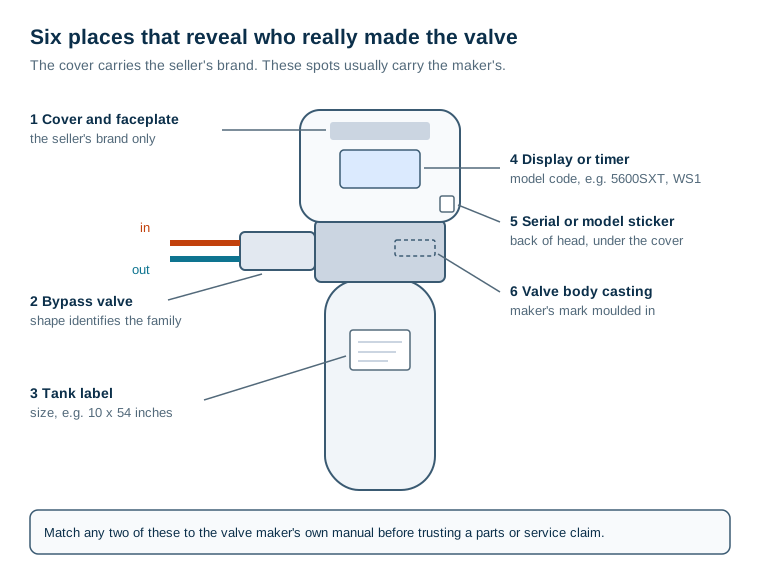
Work through these, in roughly this order:
- The display or timer. Many valves show a model code on the screen at start-up or carry it on the timer face. Codes such as 5600SXT or WS1 identify well-known valve families at a glance.
- The serial or model sticker. Usually on the back of the head or under the cover. It often carries the valve maker's part number even when the front says something else.
- The valve body casting. Remove the cover and look at the plastic body itself. Makers mould their name or logo into it, and a reseller cannot change a casting.
- The bypass valve. Bypass designs are distinctive and usually specific to one valve family. Compare yours with images from the maker's manual.
- The manual. A reseller's manual often reproduces the valve maker's exploded parts diagrams, with the original part numbers intact. Search one of those numbers.
- The tank label. Tanks are also made by a small number of companies and carry their size (for example 10 x 54). That confirms resin volume even when the spec sheet is vague.
Two matching clues are enough. Once you know the valve, check that the maker's manual and seal kits are sold openly. If they are, any competent technician can service the unit. If the valve turns out to be proprietary, factor dealer-only service into the price. The same test, applied across the market, is how we rank water softener brands by who makes the valve and whether its parts are sold openly.
How to Verify a Certification Listing Instead of Trusting a Logo
A logo on a box is a claim. A listing in a public database is the evidence. Certification applies to a specific model, for specific claims, under a specific standard, and it is common for a badge to refer to a component, a sister model or a different standard altogether.
Two databases cover most US softeners:
- NSF's public listings at info.nsf.org/Certified/DWTU. Search by company, then look for the product under water softeners and Standard 44.
- WQA's Gold Seal product search at wqa.org/find-products. Search by manufacturer or brand.
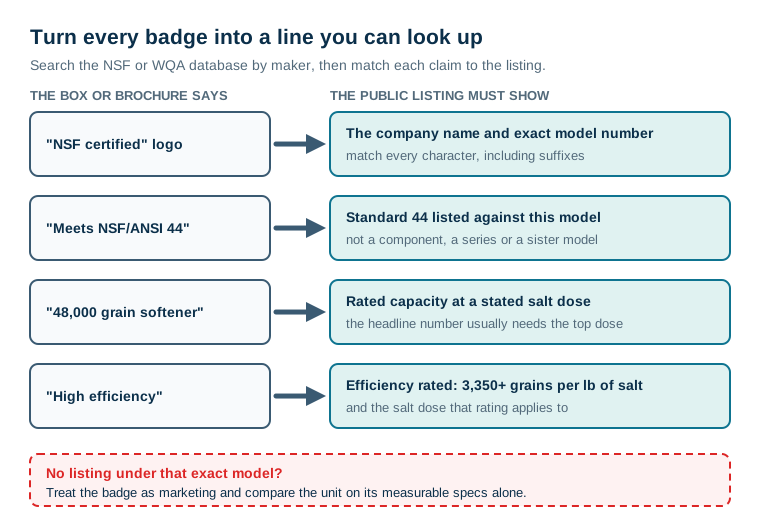
What to check once you find the entry:
- The model number matches exactly, including suffixes. A listing for "WS-48" does not cover "WS-48X".
- The standard is 44 for softening claims. Standard 42 and 53 cover filters; a softener carrying only a Standard 61 listing has been checked for what leaches from its materials, not for how well it softens.
- The capacity and salt dose on the listing match what the seller quotes.
- An efficiency claim is listed, not only printed on the box.
The listing may be under the valve or resin maker's name rather than the brand you are buying, which is another reason identifying the real manufacturer pays off.
What a Spec Sheet Cannot Tell You
Even a complete, honest spec sheet leaves out three things that decide how happy you will be.
- Whether the unit suits your water. Spec sheets assume clean hard water. Iron, manganese, low pH, tannins or high chlorine each change what you need, and no grain number accounts for them.
- How it will be set up. A good softener programmed with the wrong hardness or a 15-pound salt dose performs like a poor one. Ask the installer what hardness and salt setting they will program, and why.
- What happens when it breaks. That lives in the warranty, which usually splits tank, valve and electronics into very different terms. Our guide on how to read a water softener warranty walks through the clauses that matter.
A softener also cannot do everything. It removes calcium and magnesium, and modest amounts of dissolved iron. It does not remove chlorine, lead, bacteria, nitrate or arsenic, and a spec sheet claiming broad "water purification" from a softener alone is overstating it.
What to Do Next
- Get the spec sheet and manual for each unit you are considering, not the brochure.
- Fill in the worksheet, writing "not stated" wherever a figure is missing.
- Identify the valve maker for each unit using two clues from the diagram.
- Look up each model in the NSF and WQA databases and note exactly what is listed.
- Compare capacity at the same efficient salt dose, then choose between the units that survive, on price and installer. If installers are quoting, line their quotes up against the same template so two equal totals are not hiding different systems.
Frequently Asked Questions
What is the most important spec on a water softener?
Resin volume in cubic feet. Every capacity figure is derived from it, so it is the one number you can compare honestly between brands. A 48,000-grain label usually means about 1.5 cubic feet of resin regenerated with the maximum salt dose, and the same resin gives much less capacity at an efficient salt setting.
How do I know who made my water softener valve?
Look past the cover. The model code on the display or timer, the serial sticker on the back of the head, the shape of the bypass valve and the maker's mark moulded into the valve body usually identify the real manufacturer. Many private-label softeners use valves from a small number of makers, and knowing which one tells you where parts and manuals come from.
Is a higher grain capacity softener always better?
No. A grain number is only meaningful with the salt dose it was measured at, and a unit sized well above your needs regenerates less often, which can let the resin sit and channel. The right size gives you a regeneration every several days at an efficient salt setting, not the biggest number on the shelf.
What does NSF/ANSI 44 certification mean for a softener?
It means a specific model was tested and listed by a certifier for the claims on its listing, typically hardness reduction and, when rated for efficiency, salt and water use at a stated dose. The listing, not the badge on the box, is the proof. Check the model number in the NSF or WQA public database.
What is an efficiency-rated water softener?
Under the criteria summarised by the Department of Energy's Building America program, an efficiency-rated softener delivers at least 3,350 grains of hardness removal per pound of salt, uses no more than 5 gallons of water per 1,000 grains removed, and regenerates on demand rather than on a fixed timer. The rating applies only at the salt dose it was tested at.
Do fine mesh or 10 percent crosslink resin matter on a spec sheet?
They can. Ten percent crosslink resin resists chlorine damage better than standard 8 percent, which matters on chlorinated city water. Fine mesh resin has more surface area and handles low levels of iron better. Neither changes the grain rating much, which is exactly why a spec sheet that names the resin type is more useful than one that does not.
