
Water Softener Resin Replacement Cost: DIY vs Pro by Tank Size

Water softener resin replacement cost is about $180 to $430 if you do it yourself and roughly $480 to $1,130 for a professional rebed, depending on whether the tank holds 1, 1.5 or 2 cubic feet. The resin itself sells for about $150 to $200 a cubic foot online, and premium 10% crosslink grades such as ResinTech CG10 sit inside that range. Labor and the service call are most of a pro's bill. Rebedding makes sense when the control valve is under about 8 years old. Past about 12 years, new resin under an old head is usually a false economy.
Disclosure: Hard Water Solved may earn a commission if you buy through links on this page, at no extra cost to you. It does not change which products we include or how we rank them. Read our disclaimer.
How these numbers were built. Nothing on this page was physically tested. Resin price ranges come from retailer listings and the makers' product pages; labor figures are illustrative placeholders using the same method as the site's repair-cost pages: a $100 to $150 service call plus labor at $100 an hour. Replace them with the rates on your own quote.
- Included: whole 1 cubic foot bags of 10% crosslink cation softening resin from a named resin maker.
- Excluded: unbranded "high capacity" resin with no maker named, half-cubic-foot top-up bags, and two listings in our original research that we could not verify on the day (details below).
- Prices of individual products are not listed here because they change often. Use the buttons to see the current price on Amazon.
Water Softener Resin Replacement Cost by Tank Size
| Resin volume | Typical tank | DIY: resin | DIY total | Pro: resin billed | Pro: call and labor | Pro total |
|---|---|---|---|---|---|---|
| 1 cu ft | 9 x 48 in | $150–$200 | $180–$230 | $150–$300 | $300–$450 (2–3 h) | $480–$780 |
| 1.5 cu ft | 10 x 54 in | $225–$300 | $255–$330 | $225–$450 | $300–$450 (2–3 h) | $555–$930 |
| 2 cu ft | 12 x 52 in | $300–$400 | $330–$430 | $300–$600 | $350–$500 (2.5–3.5 h) | $680–$1,130 |
Both totals include about $30 for gravel, a funnel and a new tank O-ring. DIY resin is priced at $150 to $200 per cubic foot. The pro column bills resin at $150 to $300 per cubic foot, because an installer marks up stock it carries and hauls. Illustrative, not a price survey.
Three things stand out from the table.
The resin is the cheap part of a pro job. On a 1.5 cubic foot tank, resin is under half of the bill at almost any point in the range. That is the same pattern the site's guide to water softener resin life and replacement describes: draining, emptying, cleaning, refilling and recommissioning take hours, and hours are what you pay for.
DIY saves more than half. The gap between the two columns is roughly $300 to $700 on every size. That is real money for an afternoon's work, if you can manage the weight.
Bigger tanks cost more to rebed, but not proportionally. Going from 1 to 2 cubic feet roughly doubles the resin cost, but the service call stays the same and labor rises only slightly. A 2 cubic foot rebed is still well under the price of a new 64,000-grain system installed.
How Much Resin Your Tank Holds
Rebed with the volume the tank was designed for. Most tanks carry a size code such as 1054, which means 10 inches across and 54 inches tall. If the label is gone, measure the diameter and the height of the shell.
| Tank size | Resin it normally holds | Common grain rating on the box |
|---|---|---|
| 9 x 48 in (0948) | about 1 cu ft | 32,000 |
| 10 x 54 in (1054) | about 1.5 cu ft | 48,000 |
| 12 x 52 in (1252) | about 2 cu ft | 64,000 |
The box rating assumes about 32,000 grains per cubic foot, which needs a heavy salt dose. At a moderate 6 lb of salt per cubic foot, standard softening resin delivers closer to 20,000 grains per cubic foot. That matters for one decision: if the old unit was running out between regenerations because it was undersized, replacing the resin restores it to being undersized. Resize instead.
Do not overfill. Resin needs empty space above it so the bed can lift and loosen during backwash. Filling the tank to the top to "get more capacity" packs the bed, and a packed bed channels and wears unevenly.
Resin Worth Buying for a Rebed
Both picks are 10% crosslink resin. The extra crosslinking makes the beads tougher against chlorine, which is what slowly degrades softener resin on city water. On unchlorinated well water a standard 8% grade will do, but the step up costs little.
ResinTech CG10: best documented 1 cubic foot bag
- Grade: premium 10% crosslink strong acid cation resin, sodium form
- Certifications: WQA Gold Seal; meets NSF/ANSI/CAN 61 and 372, per ResinTech's CG10 product page
- Bag: 1 cubic foot, about 53 to 55 lb
- Price note: an unusually low price on this bag is usually a short-term sale, not the normal price
CG10 is the safest choice when you want to know exactly what went into the tank. ResinTech publishes the specification, the capacity figure (2.2 meq/mL) and the certifications for it. Buy one bag for a 9 x 48 inch tank. For a 10 x 54 inch tank you need a second half bag, or two bags with the spare kept sealed and damp for a top-up later.
Watch for: shipping. A 55 lb bag can carry a freight charge that changes which seller is cheapest.
Aldex C-800 10%: the certified alternative
- Grade: gel-type 10% crosslink strong acid cation resin, sodium form
- Certifications: NSF/ANSI 44, 61 and 372 and CSA B483.1, as listed by the retailers we checked
- Capacity listed: about 30,000 grains per cubic foot at 15 lb of salt, or 20,000 grains at 6 lb
The useful thing about the Aldex listing is that it prints capacity at two salt doses. That shows plainly that the grain rating on a softener box is a high-salt figure, and it is the number to use when you plan the salt setting after the rebed.
Watch for: confirm the bag is the 10% grade. Aldex sells several C-800 variants, including fine mesh and low-temperature versions.
Dropped from this page
Two products from our original research were left out. A LiquaGen 2 cubic foot pack with funnel could not be found as a resin product on the day; LiquaGen listings we found were gravel and accessories. A generic 1.5 cubic foot "10% crosslink refill kit" could not be matched to a named resin maker or a current price. We do not recommend resin we cannot identify.
What a Professional Rebed Quote Should Include
A rebed quote that says "resin replacement, $750" tells you nothing. Ask for these lines:
- Resin volume and grade. Cubic feet and the maker's product name, for example "1.5 cu ft ResinTech CG10". "High capacity resin" is not a grade.
- Gravel underbed. Yes or no. Some tanks use a layer of gravel under the resin, others use a distributor basket alone. Replacing it is cheap.
- Distributor tube. Inspected, or replaced. A cracked distributor is a common reason resin escapes into the plumbing, and a new one is a few dollars while the tank is open.
- Tank O-ring and valve check. A new O-ring at the tank neck, and a note on the valve's condition while it is off the tank.
- Labor hours and the service call, shown separately.
- Disposal of the old resin. Included, or a fee.
- Recommissioning. Backwash, brine refill, a reset of hardness and salt settings, and an outlet hardness test before the installer leaves.
- Workmanship guarantee. How long they stand behind the job if resin appears in the taps or the tank leaks at the neck.
If the quote is for a dealer's proprietary softener, ask whether the resin is a named product you could buy yourself. Some dealers only supply their own media, which takes the DIY column off the table.
The DIY Job, Honestly Costed
The money saved is in the table. The work is this:
- Weight. A 1 cubic foot bag weighs about 55 lb, and a 10 x 54 inch tank full of wet resin and water is far too heavy to tip. You empty it in place with a wet vacuum, or by scooping, or by siphoning.
- Time. A half day for a first-timer: bypass and depressurise, unplug, unscrew the valve, empty the tank, rinse, check the distributor, refill, and run through backwash and brine refill.
- The distributor tube. It must stay centred and capped while you pour the new resin in through a funnel, or resin goes down the tube and into the valve. A funnel that sits on the tank neck makes this much easier.
- Disposal. Old resin is usually rinsed, drained and bagged for household trash where local rules allow. The site's guide to disposing of old softener resin and components covers the rinse step and the cases, such as radium in well water, where the resin needs a different route.
Stop and get help if the tank threads or neck are cracked, if the valve will not come off without force, or if the old beads are coming out as mush that clogs the vacuum. A damaged tank turns a rebed into a replacement.
When Rebedding Is a False Economy: The Valve-Age Rule
A rebed restores the bed. It does nothing for the control valve, which is the part with motors, seals, a meter and electronics. That is where the false economy hides.
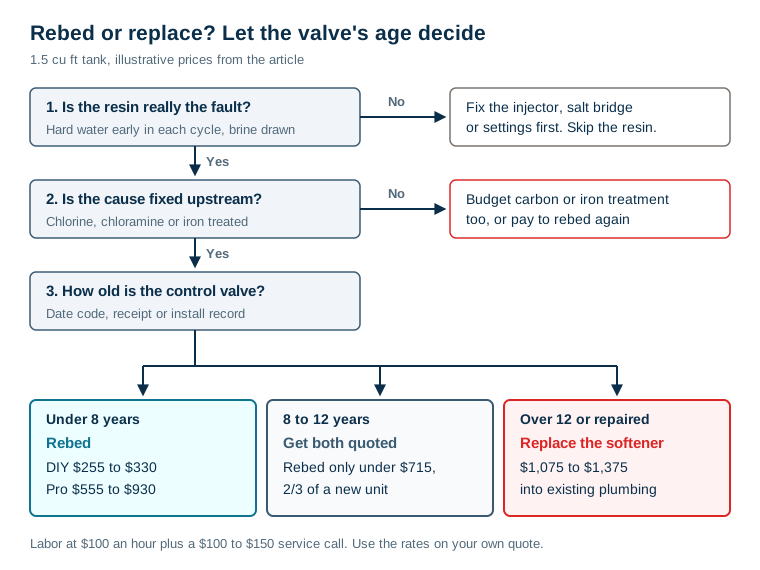
The rule: rebed if the valve is under about 8 years old. Between 8 and 12 years, rebed only if the job costs less than about two thirds of a comparable new unit. Past 12 years, or after any valve repair, replace the softener. Those thresholds follow the crossover in water softener resin life and replacement.
A worked example. A 13-year-old 1.5 cubic foot softener needs new resin. A pro quotes $700 for the rebed. A comparable new 48,000-grain unit with a Fleck 5600SXT valve, bought online and swapped into the existing plumbing with perhaps $300 to $600 of labor and fittings, comes to about $1,075 to $1,375 for a brand-new softener in our model.
| Path | Upfront | If the old valve then fails | Total |
|---|---|---|---|
| Pro rebed on the 13-year-old valve | $700 | Valve replacement, roughly $580–$880 installed | $1,280–$1,580 |
| New softener, swapped into existing plumbing | $1,075–$1,375 | New valve, under warranty | $1,075–$1,375 |
Illustrative. The valve figure uses the installed range for a complete metered valve head on the site's repair-cost pages.
The rebed only wins if the old valve keeps going for years. At 13 years, that is a bet against the odds. At 5 years, with a DIY rebed at $255 to $330, it is the clearly better buy.
The two-thirds test in numbers, on that same tank: two thirds of $1,075 is about $715. A pro rebed at $555 to $930 straddles the line, which is why 8 to 12 years is the "get both quoted" zone. A DIY rebed at $255 to $330 passes easily.
Costs a Resin Quote Leaves Out
- Pretreatment. If chlorine or chloramine broke down the old beads, or iron fouled them, the new bed will fail the same way. A carbon filter ahead of the softener on city water, or iron treatment on a well, belongs in the same budget. Installing new resin on the water that killed the old resin is the most reliable way to pay twice.
- Shipping on heavy bags. Compare delivered prices, not list prices.
- Salt resetting. After a rebed the capacity is back to new, so the old salt setting may now be wrong. Set it from the resin's capacity at your chosen salt dose, not the box rating.
- A second visit. If a pro discovers a cracked distributor or worn valve seals with the tank open, the quote changes on the day. Ask in advance what they charge for those.
The wider budget picture, including what a fresh installation costs when a rebed is not worth it, is in water softener installation cost.
Who Should Not Pay for New Resin at All
- Anyone who has not confirmed the resin is the problem. Hard water with no brine draw is an injector, a salt bridge or a setting, not the resin. Test before you buy.
- Owners of valves over about 12 years old, or with a repair history. Price a replacement softener first.
- Owners of undersized units. New resin restores the original undersized capacity.
- Homes with untreated chlorine, chloramine or iron. Fix the water ahead of the softener first, or budget to rebed again in a few years.
- Owners of dealer systems with proprietary media and a service contract. Check the contract; the rebed may be covered, or you may be barred from doing it yourself without losing the warranty.
If your valve is young and the tank is sound, buy a 10% crosslink resin from a named maker, put one cubic foot back for every cubic foot that came out, and expect to spend about a third of what a pro would charge.
Frequently Asked Questions
How much does it cost to replace the resin in a water softener?
Doing it yourself, about $180 to $230 for a 1 cubic foot tank, $255 to $330 for 1.5 cubic feet and $330 to $430 for 2 cubic feet, using resin at about $150 to $200 a cubic foot plus roughly $30 of gravel and sundries. A professional rebed is about $480 to $780, $555 to $930 and $680 to $1,130 for the same sizes in our illustrative model, because labor and the service call are most of the bill.
Is it worth replacing water softener resin or buying a new softener?
Rebed when the control valve is under about 8 years old, has no repair history and the tank is sound. Between 8 and 12 years, rebed only if the job costs less than about two thirds of a comparable new unit, which in practice means doing it yourself. Past 12 years, or with a valve that has already needed repairs, a new softener usually costs little more than a professional rebed and replaces the valve as well.
How much resin do I need for my water softener?
Check the label on the mineral tank or measure it. A 9 x 48 inch tank holds about 1 cubic foot, a 10 x 54 inch tank about 1.5 cubic feet and a 12 x 52 inch tank about 2 cubic feet. Buy the volume the tank was built for, not more. Resin needs empty space above it, called freeboard, so the bed can lift and clean itself during backwash.
Can I replace water softener resin myself?
Yes, if you can lift a 55 lb bag and unscrew the control valve from the tank. The job is draining the tank, removing the valve, emptying the old resin, checking the distributor tube, refilling with new resin through a funnel and recommissioning the softener. Expect a messy half day. Stop and call a pro if the tank threads or neck are damaged, because a cracked tank is a replacement, not a rebed.
How long does new water softener resin last?
Commonly 10 years or more on well-maintained, unchlorinated water and less on chlorinated city water, where chlorine slowly breaks down the beads. 10% crosslink resin resists chlorine better than standard 8% resin, which is why both picks on this page are 10% grades. Fixing whatever killed the old bed, such as chlorine or iron, matters more to the new bed's life than the brand of resin.
