
AquaTru Classic Review: What Countertop RO Really Costs Per Gallon

This AquaTru Classic review comes down to a trade. You pay more per gallon than you would for an under-sink RO system, and in return you get certified reverse osmosis with no plumbing, no drilling and no drain connection. That makes it one of the best options for renters. Over three years, counting the purchase and the replacement filters, it costs roughly twice as much per gallon as an under-sink system at the prices we compared, and each gallon gets cheaper the more you drink. And on water over 10 grains per gallon, AquaTru itself says the membrane will scale unless the water is softened or the unit is descaled regularly.
Disclosure: Hard Water Solved may earn a commission if you buy through links on this page, at no extra cost to you. It does not change which products we include or how we rank them. Read our disclaimer.
AquaTru Classic at a Glance
| Item | Figure | Source |
|---|---|---|
| Stages | 4: Pre/Carbon filter (stages 1 and 2), RO membrane, VOC carbon | Product page |
| Certification | IAPMO R&T to NSF/ANSI 42, 53, 58, 372 and 401 | Performance data sheet |
| Contaminants | 84, including lead, fluoride, PFOA/PFOS, chromium-6 | Product page |
| TDS reduction | 95.2% average, 90.6% minimum | Performance data sheet |
| Daily production | 54 GPD | Performance data sheet |
| Efficiency | 75% | Performance data sheet |
| Clean water tank | 0.75 gallon | Product page |
| Feed limits | hardness 10 gpg, TDS 1,500 mg/L, iron, manganese and sulfide under 0.1 mg/L, 39 to 100°F | Performance data sheet |
| Power | 120 V wall plug | Product page |
| Size | 12" W x 14" D x 14" H, about 17 lb | Product page |
| Warranty | 1 year, 30-day money-back guarantee | Product page |
Variants. AquaTru also sells a Classic with its Alkaline Mineral Boost filter, a Classic Smart with app connection, and a Classic Smart with the alkaline filter, all on its own store. We could not load their Amazon listings when we checked, so only the standard Classic is linked here.
How This Review Was Put Together
Method. No unit was physically tested for this review. Figures come from AquaTru's Classic performance data sheet, its product page and FAQ. The under-sink comparison uses the iSpring RCC7AK as a typical certified tank RO. The cost model counts the filters in the box as the first set, then adds each replacement when its months or gallons limit is reached, over 36 months. The Amazon listing was opened to confirm it is live.
Prices are not listed here because they change often. Use the buttons to see the current price on Amazon.
How a Countertop RO Works Without Plumbing
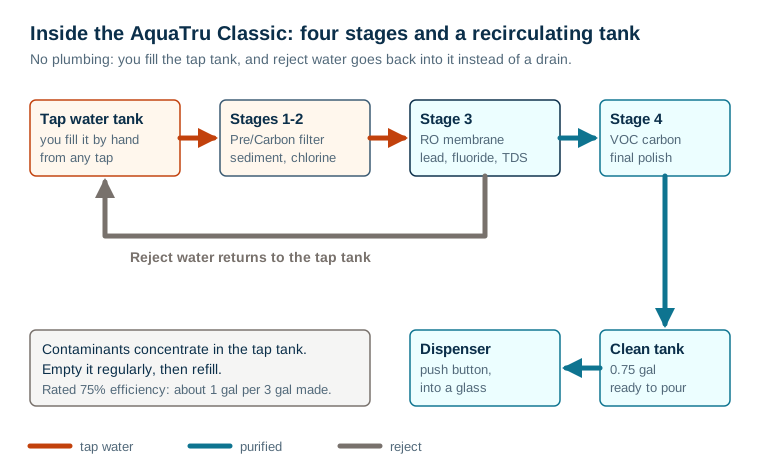
You fill the tap water tank from any faucet and slide it into the unit. A pump pushes the water through the Pre/Carbon filter, the RO membrane and the VOC carbon filter into a 0.75 gallon clean tank, and you dispense it with a button.
The clever part is the reject water. An under-sink RO sends it down a drain line. The AquaTru has no drain line, so it returns the reject water to the tap tank and filters it again. AquaTru says this is how it reaches a 75% efficiency rating. The cost is that dissolved solids build up in the tap tank, which is why you empty and refill it rather than just topping it up.
At the data sheet's 54 GPD, refilling the 0.75 gallon clean tank takes about 20 minutes. That is fine for glasses and bottles. It is slow if you want to fill a large pot from it.
The AquaTru Classic Filters: What the Data Sheet Says Now
AquaTru's current performance data sheet lists these filter lives. Some older listings and reviews quote shorter gallon limits, so check the sheet for your model.
| Filter | Replace every |
|---|---|
| Pre/Carbon (stages 1 and 2) | 6 months or 600 gallons |
| VOC carbon (stage 4) | 12 months or 600 gallons |
| Reverse osmosis (stage 3) | 24 months or 1,200 gallons |
| Alkaline Mineral Boost VOC (alkaline models) | 12 months or 600 gallons |
The bundles follow the same schedule. The One-Year Filter Combo Pack is two Pre/Carbon filters and one VOC filter. The Two-Year Combo Pack is four Pre/Carbon, two VOC and one RO filter. The RO filter is the most expensive of the three.
For most households the months run out before the gallons. Only above about 1.6 gallons a day does the VOC filter's 600-gallon limit arrive before its 12 months.
Cost Per Gallon Over Three Years
This is the number that decides whether a countertop RO makes sense for you. Here is what the AquaTru Classic gets through at three daily drinking volumes over 36 months:
| Daily use | Gallons in 3 years | Replacement filters |
|---|---|---|
| 0.5 gal (one person) | ~550 | 5 Pre/Carbon, 2 VOC, 1 RO |
| 1 gal (a couple) | ~1,095 | 5 Pre/Carbon, 2 VOC, 1 RO |
| 2 gal (family drinking water) | ~2,190 | 5 Pre/Carbon, 3 VOC, 1 RO |
Add the purchase price to those filters and divide by the gallons. Because the filter count barely changes between one light drinker and a family, a household drinking 2 gallons a day pays roughly a quarter as much per gallon as one person drinking half a gallon.
Set against an under-sink RO. A certified under-sink tank system such as the iSpring RCC7AK costs less to buy, and its yearly filter set and occasional membrane cost less than the AquaTru's filters. When we compared the two over the same three years, the under-sink system came to a little over half the AquaTru's cost per gallon at every level.
Two things narrow the gap:
- Waste water. The AquaTru's 75% efficiency means about 1 gallon of reject per 3 gallons made. EPA's WaterSense page on point-of-use RO says a typical under-sink system sends five gallons or more to drain per gallon. On metered water, that difference is real money, though it rarely closes the whole gap.
- No installation. An under-sink system needs a hole in the counter or sink for its faucet, a saddle on the drain pipe and space in the cabinet. If you would pay a plumber for that, or lose a deposit over it, the AquaTru's higher filter cost may still come out cheaper.
Why Renters Choose It, and the Hard-Water Catch
For a renter, the AquaTru solves the main problem with RO: it needs no changes to the property. It plugs into a wall socket, sits on the counter, and moves with you. A countertop appliance is not a plumbing alteration, which is usually what leases and condo rules restrict. What those rules usually say about water treatment equipment, and which options fit within them, is set out in water softener for a condo or apartment.
The catch is hardness. AquaTru's data sheet and FAQ both say the purifier is intended for water under 10 gpg. Above that, "lime scale will build up rapidly on the membrane" and plug it, which slows filtering and means more frequent descaling and RO filter replacement. AquaTru does not recommend it for harder water "unless the water is softened prior to filtering in AquaTru, or unless you regularly complete descaling maintenance". It sells a descaling kit for the purpose.
That puts many renters in a bind, because the hardest-water areas are exactly where a renter usually cannot add a softener. In practice:
- Under 10 gpg: the filter lives above apply.
- Over 10 gpg in a softened building: fill the tap tank from a softened faucet. The membrane removes most of the sodium a softener adds.
- Over 10 gpg with no softener: budget for regular descaling and expect the RO filter to fall short of 24 months. Replacing it every year instead of every two doubles the spend on the most expensive filter.
Well water needs a check first. The data sheet sets limits of 0.1 mg/L for iron, manganese and sulfide, far below what many private wells carry. A countertop RO is not an iron filter.
For the wider question of whether to treat hardness for the whole home, salt-based or salt-free, see salt-based vs salt-free water treatment.
Certification: Broader Than Most
AquaTru's certification is the strongest part of the case for it. The data sheet states that its countertop models are certified by IAPMO R&T to:
- NSF/ANSI 42 for aesthetic claims such as chlorine, taste and odor
- NSF/ANSI 53 for health-effect contaminants such as lead and VOCs
- NSF/ANSI 58 for reverse osmosis TDS reduction, at 95.2% average in testing
- NSF/ANSI 401 for emerging contaminants such as some pharmaceuticals
- NSF/ANSI 372 for lead-free materials
Many under-sink systems are certified to 58 alone, often for TDS and a handful of metals. If your reason for buying RO is a specific contaminant on your water report, check that it appears on the AquaTru data sheet. The sheet also warns, as all RO sheets do, that it is not for water that is microbiologically unsafe without disinfection.
Pros and Cons
Pros
- No plumbing, drilling or drain connection, so it is portable and lease-friendly
- Certified by IAPMO R&T to NSF/ANSI 42, 53, 58, 372 and 401
- 75% efficiency, far better than a typical under-sink RO
- Filters twist in and out, with clear months-or-gallons limits
- 30-day money-back guarantee
Cons
- About twice the cost per gallon of an under-sink RO over three years
- Not recommended over 10 gpg without softening or regular descaling
- Iron, manganese and sulfide limit of 0.1 mg/L rules out many wells
- You fill and empty the tap tank by hand, and the clean tank holds only 0.75 gallon
- Takes about 12 x 14 inches of counter space and needs an outlet
Who Should Buy Under-Sink RO Instead
- Homeowners who can drill a faucet hole and fit a drain saddle. You get the same purification for about half the cost per gallon, from a dedicated tap, with no refilling.
- Families drinking and cooking with 3 gallons a day or more. At that volume, hand-filling a tap tank becomes a chore, and the cost gap grows.
- Homes with a whole-house softener. An under-sink unit on a softened cold line gets soft feed water automatically.
- Anyone whose counter space matters more than cabinet space.
AquaTru Classic Review: The Verdict
The AquaTru Classic is the right RO system for a specific buyer: a renter, or anyone who cannot or will not alter their plumbing, on water under 10 gpg. For that buyer, it offers unusually broad third-party certification, very little waste, and a filter schedule simple enough to follow. Do the cost-per-gallon maths before you buy. If you can install an under-sink system, it will cost about half as much for the same water. And if your water is very hard and you cannot soften it, plan on descaling the AquaTru regularly and replacing the RO filter more often than the box suggests.
Frequently Asked Questions
How often do you change the AquaTru Classic filters?
AquaTru's performance data sheet says to replace the Pre/Carbon filter every 6 months or 600 gallons, the VOC filter every 12 months or 600 gallons, and the reverse osmosis filter every 24 months or 1,200 gallons, whichever comes first in each case. Most households reach the time limits first.
Can the AquaTru Classic handle hard water?
Only up to a point. AquaTru says the purifier is intended for water under 10 grains per gallon of hardness. Above that, scale builds up on the RO membrane and plugs it. AquaTru does not recommend using it on harder water unless the water is softened first, or you descale the unit regularly.
What is the AquaTru Classic certified for?
Its performance data sheet states that the countertop models are certified by IAPMO R&T to NSF/ANSI 42, 53, 58, 372 and 401 for the claims listed on the sheet. AquaTru counts 84 contaminants in total, including lead, fluoride, PFOA and PFOS, chromium-6 and TDS. The average TDS reduction in testing was 95.2%.
How much water does the AquaTru Classic waste?
Its data sheet rates it at 75% efficiency, so about 1 gallon of reject water for every 3 gallons of purified water. The reject water does not go down a drain. It returns to the tap water tank, where contaminants concentrate until you empty the tank. That is far less waste than a typical under-sink RO system.
Is the AquaTru Classic worth it compared with under-sink RO?
For renters, or anyone who cannot drill a countertop or connect a drain, yes. If you can install an under-sink system, it costs roughly half as much per gallon over three years and needs no refilling by hand. The AquaTru wins on waste water and portability, not on cost.
