
Water Softeners in Condos, Apartments and HOA Properties
A water softener for a condo or apartment is possible when three things line up: your unit has its own shutoff valve on a branch that serves only your unit, there is a drain, outlet and space near that valve, and the association or landlord approves the plumbing change. When any one of them is missing, a whole-unit softener is usually off the table. A portable exchange tank or point-of-use treatment is then the practical answer.
"Check with your HOA" is correct but not much help. This page covers what to look for before you ask, what to ask for, and what still works when the answer is no.
What Decides It: Your Unit's Plumbing Branch
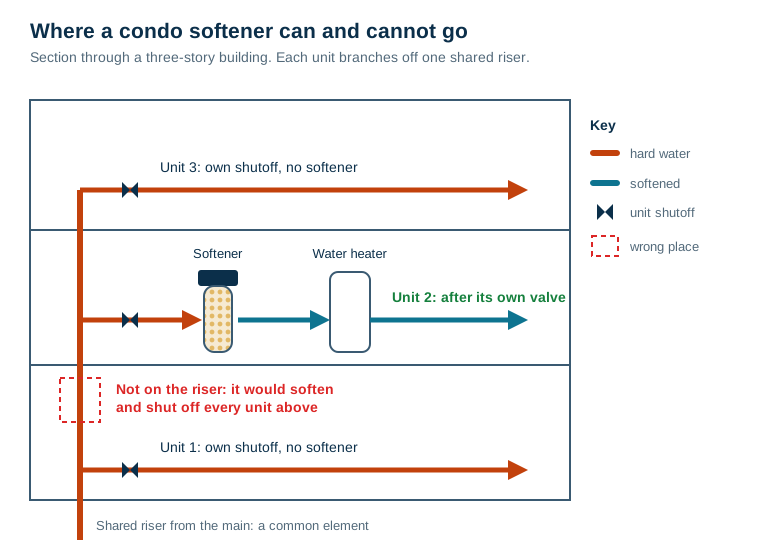
In a detached house, one service line feeds one household. In most condo and apartment buildings, a vertical riser carries water up through the building, and each unit branches off it. Some buildings give each unit a shutoff valve where its branch leaves the riser. Others have one valve for a whole stack, so shutting off water for your unit also shuts it off for your neighbors.
That difference decides more than any rule does.
- Your unit has its own shutoff, and everything after it serves only your unit. A softener can go on your branch after that valve. It softens only your water and uses only your water for regeneration.
- Your unit shares a valve or a branch with other units. Any softener on that pipe would soften your neighbors' water too, and servicing it would shut off their supply. That is a building project, not a unit project.
- Your water heater is inside your unit. The softener goes after your shutoff and before your water heater, the same as in a house. If hot water comes from a central boiler, a unit softener can soften only your cold water, which removes most of the benefit.
To find out which you have, look for a valve in the water heater closet, behind an access panel in the bathroom, or under the kitchen sink. Then ask the building manager what it controls.
What to Look for in the Governing Documents
Condo rules are usually spread across three or four documents. Search each for specific words rather than reading every page.
| Document | Search for | What it tells you |
|---|---|---|
| Declaration (CC&Rs, master deed) | "unit boundaries," "common element," "limited common element," "pipes," "fixtures" | Whether the pipes inside your walls belong to you, to the association, or to you with association control |
| Bylaws | "alteration," "improvement," "approval" | Who approves changes, such as the board or an architectural committee, and how |
| Rules and regulations | "plumbing," "water heater," "appliance," "contractor," "leak" | Licensed plumber requirements, required leak pans or leak-detection shutoffs, and restrictions on work hours |
| Insurance provisions | "HO-6," "unit owner coverage," "improvements and betterments" | Who pays if your softener leaks into the unit below |
| Architectural or alteration guidelines | "application," "plans," "specifications" | The request form and what to attach |
Two things to watch for:
- Pipes you own but cannot modify freely. Many declarations make the pipes that serve only one unit that owner's responsibility, while still requiring approval for any change. Ownership and permission are separate questions.
- Water in the dues. Many buildings have one master water meter and pay for water through the common budget. Regeneration water then becomes a shared cost. The EPA WaterSense program says regeneration "can use 25 gallons of water or more per day, or up to 10,000 gallons per year." Boards that raise this are not being difficult. Offer a demand-initiated (metered) model, which regenerates only after a set volume of water has been used.
Questions to Ask the Building Before You Buy
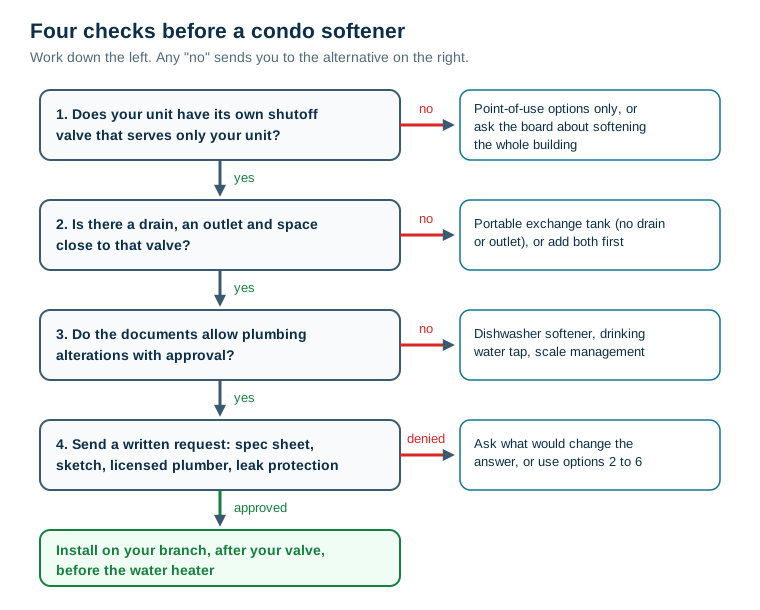
Put these to the manager or board in writing. The answers settle most cases before you spend anything.
- What does my unit's shutoff valve control? Only my unit, or a stack?
- Is building water already softened? Some buildings soften at the main to protect boilers. Softening water that is already soft does nothing.
- What is the hardness? Ask for the building's or the utility's hardness figure. Below about 7 grains per gallon, a whole-unit softener is hard to justify in an apartment.
- Can regeneration water go to the building drain? Is there a laundry standpipe or floor drain in my unit that I may use?
- Are there local brine discharge restrictions? Some communities limit salt-based softeners to protect wastewater treatment, and a building may follow those rules.
- What does an alteration request need? Plans, product specifications, a licensed and insured plumber, a leak pan, an automatic leak shutoff?
- Who is liable if it leaks? And does the master policy or my HO-6 policy cover damage to the unit below?
Water Softener for a Condo or Apartment: Six Options, Ranked
| Rank | Option | Softens | Plumbing change | Typical permission needed |
|---|---|---|---|---|
| 1 | Compact cabinet softener on your unit branch | Every tap in the unit | Yes: cut into the supply, drain connection | Board approval; landlord consent |
| 2 | Portable exchange tank on your unit branch | Every tap in the unit | Yes, but no drain and no outlet | Board approval; easier to grant |
| 3 | Building-wide softener | Every unit | At the main service | Board decision and budget |
| 4 | Dishwasher with a built-in softener | Dishwasher water only | None beyond the normal dishwasher hookup | Usually none |
| 5 | Under-sink or countertop drinking water treatment | One tap | Minor or none | Usually none, or minor |
| 6 | Manage the scale | Nothing | None | None |
1. Compact cabinet softener. A cabinet unit, with the resin tank inside the salt cabinet, fits water heater and laundry closets where a two-tank system would not. It is the complete answer if you have your own branch, a drain and an outlet, and compact softeners scored on space, drain and lease limits compares the units that fit. Choose a metered model to keep regeneration water down. Plan the space carefully, including room above the lid, using how much space a water softener needs.
2. Portable exchange tank. This goes in the same position on your branch, but it needs no drain, no outlet and no salt. It regenerates off site, so none of your building's water or drains are used for it. That removes the main objections a board has. What you give up is an ongoing service fee and swap visits. See portable exchange tank vs installed softener.
3. Building-wide softening. If many owners complain about scale, a single softener at the main service can do what dozens of separate units would. It is a capital project for the board, and it should be sized by a professional. It also means every unit receives softened water, including owners who would not have chosen it.
4. A dishwasher with a built-in softener. Some dishwashers, mostly European brands, have a small ion exchange softener with a salt reservoir built in. This solves spotting on dishes, which is one of the most visible hard water complaints, with no plumbing change at all.
5. Drinking water treatment at one tap. A reverse osmosis unit under the sink removes most hardness at that one faucet, along with much else. The CDC's home water treatment page describes point-of-use systems as delivering treated water "to a single tap." That is the trade-off. The kitchen tap improves, and the shower does not. Where drilling the sink is not allowed either, a plug-in countertop unit needs no plumbing at all. Comparing countertop RO units on certification and filter cost covers the options, and what the AquaTru Classic costs per gallon shows the running cost of one certified model. The difference between the two approaches is explained in point-of-entry vs point-of-use water softening.
6. Manage the scale. Cleaning aerators and showerheads with vinegar, descaling the kettle and coffee maker, and using rinse aid in the dishwasher all deal with the results of hard water without any approval.
What is not on the list. Shower filters and salt-free "conditioners" are often sold to renters as softeners. Most shower filters target chlorine, not hardness. Salt-free conditioners change how scale forms but leave the calcium and magnesium in the water. Neither one softens water.
Single-Unit Installations That Are Genuinely Permitted
Softeners do go into condos and apartments regularly. The permitted cases usually look like one of these:
- Townhouse-style condos with their own water service, meter and water heater. These are plumbed like houses. The association usually controls only the exterior, and approval, if it is needed at all, is a formality.
- Units with a dedicated branch, an in-unit water heater and a laundry closet. The laundry standpipe provides the drain, and the washer outlet provides power. This is the most common approved condo installation.
- Landlord-installed softeners in apartments with hard water, where the owner adds them as an amenity or to protect water heaters. Tenants in this case should know who maintains the salt. The landlord and tenant side is covered in water softeners in rental properties.
- Associations with a published approval process. Some boards have approved enough softeners to have a standard checklist, typically a licensed plumber, a leak pan or leak-detection shutoff, and a metered valve.
A strong alteration request includes the product's specification sheet, a sketch showing the unit shutoff, the softener, the drain and the water heater, the plumber's license and insurance, the regeneration settings, and the leak protection you will add. The board is deciding about risk. Make it easy to see that the risk has been dealt with.
What a Condo Softener Cannot Do
A softener on your branch changes only your water, after your valve. It does not fix scale in a shared boiler, corrosion in building risers, or low pressure from undersized building plumbing. It also removes only hardness and a small amount of dissolved iron. The CDC notes that water softeners "do not remove parasites, bacteria, or viruses." Test your water before you buy, and if the problem is taste, chlorine or lead rather than hardness, a softener is the wrong tool whatever the rules allow.
Frequently Asked Questions
Can you put a water softener in a condo?
Often, yes, if three things line up. Your unit needs its own shutoff valve on a branch that serves only your unit. It needs a drain, an outlet and space near that shutoff. And the association has to approve the plumbing alteration if the governing documents require it. If any of the three is missing, a portable exchange tank or point-of-use treatment is usually the practical answer.
Do I need HOA approval to install a water softener?
Usually. Most condo declarations require board or architectural committee approval before changes to plumbing, especially anything that cuts into supply lines or connects to building drains. Read the declaration, bylaws and rules for words like alteration, improvement, plumbing and common element, and submit a written request with the plumber's details and product specifications.
Can a renter install a water softener in an apartment?
Only with the landlord's written permission, because it means cutting into the building's plumbing. Renters who cannot get permission can use options that need no plumbing changes: a countertop or under-sink filter for drinking water, a dishwasher with a built-in softener, and descaling routines for fixtures and kettles.
Is there a water softener for apartments that doesn't need plumbing?
Not one that softens the whole unit. Any whole-unit softener has to be connected to the supply line. Options that need no permanent plumbing are limited to single points of use, such as a faucet-mounted or countertop filter, and none of these softens every tap. Salt-free conditioners and shower filters are often marketed this way, but they do not remove hardness.
Where does a water softener go in a condo?
On the cold supply branch after your unit's own shutoff valve, before the water heater, and close to a drain and an outlet. In many condos, that point is in the water heater closet or the laundry closet. It never goes on a shared riser or on any pipe that also serves another unit.
Can a whole condo building have one water softener?
Yes. Some buildings soften water centrally at the main service, usually to protect boilers and water heaters. It is a board decision and a building-wide project, but it avoids a separate installation in every unit. Ask whether the building already softens water before you plan your own, because softening already softened water adds nothing.
