
Salt-Based vs Salt-Free Water Treatment
The honest answer to salt based vs salt free water softener is that only one of them softens water. A salt-based softener removes calcium and magnesium, so a hardness test after it reads near zero. A salt-free conditioner leaves the hardness in and changes how it behaves, mainly so it forms less scale when heated. Which is right depends on the problem you need fixed.
That sounds like a point in favour of salt-based systems. It is not, necessarily. There are problems salt-free systems solve well, households where they are clearly the better choice, and places where a salt-based unit is not allowed at all. The useful comparison starts from what each technology measurably does, not from what either industry calls it.
Salt Based vs Salt Free Water Softener: What Each One Measurably Does
A salt-based softener uses ion exchange. Water passes through a bed of resin beads that hold sodium. Calcium and magnesium stick to the resin and sodium is released in their place. When the resin is full of hardness, the softener regenerates. It floods the resin with strong brine from the salt tank, which pushes the hardness off, then flushes the hardness and spent brine to a drain. The full cycle is walked through in how a whole-house water softener works.
A salt-free conditioner, in the form most whole-house units take, uses template assisted crystallization (TAC). Water passes through a bed of treated media. The surface of the media encourages dissolved calcium and magnesium to form microscopic crystals, which then leave with the water. Hardness is still in the water, but more of it is in crystal form, and crystals already formed are less likely to grow as scale on hot surfaces. How a salt-free water conditioner works covers the media and its limits in more detail.
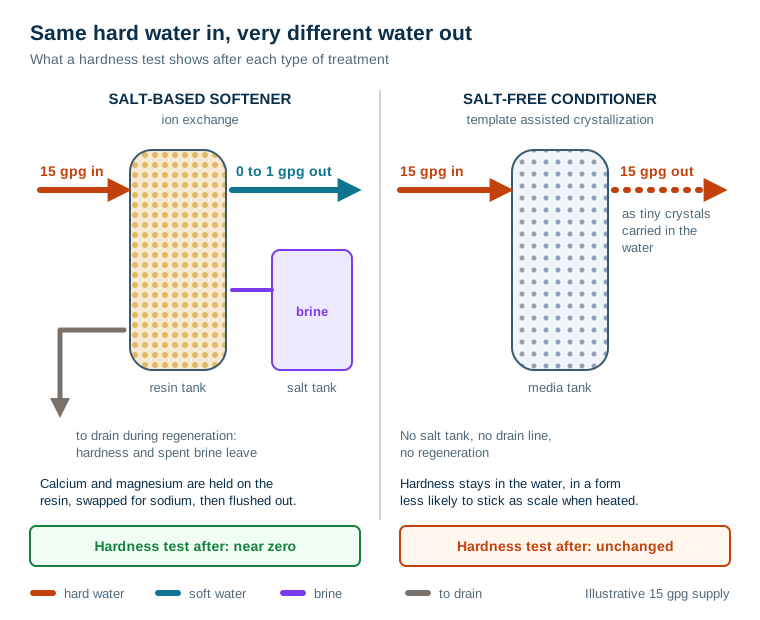
The practical difference shows up in a test kit. Test the water after each system:
| Measurement | After a salt-based softener | After a salt-free (TAC) conditioner |
|---|---|---|
| Total hardness | Near zero (often 0 to 1 gpg) | Same as the incoming water |
| Scale on heated surfaces | Largely prevented | Reduced |
| Spots on glass and shower doors | Largely prevented | Not prevented |
| Soap lather | Much improved | Little change |
| Sodium added | Yes, in proportion to hardness removed | No |
| Water sent to drain | Yes, at each regeneration | No |
Most of the argument between the two industries comes from blurring those rows.
The Framing Both Industries Get Wrong
Salt-free systems are not softeners. Softening means removing hardness, and a TAC unit does not. The products are sold as "salt-free softeners" because that is what people search for, and the name leads buyers to expect results a conditioner cannot deliver: spot-free glasses, rich lather, the slippery feel. When those do not appear, the buyer concludes salt-free "doesn't work," when it was working all along at what it actually does. Whether any of them soften at all is examined in detail in does a salt-free system actually soften water.
Salt-based systems are not filters. A softener exchanges hardness ions, and within limits some dissolved iron and manganese. It does not remove lead, arsenic, nitrate, bacteria, pesticides or most other health-related contaminants. Where a filter fits alongside or instead of one is covered in water softener vs whole-house water filter. Sales pitches that present a softener as general "water purification" overstate it as badly as calling a conditioner a softener.
Both are sold on fear of the other. Salt-free sellers talk about brine, sodium and wasted water. Salt-based sellers talk about scale and snake oil. Each has a real point and each leaves out the other's strengths.
What the Evidence Says About Salt-Free Performance
Salt-free treatment covers several different technologies, and they do not perform alike. The most useful independent test compared them directly.
The WateReuse Research Foundation's Evaluation of Alternatives to Domestic Ion Exchange Water Softeners, funded with the US Bureau of Reclamation, the California State Water Resources Control Board and several water utilities, found:
- Template assisted crystallization reduced scale formation by more than 88 percent.
- Electromagnetic treatment and electrically induced precipitation reduced it by about 50 percent.
- Capacitive deionization and ion exchange also reduced scale efficiently.
Two things follow. TAC is the salt-free technology with evidence behind it, and magnetic or electronic devices are a weaker class (see water softener vs electronic and magnetic descalers). And even the best salt-free result was a reduction in scale, measured on heated surfaces, not a reduction in hardness. Why those are different goals is set out in scale prevention vs hardness removal.
The limits of that evidence matter. It was a controlled test on specific waters, not a guarantee for every product sold with "TAC" on the label. Ask any seller for the independent test data behind their specific media, and for its stated operating limits, before you rely on it. How to evaluate salt-free and maintenance-free claims and how to verify a softener certification show what to ask for and how to check it.
Where Salt-Free Genuinely Wins
This is the section most comparison pages from softener sellers leave out. There are situations where a salt-free conditioner is the better choice, not a compromise.
When salt discharge is restricted. Regeneration sends salty brine to the sewer or septic system, and some wastewater plants cannot remove chloride before their water is discharged or reused. California's Health and Safety Code section 116786 lets a local agency limit or prohibit the installation of new residential softeners that discharge to the community sewer, if an independent study shows it is needed to meet discharge requirements. Where such rules apply, salt-free is the legal route.
When there is no drain. A salt-based softener needs somewhere to send regeneration water. Condos, some apartments and outdoor installations often have nowhere suitable. A TAC unit has no drain line.
When the goal is protecting equipment, not changing the water's feel. On moderately hard city water, if what you care about is scale in a water heater, a tankless heater, or the fixtures, a salt-free conditioner within its limits can deliver most of that protection with almost no upkeep. The tankless case is covered in salt-free conditioning for tankless heaters and boilers.
When sodium is a real concern. A softener adds sodium in proportion to the hardness removed. For someone on a strict sodium-restricted diet with very hard water, a conditioner adds none. Potassium chloride in a salt-based unit is the other answer.
When nobody will look after it. A salt-based softener needs salt added, occasional cleaning, and a working control valve. A salt-free conditioner needs a media change every few years (what that maintenance involves). For a second home, a rental, or an owner who cannot lift 40 lb bags, that difference matters.
When water waste is the objection. EPA's WaterSense page on cation exchange water softeners notes regeneration can use 25 gallons of water or more a day, or up to 10,000 gallons a year. A conditioner uses none.
Where Salt-Based Clearly Wins
Visible hardness symptoms. Spots on glassware and shower doors, soap scum, a ring in the tub, stiff laundry and poor lather all come from dissolved hardness. Only removing it fixes them.
Very hard water. Salt-free manufacturers publish a maximum hardness their media is designed for. Above it, results drop off. Ion exchange keeps working at high hardness; it just regenerates more often.
Iron and manganese. Small amounts of iron and manganese foul TAC media and are usually listed as strict limits. A softener can handle modest dissolved iron, although significant iron needs its own filter either way. See water softener vs iron filter, and salt-free conditioners on city vs well water for why well supplies are harder on TAC media.
Certainty. A softener's result is measurable at home with a test strip, though softened water need not test at zero. A conditioner's result is scale that does not form, which is much harder to confirm without waiting months and inspecting a heater element.
The Needs-Based Decision Table
Find the row that describes your main need. If two rows conflict, the one you care about more decides it.
| Your main need | Better choice | Why |
|---|---|---|
| Spot-free glass, better lather, soft feel | Salt-based | Only removing hardness fixes these |
| Protect a water heater on moderately hard city water, low upkeep | Salt-free (TAC), within its limits | Scale reduction without salt, drain or power |
| Local rules restrict salt discharge | Salt-free | Legal where salt-discharging units are not |
| No drain available (condo, some rentals) | Salt-free | No regeneration water to dispose of |
| Very hard water, above the conditioner's stated limit | Salt-based | TAC performance falls off beyond its rating |
| Well water with iron or manganese | Salt-based, plus iron treatment if needed | Iron and manganese foul TAC media |
| Strict sodium restriction | Salt-free, or salt-based with potassium chloride | No sodium added |
| Minimal maintenance, owner often away | Salt-free | No salt, no valve, media every few years |
If your answer is "both" in the sense that you want the softened feel and you live where salt discharge is restricted, the options are an off-site exchange tank service (compared in portable exchange tank vs installed softener) or accepting that a conditioner will protect equipment but not change the feel. The cases where salt-free is sold to people it cannot help are covered in when a salt-free conditioner is the wrong choice, and the operating limits to check before buying are in hardness limits for salt-free conditioners.
Running Costs and Upkeep Compared
| Item | Salt-based softener | Salt-free conditioner |
|---|---|---|
| Consumable | Salt or potassium chloride, refilled regularly | Media, replaced every few years |
| Water use | Regeneration water to drain | None |
| Electricity | Small, for the control valve | Usually none |
| Routine tasks | Add salt, check for bridges, clean brine tank occasionally | Replace prefilter if fitted, change media when due |
| Parts that wear | Control valve seals, injector, resin over many years | Media |
| Installation needs | Drain, power outlet, bypass valve | Bypass valve; prefilter often recommended |
Neither needs much attention if it is sized and installed properly, but the attention each one needs is different. A salt-based softener fails loudly: hard water comes back and the owner notices. A conditioner that has passed the end of its media life fails quietly, and scale builds up slowly before anyone knows. In money terms, pricing a salt-free conditioner's media changes over ten years against a salt softener shows when going salt-free actually saves money.
What Neither System Does
It is worth saying plainly, because both are sometimes sold as if they did:
- Neither disinfects. Bacteria in a well need disinfection, not softening or conditioning.
- Neither removes lead, arsenic, nitrate or PFAS. These need treatment designed and tested for those specific contaminants, often reverse osmosis.
- Neither fixes low pH or corrosive water. That needs a neutralizer. See water softener vs acid neutralizer.
- Neither removes chlorine or chloramine. A carbon filter does that, and some conditioners need it upstream to protect the media.
Whether your house needs either system at all is a separate question, worked through in do you need a whole-house water softener.
The Short Answer
Choose salt-based when you want the hardness gone and can see the evidence in your glasses, showers and laundry. Choose salt-free when the goal is protecting equipment from scale, you cannot discharge brine, or you want as little upkeep as possible, and your water sits inside the conditioner's stated limits. Test your hardness, iron and manganese first. The right answer comes from the test, not from either sales pitch. The Pelican review sets one brand's salt-based softener and salt-free conditioner side by side against a water test, which is this choice applied to two real products. If the test points to salt-free, choosing a conditioner that publishes its scale evidence and water limits is the next step.
Related Comparisons
If you have settled on salt-based, these cover the choices within it:
- Single-tank vs twin-tank softeners: whether you need soft water during regeneration.
- Metered vs timer-based softeners: why regenerating on use saves salt and water.
- Upflow vs downflow regeneration: how brine direction affects salt efficiency.
- Proportional brining vs fixed salt dosing: what the valve feature is worth.
- Electric vs non-electric softeners: water-powered valves and where they fit.
- Standard vs fine-mesh resin and standard vs chlorine-resistant resin: which resin suits your water.
- How to compare softener spec sheets and what NSF/ANSI 44 means: reading ratings and certifications.
- Can water be too soft? and does soft water damage or protect pipes?: the common worries about softened water.
And if salt-free is the likelier fit, can a salt-free conditioner remove existing scale? covers what to expect in a house that already has buildup.
Frequently Asked Questions
What is the difference between a salt-based and a salt-free water softener?
A salt-based softener removes calcium and magnesium by ion exchange, so a hardness test after it reads near zero. A salt-free system, usually template assisted crystallization, leaves the hardness in the water but converts some of it into tiny crystals that are less likely to form scale. A hardness test after a salt-free system reads the same as before.
Do salt-free water softeners really work?
They work at reducing scale, not at softening. In a study co-funded by the US Bureau of Reclamation, template assisted crystallization reduced scale formation by more than 88 percent in heated test rigs. They do not remove hardness, so they will not stop spots on glass, improve soap lather or give the slippery feel of softened water.
Which is better for a water heater, salt-based or salt-free?
Both reduce scale in a water heater. A salt-based softener does it by removing the hardness entirely. A good salt-free conditioner does it by changing how the hardness behaves when heated, as long as the water is within the product's limits for hardness, iron, manganese and chlorine. Salt-based is the more certain protection; salt-free is the lower-maintenance one.
Is salt-free water treatment healthier than salt-based?
Neither is a health treatment. A salt-based softener adds a small amount of sodium in proportion to the hardness it removes, which matters for people on a sodium-restricted diet. Potassium chloride can replace salt, or softened water can be kept off the kitchen tap. A salt-free conditioner adds no sodium. Neither removes lead, nitrate, bacteria or most health-related contaminants.
Why do some cities ban salt-based water softeners?
Regeneration sends salty brine down the drain, and some wastewater plants cannot remove chloride before discharging to rivers or reuse. California law lets a local agency limit or prohibit new salt-discharging softeners if it is needed to meet its discharge requirements. In those areas, a salt-free system or an off-site exchange service may be the only option.
How long does a salt-free water conditioner last?
The media in a template assisted crystallization tank typically needs replacing every few years, with the interval set by the manufacturer and by water quality. Chlorine, iron and manganese can shorten its life. There is no salt to add in between, and most units need no electricity and no drain.
