
Best Alkaline Reverse Osmosis Systems

The best alkaline reverse osmosis system for most kitchens is the iSpring RCC7AK. It is a 75-gallon-per-day tank system with an NSF/ANSI 58 listing for TDS reduction and a pH-raising mineral cartridge, and it needs no power. If you want the remineralization that does the most, the Home Master TMAFC adds calcium and magnesium twice, but it carries certified components rather than a certified system. The Waterdrop X12 is the certified tankless option.
Every alkaline RO system works the same way. The membrane strips the water, and a cartridge after it dissolves some mineral back in. The cartridge is a small, cheap part. Certification and running cost are what actually separate these systems.
Disclosure: Hard Water Solved may earn a commission if you buy through links on this page, at no extra cost to you. It does not change which products we include or how we rank them. Read our disclaimer.
How We Picked: Mineral Stage, Certification, Running Cost
Method. Each system was compared on what its maker says the mineral stage adds, which certification the system carries and from whom, its published feed limits, and its filter replacement schedule. Evidence comes from product pages, filter pages and certification listings. Nothing was physically tested.
Included: under-sink RO systems with a remineralization or alkaline stage, sold on Amazon.com.
Excluded: countertop units, alkaline pitchers and ionizers. They do not use an RO membrane, or they are covered separately.
Health claims: none. The makers market these stages for taste and pH, and that is how they are judged here.
Prices are not listed here because they change often. Use the buttons to see the current price on Amazon.
Who should buy none of these: anyone who wants to remove a specific contaminant that the system's listing does not cover, and anyone hoping the mineral cartridge replaces a softener. Both are covered at the end.
Where the Alkaline Stage Sits and What It Adds
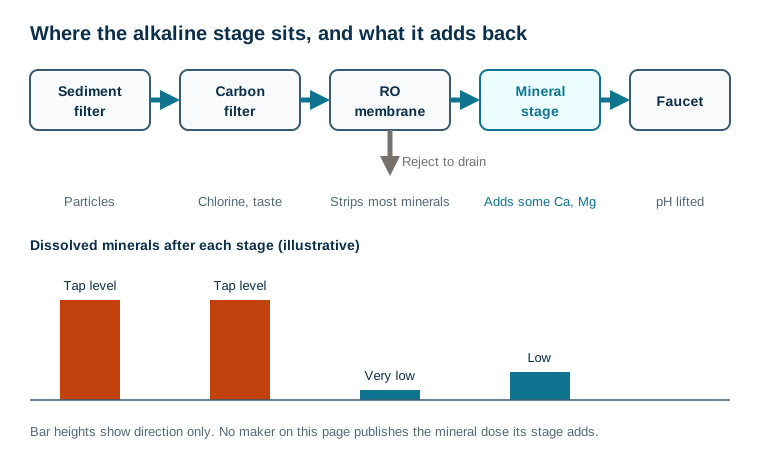
The RO membrane takes out most dissolved solids, including the calcium, magnesium and bicarbonate that buffer pH. Carbon dioxide passes through, so plain RO water tends to sit slightly on the acid side. A mineral cartridge, usually calcium carbonate with or without magnesium, dissolves a little back in. The pH rises and the taste rounds out.
This is the reverse of what a softener does. A softener swaps calcium and magnesium for sodium and leaves pH largely alone, as does a water softener change pH explains with measurements. An alkaline RO system removes nearly everything, then adds back a small amount of the same two minerals.
What Each Mineral Stage Adds, Compared
| System | Amazon | Mineral stage | Minerals named by the maker | pH claim |
|---|---|---|---|---|
| iSpring RCC7AK | Check price on Amazon | One alkaline pH+ cartridge, stage 6 | Not named on the pages we could read | "Alkaline", no figure |
| Home Master TMAFC | Check price on Amazon | Patented 2-pass "full contact" | Calcium and magnesium, added twice | No figure found |
| Home Master TMHP | Check price on Amazon | Same 2-pass system | Calcium and magnesium, added twice | No figure found |
| Waterdrop X12 | Check price on Amazon | Built-in mineral stage | Calcium and magnesium | About 7.5 |
Mineral claims are as the makers describe them on their own pages. None publishes the dose in mg/L.
Two things stand out. Only one maker gives a pH figure, and none gives a mineral dose. That makes it impossible to rank these on "how alkaline" from published data.
The Certification Behind Each Alkaline RO
The mineral stage is not what gets certified. The RO system is, or is not. Here is the evidence for each:
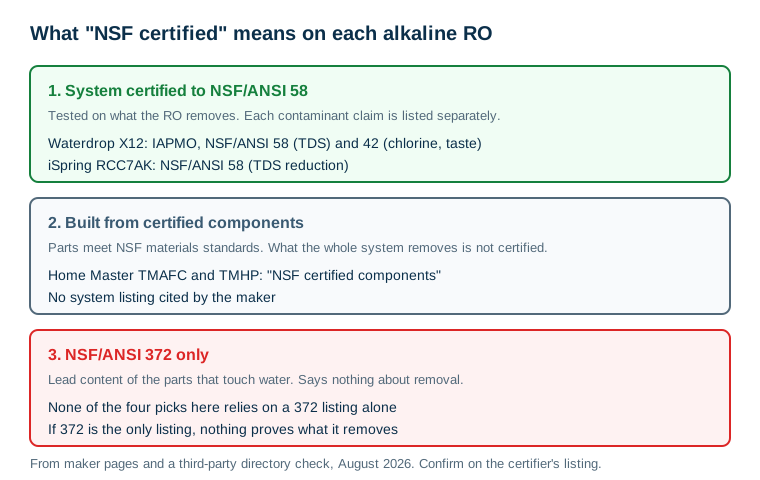
- NSF/ANSI 58 is the RO performance standard. A listing proves TDS reduction, plus any contaminant listed by name. The Waterdrop X12 is listed with IAPMO under 58 for TDS and under 42 for chlorine, taste and odour. The iSpring RCC7AK is listed under 58 for TDS reduction.
- Certified components means the parts meet NSF materials standards. Home Master says its systems are built with "NSF certified components". We found no system-level 58 listing cited for the TMAFC or TMHP.
- NSF/ANSI 372 only covers lead content in wetted parts. None of the four picks relies on it alone, but if 372 is the only listing on an alkaline RO you are considering, nothing third-party proves what it removes.
None of the four has a certified claim for lead, PFAS or nitrate on the listings we found. If one of those is why you are buying RO, choose a system whose listing names that contaminant, and treat the mineral stage as an extra.
Running Cost and Feed Limits
| System | Filter replacement | Waste ratio | Feed hardness limit | Power |
|---|---|---|---|---|
| iSpring RCC7AK | Sediment 6 months; others yearly; membrane about 3 years | Not published on pages read | 7 gpg or less in iSpring's RO manual | None |
| Home Master TMAFC | All filters once a year or 2,000 gallons | Up to about 4:1 without the optional permeate pump | 10 gpg max | None |
| Home Master TMHP | Once a year or 2,000 gallons | About 1:1 (permeate pump built in) | 10 gpg max | Plug-in UV |
| Waterdrop X12 | 6, 12 and 24 months | 1 to drain per 3 made (3:1) | Under 7 gpg | Plug-in pump |
Waste ratios shown as gallons sent to drain per gallon of drinking water, except where a pure-to-drain ratio is quoted. EPA's WaterSense page on point-of-use RO puts a typical system at five gallons or more to drain per gallon made, and a WaterSense-labeled one at 2.3 or less.
On hard water, the feed limit matters as much as the price. Every maker that publishes one sets it between 7 and 10 grains per gallon. Above that, the membrane works outside its rated conditions, and the mineral cartridge cannot help, because it sits after the membrane. A softener ahead of the RO is the fix, sized for the whole house as set out in how to size a water softener. How reverse osmosis and a water softener work together covers the layout and why softened feed suits a membrane.
1. iSpring RCC7AK: Best Certified Value
A 6-stage, 75 GPD tank system with a 3.2-gallon tank and iSpring's top-mounted faucet. It is the least expensive system here with a performance listing: NSF/ANSI 58 for TDS reduction. It needs no electricity. A directory record of the maker's schedule gives the sediment filter 6 months, the other filters a year, and the membrane about 3 years. iSpring's RO manual makes feed hardness of 7 gpg or less a warranty condition.
The mineral stage. A single alkaline cartridge after the membrane. iSpring sells it as raising pH, but the minerals and dose were not specified on the pages we could read.
What it skimps on. Its certification covers TDS only. The marketing lists far more, including fluoride, lead and PFAS, without a listing to back those claims.
Buy it if you want certified RO with a taste-improving mineral stage at the lowest price, on softened or moderately hard city water.
2. Home Master TMAFC: Most Remineralization, No System Listing
Home Master's TMAFC page describes a 7-stage system with a 5-micron sediment filter, an 8.5-inch catalytic carbon filter and a patented remineralization stage. It adds calcium and magnesium twice during purification. The filters are modular all-in-one cartridges, sold together as the Artesian change set and changed once a year or every 2,000 gallons. Published limits are 10 gpg maximum hardness and 2,000 ppm TDS. It has a 5-year limited warranty and needs no power.
The mineral stage. It is the most thorough described here, because it is the only one that contacts the water twice. Home Master also says the minerals help prevent storage tank degradation.
What it skimps on. Certification and water efficiency. Home Master cites certified components, not a system listing. Without the optional permeate pump, its own overview gives waste ratios up to about 4:1. The pump version, TMAFC-ERP, brings that to about 1:1.
Buy it if taste is the goal, you want the lowest yearly filter cost here, and you do not need a certified contaminant claim.
3. Home Master TMHP HydroPerfection: For Water That Needs More Pre-treatment
This is the same 2-pass calcium and magnesium remineralization with three additions. An iron and KDF85 pre-filter handles chlorine and light iron. A built-in non-electric permeate pump brings the waste ratio to about 1:1. A cold LED UV stage finishes the water. Filters change once a year or every 2,000 gallons. It has the same 10 gpg hardness limit and the same 5-year limited warranty.
The mineral stage. It is identical to the TMAFC's.
What it skimps on. The same certification gap as the TMAFC, at a higher price to buy and a higher filter cost to run. The UV stage is not a substitute for disinfecting an unsafe well.
Buy it if you are on treated well water or water with light iron, want the best water efficiency of the tank systems here, and value Home Master's remineralization over a performance listing.
4. Waterdrop X12: Certified Tankless With a Mineral Stage
Waterdrop's X12 page describes an 11-stage tankless system rated at 1,200 GPD with a 3:1 pure-to-drain ratio. Its mineral stage adds calcium and magnesium and brings pH to about 7.5. Filters are rated at 6 months or 550 gallons (F2), 12 months or 1,100 gallons (F1A) and 24 months or 2,200 gallons (F3 RO). It needs an outlet. Feed limits are municipal water, under 7 gpg hardness and under 750 ppm TDS.
Certification. IAPMO listings under NSF/ANSI 58 for TDS reduction and 42 for chlorine, taste and odour, per a third-party directory check.
What it skimps on. Price. It costs several times as much as the RCC7AK for a tankless format and faster flow.
Buy it if you want no tank, a certified RO and a mineral stage, and you have an outlet under the sink and the budget.
Who Should Buy None of These
- You are buying to remove lead, PFAS, nitrate or arsenic. None of the four has one of those on the listing we found. Buy an RO system certified for that contaminant by name, then add a mineral cartridge if you like the taste.
- You want softer water through the house. An alkaline RO unit treats one tap. Scale on fixtures and in the water heater is a softener's job.
- You want mineral water for its health effects. No maker publishes the dose, and the amounts these cartridges add are small. If hard water's minerals are the appeal, is hard water bad for you covers what the evidence says about them.
- Your feed water is above 10 gpg and you will not soften it. Every published limit here is 7 to 10 gpg. Expect earlier membrane changes.
For most buyers, the alkaline stage should be the tiebreaker, not the reason to buy. Start with a system whose certification covers what you need removed. Then choose the mineral stage whose taste you prefer.
Frequently Asked Questions
What is an alkaline reverse osmosis system?
It is a standard reverse osmosis system with an extra cartridge after the membrane that dissolves a small amount of mineral, usually calcium and magnesium, back into the purified water. That raises the pH slightly and changes the taste. The RO membrane still does the purifying. The mineral stage only adds.
Is alkaline RO water healthier than plain RO water?
No maker on this page publishes the mineral dose its cartridge adds, and the amounts involved are small. Treat the mineral stage as a taste and pH feature. We make no health claim for it, and the certification standards do not test for one.
Why is plain RO water slightly acidic?
The membrane removes most dissolved minerals, including the bicarbonate that buffers pH, but carbon dioxide passes through. With little left to buffer it, the dissolved carbon dioxide pulls the pH down a little. A calcium or calcium-magnesium cartridge adds back some alkalinity, which is why makers describe it as raising pH.
Does an alkaline RO system need a water softener in front of it?
Not always, but it protects the membrane. Waterdrop lists feed hardness under 7 grains per gallon for the X12. Home Master lists a maximum of 10 gpg for its systems. iSpring's RO manual makes 7 gpg or less a warranty condition. If your water is harder than that, a softener upstream keeps the membrane inside its rated conditions.
Is an NSF 372 certified RO system the same as NSF 58?
No. NSF/ANSI 372 covers only the lead content of the parts that touch the water. NSF/ANSI 58 is the reverse osmosis performance standard, which tests TDS reduction and any contaminant claims listed for the system. An alkaline RO listed only to 372 has no third-party proof of what it removes.
How often do you replace the alkaline filter?
Usually once a year with the other post-filters. Home Master changes all its filters once a year or every 2,000 gallons. Waterdrop rates the X12's cartridges at 6, 12 and 24 months. When the mineral cartridge is spent, the water simply tastes like plain RO water again.
