
Is Hard Water Unhealthy to Drink?
Is hard water bad for you? No. Hardness is calcium and magnesium dissolved from rock, and neither is a health hazard at the levels found in tap water. The World Health Organization proposes no health-based guideline value for hardness, and EPA has no drinking water standard for it. If anything, the research leans slightly the other way: some studies link magnesium in drinking water to fewer heart disease deaths.
That is an odd thing for a website about water softeners to put first. It is also the honest answer, and a softener bought for health reasons is a softener bought for the wrong reason. The good reasons to soften water are scale, soap and appliance life. This page sets out what the evidence actually says, outcome by outcome, and where a real health question does start.
Is Hard Water Bad for You? What WHO and EPA Actually Say
Two bodies set the rules that matter for US drinking water, and neither treats hardness as a health contaminant.
The World Health Organization wrote a dedicated background document, Hardness in Drinking-water, for its drinking water guidelines. Its conclusion is direct. It says there is some evidence for "a protective effect of magnesium or hardness on cardiovascular mortality", but the evidence "is being debated and does not prove causality". It adds that there are "insufficient data to suggest either minimum or maximum concentrations of minerals", so "no guideline values are proposed". WHO describes hardness as important "for aesthetic acceptability by consumers and for economic and operational considerations". It does not describe it as a health matter.
EPA sets legally enforceable limits, called maximum contaminant levels, for contaminants that can harm health. Hardness is not one of them. EPA also publishes a list of 15 non-enforceable secondary drinking water standards for nuisance effects such as taste, staining and deposits. Hardness is not on that list either. It appears only as one of the effects of high total dissolved solids, next to deposits and staining.
In short, the two agencies that write drinking water rules put hardness in the same category as spots on glasses. It is a cost and nuisance issue, and neither agency sets a health limit for it.
The Evidence, Outcome by Outcome
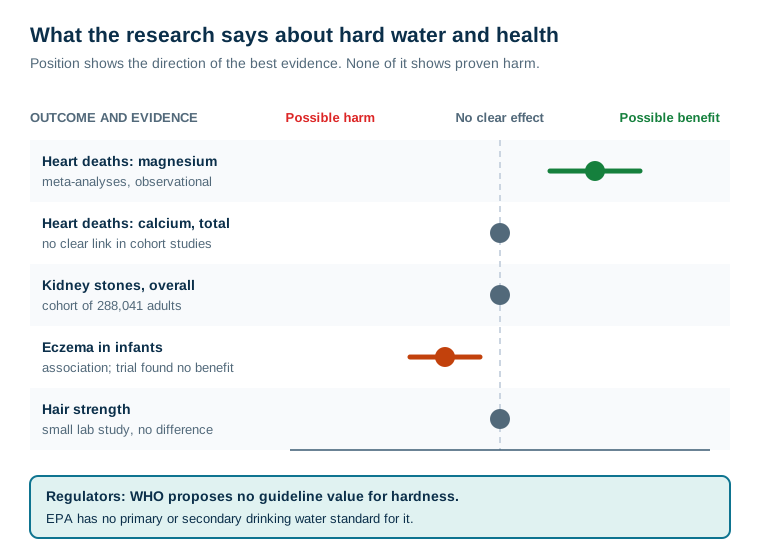
Health claims about hard water usually cite one of five outcomes. Here is what the best available research found for each, and how strong that research is.
| Outcome | What the research found | How strong it is |
|---|---|---|
| Heart disease deaths | Inverse association with magnesium in drinking water. No clear association with calcium or total hardness in higher-quality studies | Observational only. WHO: "does not prove causality" |
| Kidney stones | No significant link with hardness or calcium overall. Higher magnesium linked to lower risk. Some subgroups showed higher risk | One large prospective cohort, 288,041 people |
| Eczema in infants | More eczema in hard water areas, with a small effect size | Cohort studies show association. The one large trial of softeners found no added benefit |
| Hair strength | No difference between hair soaked in hard water and in distilled water | Small lab study |
| Dry skin | Soap residue can leave skin feeling tight | Comfort effect, not a disease |
Heart disease: a weak signal, in the protective direction
This is the most studied question, and every result that stands up points toward a small protective effect.
A 2008 systematic review in the Journal of Water and Health pooled nine case-control studies. It found a significant inverse association between drinking water magnesium and cardiovascular death, with an odds ratio of 0.75. Evidence for calcium was unclear. The cohort studies found no association between hardness and death from heart disease or stroke. A 2016 meta-analysis in Nutrients covered 77,821 coronary heart disease cases and found the same inverse link for magnesium, with a relative risk of 0.89. A 2023 meta-analysis in Foods reported that 17 of 25 studies found a protective relationship between total hardness and cardiovascular deaths. Its authors noted high heterogeneity and "many confounding factors".
Two cautions keep this in proportion. First, these are observational studies. People in hard water areas differ in diet, income and climate, and not every study can control for that. Second, WHO notes that where benefits were seen, they "generally occurred at magnesium concentrations of about 10 mg/l and greater". Much US hard water is mostly calcium, and calcium is the part with the weakest evidence.
The fair summary is that hard water is not bad for your heart, and it might be slightly good for it. That is not strong enough to choose your water for.
Kidney stones: no link overall
It sounds logical that calcium in water would feed calcium stones. The largest study so far does not support that for the population as a whole. A 2025 UK Biobank cohort study followed 288,041 adults with no previous stones. It found that hardness, calcium and calcium carbonate had "no significant impact on the formation of kidney stones" overall. Magnesium above 5 mg/L was linked to about 12 percent lower risk.
The same study found a raised risk with hard water in people over 60 and in women, of 18 to 34 percent. That is a subgroup result, and it needs to be repeated before anyone acts on it. If you have a history of stones, ask your doctor or urologist. They may give specific advice on fluids and minerals. A water website should not.
Eczema: an association, and a trial that found no benefit
Here the association runs the other way, and it deserves a straight answer. A Danish birth cohort of 52,950 children found that infant eczema was 5 percent more common for each 5-degree step up in water hardness. The authors estimated that hard water accounted for about 2 percent of cases. Several other cohorts have reported similar associations.
An association is not proof, and it has been tested directly. The Softened Water Eczema Trial randomised 336 children with moderate or severe eczema, all in areas with at least 200 mg/L hardness. Half had an ion-exchange softener installed and half had usual care. Nurses who did not know which homes had softeners scored the eczema. At 12 weeks, both groups had improved by about 20 percent, and the softener added no benefit. Parents reported small improvements, which the authors put down to people knowing they had a softener.
So softening is not a proven eczema treatment. The comfort side of hard water on skin, the tight feeling after a shower, is covered in can hard water make skin feel dry.
Hair: no change in strength
A lab study in the International Journal of Trichology soaked hair samples from 15 volunteers in hard water at 212.5 ppm and in distilled water for 30 days. It found no significant difference in tensile strength or elasticity. Hard water can leave residue that makes hair feel dull or rough, and that is a cosmetic issue.
How Much Calcium and Magnesium Hard Water Actually Supplies
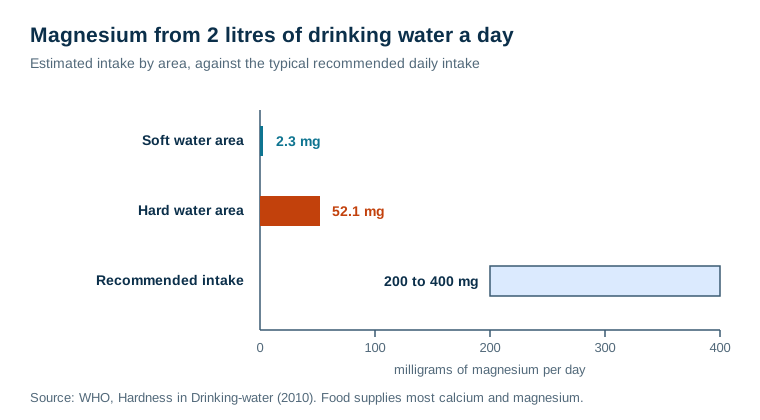
Hardness minerals are nutrients, and the amount in water is not trivial. WHO cites estimated magnesium intakes from water of about 2.3 mg a day in soft water areas and 52.1 mg a day in hard water areas, for an adult drinking 2 litres. Against typical recommended intakes of 200 to 400 mg of magnesium a day, the hard water figure is a noticeable share.
For calcium and magnesium together, WHO puts water's typical contribution at 5 to 20 percent of total intake. Food supplies the rest, and dairy alone often supplies over half of dietary calcium. WHO also notes that many people do not reach the recommended intakes from diet. For them, mineral-rich water "may provide substantial contributions".
That is why the real trade-off in softening is not safety. Softening removes these minerals and adds sodium. WHO says this directly: softening improves scaling, laundry and washing, "but it also increases the sodium (and chloride) content of the drinking-water", and mineral intake from water falls unless the water you drink "is not softened or is remineralized".
Why "Hard Water Is Unhealthy" Keeps Getting Repeated
If the evidence is this mild, the belief needs an explanation. There are four common sources.
- Scale looks alarming. A kettle crusted with white deposit or a shower head choked with scale looks like something you should not drink. It is calcium carbonate, the same compound as chalk and many calcium supplements. It forms when water is heated or evaporates. It is not a sign that something toxic is in the water.
- Sales pitches blur nuisance and health. "Protect your family" language gets attached to hardness because it sells equipment. A salesperson who implies that hard water is a health risk is either confused or counting on you not checking.
- Hardness gets confused with contamination. People see one number on a test report and assume "hard" means "bad". Hardness says nothing about bacteria, lead, arsenic or nitrate, which are the things that actually make water unsafe.
- Real comfort effects feel like health effects. Tight skin, itchy scalp and dull hair are real, and they are caused by soap residue. They are comfort problems, not illnesses.
The Real Reasons to Soften Hard Water
Take health off the list and the case for softening is still strong for many homes. It just rests on money and nuisance.
- Scale in water heaters and appliances. WHO notes that hard water causes scale that coats surfaces and reduces the efficiency of heat exchangers. It says soft or softened water allows "more efficient heat transfer" and "probably longer life of hot water heaters".
- Soap and detergent use. Hard water needs "considerably more soap to produce a lather", in WHO's words. It leaves soap curd on skin, hair, tubs and laundry.
- Spots and film. Glassware, shower doors, fixtures and cars all show hard water spots.
Where your water falls on those costs depends on how hard it is. That is covered in what water hardness level is considered too hard. By WHO's classification, water under 60 mg/L (3.5 gpg) is soft, 60 to 120 mg/L (3.5 to 7 gpg) is moderately hard, 120 to 180 mg/L (7 to 10.5 gpg) is hard, and above 180 mg/L (10.5 gpg) is very hard. Whether a softener pays off in your house is worked through in do you actually need a whole-house water softener.
When Something in Your Water Is a Health Concern
Hardness is not the thing to worry about. That does not mean your water is fine. The same well or supply can carry contaminants that do matter, and a hardness test does not detect any of them.
- Private wells are not regulated by EPA, and the owner is responsible for testing. EPA's private well guidance recommends regular testing for bacteria, nitrate and other local concerns. Very hard well water is often a sign of limestone geology. It tells you nothing about the well's sanitary condition.
- Lead comes from plumbing, not from the aquifer. Hard water does not cause it, and a softener is not a lead treatment.
- Arsenic, uranium, radon and PFAS are local issues, and each needs its own test and its own treatment.
WHO makes one point about corrosion worth noting. Soft water that is "not stabilized" tends to corrode pipes and can release lead and copper. That warning is about naturally soft, acidic water. Softened water keeps the pH and alkalinity of the water it came from, so it does not carry the same risk.
Who Should Ask a Doctor Before Changing Their Water
For most healthy people, the choice between hard and softened water is a comfort and cost decision. A few groups should involve a clinician, because either the minerals or the added sodium can matter:
- People on a sodium-restricted diet. Softening adds sodium in proportion to the hardness removed. The amounts are worked through in is softened water safe to drink.
- People with kidney disease. Kidney function affects how the body handles magnesium, calcium and sodium. WHO notes that the main cause of high blood magnesium is kidney insufficiency.
- People with a history of kidney stones. The evidence on water hardness is mixed by subgroup, and a urologist can give specific fluid advice.
- Parents preparing infant formula. WHO says formula-fed infants are not normally at risk from calcium in water, whether it is very low or very high. The sodium from softened water is a separate question. Ask your pediatrician about it.
WHO describes a simple way to keep both benefits: leave one tap unsoftened, usually the kitchen cold tap. You then drink and cook with the original water while the rest of the house gets the scale protection. Many installers can plumb this at little extra cost.
What a Softener Cannot Do for Your Health
A softener is a scale and soap appliance. It is not a health device, and a seller who presents it as one is overselling it.
- It does not make safe water safer. Hard water was not a health risk in the first place.
- It does not remove bacteria, nitrate, arsenic, PFAS or most other health contaminants. Each of those needs its own test and its own treatment.
- It does not treat eczema. The best trial found no added benefit.
- It does add sodium and remove the calcium and magnesium you would otherwise drink.
What to Do Next
If your only concern was health, you can stop worrying about hardness. Spend the effort on a proper water test instead. If you are on a private well, a lab panel for bacteria, nitrate and local contaminants tells you far more than a hardness strip.
If scale, soap and appliance life are costing you money, a softener is still a sound choice. Buy it for those reasons, keep an unsoftened drinking tap if you want the minerals, and ignore anyone who tells you hard water is making your family ill.
Frequently Asked Questions
Is it safe to drink hard water every day?
Yes, for healthy people. The World Health Organization reviewed the evidence and proposed no guideline value for hardness, and EPA has no drinking water standard for it. Hard water mainly carries calcium and magnesium, which are essential nutrients. It still needs to meet the normal standards for bacteria, lead, nitrate and other contaminants, which a hardness test does not measure.
Can hard water cause kidney stones?
Not in the population as a whole, on current evidence. A 2025 UK Biobank study of 288,041 people found no significant link between water hardness or calcium and kidney stones overall, and found that higher magnesium in water was linked to lower risk. It did report a raised risk in people over 60 and in women. If you have had stones, ask your doctor, who may give specific advice on fluids and minerals.
Is hard water good for your heart?
Possibly a little, but it is not proven. Meta-analyses have found an inverse association between magnesium in drinking water and deaths from heart disease. WHO says this evidence is debated and does not prove causality. It is not a reason to seek out hard water, and it is not a reason to fear softening.
Does hard water cause eczema?
Several cohort studies have found more infant eczema in hard water areas, which is an association rather than proof of cause. In the best trial so far, 336 children with eczema were given an ion-exchange softener or usual care. The softener gave no added benefit at 12 weeks. Softening is not a proven eczema treatment.
Is hard water bad for your hair and skin?
It can leave soap residue that makes skin feel tight and hair feel dull, which is a comfort issue. A lab study found that hard water did not change hair strength or elasticity. It is not a medical harm, and a cheap change of cleanser often helps as much as a softener.
Is softened water healthier than hard water?
No. Softening removes calcium and magnesium and adds sodium, so the drinking water is not healthier, just different. WHO notes that softening lowers the minerals you get from water unless you keep an unsoftened drinking tap. The benefits of softening are practical: less scale, less soap and longer-lasting water heaters.
