
Does a Water Softener Raise or Lower pH?
Does a water softener change pH? No, not in any meaningful way. A household softener swaps calcium and magnesium for sodium. It does not add or remove the hydrogen ions, bicarbonate or carbon dioxide that set pH, so water leaves at about the pH it arrived at. What does change is the water's tendency to form scale. That change, not pH, explains most of what people notice after installing a softener.
This matters because the myth works in both directions. Some owners blame a new softener for blue-green stains, when their water was acidic all along. Others buy a softener expecting it to fix low-pH well water, and it cannot. Both come from assuming that "softer" means "different pH".
Does a Water Softener Change pH? What Ion Exchange Actually Swaps
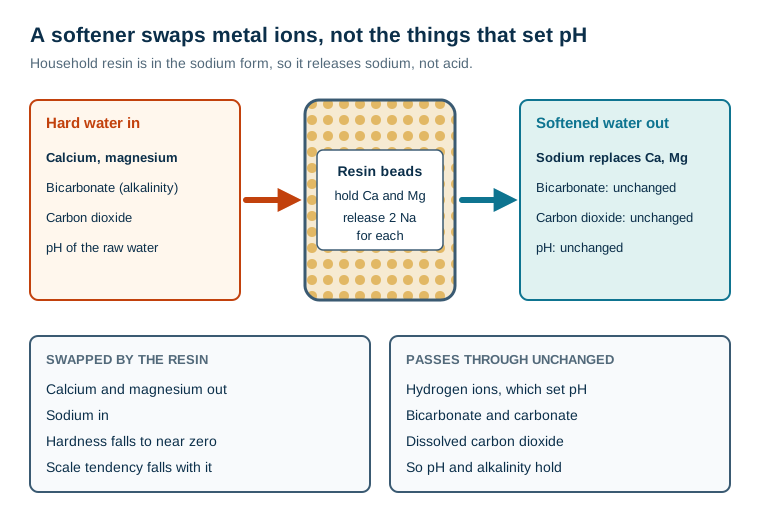
A softener's resin beads start each cycle loaded with sodium from the salt brine. As hard water flows through, the beads hold calcium and magnesium and release sodium in their place, two sodium ions for each calcium or magnesium ion. That swap involves only positively charged metal ions.
pH is set by other things:
- Hydrogen ions. The resin in a household softener is in the sodium form, not the hydrogen form, so it does not release acid.
- Bicarbonate and carbonate, which make up most of the water's alkalinity, its buffer against pH change. These are negative ions, and a cation resin does not exchange them.
- Dissolved carbon dioxide, which forms carbonic acid. It is a dissolved gas and passes through the resin bed.
Because none of those change, the balance between them does not change either. The pH that comes out is the pH that went in, within the precision of a home test.
There is one type of cation resin that does lower pH: resin in the hydrogen form, used in deionizers and dealkalizers. It releases hydrogen ions instead of sodium, and the water leaving it is acidic. Household softeners regenerate with sodium chloride or potassium chloride, not acid, so they do not behave like this.
What the Measurements Show
The question has been tested on real water. In a pilot study for EPA's National Risk Management Research Laboratory, researchers ran two waters through a household ion exchange softener and fed both the raw and softened water to matched pipe loops. The study is described in the EPA Science Inventory record:
- Phase I: a finished city tap water at 160 mg/L hardness and pH 9.1
- Phase II: a groundwater at 300 mg/L hardness and pH around 7.3
The report concluded that the softener did not have "a detrimental effect on the significant water quality parameters that influence metallic solubility". The Water Quality Association's white paper on softened water and corrosion summarises the same study more bluntly: "Cation exchange softening does not lower the pH, TDS, or alkalinity." WQA is an industry association, so the EPA record is the independent source to rely on. The two say the same thing.
The World Health Organization's background document on hardness reaches a compatible conclusion from the corrosion side. It notes that cation exchange softened water, although it contains added sodium, "is not necessarily corrosive". It contrasts this with naturally soft water, which usually needs stabilizing before distribution.
There is no large public dataset of household softeners tested on dozens of water types. That is why the next section works through three typical waters by calculation, and why the last sections show you how to measure your own.
The Change That Is Real: Saturation, Not pH
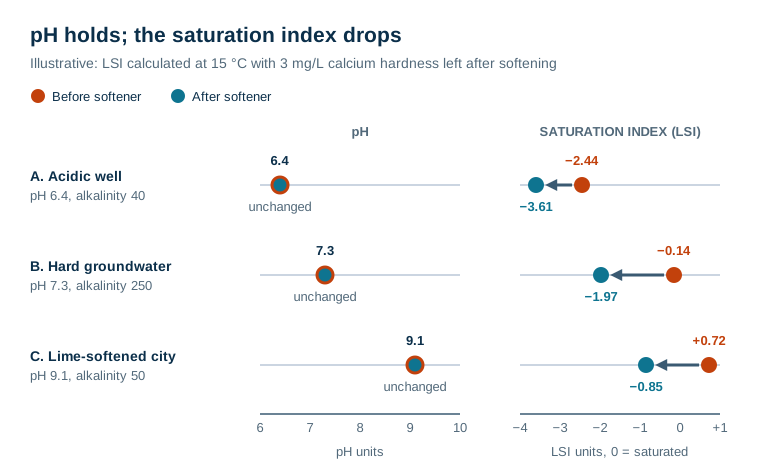
If pH stays the same, why does softened water behave so differently? Because hardness is one of the inputs to how readily water deposits calcium carbonate scale. The usual measure of that is the Langelier Saturation Index (LSI). A positive number means the water tends to deposit scale. A negative number means it tends to dissolve it.
The table below works three typical waters through before and after softening. The pH values follow the EPA and WQA finding that softening does not change pH. The LSI values are calculated, not measured, using cold water at 15 °C and assuming about 3 mg/L of calcium hardness remains after the softener.
| Water type | pH before | pH after | Calcium hardness before (mg/L) | LSI before | LSI after |
|---|---|---|---|---|---|
| A. Acidic, low-alkalinity well (alkalinity 40 mg/L) | 6.4 | 6.4 | 45 | −2.44 | −3.61 |
| B. Hard groundwater, like the EPA Phase II water (alkalinity 250 mg/L) | 7.3 | 7.3 | 200 | −0.14 | −1.97 |
| C. Lime-softened city water, like the EPA Phase I water (alkalinity 50 mg/L) | 9.1 | 9.1 | 110 | +0.72 | −0.85 |
Three things stand out.
- The pH column does not move, and the LSI column always does. Removing calcium takes away one of the inputs, so the index drops by more than a full unit in every case. It would drop for any water you softened.
- Water A was corrosive before the softener. Its LSI was already −2.44 because of its low pH and low alkalinity. Softening does not cause that, and it does not fix it either.
- Waters B and C both end up with a negative index, yet these are the two waters in which EPA's pipe loops found no increase in metal leaching. The index is a measure of calcium carbonate saturation. Once the calcium is gone, it reads negative whether or not the water attacks copper.
That third point is why softened water stops depositing scale without starting to corrode pipes. The pipe-by-pipe evidence is in does soft water damage or protect household pipes. How to run the LSI calculation on your own test report is in how to interpret pH and hardness together.
Five Things People Blame on a pH Change
Most "my softener changed the pH" reports trace back to one of these.
1. The slippery feel. EPA's secondary drinking water standards list a "slippery feel" and "soda taste" as signs of high pH, above 8.5. Softened water often feels slippery too, so people assume the pH has risen. With softened water the cause is different: soap no longer forms curd with calcium, so it rinses off differently. See why soft water feels slippery.
2. Scale stops forming. Kettles and shower heads stay clean, and some owners read that as the water becoming "less alkaline". The alkalinity is unchanged. The calcium it used to combine with is gone.
3. Blue-green stains or pinhole leaks appear after installation. This usually means the raw water was acidic all along, and the stains were building up before anyone looked. It can also mean old scale was hiding a corroded surface. Test the raw water's pH at a tap before the softener, or with the softener in bypass. If it reads below 6.5, the problem is the source water.
4. A different test, not different water. pH test strips read to about half a unit at best. A sample left in an open cup loses carbon dioxide and its pH creeps up. A hot tap sample is not comparable with a cold one. A reading taken at the kitchen tap before installation and at a bathroom tap after it is not a before-and-after measurement.
5. Another device is doing it. A combination softener with a calcite or corosex layer, or a separate acid neutralizer upstream, does raise pH. A salt-free citric acid conditioner lowers it a little by design, which is why the Nuvo H2O review flags it for water below pH 7.3. A point-of-use reverse osmosis unit usually lowers it slightly, because dissolved carbon dioxide passes through the membrane while most of the bicarbonate buffer does not. Alkaline RO systems add a mineral cartridge after the membrane to raise it again; comparing alkaline reverse osmosis systems on certification and running cost covers the options, and the iSpring RCC7AK review looks at one certified tank system with that stage built in. None of these effects comes from the softening resin.
How to Check Your Own Softener's Effect on pH
You can settle the question in your own house in ten minutes. The key is taking both samples the same way, at the same time.
- Get a meter, not strips. A pocket pH meter calibrated with fresh buffer solutions reads to about 0.1 unit. Strips cannot resolve the difference you are looking for.
- Take the raw sample first. Use a tap before the softener, such as an outdoor spigot on the raw line, or put the softener in bypass and run a cold tap for two minutes.
- Take the softened sample. Return the softener to service, run the same cold tap for two to three minutes to flush the raw water out, then sample.
- Measure immediately. Put the probe in within a minute of filling each cup, and use the same cup and temperature for both.
- Avoid the regeneration window. Do not sample during or right after a regeneration, when rinse water can still be clearing the bed.
If the two readings agree within about 0.2 units, the softener is doing what the chemistry predicts. If they differ by more than that, look for a calcite layer, an upstream neutralizer or a sampling difference before you look at the resin.
When pH Needs Its Own Treatment
EPA's secondary standard puts the acceptable pH range for drinking water at 6.5 to 8.5. Below 6.5, EPA lists a bitter metallic taste and corrosion. Because a softener passes pH straight through, water outside that range needs its own treatment, and it belongs in a separate stage.
- Below about 6.5, on a well: an acid neutralizer, usually a calcite or calcite and corosex tank, or a soda ash feed for very low pH. It goes before the softener. The neutralizer adds calcium, so the softener has to be set for the hardness coming out of it, not the raw figure. The full method by pH range is in why low-pH well water needs separate treatment.
- Above 8.5: this is uncommon on private wells. On city water it is usually intentional, because many utilities raise pH to control lead and copper. Leave it alone.
What a Softener Cannot Do About pH
- It cannot raise the pH of acidic water, so it will not stop the corrosion that low pH causes.
- It cannot lower high pH or the soda taste that goes with it.
- It cannot add alkalinity, the buffer that keeps pH stable.
- It can make a corrosion problem harder to spot, by removing the scale that sometimes covered corroded copper. The corrosion came from the water chemistry. The softener only uncovered it.
If you are worried about pH, test the raw water and treat it for what it is. Then soften the result if the hardness calls for it. The two jobs need two different stages.
Frequently Asked Questions
Does a water softener make water more acidic?
No. A household softener exchanges calcium and magnesium for sodium. It does not add or remove hydrogen ions, bicarbonate or carbon dioxide, which are what set pH. An EPA pilot study found softening had no detrimental effect on the water quality factors that control corrosion, including pH. If your water is acidic after a softener, it was acidic before it too.
Does a water softener raise pH?
Not an ordinary sodium-form softener. Softened water can feel slippery, and EPA lists a slippery feel as a sign of high pH, so people often assume the pH has gone up. With softened water the slippery feel comes from soap rinsing differently. A combination unit that includes a calcite neutralizing layer does raise pH, but that is the calcite at work, not the softening resin.
What pH should softened water be?
The same as the water going in. EPA's non-enforceable secondary standard for drinking water is pH 6.5 to 8.5. If your raw water is inside that range, softened water will be too. If it is below 6.5, treat the pH with a neutralizer before the softener.
Can I use a softener to fix low pH water?
No. A softener does not change pH, so acidic water leaves the softener still acidic. Low-pH water needs an acid neutralizer, such as a calcite filter, or a chemical feed of soda ash. The neutralizer goes before the softener, and the softener is then set for the hardness the neutralizer adds.
Why did my pH test read different after installing a softener?
Usually because of how the sample was taken. pH drifts as carbon dioxide leaves a sample that sits in an open cup, test strips read to only about half a pH unit, and a reading from a hot tap or a different faucet is not comparable. Take both samples the same way, one from the bypass or a raw tap and one from a softened tap, and read them within a minute.
Does softened water corrode pipes because of pH?
No. Studies of real plumbing materials found no increase in corrosion or metal leaching from softened water. What does fall after softening is the calcium carbonate saturation index, because calcium is one of its inputs. That drop is a calculation effect and does not mean the water has become acidic.
