
Best Chlorine Injection Systems for Well Water: The 4 Parts and How to Size Them

The best chlorine injection systems for well water are built from four parts rather than bought as one box: an adjustable Stenner metering pump, a contact tank sized to your peak flow, a backwashing filter for the iron the chlorine oxidizes, and a catalytic carbon tank that strips the chlorine before it reaches softener resin. For most homes that means the Stenner 45MHP10 (0.5 to 10 gallons a day), a 120-gallon fiberglass retention tank and a 1.5 cubic foot catalytic carbon tank. Chlorine is the right tool where air injection keeps failing: iron bacteria, heavy sulfur, or a well that needs continuous disinfection.
The parts matter more than the brand. A pump too small for your chlorine demand, or a contact tank too small for your flow, will not do the job, however good the badge.
Disclosure: Hard Water Solved may earn a commission if you buy through links on this page, at no extra cost to you. It does not change which products we include or how we rank them. Read our disclaimer.
Best Chlorine Injection Systems: Parts at a Glance
| Stage | Pick | What decides it | Amazon |
|---|---|---|---|
| Metering pump, most wells | Stenner 45MHP10 adjustable | 0.5 to 10 gpd at up to 100 psi | Check price on Amazon |
| Metering pump, low demand | Stenner 45MHP2 adjustable | 0.2 to 3 gpd at up to 100 psi | Check price on Amazon |
| Contact tank | IPW / Watts 120-gallon fiberglass retention tank | 24 x 78 in, 1¼ in ports, 75 psi max | Check price on Amazon |
| Dechlorination | Catalytic carbon backwashing tank, Fleck 5600SXT, 1.5 cu ft | Removes chlorine and chloramine before the softener | Check price on Amazon |
How We Chose
Methodology. Nothing on this page was physically tested. Every figure comes from the maker's specification sheet, the seller's product page or extension-service guidance, and the sizing examples are worked from those figures.
- Included: residential components sold on Amazon: adjustable peristaltic metering pumps rated for at least 100 psi, pressure-rated retention tanks, and backwashing carbon tanks with an automatic valve.
- Normalised: pumps are compared on the strongest dose they can deliver at a given well-pump flow using ordinary bleach, not on their headline gallons per day. Contact tanks are compared on minutes of contact at your peak flow, not on gallons.
- Excluded: pellet chlorinators that drop tablets into the well (some states require approval, and they do not dose in proportion to flow), suction-feed injectors without a pressure rating, and non-backwashing carbon cartridges, which clog on oxidized iron.
- Prices are not listed here because they change often. Use the buttons to see the current price on Amazon.
Whether chlorine is the right treatment at all, and how iron bacteria differ from ordinary iron, is covered in why iron bacteria require more than a softener. This page assumes you have the test results and have decided on continuous chlorination.
The Four Parts of a Chlorine Injection System
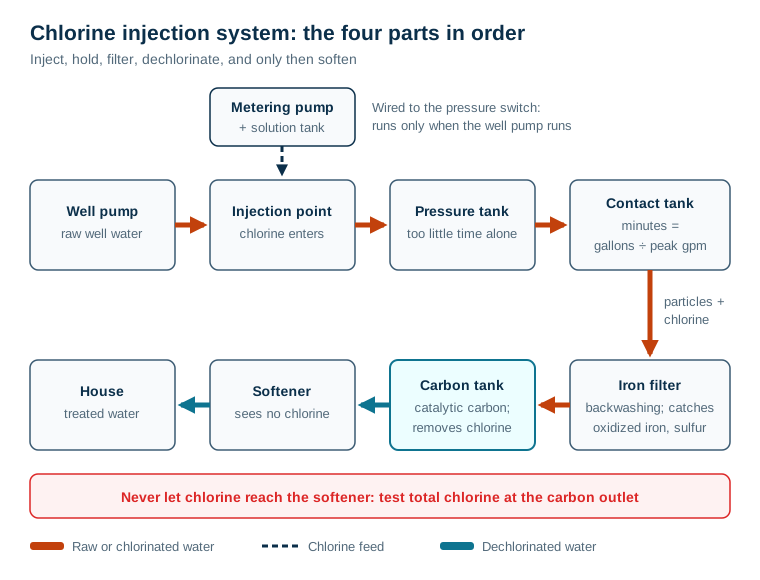
Every working system has the same order. Each part does one job the others cannot:
- Metering pump and solution tank. The pump pushes a measured stream of diluted chlorine into the line from the well. Nebraska Extension's guide to continuous chlorination says the feed pump should be wired to the well pump's pressure switch, "so that the chemical pump operates only when the water well pump is operating." That way the dose follows the flow.
- Contact tank. Chlorine does not work instantly. The same guide notes that "the time between the pump and the nearest faucet is usually one minute or less" in a home, which is why a retention tank is added.
- Backwashing filter. Chlorine turns dissolved iron, manganese and sulfide into particles. Something has to catch them. On a well with more than a trace of iron, that is a dedicated backwashing iron filter. AFWFilters' packaged trains use a Filox or air injection tank in this position.
- Carbon tank. Activated carbon removes the leftover chlorine and its taste. Nebraska Extension lists this as the standard follow-on stage. For a well with a softener, it is not optional.
Skipping any stage moves the problem downstream. Without the contact tank, bacteria survive. Without the filter, rust-coloured particles reach the carbon and blind it. Without the carbon, chlorine reaches the softener.
Sizing the Metering Pump: Dose, Flow and Bleach Strength
The pump's job is to deliver enough chlorine to satisfy the water's demand and leave a small free residual. The demand comes from what the chlorine reacts with. Standard water-treatment figures for the chlorine needed per ppm of each are:
| What chlorine reacts with | Chlorine needed (theoretical) |
|---|---|
| Ferrous iron | about 0.64 ppm per ppm of iron |
| Manganese | about 1.3 ppm per ppm of manganese |
| Hydrogen sulfide | about 2.2 ppm per ppm, oxidized to sulfur, and several times more if oxidized fully to sulfate |
These are the chemistry minimums. Organic matter and bacteria add more, so treat the result as a starting point and adjust from a residual test after the contact tank.
Worked example. A well with 3 ppm of iron and 3 ppm of hydrogen sulfide needs about 1.9 ppm for the iron and 6.6 ppm for the sulfide. Add an illustrative 1 ppm residual and the target dose is roughly 10 ppm.
The pump only runs while the well pump runs, so what matters is how fast it feeds compared with the well pump's flow. The required strength of the solution in the tank is:
Solution strength (ppm) = target dose (ppm) × well pump gpm × 1,440 ÷ pump gallons per day
Plain household bleach is roughly 60,000 ppm (6% sodium hypochlorite). Check your label, because strengths vary. Here is what each Stenner pump needs at an 8 gpm well pump, using its full rated output:
| Target dose | 45MHP2 (3 gpd max) needs | 45MHP10 (10 gpd max) needs |
|---|---|---|
| 3 ppm (bacteria, light iron) | about 11,500 ppm: 1 part bleach to 4 parts water | about 3,500 ppm: 1 part bleach to 16 parts water |
| 10 ppm (the worked example) | about 38,400 ppm: nearly neat bleach | about 11,500 ppm: 1 part bleach to 4 parts water |
| 20 ppm (heavy sulfur) | about 76,800 ppm: stronger than household bleach, so it cannot be done | about 23,000 ppm: 1 part bleach to 1.6 parts water |
Illustrative. Figures assume 6% bleach and the pump at 100% of its dial. Real output varies; Stenner's specification sheet recommends field calibration of every metering pump.
The table is why the 45MHP10 is the default pick. At light doses it runs at a low dial setting with a weak, forgiving solution. At heavy doses it still has headroom. The 45MHP2 makes sense only for low demand: disinfection of clear water, or a slow well pump.
The Best Metering Pumps
Stenner 45MHP10: best for most wells
- Output: 0.5 to 10 gallons per day, set by an external dial from 5% to 100% in 2.5% steps (Stenner's sheet)
- Pressure: 100 psi maximum, with an injection check valve included
- Tubing: ¼ in or ⅜ in versions; Poolweb lists the ¼ in standard-tube model as item 45MJH2A1STAA
- Certification: Stenner states that Santoprene-tube models were tested by the Water Quality Association to conform to NSF/ANSI 61, and adjustable models by ETL to NSF/ANSI 50
The peristaltic design suits a home well. Stenner's sheet says it self-primes against full working pressure, does not vapour-lock on gassy chlorine solution, and its output "is not affected by back pressure." The pump tube is the wear part, and a spare comes in the box.
Watch for: the solution tank. The pump is sold alone or with a 7.5, 15 or 30 gallon tank. A larger tank means less frequent mixing, but bleach weakens as it sits, so do not buy more tank than about a month of solution.
Stenner 45MHP2: best for low chlorine demand
- Output: 0.2 to 3 gallons per day; the Amazon listing names it 45MJH1A3S
- Pressure: 100 psi maximum
- Tubing: Poolweb lists the ⅜ in standard-tube version as item 45MJH1A3STAA
Choose it for clear water that needs disinfection only, where the dose is small and a 10 gpd pump would sit near the bottom of its dial. It is not cheaper than the 45MHP10, so check that the lower output is what you actually need.
Watch for: sulfur. As the table shows, it cannot reach a heavy sulfide dose with household bleach.
Sizing the Contact Tank by Peak Flow
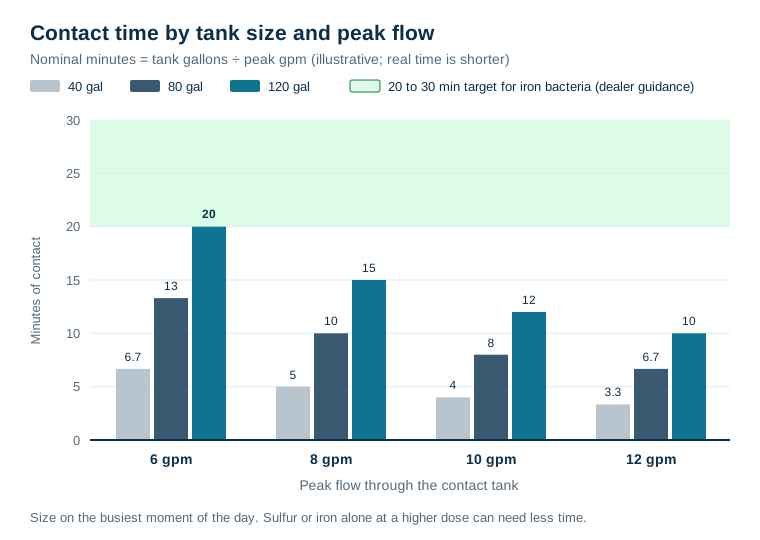
Contact time is simply the tank's volume divided by the flow through it:
Nominal minutes = tank gallons ÷ peak flow (gpm)
Size it on the busiest moment of the day, when two showers and a washing machine run together, not on average use. Water Filters of America, a treatment dealer, gives 20 to 30 minutes of contact for iron bacteria and coliform in its chemical feed guide. Oxidizing sulfur or iron alone at a higher dose needs less.
| Tank | 6 gpm | 8 gpm | 10 gpm | 12 gpm |
|---|---|---|---|---|
| 40 gal | about 7 min | 5 min | 4 min | about 3 min |
| 80 gal | about 13 min | 10 min | 8 min | about 7 min |
| 120 gal | 20 min | 15 min | 12 min | 10 min |
Nominal. Real contact time is shorter, because some water takes a quicker path through the tank. A tank with an inlet diffuser or distributor tube does better than an open one.
Two things follow. First, for bacteria the 120-gallon tank is the smallest that comes close at typical household flows. Second, at 10 gpm and above even 120 gallons falls short, and the usual fix is a higher chlorine residual, which raises the carbon stage's workload. Ask whoever designs your system which trade-off they are making.
IPW / Watts 120-gallon fiberglass retention tank
- Size: 120 gallons, 24 in diameter by 78 in tall; Watts' code C52-C2252
- Connections: 1¼ in male NPT inlet and outlet on top, and a 1 in blow-down drain at the lowest point
- Ratings: 75 psi and 120°F maximum, with a one-piece polyethylene liner; lead-free certified
The Watts product page states that "an appropriate vacuum/pressure relief valve must be incorporated in the plumbing." Budget for it.
Watch for: the 75 psi rating. If your pressure switch is set high, or the tank sits on the pump side of a pressure-reducing valve, check that the tank never sees more. Also measure your ceiling: 78 inches of tank plus fittings needs about 7 feet of headroom.
The Filter and Carbon Stages
After the contact tank, the water carries oxidized particles and leftover chlorine. Two tanks deal with them.
The filter for oxidized iron and sulfur. If the well has more than a trace of iron or manganese, put a dedicated backwashing filter before the carbon. The Water Systems Council calls for a backwashing filter rated at 10 microns. AFWFilters' packaged trains use a Filox tank here, with 6.5 gpm minimum backwash on its 9 gpm package. Check that your well pump can deliver that backwash flow.
The carbon tank. This is the softener's protection. Pick a backwashing tank on an automatic valve, so oxidized particles that get past the filter are flushed rather than packed into the bed.
Catalytic carbon backwashing tank, Fleck 5600SXT, 1.5 cu ft
- What it is: 1.5 cubic feet of catalytic carbon on a Fleck 5600SXT metered valve; the listing says it removes chlorine, chloramines and hydrogen sulfide odour
- Smaller sibling: AFWFilters' store sells a 1.0 cubic foot catalytic carbon system on a 9 x 48 in tank, rated for up to 10 ppm of iron and 10 ppm of hydrogen sulfide, needing at least 3.5 gpm to backwash
Choose the larger bed if you run a high residual or a high peak flow. More carbon means more contact time for dechlorination.
Watch for: the absence of a published replacement interval. Carbon is spent when chlorine starts getting through, and nothing on the listing tells you when that will be.
Warning: protect the softener resin. Chlorine oxidizes softener resin. Over months the beads swell, soften and break into fines, capacity falls and pressure drop rises. With continuous chlorination the carbon tank is the only thing standing between the chlorine and the resin, so:
- Plumb the carbon before the softener, never after it and never bypassed while the chlorine pump runs.
- Test total chlorine at the carbon outlet every month or two with a test kit that reads total, not just free, chlorine. Anything above zero means the carbon is spent or too small.
- Bypass the softener whenever you shock chlorinate the well, and keep it bypassed until the chlorine is flushed out.
How the damage happens, and the squeeze test that shows it, are in how chlorine damages water softener resin.
Packaged Trains vs Building Your Own
| Route | What you get |
|---|---|
| Parts on this page | Stenner pump, 120 gal retention tank, catalytic carbon tank; an iron filter, plumbing and solution tank come on top |
| AFWFilters packaged train, 9 gpm | Chlorine pump, mixing tank, Filox iron filter, upflow carbon |
| Same, with Platinum 10 air injection filter | As above, with an air injection iron filter |
| Same, 2 cu ft, 12.5 gpm | Larger iron and carbon tanks |
| Same, with 48k softener | Adds a 2510SXT softener after the carbon |
AFWFilters packages as listed on its store. We did not confirm these packages are sold on Amazon. AFWFilters' product pages do not state the pump model or mixing tank volume, so ask before buying and compare the tank against the contact-time table above.
A package saves you matching fittings and port sizes. Building from parts lets you pick the contact tank for your flow, which a package fixes for you. Note that AFWFilters' packages use upflow carbon. An upflow bed is never backwashed, so the iron filter ahead of it must catch every oxidized particle.
What It Costs to Run
Chlorine use is small in volume. An illustrative house using 300 gallons a day at a 5 ppm dose feeds about 0.025 gallons of 6% bleach a day, about 9 gallons a year. Bleach is a modest line item. The running costs that add up are elsewhere:
- Pump tubes. The peristaltic tube wears and is replaced on a schedule set by the dial setting and run time.
- Carbon media. Replaced when chlorine breaks through, which a higher residual brings forward.
- Test reagents. A free and total chlorine kit, used weekly at first and monthly once stable.
- Electricity and backwash water for the filter and carbon tanks.
The hidden cost is time. Expect to mix solution, check the dial and test the residual every few weeks. If that routine will not happen, chlorine injection is the wrong system.
Who Should Buy None of These
- Clear water with coliform but no iron, sulfur or bacteria slime. UV disinfection needs no chemicals and no carbon stage. Our separate guide to the best UV systems for well water covers it.
- Iron under about 3 ppm with no iron bacteria. A fine-mesh softener or an air injection iron filter is simpler. The choice is set out in water softener for well water.
- A rotten-egg smell from the hot taps only. That is usually the water heater's anode rod, not the well.
- A well that has never been shock chlorinated. Shock it first and retest. If the problem does not come back, you do not need continuous treatment.
- Anyone who cannot keep up the routine. An unattended chlorine system either stops dosing or overdoses, and the softener pays for the second.
Size the pump on your chlorine demand and well-pump flow, size the contact tank on your peak flow, and never let chlorine reach the resin. For most homes that means the Stenner 45MHP10, a 120-gallon tank, an iron filter where the test calls for one, and a catalytic carbon tank ahead of the softener.
Frequently Asked Questions
Do I need a contact tank with a chlorine injection system?
For iron bacteria or coliform, yes. Household piping gives about a minute or less between the well pump and the nearest tap, according to Nebraska Extension, which is too short for chlorine to finish its work. A retention tank adds the time. Dividing the tank's gallons by your peak flow gives the nominal minutes: a 120-gallon tank at 8 gpm gives about 15. For sulfur or iron alone at a higher chlorine dose, a smaller tank can be enough.
How much does a chlorine injection system for a well cost?
The price depends on how many of the four parts you need and how big they are. The metering pump, the contact tank (larger for higher peak flow), the iron filter and the carbon tank are each a separate purchase, and plumbing comes on top. Packaged trains, such as AFWFilters', bundle the pump, mixing tank, iron filter and carbon and cost more than the parts alone. Prices change often, so check the current price of each part before budgeting.
Will chlorine injection damage my water softener?
It will if the chlorine reaches the resin. Chlorine oxidizes softener resin, and the beads swell and break down over time. That is why a carbon tank sits after the contact tank and before the softener. Test total chlorine at the carbon outlet every month or two. A reading above zero there means the carbon is spent or undersized, and the softener is the next thing to suffer.
Can I use household bleach in a chlorine injection pump?
Yes, if it is plain, unscented bleach with no added detergents or thickeners. Most residential systems feed diluted sodium hypochlorite. Check the strength on the label, because it sets how much water you mix with it. Mix small batches, since bleach loses strength as it sits, and keep the solution tank covered and out of sunlight.
Is chlorine injection better than air injection for iron and sulfur?
Not for every well. Air injection handles moderate iron and sulfur with no chemicals to buy. Chlorine is the better tool when iron bacteria are present, when sulfur is heavy enough that air leaves an odour, or when a disinfectant is needed anyway. It costs more to run and needs a monthly routine of mixing solution and testing residual.
