
Best Portable Water Softeners: 3 RV Picks and Real Gallons per Regeneration
The best portable water softeners for RVs are the On The Go 16,000-grain double for most travellers, its brass-fitting version if you want metal hose adapters, and the 8,000-grain standard for solo or weekend trips. All three regenerate with table salt and a garden hose, with no electricity. What the boxes do not tell you is that the makers' gallons-per-regeneration tables assume a fuller recharge than two boxes of table salt give. Re-worked at the real salt dose, a 16,000-grain unit softens about 555 gallons at 20 gpg, not 800. That is still about two weeks for a couple.
Disclosure: Hard Water Solved may earn a commission if you buy through links on this page, at no extra cost to you. It does not change which products we include or how we rank them. Read our disclaimer.
Best Portable Water Softeners at a Glance
| Pick | Capacity (maker) | Resin | Size and weight | Flow | Amazon |
|---|---|---|---|---|---|
| On The Go double, OTG4-DBLSOFT | 16,000 grains | 0.52 cu ft | 22 x 9.5 in, 32 lb | 3 gpm | Check price on Amazon |
| On The Go double with brass adapters, OTG4-VM-DBLSOFT | 16,000 grains | 0.52 cu ft | 22 x 9.5 in, 32 lb | 3 gpm | Check price on Amazon |
| On The Go standard | 8,000 grains | 0.25 cu ft | 22 x 6.75 in, 18 lb | 2 gpm | Check price on Amazon |
How We Chose
Methodology. Nothing on this page was physically tested. Specifications come from the maker's product pages, and the gallons-per-regeneration figures are recalculated from published resin performance at a stated salt dose.
- Included: ion-exchange portable softeners with hose connections, regenerated with salt and no power, sold on Amazon.
- Normalised: capacity is re-stated at the salt dose the instructions actually use, one or two boxes of table salt, rather than the headline grain rating.
- Excluded: salt-free "RV conditioners" (they do not remove hardness), and the Watts Flow-Pur RV-Pro 10,000, which was listed as out of stock on Flow-Pur's own store on the day we checked.
- Prices are not listed here because they change often. Use the buttons to see the current price on Amazon.
Gallons per Regeneration: The Maker's Table vs the Salt You Use
On The Go publishes a clear table for each model. For the 16,000-grain double it lists 3,200 gallons at 5 gpg, 1,066 at 15 gpg and 640 at 25 gpg (product page). Every figure is simply 16,000 divided by the hardness. In other words, the table assumes the bed gives back its full 16,000 grains every cycle.
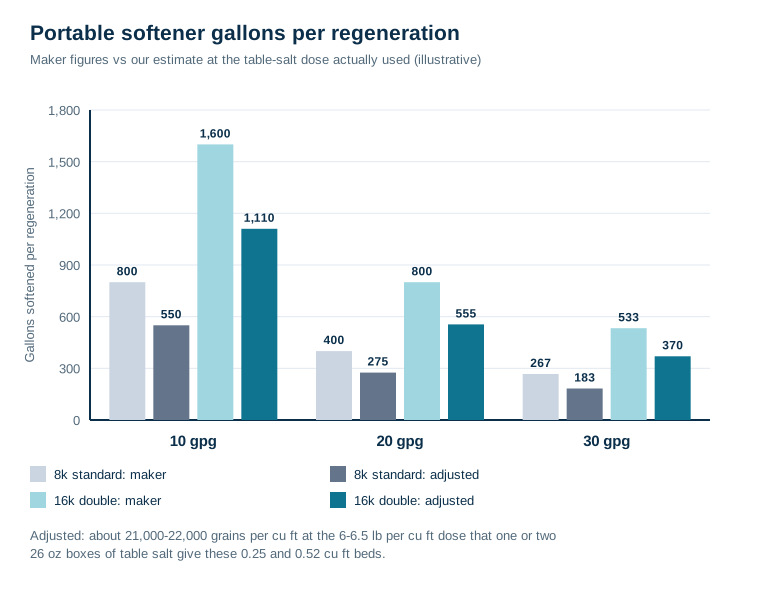
That is about 30,800 grains per cubic foot of resin, which is the top of the capacity curve and normally needs a heavy salt dose. The regeneration instructions use two boxes of table salt. A standard round box holds 26 oz, so two boxes is about 3.25 lb of salt on 0.52 cubic feet of resin, roughly 6.25 lb per cubic foot. Published design guidance for standard softener resin, summarised in Water Conditioning & Purification, puts capacity at about 21,000 grains per cubic foot at 6 lb of salt. So two boxes restore roughly 11,000 grains, about two-thirds of the rating.
| Campsite hardness | 8k standard, maker | 8k standard, adjusted | 16k double, maker | 16k double, adjusted |
|---|---|---|---|---|
| 10 gpg | 800 gal | ~550 gal | 1,600 gal | ~1,110 gal |
| 20 gpg | 400 gal | ~275 gal | 800 gal | ~555 gal |
| 30 gpg | 267 gal | ~183 gal | 533 gal | ~370 gal |
Adjusted figures are our illustrative estimates: about 5,500 grains for the 8k (one 26 oz box on 0.25 cu ft) and 11,100 grains for the 16k (two boxes on 0.52 cu ft). Real results vary with resin condition, contact time and how the salt dissolves.
If you want the maker's numbers, use more salt. Adding a third box to the double raises the dose to about 9.4 lb per cubic foot, which by the same guidance restores roughly 26,000 grains per cubic foot, or about 13,500 grains. The returns shrink with each extra box, which is why the site's guide to advertised vs usable softener capacity treats the box rating as a ceiling, not a target.
How Often You Will Regenerate on the Road
Daily RV water use varies more than hardness does. We use two illustrative figures: 40 gallons a day for two people being careful on a full hookup, and 80 gallons a day for a family of four. Check yours against your fresh-tank gauge or a hose-end meter for a few days.
| Campsite hardness | 8k standard, 40 gal/day | 8k standard, 80 gal/day | 16k double, 40 gal/day | 16k double, 80 gal/day |
|---|---|---|---|---|
| 10 gpg | ~14 days | ~7 days | ~28 days | ~14 days |
| 20 gpg | ~7 days | ~3.4 days | ~14 days | ~7 days |
| 30 gpg | ~4.6 days | ~2.3 days | ~9 days | ~4.6 days |
Illustrative, from the adjusted gallons above.
Two things stand out. First, the 8,000-grain standard turns into an every-few-days chore for a family on hard water. Second, the double covers a typical two-week trip for a couple at 20 gpg on one regeneration. If your route runs through hard-water areas, size for the hardest stop, not the average.
The Best Portable Water Softeners, Pick by Pick
On The Go 16,000-grain double: best for most RVers
- Resin: 0.52 cu ft; 16,000-grain rating; about 11,100 grains on two boxes of salt by our estimate
- Flow: 3 gpm
- Size: 22 inches tall, 9.5 inches across, 32 lb
- Regeneration: two boxes of table salt, under 30 minutes, per the maker
- In the box: inlet and outlet hose adapters, a back-flush adapter, a 4-foot white drinking-water hose and storage caps, per the maker
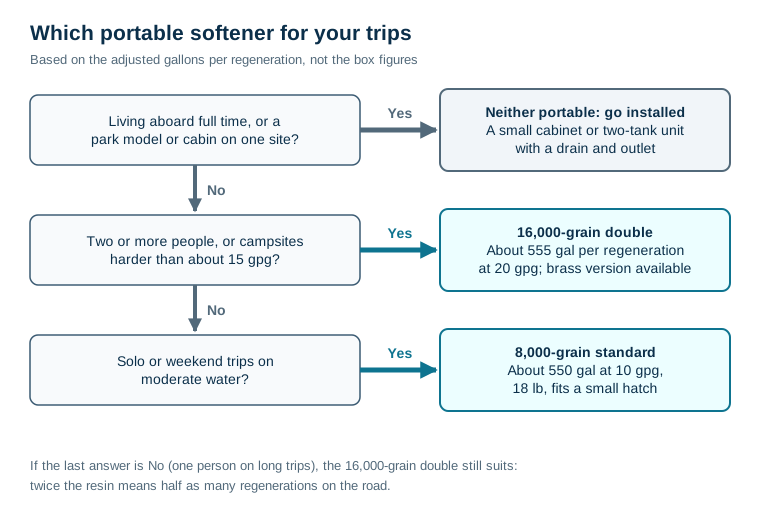
This is the pick for two or more people or for campsites harder than about 15 gpg. It has twice the resin of the standard model, which means half as many regenerations. The 3 gpm flow is enough for one shower at a time. At 32 lb it needs a bay or a corner of the campsite, not a cupboard.
Watch for: the regeneration timing. On The Go quotes under 30 minutes for the whole regeneration. Plan it for arrival day, when you are hooked up and have time, rather than the morning you leave.
On The Go double with brass adapters: best for the drinking-water hose
- Item: OTG4-VM-DBLSOFT, the same 16,000-grain, 0.52 cu ft tank with brass inlet and outlet hose adapters
The only difference On The Go lists is the brass hose adapters. They are harder to cross-thread or crack than plastic at a campground spigot you connect to every few days. On The Go's page does not make a lead-free or certification claim for the brass. If your drinking water passes through it and that matters to you, ask the seller for the fitting specification before you buy.
Watch for: paying more for an Amazon listing than the maker charges. On The Go prices the two versions close together on its own store, so compare before ordering.
On The Go 8,000-grain standard: best for solo and weekend trips
- Resin: 0.25 cu ft; 8,000-grain rating; about 5,500 grains on one box of salt by our estimate
- Flow: 2 gpm
- Size: 22 inches tall, 6.75 inches across, 18 lb
- Regeneration: one box of table salt, under 15 minutes, per the maker's product page
At 6.75 inches across and 18 lb, the standard fits a storage hatch the double will not. For one person on 10 to 15 gpg water it lasts a week or two between regenerations on our estimate. It usually costs only a little less than the double, so buy it for the size, not the saving.
Watch for: 2 gpm. It will make a shower feel weak if the park's pressure is low, and on 30 gpg water it needs salt every few days for two people.
Which Size for Your Trips
Test the water at a new site before you trust a park's description. A strip kit takes a minute, and the hardness sets everything in the tables above. If you park in one place for months, a portable stops making sense. Our guide to water softeners for mobile and manufactured homes covers installed options that fit those homes.
Getting the Most From a Portable Softener
- Back-flush after setup. Run water through to waste for a minute before connecting the RV, so any loose resin fines or salty water do not reach your fresh tank.
- Regenerate before it runs out, not after. Keep a note of gallons used. Once hard water reaches the water heater, the scale is already forming.
- Keep it out of freezing nights. A frozen tank can crack. Drain it or bring it inside when temperatures drop.
- Soften only what needs it. The fresh-water inlet feeds the water heater, shower and taps. There is no need to soften water for rinsing the awning or washing the truck.
- Store it wet and capped. The maker includes storage caps. Resin that dries out completely can be damaged.
Who Should Buy None of These
- Full-time residents on one site. At home-sized water use, a portable needs salt every few days. An installed softener with a metered valve costs less to run.
- Anyone wanting a soft-water exchange service. Swapping a dealer's tank every month is a different arrangement, covered in portable exchange tank vs installed softener.
- Travellers who mostly use soft-water parks. Below about 3 or 4 gpg there is little to gain.
- Sites with iron or sulfur smell. A small portable bed fouls quickly. Filter first, or skip softening at that stop.
Buy on the salt-adjusted gallons, not the box figure. For most RVers that means the 16,000-grain double and a spare box of salt in the bay. Size it for the hardest water on the route, and how to size any softener from the daily load is in how to size a water softener.
Frequently Asked Questions
How long does a portable RV water softener last between regenerations?
It depends on the campsite hardness and your water use. Using our salt-adjusted figures, a 16,000-grain double softens about 555 gallons at 20 gpg. That is roughly two weeks for two people using 40 gallons a day, or one week for a family using 80 gallons a day. At 30 gpg it falls to about 370 gallons. The maker's own table quotes about 800 gallons at 20 gpg, which assumes more salt than two boxes deliver.
Can you regenerate a portable water softener with table salt?
Yes. On The Go's instructions use ordinary table salt: two boxes for the 16,000-grain double and one box for the 8,000-grain standard. The salt goes into the tank and fresh water is then flushed through, following the maker's instructions. The maker quotes under 30 minutes for the double. It is the amount of salt, more than the type, that limits how much capacity comes back.
Is a portable water softener worth it for an RV?
Usually, if you camp regularly in hard-water areas. Scale builds fastest in the RV water heater and on shower heads and faucets, and campground water in some hard-water regions can be well over 15 gpg. A portable softener is a one-off purchase and regenerates for the price of a couple of boxes of salt. If you mostly stay at sites with soft water, it adds little.
Which is better, an 8,000 or 16,000 grain portable softener?
The 16,000-grain double, for most RVers. It holds about twice the resin, so it goes about twice as long between regenerations. That matters on hard water, where the 8,000-grain model gives only about 275 gallons per regeneration at 20 gpg on our estimate. The 8,000-grain standard makes sense for a solo traveller on short trips with limited storage. It weighs about 18 lb against 32 lb.
Can a portable water softener be used in a house?
Only for a single line, such as a washing machine or one shower. At 2 to 3 gpm, a portable unit cannot supply a whole house, and it would need regenerating every few days on a household's water use. For a mobile home, cabin or house, an installed softener with a metered valve is the right tool.
