
Advertised vs Usable Water Softener Capacity

Advertised vs usable softener capacity is the gap between the grain rating printed on the box and what the resin delivers at the salt setting you actually run. The box number assumes a heavy salt dose, around 15 lb per cubic foot of resin. At an efficient 6 lb dose the same softener delivers about two-thirds of it, so a 48,000-grain unit gives roughly 31,500 grains, and less once the reserve is held back.
This matters because almost every sizing calculation, online calculator and sales quote divides your daily hardness load by the box number. If the valve is programmed for efficiency, and on most modern units it should be, that calculation overstates the days between regenerations by around half.
Where the Box Number Comes From
Residential softeners are named after a grain rating that is really a statement of resin volume. The convention is about 32,000 grains per cubic foot of standard cation resin:
- 0.75 cu ft of resin is sold as a 24,000-grain unit
- 1.0 cu ft as a 32,000-grain unit
- 1.5 cu ft as a 48,000-grain unit
- 2.0 cu ft as a 64,000-grain unit
That 32,000 figure is the top of the capacity curve. The design guidance published in the trade journal Water Conditioning & Purification puts standard resin at about 21,000 grains per cubic foot at 6 lb of salt and about 31,000 grains at 15 lb, which it describes as the maximum. The box rating is that maximum, rounded to a tidy number. Some manufacturers' own tables reach about 32,000 grains per cubic foot at their highest salt dose; none reach it at an efficient one.
The rating is not a lie, and it is not the number to size from. It tells you how much resin is in the tank. How much of that resin's capacity you get back each cycle depends on how much salt you put through it.
The Capacity-Versus-Salt-Dose Table
The same resin bed delivers a different capacity at every salt setting. Capacity climbs quickly at low doses and flattens out at high ones. This table scales the published per-cubic-foot figures to the resin volumes that residential softeners actually ship with:
| Resin volume | Sold as | Economy, 6 lb/cu ft | Standard, 9 lb/cu ft | High, 12 lb/cu ft | Maximum, 15 lb/cu ft |
|---|---|---|---|---|---|
| 0.75 cu ft | 24,000 grain | 15,750 | 19,500 | 21,750 | 23,250 |
| 1.0 cu ft | 32,000 grain | 21,000 | 26,000 | 29,000 | 31,000 |
| 1.5 cu ft | 48,000 grain | 31,500 | 39,000 | 43,500 | 46,500 |
| 2.0 cu ft | 64,000 grain | 42,000 | 52,000 | 58,000 | 62,000 |
| 2.5 cu ft | 80,000 grain | 52,500 | 65,000 | 72,500 | 77,500 |
| 3.0 cu ft | 96,000 grain | 63,000 | 78,000 | 87,000 | 93,000 |
Grains of hardness removed per regeneration, standard gel cation resin in good condition. Figures are approximate. Individual resins and valves vary by a few percent.
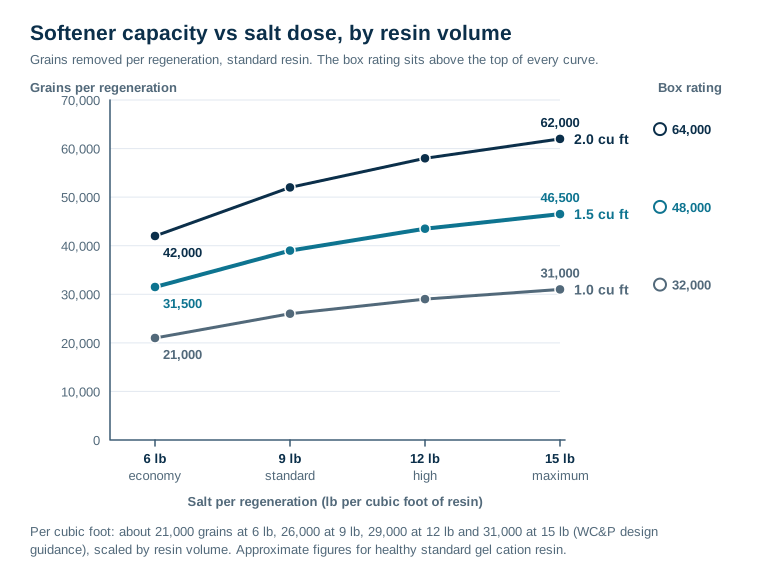
Read across any row and the shape is the same. Going from 6 lb to 9 lb adds about 24 percent more capacity. Going from 12 lb to 15 lb adds under 7 percent. On these figures, even 15 lb does not quite reach the box rating, and the economy column sits a third below it.
Three things follow from the table:
- You cannot compare a "48,000-grain" unit with a "40,000-grain" unit on the box numbers. Compare resin volumes, then look up both at the same salt dose.
- A salt dose quoted on its own means nothing. "8 lb salt setting" is a small dose for 1.5 cu ft of resin (about 5.3 lb per cubic foot) and a heavy one for 0.75 cu ft (about 10.7 lb per cubic foot). Always convert to pounds per cubic foot.
- The first pounds of salt do most of the work. That is the whole economic argument for efficient programming.
The companion page on what grain capacity means on a spec sheet covers how the rating is measured. This page is about what it does to your sizing.
What Each Setting Costs in Salt
Divide the capacity by the salt used and you get salt efficiency, in grains of hardness removed per pound of salt:
| Salt dose | Capacity per cu ft | Grains per lb of salt | Salt per regeneration, 1.5 cu ft unit |
|---|---|---|---|
| 6 lb/cu ft | ~21,000 | ~3,500 | 9 lb |
| 9 lb/cu ft | ~26,000 | ~2,890 | 13.5 lb |
| 12 lb/cu ft | ~29,000 | ~2,420 | 18 lb |
| 15 lb/cu ft | ~31,000 | ~2,070 | 22.5 lb |
Running at maximum salt uses about 70 percent more salt per grain removed than running at economy. Water Conditioning & Purification's review of softener efficiency makes the same point from the other direction: efficiency falls as the salt dose rises, and above a certain dose extra salt adds almost no capacity and simply rinses to the drain.
Worked example. A family of four uses about 75 gallons per person per day, a common planning figure for household softener sizing. Their water is 15 grains per gallon. That is 300 gallons a day and 4,500 grains of hardness a day, or about 1.64 million grains a year.
- At 6 lb/cu ft (about 3,500 grains per lb): roughly 470 lb of salt a year
- At 15 lb/cu ft (about 2,070 grains per lb): roughly 795 lb of salt a year
That is the difference between about twelve and twenty 40-lb bags, every year, for the same soft water. Real consumption runs a little higher than this at either setting, because regenerations happen with some capacity still unused. The ratio holds. The detail of how valves hit these efficiencies is in what water softener salt efficiency means.
Advertised vs Usable Softener Capacity, Step by Step
The salt dose is the biggest deduction, but not the last. A demand-initiated valve that regenerates at night must hold back a reserve: enough capacity to get through the next day, because it only decides whether to regenerate once every 24 hours. That slice exists in the resin but is not available for sizing. If you size to the full capacity, the house runs out of soft water on the last day of every cycle.
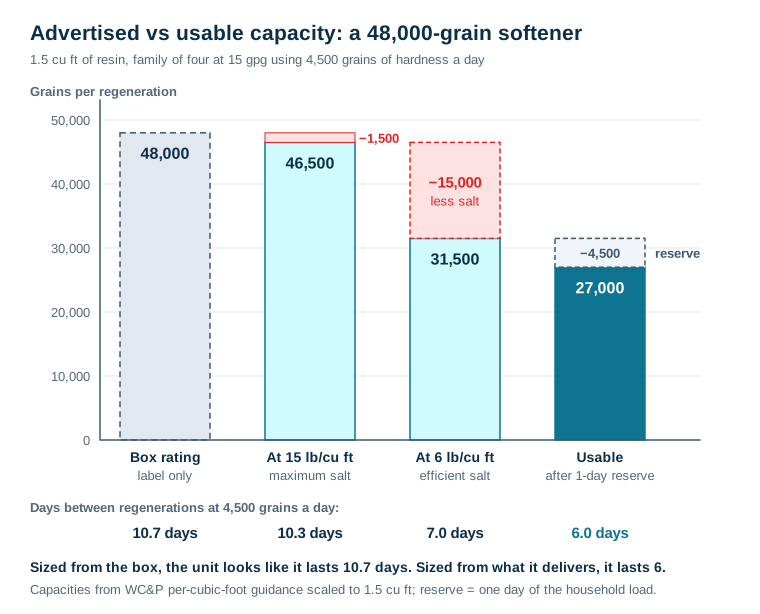
For the same family of four, one day of reserve is 4,500 grains. Here is where a "48,000-grain" softener ends up:
| Stage | Grains | What removed it |
|---|---|---|
| Box rating | 48,000 | Nothing. This is the label |
| Capacity at 15 lb/cu ft | 46,500 | The rating rounds up the top of the curve |
| Capacity at 6 lb/cu ft | 31,500 | Efficient salt programming |
| Usable after reserve | 27,000 | One day of the household's hardness load held back |
Days between regenerations:
- Sized from the box: 48,000 ÷ 4,500 = 10.7 days
- Sized from the usable number: 27,000 ÷ 4,500 = 6 days
Six days is a perfectly good interval. The problem is only that everyone was told it would be ten, and when the unit starts regenerating twice as often as promised, it looks like a fault.
Other Things That Take Capacity Away
Iron and manganese. These occupy exchange sites just as calcium does, but a hardness test does not report them. The usual rule is to add about 4 grains per gallon of compensated hardness for every 1 ppm of dissolved iron. This does not shrink the resin's capacity. It raises your daily load, which has the same effect on the number of days between regenerations. The calculation is set out in how iron changes water softener sizing.
Resin condition. The table describes healthy resin. Chlorinated supplies slowly oxidise the beads, and iron and silt foul them. An older bed can deliver noticeably less than the table at the same salt dose.
Hardness leakage at low doses. A lightly regenerated bed leaves more of its exchange sites loaded with hardness, so a little hardness can slip through during service. For household use this is normally well below anything you would notice, but it is why very low salt settings are not a free lunch on extremely hard water.
Brine delivery. The salt dose on the display is what the valve intends to draw. A partly blocked injector, a short brine refill or a salt bridge means less brine reaches the resin, and the capacity is lower than the setting suggests.
How to Compare Two Softeners Honestly
When you have two quotes or two spec sheets in front of you:
- Find the resin volume in cubic feet for each. It is on the spec sheet or the tank label. If a seller will not tell you, treat that as the answer.
- Ask what salt dose the unit will be programmed at, in pounds per regeneration. Divide by the resin volume to get pounds per cubic foot.
- Look both up in the table above at that dose. That is each unit's real capacity per cycle.
- Subtract a day of your household's hardness load for the reserve.
- Divide by your daily load to get days between regenerations. Compare those, not the grain ratings.
Watch for two presentation tricks. One is a large grain rating on a small resin volume, where the capacity has been calculated at a salt dose you would never run. The other is a salt-efficiency claim quoted without the capacity that goes with it. High efficiency always comes with lower capacity per cycle. Both numbers are needed, and they must be quoted at the same salt dose. For a worked case on a real product, see how the SpringWell SS4's 48,000-grain rating holds up at a stated salt dose. The same check decides head-to-head choices, such as whether SpringWell or Pelican puts more usable resin behind its rating, or whether a budget Aquasure matches a mid-range SpringWell once both are read at the same salt dose.
For certification, University of Nebraska–Lincoln Extension's guide to water softening notes that softeners can be certified to the NSF standard, directly or through the Water Quality Association's Gold Seal program, which uses the same standard. A certified product's performance data should show the salt dose behind each capacity figure. If it does not, ask for it.
Sizing From the Usable Number
Once you work in usable grains, sizing becomes simple:
Usable capacity needed = daily hardness load × target days between regenerations + one day of reserve
For the family of four at 15 gpg with a target of about a week:
- 4,500 × 7 = 31,500 grains, plus 4,500 reserve = 36,000 grains at your chosen salt dose
- At 6 lb/cu ft (21,000 per cu ft), that is about 1.7 cu ft, so a 2.0 cu ft unit, sold as 64,000 grains
- At 9 lb/cu ft (26,000 per cu ft), that is about 1.4 cu ft, so a 1.5 cu ft unit, sold as 48,000 grains
The bigger bed on an efficient setting uses less salt for the same soft water. That is the usual answer, provided the household uses enough water to keep the larger bed regenerating at least weekly. The full method, including peak flow, is in how to size a water softener.
What the Table Cannot Tell You
- It is not a specification for your unit. It describes standard gel cation resin. Fine-mesh and high-capacity resins, and valves with unusual brining methods, sit somewhat off these figures. Your manufacturer's data wins where it exists.
- It says nothing about flow. Capacity decides how long a bed lasts. It has no bearing on whether two showers and a washing machine can run at once. That is a separate sizing question.
- It does not make a softener a general water treatment system. More capacity removes more hardness and nothing else. Nebraska Extension's guide is explicit that softening does not remove bacteria, hydrogen sulfide, silt or sand, lead, nitrate, pesticides and many other contaminants. Sizing up the resin will not change that.
Start with the resin volume, look up your salt dose, take off a day for reserve, and size from what is left.
Frequently Asked Questions
Is a 48,000-grain water softener really 48,000 grains?
Only at a heavy salt dose. The 48,000 figure belongs to 1.5 cubic feet of resin, rated at roughly 32,000 grains per cubic foot. In the industry's design tables, one cubic foot of standard resin delivers about 31,000 grains at 15 lb of salt per regeneration and about 21,000 grains at 6 lb. So the same 48,000-grain unit gives about 46,500 grains at the maximum setting and about 31,500 grains at an efficient one.
What salt setting gives the best efficiency on a water softener?
Low salt doses give the most softening per pound of salt. At about 6 lb of salt per cubic foot of resin, standard resin yields roughly 3,500 grains of capacity per pound of salt. At 15 lb per cubic foot it yields only about 2,070 grains per pound, because each extra pound of salt buys less capacity than the one before. That is why efficient programming trades a smaller capacity per cycle for a much lower salt bill.
How do I work out the usable capacity of my softener?
Find the resin volume in cubic feet on the spec sheet or tank label. Multiply it by the capacity per cubic foot at the salt dose you run: about 21,000 grains at 6 lb, 26,000 at 9 lb, 29,000 at 12 lb and 31,000 at 15 lb. Then subtract the reserve, which should be about one day of your household's hardness load. What is left is the capacity you can plan around between regenerations.
Why does my softener regenerate more often than the salesperson said?
Usually because the estimate was worked from the box rating while the valve was programmed for salt efficiency. A 48,000-grain unit sized for a household using 4,500 grains a day looks like it will last almost 11 days. At an efficient 6 lb dose with a one-day reserve it gives about 27,000 usable grains, which lasts 6 days. Nothing is broken. The sizing simply used the wrong number.
Can I get the full rated capacity by increasing the salt?
You can get close to it, but at a steep price in salt. Moving a 1.5 cubic foot unit from 6 lb to 15 lb per cubic foot raises the salt per regeneration from 9 lb to 22.5 lb, which is two and a half times the salt, for about 48 percent more capacity. Past about 15 lb per cubic foot the extra salt mostly rinses to the drain. It is usually cheaper to buy more resin than to buy more salt every week.
Does grain capacity drop as a softener gets older?
It can. Chlorine slowly oxidises resin, and iron, manganese and silt coat the beads, so an older bed may deliver less than the table shows even at the same salt dose. The table describes healthy standard resin. If your unit is regenerating more often than it did in its first years with no change in water use or hardness, measure what it actually delivers per cycle before assuming it was simply too small.
