
Best Sediment Filters for Well Water: Spin-Down, Self-Cleaning and Backwashing Picks
The best sediment filters for well water depend on what size of particle your well sheds. For sand, the pick is a 50 micron automatic-flush spin-down such as the iSpring WSP50ARB. For higher flow and almost no upkeep, WECO's SEDFLUSH self-cleaning screen is the choice. For silt and cloudiness, a 20 micron backwashing Filter-Ag tank works, as long as the house's flow fits its rating. A 5 micron cartridge belongs last, where a UV system or a fussy valve needs it. Most wells need one coarse stage. Some need two, staged coarse to fine.
Disclosure: Hard Water Solved may earn a commission if you buy through links on this page, at no extra cost to you. It does not change which products we include or how we rank them. Read our disclaimer.
Best Sediment Filters for Well Water at a Glance
| Pick | Rating | Catches | Service | Routine parts | Amazon |
|---|---|---|---|---|---|
| iSpring WSP50ARB | 50 µm stainless screen | Sand, coarse silt | Automatic timed flush | None (reusable screen) | Check price on Amazon |
| WECO SEDFLUSH | 90 µm (50 µm option) | Sand | Flush; screen every 24 months | One screen every 24 months | Check price on Amazon |
| Filter-Ag backwashing tank | 20 µm | Most silt, cloudiness | Automatic backwash | None routine | Check price on Amazon |
| 5 µm cartridge stage | 5 µm | Fine silt | Swap by hand, 1 to 6 months | A cartridge at every change | Not ranked (see below) |
How These Sediment Filters Were Chosen
Method. Nothing on this page was physically tested by us. Picks are compared on the micron rating, flow rating and service interval their makers publish, and on how often each one needs parts replaced.
- Included: whole-house sediment filters for private wells, with a stated micron rating, sold on Amazon.
- Excluded: manual spin-downs, which rely on someone remembering to flush them. Frizzlife's JX800 auto-flush spin-down has a live Amazon listing, but we could not confirm it anywhere else, and Frizzlife's own store lists only its manual spin-downs, so it is not ranked. Twenty-inch cartridge housings are discussed as a stage, not ranked, because we could not confirm a sediment-only kit on Amazon on the day we checked.
- Prices are not listed here because they change often. Use the buttons to see the current price on Amazon.
How a sediment stage fits ahead of the rest of a well system is set out in water softener for well water. This page assumes you know you need one and are choosing which.
Sand, Silt or Cloudiness: Match the Micron Rating to the Particle
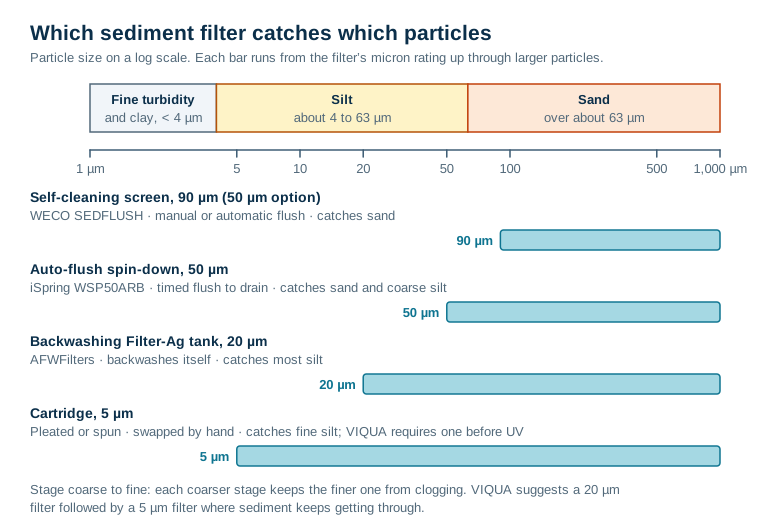
Sediment is sorted by grain size on the standard geology scale: sand is coarser than about 63 microns, silt runs from about 4 to 63 microns, and clay is finer than about 4 microns. Clay and very fine silt are what make well water look cloudy. A filter's micron rating is the size it is built to stop. Particles larger than that are caught, and smaller ones pass.
That gives three practical rules:
- The finest filter you need is set by the finest particle that causes a problem, not by the smallest number you can buy. Sand that scores valve seals is stopped at 50 microns. Cloudiness needs 20 microns or finer.
- A fine filter on its own clogs. A 5 micron cartridge on a sandy well fills with sand that a 50 micron screen would have flushed away for free. That is the reason to stage coarse to fine.
- Ratings are not all measured the same way. A screen's rating is its mesh opening. A media bed or a cartridge is rated by what it catches as water passes through depth. Compare them as rough bands, not to the last micron.
The VIQUA UV owner's manual puts this into practice. It requires a 5 micron sediment filter ahead of its UV chamber. Where sediment keeps getting through, it suggests stepped filtration: a 20 micron filter followed by a 5 micron filter, then the UV.
iSpring WSP50ARB: Best Spin-Down for Sandy Wells

- Screen: 50 micron, 316L stainless steel mesh, reusable
- Cleaning: automatic flushing module with a touch-screen timer, plus a built-in scraper that wipes the screen as it flushes
- Build: brass top; 1-inch MNPT and ¾-inch FNPT connections
- Flow: SupplyHouse lists it at 35 gpm
This is the pick for the most common well sediment problem: sand and grit that turn up in aerators, toilet fill valves and softener valves. A spin-down sends water around a screen so heavier particles drop into a clear bowl. The automatic module opens the flush valve on a schedule and sends what has collected to drain. On a manual spin-down someone has to remember. Here the timer does it, and the scraper keeps the mesh from blinding between flushes.
Watch for: the flush needs a drain within reach of the bowl, and the timer module needs its own power source. Check the manual for which one it uses before you plan the location. Fifty microns will not touch cloudiness. If the water still looks hazy after the spin-down, you need a finer stage after it.
Wrong for: wells whose problem is silt or turbidity rather than sand, and wells with oxidised iron, which slips through a 50 micron screen.
WECO SEDFLUSH: Best Self-Cleaning Screen for High Flow
- Screen: 90 micron polyester by default; 90 micron stainless steel or 50 micron polyester as options, per WECO
- Flow: 22 gpm peak (¾-inch SEDFLUSH-075), 26 gpm (1-inch -100), 50 gpm (1½-inch -150)
- Limits: minimum 26 psi; maximum 113 °F
- Cleaning: counter-current wash, opened by hand at the blowdown ball valve or automatically with WECO's auto kit
- In the box: blowdown ball valve, wrench, bracket kit and a code-compliant backflow preventer
- Amazon listing: it would not open on our check, so confirm the model size there before ordering. The specs above are from WECO's store.
The SEDFLUSH is the pick when flow matters more than fineness: a large house, an irrigation take-off before treatment, or a well pump that delivers more than a small spin-down is comfortable with. The counter-current wash reverses flow across the screen to clean it, rather than just opening a drain under a bowl.
Running cost: WECO gives every screen a 24-month life except the stainless one, which it rates for 48 months. That means one replacement screen every two years, or every four with stainless.
Watch for: the 26 psi minimum. A well system with a 20/40 pressure switch spends part of every cycle below it. Check your cut-in pressure, or choose a 30/50 or 40/60 switch setting, before relying on the self-cleaning action. Wrong for: anything finer than sand; even the 50 micron screen option leaves silt behind.
Filter-Ag Backwashing Tank: Best for Silt and Cloudy Water
AFWFilters sells Filter-Ag systems on a Fleck 5600SXT digital valve in three sizes. Filter-Ag is a granular media that catches particles through the depth of the bed. The valve backwashes it automatically, lifting the bed and flushing what it has caught to drain.
| Model (AFWFilters) | Media | Tank | Max constant flow | Backwash needs | Seller's household guide |
|---|---|---|---|---|---|
| Digital Filter-Ag 10 | 1.0 cu ft | 9x48 | 2.2 gpm | 3.5 gpm | 1 bathroom, 1 to 2 people |
| Digital Filter-Ag 15 | 1.5 cu ft | 10x54 | 2.75 gpm | 4.4 gpm | 1 to 2 bathrooms, 2 to 3 people |
| Digital Filter-Ag 20 | 2.0 cu ft | 12x48 | 3.9 gpm | 6.3 gpm | 2 to 3 bathrooms, 3 to 5 people |
From the AFWFilters Digital Filter-Ag 15 page and its sister pages. The Amazon listing in our research is a Filter-Ag Plus system on a Fleck 5600SXT sold under the Premier name. It would not open on our check, so the specs here are AFWFilters' for the same media and valve.
The number most buyers miss is the flow. AFWFilters rates the 1.5 cubic foot tank at 2.75 gpm of constant filtration. That is not a typo. Depth filtration works by slowing water through the bed, and pushing it faster drives particles through. A shower and a washing machine together can pass 2.75 gpm. AFWFilters adds that its household guides assume "flows matching system capacities". In practice, that means the tank suits a small household, a well with storage, or a single treated line. A larger home needs the largest tank, or a cartridge stage instead.
Running cost: no routine parts. The cost is backwash water, and a drain and outlet at the tank. AFWFilters does not state a media life, so budget for eventual rebedding.
Watch for: the backwash requirement. Measure what your pump sustains. A well that cannot supply 4.4 gpm for the whole backwash cannot clean a 10x54 tank properly. Wrong for: sandy wells without a coarse stage ahead, large households at the 15 size, and low-yield wells.
The Cartridge Stage: Last in Line, Not First
A 20-inch "Big Blue" housing with a pleated or spun 5 micron cartridge is the most common sediment filter on a well, and the most misused. It is a polishing stage. Placed first on a sandy well, it fills within days.
It earns its place in two situations:
- Ahead of UV. VIQUA's manual requires a 5 micron filter before its chamber.
- As a final stage after a coarse screen, where some fine silt still gets through to fixtures or a softener valve.
Running cost is the catch. Fresh water supplier ESP, which sells cartridges such as the Pentair DGD-5005-20 5 micron 4.5 x 20-inch, advises replacing well cartridges every 1 to 6 months, never longer than 12. That is anywhere from two to twelve cartridges a year. A coarse stage ahead of it is what keeps the number at the low end. How to read the pressure drop and time each change is covered in when to replace a sediment prefilter before a softener.
Service Interval and Yearly Upkeep, Side by Side
| Type | What the owner does | How often | Parts used up | Other running needs |
|---|---|---|---|---|
| Auto-flush spin-down (WSP50ARB) | Nothing routine; occasional bowl check | Timer flushes automatically | None (reusable screen) | Drain; power for the module |
| Self-cleaning screen (SEDFLUSH) | Open the blowdown valve, or let the auto kit do it | Screen change every 24 months (48 for stainless) | One screen every 24 months (48 for stainless) | Drain; 26 psi minimum |
| Backwashing Filter-Ag | Nothing routine | Valve backwashes on its schedule | no routine parts | Drain, outlet, backwash flow |
| 5 µm cartridge | Shut off, open housing, swap | 1 to 6 months on a well | Two to twelve cartridges a year | Spare cartridges on hand |
The trade-off is plain: the fine stage is the cheapest to buy and the most expensive to keep. Every coarse stage you put ahead of it cuts that cost.
A worked example: one cartridge, or a spin-down plus a cartridge
Take a well that sheds sand and a little fine silt, feeding a UV system that needs a 5 micron filter in front of it. There are two ways to set it up.
| 5 µm cartridge alone | WSP50ARB spin-down, then 5 µm cartridge | |
|---|---|---|
| Up-front, beyond the housing | Nothing extra | The spin-down |
| Cartridge changes a year (illustrative) | 12, because sand loads it | 2, because the screen takes the sand |
| Cartridges bought each year | 12 | 2 |
Illustrative. The number of changes depends on how much sand and silt your well carries. Use the pressure drop across the housing, not the calendar, to time each change.
On these assumptions the spin-down cuts cartridge purchases from twelve a year to two, which is how it pays for itself and keeps saving after that. The bigger benefit is harder to price. A cartridge that is loading up fast drops pressure at the taps and at the UV between changes. A cartridge that only sees fine silt holds steady.
The same logic applies ahead of a softener. Sand that reaches a control valve wears its seals and pistons, and a repair costs more than any filter on this page. A coarse screen is the cheapest protection a well system can have.
Which Sediment Filter for Your Well
- Sand in aerators, toilet tanks or a softener valve: a spin-down. The WSP50ARB for most homes, the SEDFLUSH for high flow.
- Cloudy water from a well with sand as well: a spin-down first, then a Filter-Ag tank if the house's flow fits, or a 5 micron cartridge if it does not.
- Clear water feeding a UV system: a 5 micron cartridge immediately ahead of the UV, as the maker requires.
- Specks in water after a softener: check what they are before buying anything. Black or amber grains can be resin from a failing softener rather than well sediment, and a filter ahead of the softener will not stop them. Black specks in water after a softener explains how to tell them apart.
Placement matters as much as the filter. The coarse stage normally goes right after the pressure tank. If the well pumps enough sand to wear the pressure switch, a spin-down can go ahead of the tank instead.
Who Should Buy None of These
- Wells with dissolved iron and no sediment. Clear water that turns orange after standing is dissolved iron. No sediment filter stops it, and a fine one clogs with whatever oxidises in the housing. An iron filter is the purchase.
- Wells that suddenly start pumping sand. A new sand problem usually means a worn pump, a failing screen or a drop in water level. A filter treats the symptom while the pump wears.
- Muddy water after heavy rain. That points to surface water reaching the well, which is a bacteria risk as much as a sediment one. Test for coliform bacteria and have the wellhead inspected first.
- Homes on low-yield wells considering a backwashing tank. Without the backwash flow, it cannot clean itself; choose a screen or cartridge.
Choose the best sediment filter for well water by the smallest particle that actually causes trouble, and put a coarse, self-cleaning stage ahead of anything fine. For most wells that means one spin-down. For some it means a spin-down plus one finer stage, and almost never a cartridge alone.
Frequently Asked Questions
What micron sediment filter is best for well water?
Start coarse. A 50 to 100 micron spin-down or self-cleaning screen catches well sand and protects everything after it. Add a finer stage only if the water is still cloudy or a downstream device asks for one: about 20 microns for silt, and 5 microns ahead of a UV system, which VIQUA's manual requires. Going straight to 5 microns on a sandy well clogs the cartridge within days.
Is a spin-down filter enough for well water?
For sand and grit, often yes. A 50 micron spin-down stops sand and coarse silt and flushes it to drain. It does not stop fine silt, clay or the cloudiness they cause, and it does not remove dissolved iron. If the water is still cloudy after a spin-down, add a 20 micron backwashing tank or a cartridge stage after it.
How often should a well water sediment filter be changed?
It depends on the type. A spin-down screen is flushed, not changed, and an automatic model flushes on a timer. WECO says its SEDFLUSH screens need replacing every 24 months, or 48 months for the stainless screen. A 5 micron cartridge typically lasts 1 to 6 months on a well, and one cartridge supplier advises never leaving one in longer than 12 months.
Do backwashing sediment filters waste water?
They use water to clean themselves. AFWFilters' Filter-Ag tanks need 3.5 to 6.3 gpm of backwash flow, depending on size, for each cycle. How much water that adds up to depends on how often the valve is set to backwash, which in turn depends on how much sediment the well carries.
Where should a sediment filter go on a well system?
Normally right after the pressure tank, so it sees steady pressure and protects every stage after it. A well that pumps sand is the exception. There a spin-down separator can go ahead of the pressure tank to protect the tank and pressure switch.
Will a sediment filter remove iron from well water?
Only iron that has already oxidised into particles, and a fine filter clogs quickly doing it. Dissolved, clear-water iron passes through any sediment filter. It needs an iron filter or, at low levels, a fine-mesh softener.