
What Causes Black Specks After a Water Softener?
Black specks in water after a softener come from one of three sources, and telling them apart takes about a minute. Crushed resin is springy and roughly round. Manganese oxide is a powder that smears black on your fingers. Rubber seal fragments are flat, matte and flexible — and that last one means the control valve is failing, which is the finding almost nobody expects.
Catch a sample before anything else. Hold a fine mesh strainer, a coffee filter or an unscrewed aerator screen under a running cold tap for a few minutes and collect what it traps. Every test below needs that sample.
Start Here: The One-Minute Identification Key
Work down this list in order. Each step is a physical test on the specks you caught, not a guess from appearance.
| Test | Manganese oxide | Resin fragments | Rubber seal debris |
|---|---|---|---|
| Crush between fingers | Powders and smears black | Deforms, then springs back | Squashes but stays whole, feels like rubber |
| Held to a bright light | Opaque, no shape | Translucent amber or dark honey at the edges | Fully opaque, matte, no shine |
| Shape | Irregular grit and dust | Round or half-round beads, uniform size | Flat flakes, sometimes curved, varying sizes |
| Rinsed on white tissue | Leaves a brown-black stain | Leaves nothing | Leaves nothing |
| Dropped in white vinegar for 2 hours | Fades, partly dissolves | Unchanged | Unchanged |
| Floats or sinks in a glass | Sinks quickly | Mostly sinks, some float | Often floats |
| Timing of appearance | Continuous, worse at first draw | Continuous, increasing over months | Bursts after each regeneration |
That final row does most of the diagnostic work, so track it before you take anything apart. Note the day and time of the next regeneration — most units run at 2 a.m. — and check whether the specks spike on the mornings afterwards.
One more free clue: where else is the black showing up?
- Black or dark brown staining in the toilet tank, dishwasher and on laundry points to manganese.
- Clogged aerators and showerheads with no staining points to resin or rubber.
- Black slime rather than specks, especially with a rotten-egg smell, is bacterial and a different problem — see why a sulfur smell remains after softening.
Cause 1: Manganese Oxide
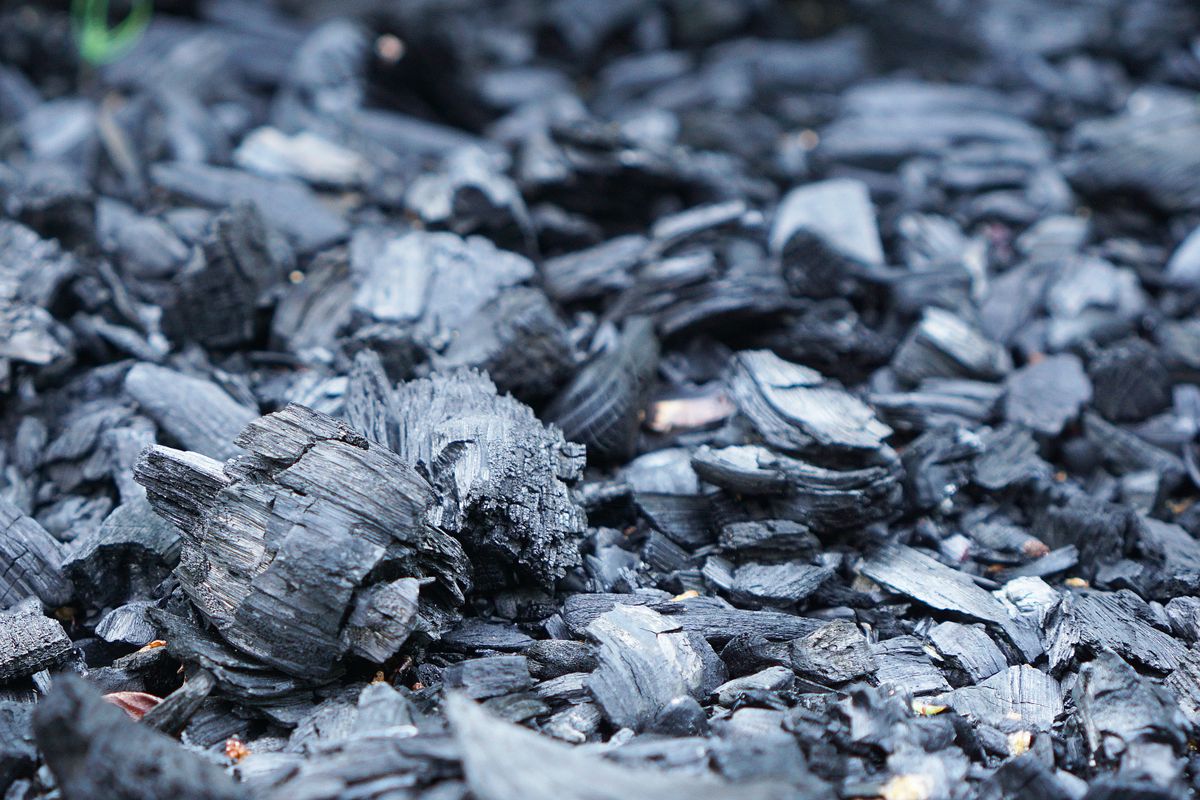
Manganese travels with iron in groundwater and behaves like iron's more troublesome relative. Dissolved, it is invisible. Exposed to air, chlorine or any oxidiser, it converts to black manganese dioxide — the specks in the glass and the black film in the toilet tank.
Why it turns up specifically after a softener:
Softener resin removes dissolved manganese by exchange, the same way it removes calcium, and it does that quite happily at low concentrations. The trouble starts when the concentration exceeds what the bed can carry between regenerations. Manganese accumulates, oxidises inside the bed, and then sheds as particles — often heaviest in the first draw after a regeneration.
The concentrations that matter:
| Manganese level | What you see | What to do |
|---|---|---|
| Below 0.02 mg/L | Nothing | No action |
| 0.05 mg/L | Black staining begins; EPA secondary standard | Monitor; softener usually copes |
| 0.05 – 0.3 mg/L | Staining, occasional specks, resin darkening | Softener with high salt dose and routine cleaner |
| Above 0.3 mg/L | Persistent specks, fouled resin, shortened life | Dedicated manganese removal ahead of the softener |
| Any manganese already oxidised in the raw water | Specks from day one | Filtration or oxidation first — exchange does not remove particles |
The 0.05 mg/L figure is the EPA's aesthetic threshold, listed with the other secondary drinking water standards. It is set on staining and taste, not toxicity — but manganese is one of the few nuisance parameters with a genuine health dimension at higher, longer-term exposures, which the Minnesota Department of Health explains in its guidance on manganese in drinking water, including its specific advice about infants. Penn State Extension's guide to iron and manganese in private water systems covers the treatment options above the softener's range.
The practical point most owners miss: manganese fouls resin at roughly a tenth the concentration iron does, and it responds far less well to cleaning once it is in the bed. Where 1 ppm of iron is manageable, 0.3 mg/L of manganese is already a problem. If the black specks are manganese, the softener is not the fix — it is the casualty. Sizing a replacement without measuring manganese first repeats the mistake, which is the argument made in testing iron and manganese before sizing a softener.
Cause 2: Resin Fragments

Healthy softener resin is a translucent amber bead, round, and roughly the size of a coarse grain of sand. It arrives in your glass when it has been damaged, and the damage tells you how much life the bed has left.
How resin ends up black rather than amber:
- Chlorine attack. Chlorine and chloramine break the crosslinks that hold each bead together. Beads soften, swell, then fracture. The fragments pick up iron and manganese staining on the way, which is why degraded resin often looks dark rather than amber.
- Iron and manganese fouling. Coats the beads brown-black and makes them brittle.
- Mechanical attrition. Fifteen years of expansion and contraction on every backwash grinds a percentage of any bed to fines.
- Osmotic shock. Repeated swings between brine and fresh water stress each bead. A valve regenerating far more often than it needs to accelerates this.
How to tell fragments from whole beads: whole beads escaping means a broken distributor or screen — a mechanical failure covered in why resin beads appear in household plumbing. Fragments and dust mean the resin itself is breaking down, which is a replacement conversation.
The bed check that settles it. Put the unit in bypass, depressurise, and open the top of the resin tank:
| What the bed looks like | Reading |
|---|---|
| Amber, uniform, pours like wet sand | Healthy — the specks came from somewhere else |
| Darker but still round and free-flowing | Fouled surface; cleaner may recover it |
| Visibly reduced in volume, fines on top | Attrition — the bed is wearing out |
| Mushy, flattened, breaks between fingers | Chlorine damage — replace |
| Clumped into a solid black mass | Heavy manganese fouling — replace, and treat upstream |
Where a softener sits on a chlorinated municipal supply, the resin's working life is genuinely finite, and Penn State Extension's overview of water softening is a good reference for what the process is and is not designed to tolerate. On city water, a carbon filter ahead of the softener is the standard way to protect the bed, and it is worth fitting before the bed shows the damage rather than after.
Cause 3: Failing Valve Seals — The One Nobody Checks
Inside the control valve is a piston that moves through a stack of rubber seals and plastic spacers to direct water between service, backwash, brine draw and rinse. Those seals are consumables. They harden with age, faster on chlorinated water, and when they start to break down they shed flat black flakes directly into the treated line.
The signature that separates this from everything else:
- Specks arrive in bursts on the mornings after a regeneration, when the piston has moved, then taper off.
- They are flat and flexible, never round, never powdery.
- The unit is eight years old or more — or younger on chlorinated city water without carbon pretreatment.
- Often accompanied by early hints of valve trouble: a slight seep at the valve body, a cycle that takes longer than it used to, or water trickling to the drain between cycles.
Why it matters more than the specks themselves. Seal degradation does not stay cosmetic. As the seals lose their edge, the valve starts leaking internally between ports, which produces exactly the symptoms owners spend money chasing elsewhere: hard water passing through during service, brine leaking to drain, a softener that runs constantly. If specks and unexplained hardness have appeared in the same few months, suspect the valve before the resin — the overlap is covered in why water is still hard after installing a softener.
The decision:
| Situation | Sensible action |
|---|---|
| Unit under 10 years, tank and resin sound | Seal-and-spacer kit plus piston — a modest parts cost |
| Unit 10–15 years, resin also degraded | Rebuild valve and rebed together, or price a replacement |
| Unit over 15 years, obsolete valve, parts scarce | Replace the system |
| Specks plus internal bypass symptoms | Rebuild now; it will not improve on its own |
Seal kits are model-specific and generally a straightforward job with the water off and the unit depressurised, but the piston must go back the same way it came out. If that description already sounds like more than you want to take on, it is a routine service call rather than a specialist one.
Sources That Are Not the Softener at All
Three checks that cost nothing and regularly end the investigation early:
- Bypass the softener for 48 hours. If black specks continue with the softener out of the loop, it was never the source. This single test is worth doing before any disassembly.
- Check hot taps against cold. Specks only at hot taps means the water heater: a disintegrating dip tube (usually white or grey plastic, not black), a decomposing anode rod, or scale flaking off the element. See hard water sediment in a storage water heater.
- Check one fixture against the rest. A single tap producing specks points at that fixture's supply hose or cartridge. Rubber supply hoses degrade from the inside and shed black flakes that look exactly like valve seal debris.
Also worth knowing: black specks after mains work on municipal supply are usually manganese deposits shaken loose from the distribution main, not anything in your house. Those clear within a few days, and the utility can confirm whether work was done nearby.
What to Do, In Order
- Catch a sample in a strainer or coffee filter on a cold tap. Nothing can be diagnosed from memory.
- Run the identification key — crush, light, vinegar, tissue.
- Log the timing against the regeneration schedule for a week. Bursts after cycles means valve seals.
- Fit a five-micron sediment cartridge downstream as containment while you work — and note how fast it loads.
- If manganese: test the raw water for manganese and iron, and treat ahead of the softener if it is above 0.3 mg/L. Do not expect the softener to cope.
- If resin fragments: open the tank and inspect. Fines and volume loss mean rebedding; fit carbon ahead of the unit on chlorinated supply or the new bed will go the same way.
- If rubber: order the seal and piston kit for your valve model, or book the service.
- Clear the debris downstream — every aerator, showerhead, and appliance inlet screen — or you will keep chasing pressure complaints for months.
- Retest and re-check the strainer two weeks after the repair to confirm it is actually resolved.
The reason this diagnosis is worth the hour is that the three causes have nothing in common. One needs upstream treatment, one needs new resin, and one needs a valve rebuilt before it strands you with hard water. Guessing between them is how people buy a new softener to solve a problem that a fifty-dollar seal kit would have fixed.
Frequently Asked Questions
What are the black specks in my water after the softener?
There are three realistic causes and they are easy to confuse. Oxidised manganese looks like fine black powder or grit, smears when you rub it and often arrives with black staining in the toilet and on laundry. Crushed or degraded resin fragments are slightly springy, usually dark amber to near-black, and are roughly the size of coarse sand. Fragments of failing rubber seals or O-rings are flat, matte black, and flexible rather than brittle. The third is the most expensive, because it means the control valve is coming apart.
Are black specks in drinking water dangerous?
Resin and rubber fragments are unpleasant rather than toxic, though rubber debris in the water means the valve needs work before it fails outright. Manganese is different: it has both an aesthetic secondary standard at 0.05 mg/L for staining and taste, and a separate health-based guidance level that public health agencies apply to long-term exposure, particularly for bottle-fed infants. If the specks test as manganese, get the water analysed rather than just filtering it.
How do I tell resin beads from manganese?
Rub a speck between finger and thumb. Resin deforms slightly and then springs back, and whole beads are perfectly round and translucent amber when held to the light. Manganese crushes into a black smear that stains your skin and will not rinse off cleanly. A second check: drop both into white vinegar. Manganese oxide slowly fades or dissolves in acid; resin sits there unchanged for hours.
Can black specks come from a broken water softener valve?
Yes, and it is the cause owners almost never suspect. The seals, spacers and piston O-rings inside a control valve are rubber, and after eight to fifteen years — faster on chlorinated supplies — they harden, crack and shed flakes into the treated water. The clue is timing: rubber debris arrives in bursts right after a regeneration cycle, when the piston moves, rather than continuously. That is a valve rebuild, not a resin problem.
Will a sediment filter fix black specks in my water?
It will catch them, which is worth doing immediately to protect appliances, but it does not address why they are there. A five-micron cartridge downstream of the softener stops resin and rubber fragments and most oxidised manganese. It will load quickly and need frequent changes, and if it is loading in days rather than months that is itself diagnostic. Treat the filter as containment while you identify the source, not as the repair.
Why did black specks start after a new water softener was installed?
Usually because the softener disturbed manganese that was already coating the inside of the pipes. A new installation changes flow, pressure and water chemistry, and that shifts loose deposits into the water for days or weeks. The other possibility is genuine: a softener passing manganese-bearing water above roughly 0.05 mg/L accumulates it in the bed and releases oxidised particles during regeneration. If it is still happening a month after install, test for manganese.