
Best Tannin Filters for Tea-Colored Well Water: Combo Tank or Separate Tanks?

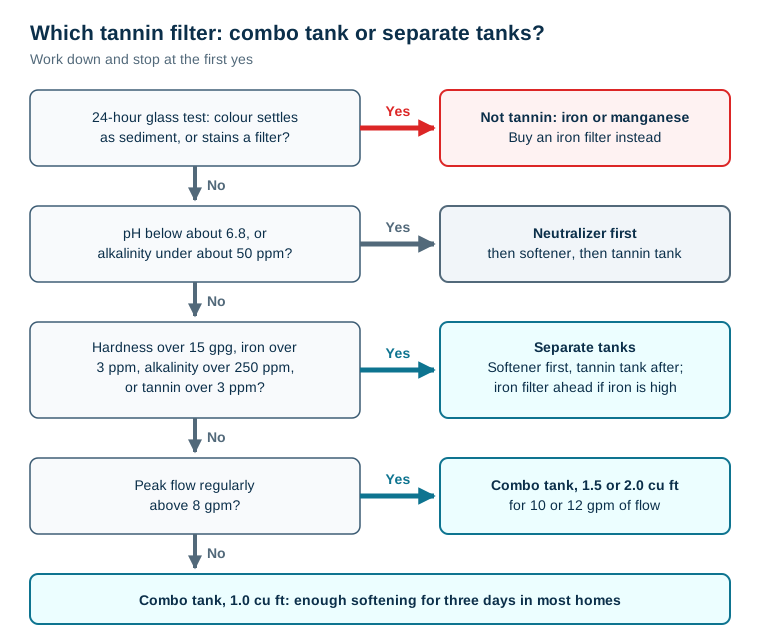
The best tannin filters are anion resin tanks that regenerate with salt, the same way a softener does. For most wells with tea-coloured water, moderate hardness and little iron, a combination unit holding tannin resin and softening resin in one tank is the simplest buy: the AFWFilters 1 cu ft digital tannin softener or the Oceanic tannin and hardness softener. If hardness is above 15 gpg, iron above 3 ppm or alkalinity above 250 ppm, buy separate tanks instead: a softener first and a tannin tank after it.
Before buying either, spend two minutes confirming that the colour really is tannin. Iron causes the same yellow water, and a tannin filter does nothing for it.
Disclosure: Hard Water Solved may earn a commission if you buy through links on this page, at no extra cost to you. It does not change which products we include or how we rank them. Read our disclaimer.
Best Tannin Filters at a Glance
| Pick | Type | Tannin resin | Hardness capacity | Rated tannin | Amazon |
|---|---|---|---|---|---|
| AFWFilters 1 cu ft digital tannin softener, Fleck 5600SXT | Combo tank | 0.5 cu ft | 16,000 grains | up to 3 ppm | Check price on Amazon |
| Oceanic tannin + hardness softener, Fleck 5600, 1 cu ft | Combo tank | not stated | from 16,000 grains | up to 3 ppm | Check price on Amazon |
| Oceanic tannin + hardness softener, Fleck 5600, 2 cu ft | Combo tank | not stated | up to 32,000 grains | up to 3 ppm | Check price on Amazon |
| Separate tannin tank after a softener | Two tanks | 1.0 cu ft or more | the softener's | depends on resin volume | Build or dealer |
How We Chose
Methodology. Nothing on this page was physically tested. Specifications come from the sellers' product pages, and the salt and sizing figures are worked from an anion resin supplier's published guidance.
- Included: salt-regenerated anion resin systems on an automatic valve, sold on Amazon, with a stated tannin rating.
- Compared on: how much tannin resin each holds (not total tank size), the hardness it softens, the salt its regeneration schedule uses, and what replacing the tannin resin involves.
- Excluded: cartridge and carbon "tannin" filters, which do not regenerate; a third combo listing in our research set whose Amazon page would not load on 2 October; and units with no tannin rating at all.
- Prices are not listed here because they change often. Use the buttons to see the current price on Amazon.
First, Confirm It Is Tannin

Draw a glass from a cold tap after running it for two minutes. Cover it and leave it out of sunlight for 24 hours:
- Colour settles to the bottom as orange or brown sediment: iron. A tannin filter will not help.
- Black or brown-black specks settle out: manganese.
- Colour stays evenly spread, like weak tea, with nothing on the bottom: tannins.
Then pour some through a white coffee filter. Iron stains the paper. Tannin passes through and the water stays yellow. Both tests, with what to do when the result is mixed, are set out in why softened water looks yellow.
If the glass says tannin, get a lab test before you buy. You need five numbers, not one:
| Result | Why it matters for the purchase |
|---|---|
| Tannin (ppm) | The combo units here are rated to 3 ppm |
| Hardness (gpg) | Over 15 gpg rules out a combo tank |
| Iron (ppm) | Over 3 ppm rules out a combo tank and fouls tannin resin |
| Alkalinity (ppm) | Over 250 ppm rules out a combo; under about 50 ppm warns of a pH drop |
| pH | Below about 6.8 needs correcting before the resin |
Combo Tank or Separate Tanks: What Actually Differs
A combination unit blends tannin (anion) resin and softening (cation) resin in one tank under one valve. A separate system puts a softener first and a tannin tank after it. Both regenerate with salt. They differ in four ways.
| Combo tank | Separate tanks | |
|---|---|---|
| Tannin capacity | Fixed by the anion resin in the blend: 0.5 cu ft in every AFWFilters size | Set by the tannin tank: 1.0 cu ft or more is common |
| Protection of the tannin resin | None: every bead sees raw hardness and iron | The softener removes hardness and some iron first |
| Salt | Whole bed brined on the tannin schedule, every 3 days or less | Softener on its own schedule; only the tannin tank every 3 days |
| Replacing worn tannin resin | The resins are blended, so the whole tank is rebedded | Replace only the tannin resin |
| Space and cost | One tank, one valve, one drain | Two tanks, two valves, more floor space |
The limits for a combo tank come from Urbans Aqua, an anion resin supplier. Its anion resin guidance says raw water hardness "should not exceed 15 grains per gallon and alkalinity should not exceed 250 ppm," and that a dual bed "is not recommended when iron is greater than 3 ppm." Treat those as one supplier's figures and ask any seller for the limits in its own manual.
Bigger combo tanks add softening, not tannin removal
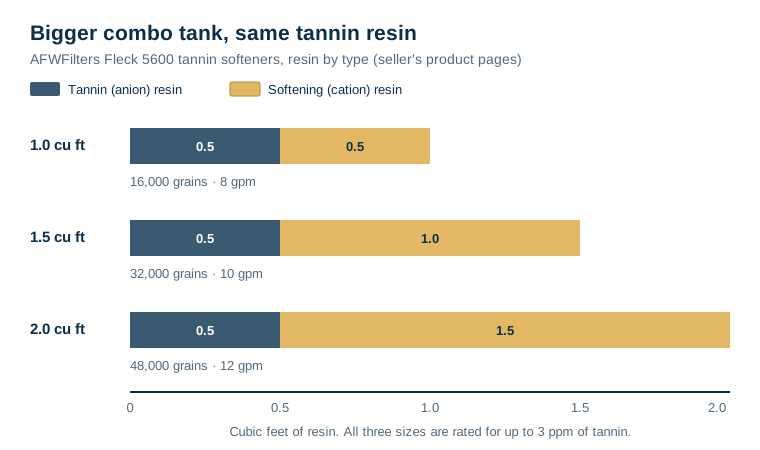
This is the detail most listings bury. AFWFilters' Fleck 5600 tannin softeners come in 1.0, 1.5 and 2.0 cubic feet. Its product pages show that each holds 0.5 cubic feet of tannin resin. The extra volume in the larger tanks is softening resin:
| AFWFilters tannin softener | Tannin resin | Softening resin | Hardness capacity | Max flow |
|---|---|---|---|---|
| 1.0 cu ft, Fleck 5600 | 0.5 cu ft | 0.5 cu ft | 16,000 grains | 8 gpm |
| 1.5 cu ft, Fleck 5600 | 0.5 cu ft | 1.0 cu ft | 32,000 grains | 10 gpm |
| 2.0 cu ft, Fleck 5600 | 0.5 cu ft | 1.5 cu ft | 48,000 grains | 12 gpm |
So moving up a size buys hardness capacity and flow, not tannin capacity. All three are rated for up to 3 ppm of tannin. If your problem is a heavier tannin load, a bigger combo will not fix it. A separate tannin tank will.
The tannin schedule decides the size
Tannin resin has to be regenerated at least every three days, according to Urbans Aqua. In a combo tank the whole bed regenerates on that schedule. That changes how much softening resin you need: enough for three days of hardness, not the week or more a softener alone is sized for.
Illustrative: 60 gallons per person per day, regenerating every three days.
| Household and hardness | Hardness load per 3 days | Smallest AFWFilters combo that covers it |
|---|---|---|
| 2 people, 10 gpg | about 3,600 grains | 1.0 cu ft (16,000 grains) |
| 4 people, 15 gpg | about 10,800 grains | 1.0 cu ft (16,000 grains) |
| 6 people, 15 gpg | about 16,200 grains | 1.5 cu ft (32,000 grains) |
For most families inside the combo limits, the 1.0 cubic foot unit is enough. Buy the larger sizes for their flow rate, if your home's peak use needs more than 8 gpm, rather than for capacity you will regenerate away unused every three days.
Salt Use Compared
Urbans Aqua puts the dose at no more than 10 lb of salt per cubic foot of tannin resin, with regeneration at least every three days. On those figures, for a four-person home at 15 gpg:
| Setup | Regenerations a year | Salt per regeneration | Salt a year |
|---|---|---|---|
| Combo, 1.0 cu ft, every 3 days | about 122 | about 10 lb | about 1,220 lb |
| Combo, 1.5 cu ft, every 3 days | about 122 | about 15 lb | about 1,830 lb |
| Separate: 1.5 cu ft softener every 7 days at 6 lb/cu ft, plus 1.0 cu ft tannin tank every 3 days | about 52 + 122 | 9 lb + 10 lb | about 1,690 lb |
Illustrative, assuming the whole bed is dosed at the tannin rate. Your valve settings and water will change these numbers.
The pattern holds even if your numbers differ. Tannin removal is salt-hungry whichever layout you pick. A correctly sized combo uses the least salt but has the least tannin resin. The separate layout holds twice the tannin resin for slightly less salt than an oversized combo.
The Best Tannin Filters, Pick by Pick
AFWFilters 1 cu ft digital tannin softener: best combo for most homes
- What it is: 0.5 cu ft of tannin resin and 0.5 cu ft of softening resin on a Fleck 5600SXT digital metered valve
- Ratings (seller): up to 3 ppm of tannins and 16,000 grains of hardness between regenerations; 8 gpm service flow
- Warranty (seller): 5 years on the control head and 10 years on the resin tank
- Other versions: the AFWFilters store also sells a mechanical-dial Fleck 5600 version and digital 1.5 and 2.0 cu ft versions
This is the pick for a typical family inside the combo limits. The digital SXT valve makes it easy to set a three-day maximum between regenerations and a longer brine draw, which tannin resin needs to release what it has picked up.
Wrong for: homes whose peak flow regularly passes 8 gpm. Step up to the 1.5 or 2.0 cu ft for 10 or 12 gpm, accepting the extra salt.
Oceanic tannin + hardness softener: alternative combo, three sizes
- What it is: a combination tannin and softening resin bed on a Fleck 5600 valve, listed in 1.0, 1.5 and 2.0 cu ft sizes
- Ratings: when we recorded the listings on 29 September 2026, Oceanic rated them for up to 3 ppm of tannin and 16,000 to 32,000 grains across the range
- What we could not confirm: the resin split and the warranty. The 1.0 and 2.0 cu ft listings loaded on 2 October; the 1.5 cu ft listing did not
1.0 cu ft:
2.0 cu ft:
The likely reason to choose it is price, if it is still below AFWFilters on the day you buy. Before ordering, ask the seller how much of the bed is tannin resin. As the AFWFilters table shows, that figure matters more than the tank size.
Wrong for: anyone who wants published warranty terms before buying.
A separate tannin tank after the softener: best above combo limits
No complete stand-alone tannin tank in our research set met the Amazon criteria, so this pick is a design, not a single product. You need:
- A softener first, sized on hardness and iron in the usual way. If you already own one, keep it.
- A second backwashing tank with its own valve and brine tank, filled with tannin-specific anion resin. AFWFilters sells tannin media in 0.5 and 1.0 cu ft quantities, and Purolite A850 anion resin by the cubic foot.
- An upper screen or distributor that stops the lighter anion resin washing out during backwash.
Buy this layout when hardness is above 15 gpg, iron is above 3 ppm, alkalinity is above 250 ppm, or tannin is above 3 ppm. It also makes sense when you already own a good softener. The tannin tank goes after it, so it sees soft water.
Wrong for: small utility rooms. Two tanks, two brine tanks and two drain connections need real floor space.
Settings That Keep Any Tannin Filter Working
Most tannin systems that "stop working" after a few months are under-regenerated. Whichever you buy:
- Regenerate at least every three days, even if a meter says the softening resin has capacity left.
- Use a long brine contact time. Urbans Aqua gives 30 minutes as the minimum.
- Watch the colour. Urbans Aqua calls returning colour "the best indication of a fouled resin bed."
- Keep chlorine off the resin. If the well is shock chlorinated, bypass the system until the chlorine is flushed out.
Why anion resin behaves this way, and how it can pull pH down early in each run on soft, low-alkalinity water, is explained in can a water softener remove tannins. Where a tannin unit sits in a full well treatment train is covered in water softener for well water.
Who Should Buy None of These
- The glass test shows sediment. That is iron or manganese, and an iron filter is the purchase.
- The yellow is only at hot taps. Look at the water heater, not the well.
- pH is below about 6.8 with low alkalinity. Correct the pH first with a neutralizer, then soften, then remove tannin. A combo tank on that water can push pH lower still.
- The colour bothers you only in drinking water. A reverse osmosis unit at the kitchen tap removes it for far less than whole-house anion resin.
- Your water is above pH 8 and chlorinated. Anion resin suppliers warn of a fishy odour in that combination. Ask for a water analysis review before buying.
For most tea-coloured wells within the combo limits, the AFWFilters 1 cu ft digital tannin softener does the job with the least salt. Above those limits, keep or buy a softener and put a separate tannin tank after it. Either way, buy on the tannin resin volume and regenerate every three days.
Frequently Asked Questions
What is the best filter for tannins in well water?
An anion resin tank that regenerates with salt. For most homes with moderate hardness and little iron, a combination unit with tannin resin and softening resin in one tank is the simplest choice. In this guide that is the AFWFilters 1 cu ft digital tannin softener or the Oceanic tannin and hardness softener. If hardness is over 15 gpg, iron is over 3 ppm or alkalinity is over 250 ppm, separate softener and tannin tanks are more reliable.
How do I know if I have tannins or iron in my water?
Fill a clear glass from a cold tap after running it for two minutes, cover it and leave it for 24 hours. Iron settles to the bottom as orange or brown sediment. Tannins stay evenly coloured, like weak tea, with nothing on the bottom. Pouring the water through a white coffee filter confirms it: iron stains the paper and tannin passes straight through.
Do tannin filters use salt?
Yes. Tannin resin is regenerated with salt brine, the same as a softener, but more often. Anion resin suppliers recommend regenerating at least every three days with about 8 to 10 lb of salt per cubic foot of resin. That usually means a tannin system uses more salt than a softener working on hardness alone.
Should the tannin filter go before or after the water softener?
After it, in a separate-tank system. Tannin resin is fouled by hardness and iron, so the softener goes first and the tannin tank sees soft water. A combination unit puts both resins in one tank, which skips that protection. That is why combination units have tighter limits on hardness, iron and alkalinity.
How much tannin can a tannin filter remove?
The combination units in this guide are rated for up to 3 ppm of tannins. AFWFilters asks buyers with more than 3 ppm to contact it before ordering. Above that level, a dedicated tannin tank with more anion resin is the usual answer.
Will a whole-house carbon filter remove tannins?
Not reliably at whole-house scale. Tannins are dissolved organic molecules. A sediment filter passes them, and a carbon tank fills up with them quickly. For drinking water only, a reverse osmosis unit at the kitchen tap removes tannin colour without any whole-house resin.
