
Why Softened Water Looks Yellow
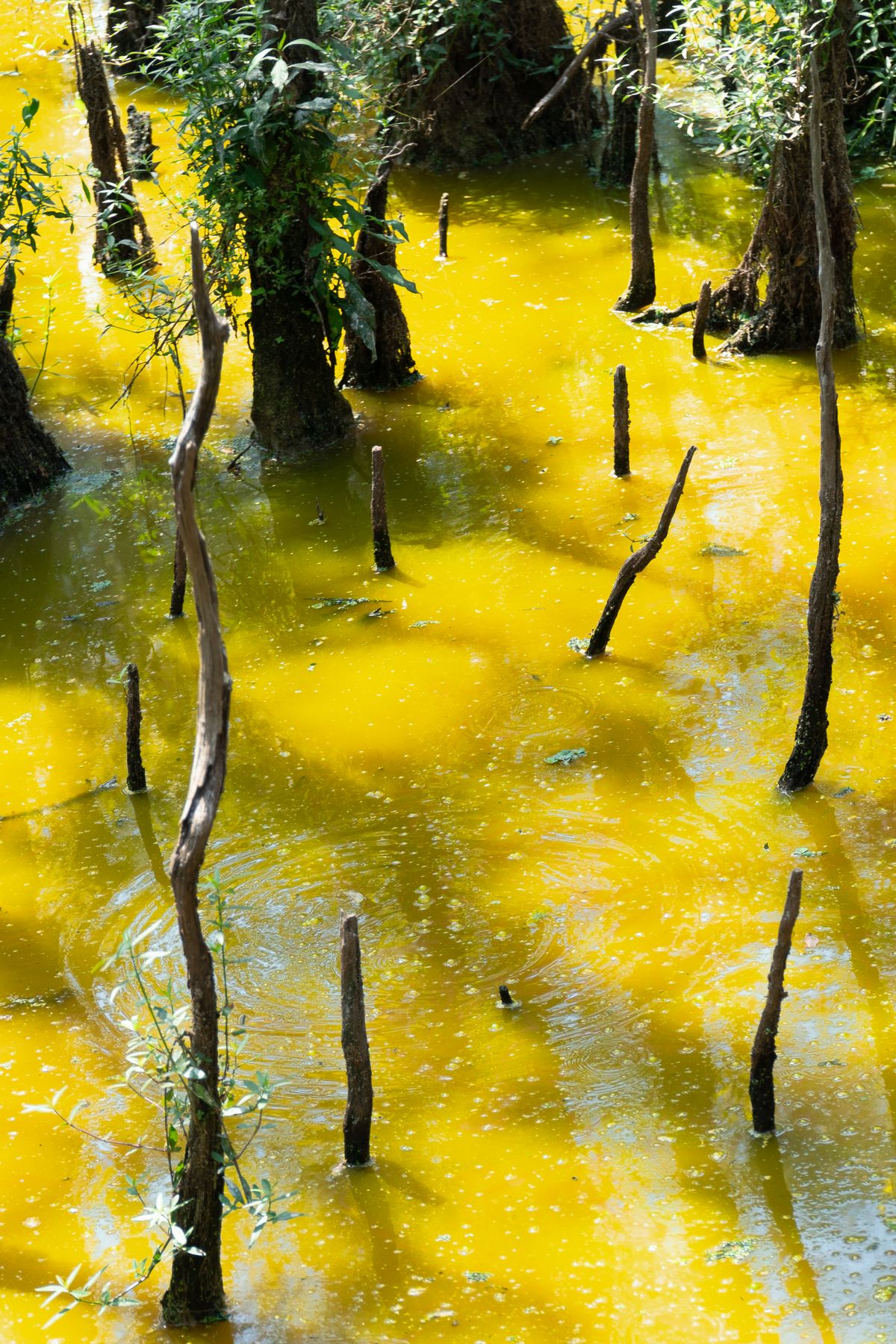
Softened water looks yellow for three main reasons, and a broken softener is the least likely of them. Fill a clear glass and leave it overnight. Colour that settles to the bottom is iron or manganese. Colour that stays evenly spread through the glass is organic tannin — and a softener cannot remove tannin at all. The third possibility, plumbing corrosion, shows up only on some taps and only after the water has been standing.
That distinction matters more than any other detail on this page, because the two causes lead to completely different equipment. Iron is a softener problem you may be able to fix. Tannin is not a softener problem at all.
Test 1: The Overnight Glass

This costs nothing and rules out half the possibilities before you touch the softener.
Draw a full glass from a cold tap, after running it for two minutes so you are sampling the supply rather than water that has been sitting in the pipes. Cover it, leave it somewhere out of sunlight, and look at it 24 hours later.
| What the glass looks like after 24 hours | What it means |
|---|---|
| Colour has dropped to the bottom as orange sediment; water above is clearer | Ferric iron — already oxidised particles |
| Water was clear when drawn, yellow-orange now, sediment forming | Ferrous iron oxidising in the glass |
| Black or brown-black specks settled out | Manganese, often alongside iron |
| Colour unchanged, evenly distributed, nothing on the bottom | Tannins — organic colour, stays in solution |
| Colour faded slightly but did not settle | Tannins, possibly with a small iron fraction |
| Clear all along; only the first draw of the morning was yellow | Plumbing corrosion, not the source water |
Iron behaves like a suspension. Tannin behaves like weak tea — because chemically it is not far off. That is the whole basis of the test.
If the glass says iron, this is not your page: the mechanism, the backwash check and the resin inspection are covered in why water turns brown after softener regeneration, and the measurement side in testing iron and manganese before sizing a softener.
Test 2: The Filter-Paper Test
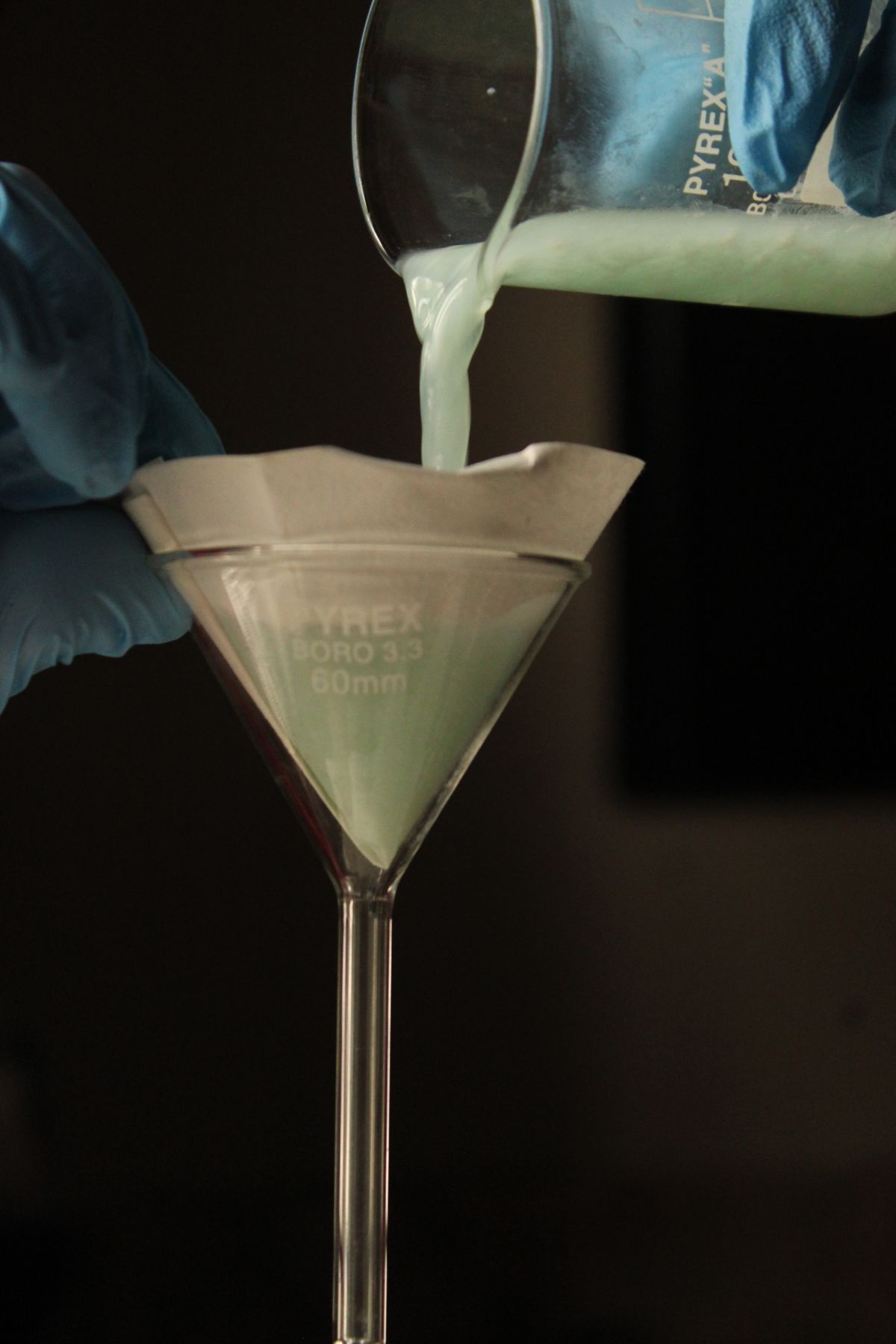
The overnight glass tells you whether the colour is particulate. The filter test tells you where the colour goes — and it is the more convincing of the two because it leaves physical evidence you can photograph and show a water treatment dealer.
What you need: a white paper coffee filter (or lab filter paper if you have it), a funnel or a mug, and a cup of the yellow water.
- Pour the sample slowly through the filter.
- Look at the paper and the filtered water separately.
| Paper | Water that came through | Diagnosis |
|---|---|---|
| Orange or rust-brown staining | Noticeably clearer | Ferric iron — a particle, filterable |
| Brown-black specks caught | Clearer | Manganese oxide |
| Stays white | Still yellow | Tannins — dissolved organic colour |
| Faint stain | Only slightly lighter | Mixed iron and tannin, common on shallow wells |
Filtration removes particles. It does not remove dissolved molecules, and tannins are dissolved. This is the same reason a sediment prefilter, a bag filter or a whole-house cartridge has never once fixed a tannin problem for anybody, whatever the micron rating on the box.
Two refinements worth running if the result is ambiguous:
- Compare raw and softened water side by side. Take one sample from a tap ahead of the softener (an outside hose bib on the untreated side, or the softener in bypass) and one from a treated tap. If both are the same yellow, the softener is doing nothing to the colour, which is itself confirmation. If the treated water is worse, look at the resin bed.
- Compare hot and cold. Yellow only at hot taps is the water heater or its anode, not the softener and not the well.
What Tannins Actually Are
Tannins are not a contaminant in the way iron is. They are a family of dissolved organic acids — humic and fulvic acids among them — produced as leaves, peat, bark and roots break down. Rain moves them into shallow groundwater. The Water Systems Council's information sheet on tannins in well water sets out the sources and treatment options, and Penn State Extension covers the colour complaint alongside the other nuisance problems in its guide to common drinking water problems and solutions.
The practical signature of tannins:
- Yellow to tea-brown colour that does not settle out and does not filter out.
- A musty, earthy or faintly bitter taste that a carbon filter hides for a while, then stops hiding as the carbon loads.
- Yellow staining on white laundry and porcelain — a tint across the whole item, not the orange spotting iron produces.
- Worse after heavy rain or snowmelt, and often worst in spring. Iron levels are far more stable through the year.
- Common on shallow wells, wells near wetlands, peat, swamp or heavily wooded ground, and in coastal plain and glacial soils.
The seasonal pattern is the most useful of those. Iron comes from rock, and the concentration changes slowly. Tannin comes from the surface, so it tracks the weather — which is also why a tannin result needs a bacteria test beside it. If surface water is reaching your well, the colour is the least interesting thing it brought. The EPA's private wells guidance sets out sensible testing intervals, and the seasonal sampling problem is covered from the hardness side in how to test hardness in private well water.
Colour is an aesthetic standard, not a health one. The EPA lists colour at 15 colour units under its secondary drinking water standards for nuisance chemicals, the same non-enforceable list that puts iron at 0.3 mg/L and manganese at 0.05 mg/L. Tannins are not on the primary, health-based list.
There is one real health-adjacent issue, and it applies to chlorinated water rather than raw well water: organic matter reacting with chlorine forms trihalomethanes and haloacetic acids, which are regulated, under the EPA's disinfectants and disinfection byproducts rules. If you chlorinate your own well and the water carries tannins, that reaction is happening in your pressure tank.
Why a Softener Cannot Remove Tannins

The reason is electrical charge, and it is absolute rather than a matter of degree.
A water softener is a cation exchanger. Its resin beads carry fixed negative sites loaded with sodium ions, and they trade those sodium ions for positively charged calcium and magnesium — the mechanism the EPA describes in its overview of cation exchange water softeners. Ferrous iron and manganese are also cations, which is why a softener picks up a modest amount of them as a side effect.
Tannins are anions. They carry a negative charge, so the resin's negative sites repel them. There is no exchange to make. No salt setting, no extra regeneration, no hardness number typed into the valve changes this.
Removing tannins takes anion exchange resin — chemically the opposite material, in its own tank, though conveniently it regenerates with the same sodium chloride brine a softener uses.
| Softener (cation resin) | Tannin unit (anion resin) | |
|---|---|---|
| Removes | Calcium, magnesium, some ferrous iron and manganese | Tannins, other organics, some sulphate and nitrate |
| Charge it targets | Positive | Negative |
| Regenerant | Sodium chloride brine | Sodium chloride brine |
| Fouled by | Iron, manganese, organics | Hardness, iron, oxidisers |
| Damaged by | Chlorine, over years | Chlorine, faster |
Read the "fouled by" row twice. It explains both the slow capacity loss you may already be seeing and the installation-order trap two sections down.
Tannins Quietly Wreck the Softener You Already Own
This is the part most coverage leaves out. Tannins do not simply pass through the softener; a fraction of them adsorb onto the cation resin and stay there, because brine does not strip large organic molecules the way it strips calcium.
The progression is slow and looks like something else at every stage:
- Months 1–12. Nothing visible except the colour the softener never removed.
- Year 1–3. Resin darkens from amber towards brown. Capacity starts slipping. Hardness begins breaking through a day or two before the scheduled regeneration — the pattern diagnosed in why hardness returns before the next regeneration.
- Year 3–6. Salt use climbs as the valve regenerates more often to compensate. Soft water becomes intermittent. Owners at this stage usually suspect the valve.
- Year 5–8. Practical end of life, against the ten to fifteen years a clean, chlorine-free supply would give.
What slows it down: a resin cleaner dosed routinely into the brine well, a higher salt dose per regeneration, and — the decisive one — removing the tannins upstream so the bed never sees them.
What does not help: more frequent regeneration on its own. You are washing the bed with a regenerant that cannot lift the thing fouling it.
Treatment Order: The Expensive Mistake
Once a lab result confirms tannins, the question becomes where the tannin unit goes. Get this wrong and you can foul an expensive tank within months.
The competing constraints:
- Anion tannin resin is fouled by hardness and iron. Put it first on hard, iron-bearing water and it blinds quickly.
- Cation softener resin is fouled by tannins. Put the softener first and it takes the organic load instead.
- Both are degraded by chlorine and other oxidisers, so any oxidising pretreatment needs carbon behind it before either tank.
How that resolves in practice:
| Raw water | Sensible order | Why |
|---|---|---|
| Tannins, low hardness, no iron | Sediment → tannin unit | Nothing upstream that needs removing first |
| Tannins + hardness, no iron | Sediment → softener → tannin unit | Protects the anion resin; accept routine softener cleaning |
| Tannins + iron + hardness | Sediment → iron removal → softener → tannin unit | Iron is the fastest killer of anion resin, so it goes first |
| Tannins on a chlorinated supply | Sediment → carbon → softener → tannin unit | Carbon protects both resins from oxidative damage |
| Tannins + bacteria present | Fix the well before buying anything | Colour is the symptom; surface intrusion is the problem |
Two rules hold across all of them:
- Iron removal always precedes both resins. Getting this backwards is one of the more expensive well water mistakes there is, and it is covered from the softener side in why water turns brown after softener regeneration.
- Never install a tannin unit ahead of an unprotected softener on iron-bearing water on the theory that it will catch everything first. It will catch iron, blind, and stop removing colour within a season.
A note on sizing. Tannin resin is dosed against the measured tannin concentration in ppm as tannic acid, not against hardness, and contact time matters as much as tank volume — undersized units on high flow give partial colour removal that owners then report as a faulty unit. Get the lab number before anyone quotes you equipment. The general argument for measuring rather than guessing is made in home water test kit versus certified laboratory test.
Alternatives, and Where They Genuinely Fit
Anion exchange is the usual whole-house answer, but it is not the only one and it is not always the right one.
- Activated carbon. Reduces colour and the musty taste, and it is cheap to try. The problem is capacity: organics load carbon quickly, so a whole-house carbon filter on real tannin water needs replacing far more often than the label suggests. Good as a polish, poor as the primary treatment.
- Reverse osmosis at the kitchen sink. Removes tannin colour and taste very effectively at one tap. If the complaint is drinking water and coffee rather than laundry, this is the cheapest route by a wide margin. It does nothing for the bathroom or the washing machine.
- Oxidation and filtration. An oxidiser followed by a filter will break down part of the tannin load. It needs contact time, a filter, and carbon to strip the residual oxidiser before it reaches any resin. Usually only worth building when iron or sulphide treatment is going in anyway.
- A deeper or better-sealed well. Where tannin comes from shallow surface influence, fixing the well sometimes removes the problem entirely. Worth pricing against a treatment train before committing to equipment, and worth raising with a driller if the well is shallow or the casing is old.
Whatever route you take, buy against a tested performance claim rather than a brochure — WQA's product listings show what a given unit has actually been certified to do.
Yellow Water That Is Neither Tannins Nor Iron
Before committing to equipment, rule these out. All are free to check:
- First-draw only. Yellow in the first cup each morning, clear after running, means metal picked up from water standing in the plumbing. That is a corrosion question, not a source-water one, and it is worth reading beside why softened water has a metallic taste if there is a taste with it.
- Hot taps only. The water heater — a sacrificial anode reacting, or accumulated sediment. See hard water sediment in a storage water heater.
- One fixture only. A failing supply hose, an old brass fitting or a worn cartridge. Not a whole-house problem.
- Recent mains work, or a new well pump. Disturbed deposits usually clear on their own within a day or two.
- Tiny bubbles rather than colour. Water that looks milky and clears from the bottom upwards is dissolved air, which is harmless and entirely different — why softened water looks cloudy.
What to Do, In Order
- Run the overnight glass. Settles out? Iron or manganese. Stays yellow? Continue.
- Run the coffee filter test. Paper stains and water clears? Iron. Paper stays white and water stays yellow? Tannins.
- Compare raw against treated, and hot against cold, to confirm the softener is not itself the source.
- Get a certified lab test covering tannins, iron, manganese, hardness, pH and bacteria — all six, because the treatment order depends on all of them. Seasonal wells should be sampled in spring, when colour peaks.
- Do not buy a finer sediment filter. Dissolved colour is not filterable.
- Do not raise the salt dose hoping to push colour out of the bed. Tannin is not exchanged, and brine does not release it.
- Design the train around the numbers — iron removal first, tannin resin last, carbon ahead of any resin on a chlorinated supply.
- Protect the softener you have in the meantime with routine resin cleaning, and plan for a shorter service life than the brochure promised.
The honest summary is that a yellow glass on a softened supply is usually not a softener fault at all. It is a softener being asked to do a job it has no chemical mechanism for — and proving that with a paper coffee filter takes ten minutes and saves the service call.
Frequently Asked Questions
Why does my softened water look yellow?
In most cases because it contains organic tannins, which a water softener is not designed to remove. Tannins are dissolved organic acids leached from decaying leaves, peat and roots, and they carry a negative charge. Softener resin is cation resin — it exchanges positively charged calcium and magnesium — so tannin molecules pass straight through the bed untouched. The other common cause is iron or manganese, but that colour behaves differently: it settles out of a glass overnight and leaves sediment, where tannin colour stays evenly suspended.
Will a water softener remove tannins from well water?
No. Removing tannins takes anion exchange resin, a different resin in a separate tank, even though it is usually regenerated with the same ordinary softener salt. Some multi-tank systems blend a tannin resin into a softener bed, but a standard softener bought to fix hardness will not reduce colour. Worse, tannins slowly foul cation resin — the organic molecules cling to the beads and are not stripped off by brine — so a softener running on tannin-bearing water gradually loses capacity as well as leaving the colour in place.
Is yellow well water safe to drink?
Tannins themselves are not regulated as a health contaminant; the EPA lists colour under secondary standards at 15 colour units, which is an aesthetic threshold rather than a toxicity limit. The real concerns are indirect. Colour usually means surface water is reaching the well, which raises the question of what else is reaching it, so a bacteria test is warranted. And on any supply that is chlorinated, organic matter reacts with chlorine to form disinfection byproducts. Yellow water is a reason to test, not a reason to panic.
How do I test for tannins at home?
Run two tests before spending anything. First, fill a clear glass, cover it and leave it 24 hours — iron and manganese settle and leave sediment, tannins stay evenly coloured with nothing on the bottom. Second, pour a cup through a white paper coffee filter: iron leaves visible orange staining on the paper and the water clears, tannins pass through and the water stays yellow while the paper stays white. A certified lab test then quantifies tannins in ppm before you size any equipment.
Can tannins damage my water softener?
Yes, gradually. Tannins are large organic anions that adsorb onto cation resin and resist brine regeneration, producing what the industry calls organic fouling. The bed darkens, exchange capacity drops, and hardness starts breaking through earlier in the cycle. Routine resin cleaning slows it but does not stop it. On water with measurable tannins, softener resin often reaches the end of its useful life in five to eight years rather than the ten to fifteen a clean supply allows.
Does chlorine or bleach get rid of yellow tannin water?
Chlorination will oxidise and fade some tannin colour, and it is used as a pretreatment step on some systems, but on its own it is the wrong answer for two reasons. It needs contact time and a filter behind it to catch the oxidised material, and chlorine reacting with organic matter produces trihalomethanes and other disinfection byproducts. It also damages both cation and anion resin downstream if it is not removed first. If chlorination is used ahead of a softener, a carbon filter belongs between them.