
Best Twin-Tank Water Softeners: 3 Dual-Tank Picks and How They Switch

The best twin-tank water softeners for most homes are Fleck 9100SXT dual-tank systems, sized so each tank lasts about five to seven days. One tank always softens while the other regenerates with soft water, so the house never gets a dose of hard water. Our picks are the AFWFilters 9100SXT twin 48k for most families, the 32k twin for smaller homes and the 64k twin for large or very hard-water households. Each costs much more than a single tank of the same per-tank size, close to double at the larger sizes, so the first question is whether you need one at all.
Disclosure: Hard Water Solved may earn a commission if you buy through links on this page, at no extra cost to you. It does not change which products we include or how we rank them. Read our disclaimer.
Top Twin-Tank Picks at a Glance
| Pick | Resin per tank | Service / peak flow | Amazon |
|---|---|---|---|
| AFWFilters Fleck 9100SXT twin 48k | 1.5 cu ft, 10 x 54 in tanks | 6.5 / 9.8 gpm | Check price on Amazon |
| AFWFilters Fleck 9100SXT twin 32k | 1.0 cu ft | 5 / 7.5 gpm | Check price on Amazon |
| Fleck 9100SXT twin 64k | 2.0 cu ft, 12 in tanks | 10 / 15 gpm | Check price on Amazon |
How We Chose
Methodology. Nothing on this page was physically tested. The ranking rests on manufacturer technical sheets, seller specifications and a comparison of store prices.
- Included: twin alternating ion-exchange softeners with a metered valve, sold on Amazon.
- Compared like for like: resin volume per tank, service flow, backwash flow and the price gap to a single tank of the same per-tank size with the same resin.
- Excluded: pairs of single-tank softeners plumbed side by side without an alternating valve, timer-only twins, and dealer-only systems. Kinetico is described below for comparison but is not sold on Amazon.
- Prices are not listed here because they change often. Use the buttons to see the current price on Amazon.
How Twin-Tank Water Softeners Switch Tanks
Every twin does the same job: one resin tank softens, the other waits, and a valve swaps them when the working tank is spent. What differs is what tells the valve to swap and what powers the swap. There are three designs on the residential market.
| Switching design | Example | What triggers the swap | Power | Where to buy |
|---|---|---|---|---|
| Electronic metered, one valve head | Fleck 9100SXT | Turbine meter counts gallons; the digital controller compares them to the capacity you program | Plug-in transformer | Online, including Amazon |
| Mechanical metered, one valve head | Fleck 9100 (mechanical) | Meter turns a gear-driven program wheel set to the capacity | Plug-in, drives the motor | Online stores; we found no Amazon listing |
| Water-powered, non-electric | Kinetico twin-tank models | Mechanical meter driven by the flowing water | None | Dealers only |
Pentair's Fleck 9100 twin valve technical sheet lists both a mechanical and an electronic version of the same valve body. It describes the operating principle in two lines: "continuous soft water provision with only one tank in use, other being in regeneration or stand-by" and "regeneration with softened water". Both versions share the valve body and the twin-tank principle. The difference is the controller: the SXT is a digital, programmable head with a wider range of settings, while the mechanical version has no electronics beyond its motor. Pentair lists a 24 V electrical rating for the series, so both need power.
Kinetico takes the motor out altogether. Its resource page on non-electric softeners explains that a mechanical water meter measures use and starts regeneration on demand, with the moving water supplying the power. That suits a house with no outlet near the main line, or one on a generator. The trade is that you buy through a dealer, at a dealer price, with no Amazon option.
What flows where during regeneration
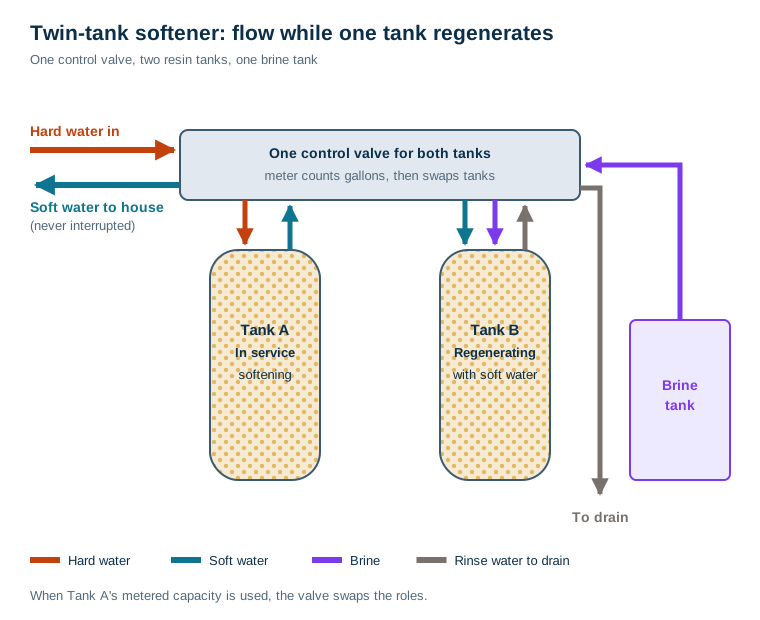
On a single-tank softener, the valve passes untreated water to the house for the whole regeneration, which the guide on using water during regeneration times stage by stage. On a twin, the house keeps drawing from the tank in service. The regenerating tank draws its brine and its rinse water from that same softened supply, so its bed is rinsed with water that is already soft.
On the Fleck 9100 in its standard downflow setup, Pentair's sheet lists the cycle order as brine and slow rinse, backwash, rapid rinse, then brine tank refill. Brining comes before backwash, the reverse of the backwash-first order common on single-tank valves.
The Best Twin-Tank Water Softeners, Pick by Pick
AFWFilters Fleck 9100SXT twin 48k: best for most families
- Resin: 1.5 cu ft of 8% crosslink high-capacity resin in each of two 10 x 54 inch tanks
- Flow: 6.5 gpm service, 9.8 gpm peak; each tank needs only 2.7 gpm to backwash
- Brine tank: 14-inch square by default, with 18 x 33 and 18 x 40 inch round options
- Resin option: AFWFilters also sells a 10% crosslink resin version for chlorinated water
At 9 lb of salt per cubic foot, each tank gives about 39,000 usable grains. A family of four on 15 gpg puts about 4,500 grains a day through it, so each tank lasts more than eight days. That is the sweet spot: the bed cycles often enough to stay fresh, and the house never sees hard water.
The low backwash requirement makes it a good fit for a well with a modest pump, where a single tank large enough for the same household might need more flow than the pump can give.
Watch for: 6.5 gpm is a service rating, not a whole-house peak. Three bathrooms running at once can reach it. The AFWFilters store page does not state the warranty for its twin systems. Its single-tank Fleck systems carry 5 years on the valve and 10 on the tank, so ask whether the same applies before you order.
AFWFilters Fleck 9100SXT twin 32k: best for small homes that need nonstop soft water
- Resin: 1.0 cu ft per tank
- Flow: 5 gpm service, 7.5 gpm peak; 2.2 gpm backwash
This suits a one- or two-bathroom home where someone uses water at night, such as a shift worker or a home with a hair-washing business. Each tank gives about 26,000 usable grains at 9 lb per cubic foot, which is about six days for two people on 30 gpg water.
Watch for: 5 gpm service flow. A tub and a shower running together will push it. It costs much more than a single 32k softener with the same resin, which is a lot to pay for a small home unless the round-the-clock supply is genuinely needed.
Fleck 9100SXT twin 64k: best for large or very hard-water households
- Resin: 2.0 cu ft per tank, in 12-inch tanks
- Flow: 10 gpm service, 15 gpm peak; 4 gpm backwash
- Amazon listing: we could not confirm who sells it, so the details here are for AFWFilters' equivalent 9100SXT build
Five people on 20 gpg water put about 7,500 grains a day through a softener. Each 2.0 cu ft tank gives about 52,000 usable grains at 9 lb per cubic foot, so roughly seven days per tank. At 30 gpg and above, a twin's lack of reserve starts to save real salt, because a single tank would be recharging a day's capacity it never used every few days.
Watch for: the backwash. At 4 gpm per tank, it is fine on city water but worth checking against a well pump. Above about 10,000 grains a day, the same family of systems comes in a 96k size with 3 cu ft per tank, sold by the AFWFilters store and on Amazon.
What a Twin Costs Over a Single Tank of the Same Size
The fair comparison is per tank. A twin only ever softens with one tank at a time, so a 48k twin replaces a 48k single, not a 96k single. Comparing AFWFilters store prices for the same Fleck brand and the same 10% crosslink resin on both sides, a Fleck 9100SXT twin cost far more than a Fleck 5600SXT single tank at every per-tank size from 32k to 64k, and roughly double at 48k and 64k. Both sides of that comparison include a brine tank and bypass.
You get part of the premium back in running cost. A single tank holds back a day's load as reserve and recharges it whether or not it was used. A twin runs each tank to exhaustion. The single tank vs twin tank comparison sets out that efficiency case in full. On moderate water the saving is a few dollars of salt a year and never repays the premium. Above about 30 gpg it grows, but the main reason to buy a twin is still the uninterrupted soft water.
Space is the other cost. Both tanks hang off one valve head on a fixed connector, so they sit side by side at a set spacing:
| Size | Single tank footprint | Twin footprint |
|---|---|---|
| 32k | One resin tank + brine tank | Two resin tanks side by side + brine tank |
| 48k | One 10 in tank + 14 in square brine tank | Two 10 in tanks + 14 in square brine tank |
| 64k | One 12 in tank + brine tank | Two 12 in tanks + brine tank |
Allow roughly one extra tank diameter of wall width, plus space at the front to reach the valve and pour salt.
Sizing a Twin: Per Tank, Not Combined
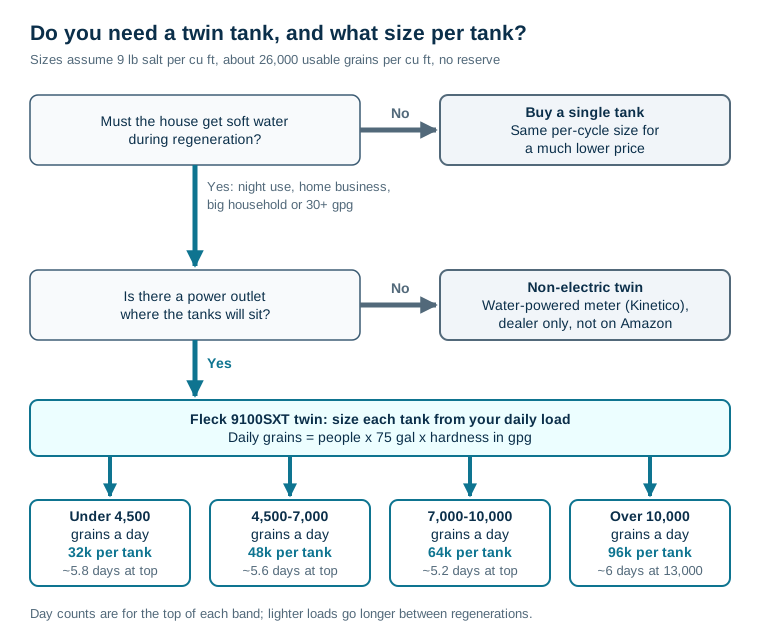
Twin listings sometimes advertise the two tanks added together, such as "96,000 grains" for a 48k-per-tank system. Ignore that figure. Size one tank from your daily hardness load using the method in how to size a water softener, then buy the twin with that tank size.
Two differences from single-tank sizing work in the twin's favour:
- No reserve. The standby tank is the reserve, so the full usable capacity of each tank counts.
- Short intervals are less of a problem. A single tank that regenerates every two days spends a lot of time sending hard water to the house. A twin that swaps every two days does not. You still pay for the salt and rinse water, so aim for five to seven days per tank.
Use real usable capacity, not the box rating. At 9 lb of salt per cubic foot, standard resin gives about 26,000 grains per cubic foot, not the 32,000 behind the label (see advertised vs usable softener capacity).
Before You Install a Twin
- Power. Both Fleck versions need an outlet within reach of the transformer cord.
- Drain. One drain line serves both tanks. It must handle the backwash rate of one tank: 2.2 to 4 gpm across these picks.
- Bypass. Fit a bypass valve so you can isolate the system for service without shutting off the house.
- Ceiling height. The valve sits on top of both tanks. A 10 x 54 inch tank with the head fitted needs roughly 62 inches of headroom, plus room to lift the head off.
- Programming. Enter the per-tank capacity at the salt dose you choose, not the combined figure. If you enter the doubled number, each tank is asked to deliver twice its capacity and hard water breaks through before the swap.
Who Should Buy None of These
- Households that sleep at night and use little water then. A single tank regenerating at 2 a.m. gives the same soft water for roughly half the price.
- Homes with no outlet at the install point that cannot run one. A non-electric dealer system is the realistic option.
- Wells with iron above a few ppm or any oxidised iron. These picks use standard high-capacity resin. Deal with the iron first. AFWFilters also lists fine-mesh "Iron Pro" twin builds.
- Tight utility closets. If two resin tanks and a brine tank will not fit with service access, a cabinet or single tank is the honest answer.
- Renters. A three-tank system with a drain connection is not something to fit without the owner's permission.
A twin-tank softener is a convenience upgrade, not a softening upgrade. Buy one when nonstop soft water is worth close to the price of a second softener to you, and size it one tank at a time.
Frequently Asked Questions
Is a twin-tank water softener better than a single tank?
It is better at one thing: the house never gets hard water, because one tank is always in service while the other regenerates. It also regenerates with soft water and holds back no reserve, so it uses all of each tank's capacity. For most households that regenerate at 2 a.m. it is not worth the extra cost. For homes that use water at all hours, run a business, or have very hard water, it usually is.
Is a 48,000-grain twin tank 48,000 or 96,000 grains?
Treat it as 48,000 grains. Each tank holds 1.5 cubic feet of resin, rated at 48,000 grains at a heavy salt dose. Only one tank softens at a time, and it regenerates as soon as it is exhausted, so the softening you get between regenerations is one tank's worth. Some sellers add the two tanks together. That number is not useful for sizing.
Do twin-tank softeners use more salt?
Not per grain of hardness removed. Each regeneration salts only one tank, and because a twin holds back no reserve it runs each tank to exhaustion before recharging it. At the same salt dose per cubic foot, a twin usually uses slightly less salt a year than a single tank of the same per-tank size. The tank that is recharged has been fully used, not topped up early.
Do twin-tank water softeners need electricity?
Most do. Fleck 9100-series valves, in both their mechanical and electronic SXT versions, need power; Pentair lists a 24 V electrical rating for the series. Kinetico's twin-tank softeners are the main exception. They use a water-driven mechanical meter and need no power at all. Kinetico sells only through dealers, not on Amazon.
How much space does a twin-tank softener need?
Roughly one more resin tank's width than a single-tank softener of the same size, because both tanks hang off one valve head. A 48,000-grain twin uses two 10-inch tanks about 54 inches tall plus a brine tank. Leave room in front to reach the valve and fill the brine tank, and check the ceiling height, because the valve sits on top of the tanks.
