
Best Water Softener and Iron Filter Combo Systems, Both Halves Checked

The best water softener and iron filter combo depends on which half has to work harder. For dissolved, clear-water iron up to about 5 ppm, a single-tank fine-mesh unit does both jobs: the AFWFilters Iron Pro 2 64k for most families, the Iron Pro 48k for smaller homes and the Iron Pro 80k for big or very hard ones. For rusty water, sulfur or heavier iron, a true two-stage package such as SpringWell's well filter and softener combo puts a separate iron filter ahead of the softener.
Every package has two halves, and both have to suit your water. Below, each one is checked twice: is the iron half right for your iron form, and is the softener half sized for hardness plus the iron it carries? Two of the packages on sale have a half that is smaller than the price suggests.
Disclosure: Hard Water Solved may earn a commission if you buy through links on this page, at no extra cost to you. It does not change which products we include or how we rank them. Read our disclaimer.
Best Water Softener and Iron Filter Combos at a Glance
| Pick | Type | Iron half | Softener half | Amazon |
|---|---|---|---|---|
| AFWFilters Iron Pro 2 64k | One tank, fine-mesh resin | Ferrous iron up to 6 ppm | 2.0 cu ft, Fleck 5600SXT, 10 gpm service | Check price on Amazon |
| AFWFilters Iron Pro 48k | One tank, fine-mesh resin | Ferrous iron up to 6 ppm | 1.5 cu ft, Fleck 5600SXT, 6.5 gpm service | Check price on Amazon |
| AFWFilters Iron Pro 80k | One tank, fine-mesh resin | Ferrous iron up to 6 ppm | 2.5 cu ft, Fleck 5600SXT, 11 gpm service | Check price on Amazon |
| SpringWell Well Water Filter + Salt-Based Softener | Two stages | Air injection: iron 7, sulfide 8, manganese 1 ppm | 32k (Core) or 48k (Pro) | Check price on Amazon |
How We Chose
Methodology. Nothing on this page was physically tested. Each package is judged from its seller's product page and listed specifications, with Penn State Extension's guidance on iron and manganese in private water systems as the yardstick for what a softener can take.
- Included: packages sold on Amazon that the seller presents as removing both iron and hardness, either in one tank or as a matched pair.
- Checked twice: the iron half against iron form, sulfide and manganese; the softener half against two example households, with capacity re-stated at 6 lb of salt per cubic foot of resin (about 21,000 grains per cubic foot) and iron counted as 4 gpg of extra hardness per ppm, AFWFilters' own instruction.
- Flagged, not ranked: packages where one half is undersized for the money (see below).
- Prices are not listed here because they change often. Use the buttons to see the current price on Amazon.
Why the iron filter belongs ahead of the softener, and what each stage protects, is explained in iron filter before water softener. The well test to run before either purchase is covered in water softener for well water. This page is about buying the pair.
The First Half: Is the Iron Half Right for Your Iron?
There are two kinds of combo, and they handle iron in completely different ways.
One tank (Iron Pro). Fine-mesh softener resin swaps dissolved ferrous iron for sodium, just as it swaps calcium. AFW says plainly on its Iron Pro 80k page that the system removes "up to 6 ppm of ferrous iron without additional systems required. If ferric iron or higher levels of iron are present a separate iron filter is recommended." It does nothing for sulfur smell, iron bacteria or iron that has already rusted.
Two stages (SpringWell). An air injection oxidation filter oxidizes and filters iron, manganese and sulfide first, and a separate softener then removes hardness. SpringWell rates the iron filter for up to 7 ppm of iron, 8 ppm of hydrogen sulfide and 1 ppm of manganese, with a pH range of 6.5 to 10.
So the iron half check comes down to three questions:
| Your water | One tank (Iron Pro) | Two stages (SpringWell) |
|---|---|---|
| Clear when drawn, turns orange in a glass, under 5 ppm | Yes | Yes |
| Orange or cloudy straight from the tap (ferric iron) | No | Yes, within 7 ppm |
| Rotten-egg smell | No | Yes, within 8 ppm |
| Manganese above 1 ppm | Only as extra hardness load | Above its 1 ppm rating |
| Iron bacteria (slime, red gel) | No | No; disinfect first |
| pH below 6.7 | No, per Penn State | Within 6.5 to 10 only |
If your iron is rusty at the tap or the water smells, the single-tank units are out, whatever their price. If it is clear, dissolved and under about 5 ppm, the single tank is the far cheaper answer.
The Second Half: Is the Softener Sized for Hardness Plus Iron?
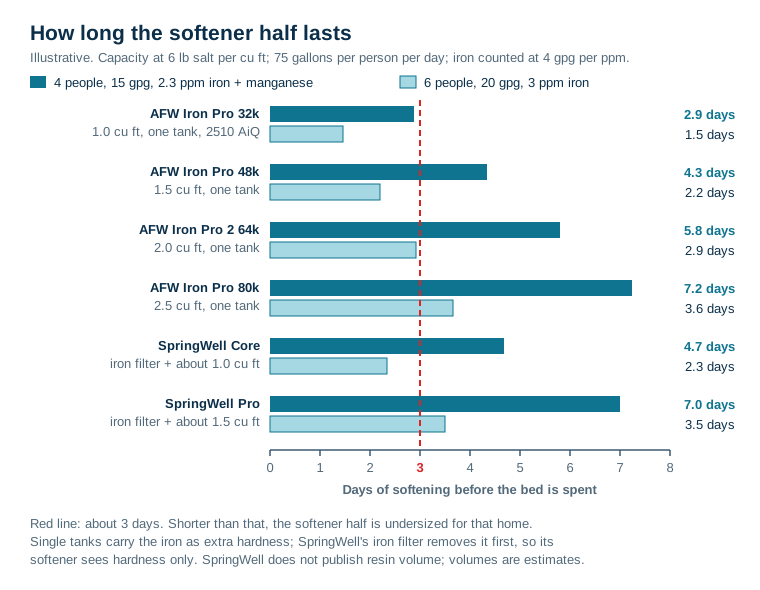
The two kinds of combo also load their softener differently. A single tank carries the iron as part of its softening job, so you add about 4 gpg for every ppm of iron and manganese. The method, with worked wells, is in how iron changes water softener sizing. In a two-stage package the iron is gone before the softener, so the softener sees hardness alone.
The chart uses two example homes at 75 gallons per person per day:
| Home A: 4 people, 15 gpg, 2 ppm iron + 0.3 ppm manganese | Home B: 6 people, 20 gpg, 3 ppm iron | |
|---|---|---|
| Single tank programs | 24.2 gpg, about 7,260 grains a day | 32 gpg, about 14,400 grains a day |
| Two-stage softener sees | 15 gpg, about 4,500 grains a day | 20 gpg, about 9,000 grains a day |
The aim is a bed that lasts at least about three days. Iron that sits on resin for longer than that lowers the next cycle's capacity, so iron softeners are set to regenerate at least every three days anyway. A bed that runs out sooner is regenerating more often than it should and burning salt.
What the chart shows:
- Home A is well served by every package except the Iron Pro 32k, at 2.9 days.
- Home B pushes every single-tank unit below three days except the 80k, at 3.6 days. A family this size on hard water with iron should buy the 80k or a two-stage package.
- SpringWell's Core package lasts 4.7 days in Home A but only 2.3 days in Home B. Its softener half is the smallest 32k unit, which SpringWell sizes for 1 to 3 bathrooms.
SpringWell does not publish resin volume, so the chart uses the industry's usual fills of about 1.0 and 1.5 cubic feet for its 32k and 48k ratings. Treat its bars as estimates.
The Best Water Softener and Iron Filter Combos, Pick by Pick
AFWFilters Iron Pro 2 64k: best single-tank combo for most families
- Iron half: fine-mesh resin rated for ferrous iron "up to 6ppm". Dissolved iron only.
- Softener half: 2.0 cu ft of fine-mesh resin in a 12-inch tank, about 42,000 grains at 6 lb of salt per cubic foot. Fleck 5600SXT metered valve. 10 gpm service, 15 gpm peak. 18x33 round brine tank.
- Warranty: 5 years on the control head, 10 years on the mineral tank, per AFW.
Both halves pass for Home A with room to spare: 5.8 days of capacity against a three-day target. The 10 gpm service flow suits a typical two- or three-bathroom house. For a four-person family on clear-water iron, this is the best value of any package here.
Half that is short: the iron half, for anything but dissolved iron. Wrong for: rusty water at the tap, sulfur smell, or large families on hard water with iron, where Home B shows it falling just short at 2.9 days.
AFWFilters Iron Pro 48k: best for smaller homes
- Iron half: fine-mesh resin, ferrous iron up to 6 ppm.
- Softener half: 1.5 cu ft in a 10x54 tank, about 31,500 grains at 6 lb per cubic foot. Fleck 5600SXT. 6.5 gpm service, 9.8 gpm peak. 14x14x36-inch brine tank.
- Also on Amazon: AFW's product page lists a DuraWater "Iron Blaster" 48k listing for the same system, so compare both listings on the day.
DuraWater "Iron Blaster" 48k listing:
At 4.3 days in Home A it passes, and it costs a little less than the 64k. The smaller bed suits two- or three-person homes and light iron. Because iron softeners regenerate every three days whatever the meter says, a smaller bed also uses less salt per cycle than a larger one, which matters on a small household.
Half that is short: the softener's flow. 6.5 gpm service is modest for a house with two showers and a washing machine running together. Wrong for: Home B, where it lasts only 2.2 days.
AFWFilters Iron Pro 80k: best for large or very hard households
- Iron half: fine-mesh resin, "up to 6 ppm of ferrous iron".
- Softener half: 2.5 cu ft in a 13-inch tank, about 52,500 grains at 6 lb per cubic foot. Fleck 5600SXT. 11 gpm service, 16 gpm peak. Backwash flow: 4.5 gpm.
- Also on Amazon: a DuraWater "Iron Blaster" 80k listing is titled as a combination softener and iron filter on a Fleck 5600SXT. We could not confirm it anywhere outside Amazon.
DuraWater "Iron Blaster" 80k listing:
The only single tank that clears three days in Home B, at 3.6 days. Buy it for capacity, not flow: the 13-inch tank still sits on a 5600SXT valve.
Half that is short: the backwash demand on a weak well. 4.5 gpm is more than the smaller Iron Pros need. Wrong for: small households, where it regenerates on the three-day schedule anyway and wastes salt on a bed it never uses up.
SpringWell Well Water Filter + Salt-Based Softener: best true two-stage package
- Iron half: SpringWell's whole-house air injection iron filter. Iron up to 7 ppm, hydrogen sulfide up to 8 ppm, manganese up to 1 ppm, pH 6.5 to 10, 25 to 80 psi. The Core size (WS1) is a 10x54 tank rated 12 gpm; the larger WS4 is a 13x54 tank rated 20 gpm.
- Softener half: Core pairs it with the SS1 32k softener (9x48 tank, 11 gpm, sized by SpringWell for 1 to 3 bathrooms). Pro pairs the WS4 filter with the SS4 48k softener (10x54 tank, 13 gpm).
- Warranty: SpringWell advertises a lifetime warranty and a 6-month money-back guarantee.
- Bundle saving: SpringWell says on its product page that the Core package costs less than buying the two separately.
- Amazon listing: we could not confirm it was in stock.
This is the package to buy when the iron half of a single tank fails your water: rusty iron, a sulfur smell, or iron heavy enough to foul resin. With the iron removed first, the softener runs long, efficient cycles on hardness alone.
Half that is short: check the pairing. In the Pro package, a 20 gpm iron filter feeds a 13 gpm softener, so the softener sets the flow limit. SpringWell's Core softener is the 32k for up to 3 bathrooms, and it drops to 2.3 days in Home B. The iron half's 1 ppm manganese rating is also low.
Wrong for: clear-water iron under 5 ppm with no smell, where an Iron Pro does the job for far less money.
Flagged: Where One Half Is Undersized for the Price
AFWFilters Iron Pro 32k on a Fleck 2510 AiQ. AFW sells this with 1 cubic foot of fine-mesh resin in a 9x48 tank on its larger 2510 valve, rated for iron up to 6 ppm. It costs more than the Iron Pro 2 64k but holds half the resin. The larger valve suits higher flow, but the softener half lasts only 2.9 days in Home A and 1.5 days in Home B. Unless you specifically need the 2510 valve in a home with light hardness and few people, the 64k is the better buy. Its Amazon listing did not load for our check.
SpringWell's Core package for anything but a small home. The iron half is rated for 1 to 4 bathrooms, the softener half for 1 to 3. For a large family on hard water, step up to Pro, or plan to add capacity later.
What the Pair Costs to Run
A single-tank combo is cheap to buy but uses more salt, because it regenerates every three days to keep iron moving and carries iron as extra hardness. A two-stage package costs more up front and less in salt. An illustrative comparison for Home A at 6 lb of salt per cubic foot:
| Iron Pro 2 64k (single tank) | Two-stage, 1 cu ft softener after an iron filter | |
|---|---|---|
| Regenerations per year | about 122 (3-day schedule) | about 78 (every 4.7 days) |
| Salt per regeneration | 12 lb | 6 lb |
| Salt per year | about 1,460 lb, or 37 bags of 40 lb | about 470 lb, or 12 bags |
| Other running costs | None beyond salt | Iron filter backwash water and media every few years |
Illustrative, from the capacity figures above. Real salt use depends on your valve's settings and reserve.
That salt gap, about 25 bags a year, narrows the price difference over ten years, but it does not close the large price gap between the Iron Pro 2 and SpringWell's Core. Choose the two-stage package for what its iron half can treat, not for the salt saving.
AFWFilters also sells its own two-tank packages on its store, such as a Filox iron filter with a 48k softener on 2510SXT valves, and an Air Injection Gold 10 with a 48k softener. We could not match them to Amazon listings, so they are not ranked, but they are a matched-pair option from a seller whose single tanks are listed above.
Installing a Combo So Both Halves Work
- Order: pressure tank, sediment filter if the well carries sand, iron filter, softener, then the water heater. A single-tank Iron Pro takes the iron filter's and softener's place.
- No air or chlorine before a single tank. Anything that oxidizes the iron ahead of an Iron Pro turns it into the ferric iron the resin cannot take.
- Stagger regeneration. Set the iron filter and softener at least an hour or two apart, so the pump does not supply both backwashes at once.
- Program compensated hardness on a single tank, not the raw hardness, and set the day override to 3 days.
- Check pressure across both tanks. Two tanks in series take more pressure than one, so read a gauge before and after if pressure is already marginal.
Who Should Buy None of These
- Wells with iron bacteria. Slime fouls both resin and filter media. Disinfect first.
- Iron above about 7 ppm, or manganese above 1 ppm. Both are beyond what these packages are rated for. Buy a dedicated iron filter rated for your result and a separate softener. Choose the filter by iron level, pH and your pump's backwash flow.
- Soft water with iron. If hardness is under about 3 gpg, an iron filter alone is the answer, and the softener half is money wasted.
- Low-pH water. Below about 6.5 to 6.7, correct the pH first. Neither kind of combo is designed for acidic water.
- Owners of a softener with years left in it. Adding an iron filter ahead of it costs less than replacing both.
The best water softener and iron filter combo is the one where neither half is the weak link. Check the iron half against your iron form and the softener half against your household, and buy the smallest package that passes both.
Frequently Asked Questions
Is a water softener and iron filter combo worth it?
It is worth it when both halves fit your water. A single-tank fine-mesh unit such as the AFWFilters Iron Pro 2 is the cheapest way to handle dissolved iron up to its rating along with hardness. A true two-stage package, with a separate iron filter ahead of the softener, costs much more but also handles rusty water, sulfur and higher iron. Neither is worth it if one half is too small for your household.
Can one tank remove both iron and hardness?
Yes, if the iron is dissolved (clear when drawn) and within the unit's rating. Fine-mesh resin exchanges ferrous iron the same way it exchanges calcium. AFWFilters rates its Iron Pro range for up to 6 ppm of ferrous iron. Penn State Extension recommends softening for iron only below 5 mg/L, with pH above 6.7 and hardness between 3 and 20 gpg. Rusty water, iron bacteria and sulfur need a separate filter.
Should the iron filter go before or after the softener?
Before. The iron filter removes iron, manganese and sulfur so the softener resin never has to deal with them. With the iron gone, the softener can be sized on hardness alone and run a longer, more salt-efficient cycle. Set the two units to regenerate at different hours so the well pump does not have to backwash both at once.
What size softener do I need with an iron filter?
Size it on hardness alone, because the iron filter has removed the iron. A family of four using 75 gallons each a day on 15 gpg water needs about 4,500 grains a day, so about 1 cubic foot of resin lasts roughly four to five days at an efficient salt setting. Without an iron filter, you would add about 4 gpg for each ppm of iron and manganese, which makes the same home need a bigger bed.
How much iron can a combination softener remove?
AFWFilters rates its fine-mesh Iron Pro softeners for up to 6 ppm of dissolved ferrous iron. SpringWell rates the air injection iron filter in its two-stage package for up to 7 ppm of iron, 8 ppm of hydrogen sulfide and 1 ppm of manganese. Those are sellers' best cases. On a single-tank unit, this guide treats 5 ppm as the practical ceiling, following Penn State's guidance.
