
How Iron Changes Water Softener Sizing
Iron water softener sizing starts with one correction. For every ppm of dissolved iron, add a hardness allowance before you size anything. Manufacturer manuals put it at 3 to 4 grains per gallon per ppm. On a 15 gpg well with 2 ppm of iron, that makes 15 gpg into 21 to 23 gpg, and a five-day regeneration cycle into a three-day one.
This page carries that correction all the way through to capacity, salt use and regeneration frequency, with three worked examples. Whether your iron should reach the softener at all is a separate question, answered in can a water softener remove iron. What to test for first is in test iron and manganese before sizing a softener.
The Compensated-Hardness Formula and Its Multiplier
Compensated hardness (gpg) = total hardness (gpg) + (multiplier × dissolved iron in ppm)
It is the figure you size the resin bed against and the figure you program into the valve. The multiplier is where the published sources differ:
| Source | Multiplier per ppm of iron | Notes |
|---|---|---|
| Hellenbrand residential softener manual | 3 | "Add 3 grains of hardness for each ppm of iron present" |
| Chandler Systems softener manual | 4 | Applied to total iron and manganese in ppm |
| Marlo sizing guide (older reference sheet) | 2 | Its worked example sizes on a three-day basis |
| Many dealer sizing guides | 5 | Usually unsourced; errs large |
Which multiplier to use. Use the one in your valve's manual, because that is what the control's capacity figures were written against. If the manual says nothing, 4 is a sensible middle value. Some cabinet units go higher: the WaterBoss 900 sets its iron window with 5 grains per ppm. Example 2 below shows that the choice moves the result by about half a day. Leaving the correction out altogether moves it by two days.
Two things the formula does not cover:
- Oxidized iron. The formula covers iron the resin can exchange. Particulate iron does not use up capacity in any predictable way. It fouls the bed, and that is a pretreatment problem, not a sizing one.
- Manganese. Chandler folds it into the same multiplier. If your manual treats it separately, follow the manual.
The Assumptions Behind the Worked Examples
Keeping everything else the same shows what iron alone changes:
- Household: four people, 300 gallons a day. This is an assumption for illustration, so substitute your own metered use.
- Raw hardness: 15 gpg.
- Multiplier: 4.
- Resin capacities: taken from Hellenbrand's specification table for a 1 cu ft unit, which lists 22,930 grains at 6 lb of salt. For a 1.5 cu ft unit it lists 34,400 grains at 9 lb. The same table rates the 1 cu ft unit at 13,952 grains on its high-efficiency setting, but the manual limits that setting to water with under 0.5 ppm of iron.
- Reserve is left out to keep the arithmetic readable. Your valve will hold some back.
Baseline with no iron: 15 gpg × 300 gallons = 4,500 grains a day. 22,930 ÷ 4,500 = 5.1 days between regenerations, or about 72 regenerations a year. At 6 lb each, that is 430 lb of salt a year.
Iron Water Softener Sizing: Three Worked Well Examples
Example 1: Light iron, 0.5 ppm
- Compensated hardness: 15 + (4 × 0.5) = 17 gpg
- Daily load: 17 × 300 = 5,100 grains
- 1 cu ft at 6 lb: 22,930 ÷ 5,100 = 4.5 days, about 81 regenerations a year
- Salt: 487 lb a year, or 57 lb more than with no iron (+13%)
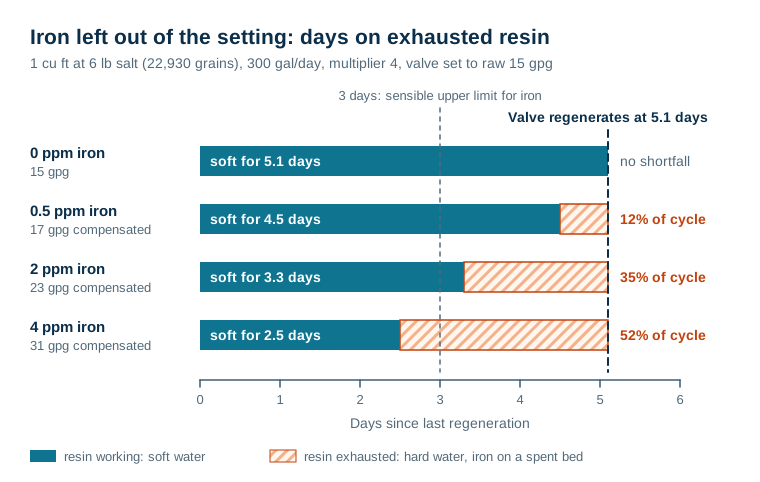
The capacity cost is small, but the salt setting changes. At 0.5 ppm the water is not under Hellenbrand's 0.5 ppm limit, so the high-efficiency setting is ruled out. If the valve is programmed at raw 15 gpg, it waits 5.1 days while the resin is exhausted at 4.5. That leaves about 12% of each cycle delivering hard water that also carries iron.
Example 2: Moderate iron, 2 ppm
- Compensated hardness: 15 + (4 × 2) = 23 gpg
- Daily load: 23 × 300 = 6,900 grains
- 1 cu ft at 6 lb: 22,930 ÷ 6,900 = 3.3 days, about 110 regenerations a year
- Salt: 659 lb a year (+53%)
This is the case that catches people out, because 2 ppm does not look like much on a report. Programmed at raw hardness, the valve still waits 5.1 days, but the resin is exhausted after 3.3. For about 35% of every cycle, the house gets untreated water while iron sits on a spent bed.
The multiplier makes a smaller difference. With 3, compensated hardness is 21 gpg and the unit lasts 3.6 days. With 5, it is 25 gpg and 3.1 days.
Two ppm is also the top of Hellenbrand's rating for its own unit. The numbers work here, but there is no room left for the iron to rise.
Example 3: Heavy iron, 4 ppm
- Compensated hardness: 15 + (4 × 4) = 31 gpg
- Daily load: 31 × 300 = 9,300 grains
- 1 cu ft at 6 lb: 22,930 ÷ 9,300 = 2.5 days, about 148 regenerations a year, 888 lb of salt
- 1.5 cu ft at 9 lb: 34,400 ÷ 9,300 = 3.7 days, about 99 regenerations a year, also 888 lb
Programmed at raw hardness, this softener is exhausted for more than half of every cycle (52%).
The arithmetic has an answer, but the specifications do not support it. Four ppm is twice Hellenbrand's rating. It is inside Penn State Extension's general guideline of under 5 mg/L for softeners, and close to the 5 ppm at which Chandler's manual says filtration will "most generally be required". The other option is an iron filter ahead of the softener. The softener then goes back to being sized on hardness alone, close to the 430 lb baseline, and the iron filter's running costs are added. That trade-off is costed in water softener vs iron filter.
The three wells side by side
| Iron (ppm) | Compensated hardness | Grains/day | Days per cycle (1 cu ft, 6 lb) | Salt per year | Share of cycle exhausted if iron is ignored |
|---|---|---|---|---|---|
| 0 | 15 gpg | 4,500 | 5.1 | 430 lb | — |
| 0.5 | 17 gpg | 5,100 | 4.5 | 487 lb | 12% |
| 2.0 | 23 gpg | 6,900 | 3.3 | 659 lb | 35% |
| 4.0 | 31 gpg | 9,300 | 2.5 | 888 lb | 52% |
Why Iron Needs More Frequent Regeneration Than the Math Says

The capacity arithmetic assumes iron comes off the resin at regeneration as completely as calcium does. The manufacturers do not seem to assume that.
- Chandler's manual recommends setting a regeneration day override "particularly... when iron is being treated to prevent fouling of the resin". The override forces a regeneration after a set number of days, whatever the meter says.
- NDSU Extension's softening guide notes that "more frequent backflushing" may be needed to remove iron buildup.
- Purolite's resin literature explains that the core of a standard resin bead stays partly unregenerated, and that iron accumulates there.
Iron that stays on the bed from one cycle to the next reduces the capacity of the following cycle. That loss does not appear in a calculation based on the specification table. The practical response is to keep the interval short whatever capacity the table promises. Marlo's sizing sheet starts from three days of capacity, and its worked example happens to be a clear-water iron well. That is not a rule, but three days is a sensible upper limit for iron unless your manual gives a different one.
This is also why a bigger softener can cost more on iron water. Take the 1.5 cu ft unit in Example 2. On capacity alone it would last 5.0 days. With a three-day day override, it regenerates every 3 days with capacity left unused. That is about 122 regenerations at 9 lb, or roughly 1,095 lb of salt a year, against 659 lb for the 1 cu ft unit that runs out naturally at 3.3 days. With iron in the water, choose a bed that lasts about three days, not one that lasts as long as possible. The AFWFilters Iron Pro 2 review applies that rule to a fine-mesh range, where the right model is often a size smaller than instinct suggests.
Programming the Valve With the Result
- Enter compensated hardness, not raw hardness. Hellenbrand's programming step asks for "total compensated hardness". The valve works out its gallon capacity from this number.
- Set a day override of about three days, or whatever your manual specifies for iron.
- Use a standard salt setting, not the high-efficiency one, unless your iron is under the manufacturer's clean-water limit.
- Record your figures. Write the iron, hardness, multiplier and date on a label inside the cabinet.
- Check the result against real use. Log gallons between regenerations and watch for hardness coming through near the end of each cycle. The worksheet in hard water returns before regeneration is set up for exactly this.
- Plan resin cleaning from the start. A bed that carries iron needs cleaning on a schedule, not only when problems appear. Dosing and frequency are in resin and iron cleaners.
Where the Sizing Math Stops
Compensated hardness corrects capacity for iron the resin can exchange. It cannot make a softener suitable for iron above the manufacturer's rating. It does nothing for iron that has already oxidized, and it cannot deal with iron bacteria. In any of those cases the answer is pretreatment, and the order of stages is set out in should an iron filter go before a water softener. When you are choosing equipment, matching a well-water softener to your iron band sorts the options by those same limits.
Within the rating, the arithmetic is simple and the penalty for skipping it is large. Two ppm of iron that is left out of the setting means about a third of every cycle runs on exhausted resin.
Frequently Asked Questions
How many grains of hardness should I add for iron?
Use the figure in your control valve's manual. Published multipliers differ: Hellenbrand's residential manual says to add 3 grains per gallon for each ppm of iron, Chandler Systems' manual says to multiply total iron and manganese in ppm by 4, an older Marlo sizing sheet uses 2, and many dealer guides use 5. If your manual gives nothing, 4 is a reasonable middle figure. Using one consistently matters more than which one you choose.
Do I set my softener to the hardness or the compensated hardness?
The compensated hardness. Metered controls work out how many gallons they can treat from the hardness figure you enter. If you enter raw hardness on water that carries iron, the valve overestimates its capacity and regenerates after the resin is already exhausted. Hellenbrand's programming instructions ask for total compensated hardness at the hardness step.
What size water softener do I need with iron in my well water?
Work out compensated hardness, multiply it by daily household water use to get grains per day, then choose a resin volume and salt dose whose capacity lasts about three days. For a four-person house using 300 gallons a day, at 15 gpg with 2 ppm of iron, that is about 6,900 grains a day. One cubic foot of resin at 6 lb of salt, rated around 22,900 grains, lasts about 3.3 days.
Should I buy a bigger softener if I have iron?
Not automatically. A bigger bed runs longer between regenerations, and iron benefits from shorter intervals. If you then cap the interval with a day override, the bigger bed regenerates with capacity left unused and wastes salt. Size for roughly a three-day cycle at your compensated hardness rather than for the longest possible interval.
Can I use the high-efficiency salt setting with iron in my water?
Check your manual, but usually not. Hellenbrand's specification sheet says its high-efficiency salting is intended for clean water with iron under 0.5 ppm, such as most city supplies. On well water with more iron than that, use one of the standard salt settings and size the bed against the capacity that setting delivers.
