
Best Water Softener and Reverse Osmosis Bundles

A water softener and reverse osmosis bundle saves a little over buying the same softener and RO unit separately, judging by the three bundles compared for this page. That saving is the only real argument for a bundle. The best one is the bundle whose two halves you would have chosen anyway: a softener with enough resin for your hardness load, and an RO unit certified for what it claims to remove.
- Best balanced bundle: APEC Hydro Express 30 + ROES-PH75. A 1.0 cu ft softener and an RO unit APEC describes as WQA Gold Seal certified.
- Lowest price: Aquasure Harmony 32k + Premier 75 GPD. A sound softener with a cheaper RO whose product page names no system certification.
- For higher hardness loads: APEC Hydro Express 45 + ROES-PH75. The same RO with 1.5 cu ft of resin.
Disclosure: Hard Water Solved may earn a commission if you buy through links on this page, at no extra cost to you. It does not change which products we include or how we rank them. Read our disclaimer.
How These Bundles Were Chosen
Method. Each bundle was priced against its own two halves bought separately, and each half was checked on its own terms. The softener half was checked on resin volume and capacity at an efficient 6 lb/cu ft salt setting, not the box rating. The RO half was checked on whether the system, and not just its faucet, carries a reverse osmosis certification. Evidence comes from brand spec pages, warranty statements and certification listings. Nothing was physically tested.
Included: sold on Amazon.com as a single listing, with a price we could confirm at a brand store or a major retailer.
Excluded: bundles whose price could not be confirmed (listed further down), and bundles built for iron or sulfur well water, which need a different kind of comparison.
Prices are not listed here because they change often. Use the buttons to see the current price on Amazon.
Nobody who already owns a working softener should buy a bundle. Neither should anyone on a well with iron or a sulfur smell, because none of these softeners is sold as an iron remover. Both cases are covered at the end.
The Three Bundles Side by Side
| APEC Hydro Express 30 + ROES-PH75 | Aquasure Harmony 32k + Premier 75 | APEC Hydro Express 45 + ROES-PH75 | |
|---|---|---|---|
| Box rating | 30,000 grains | 32,000 grains | 45,000 grains |
| Resin volume | 1.0 cu ft, published | Not published | 1.5 cu ft, published |
| Capacity at 6 lb/cu ft | about 21,000 grains | about 21,000 grains if 1.0 cu ft | about 31,500 grains |
| RO output | 75 GPD at 60 psi | 75 GPD | 75 GPD at 60 psi |
| RO stages | 6, last one calcium | 4 | 6, last one calcium |
| RO certification named by the brand | WQA Gold Seal | Lead-free faucet only | WQA Gold Seal |
| RO pure-to-drain ratio | Not published | 1.5:1 claimed | Not published |
| Stated warranty | 5-year limited (softener page) | 2-year extended when registered | 5-year limited (softener page) |
| Amazon | Check price on Amazon | Check price on Amazon | Check price on Amazon |
Capacity at 6 lb/cu ft uses standard resin's published capacity curve, about 21,000 grains per cubic foot at that dose. Warranty terms are as stated on each brand's product page; read the document that ships with the unit.
The table shows where each bundle saves money. The Aquasure softener does not publish its resin volume, so its real capacity is an inference from the rating. Its RO half names a lead-free faucet, not a system certification. The APEC bundles publish resin volume, but not their RO waste ratio.
Water Softener and Reverse Osmosis Bundles vs Buying the Halves
The bundle exists to save money, so the first check is whether it does. Each softener and RO unit in these bundles is also sold on its own. When we compared the brands' own list prices for each bundle and for its two halves, every bundle came out slightly cheaper than its halves bought separately.
Three things follow from that:
- The saving is real but small. It is less than a tenth of the price, and not large enough to justify a softener that is too small for your water, or an RO unit you would not otherwise have picked.
- The cheapest bundle has the cheapest RO. The Aquasure Premier costs less than the APEC ROES-PH75 when each is bought alone, and most of the price gap between the two smaller bundles is the RO half.
- Watch the sale price on single units. Home Depot has listed the Aquasure Premier with a brushed nickel faucet on sale, low enough that buying the two halves separately cost about the same as the bundle. Check both ways on the day you buy.
Aquasure also sells a version that adds a sediment, carbon and zinc pre-filter (Signature Pro, AS-WHF32D) at a higher price. The extra money buys one whole-house cartridge filter. It is worth it only if your water carries sediment or chlorine you want out of every tap.
1. APEC Hydro Express 30 + ROES-PH75: Best Balanced Bundle
1–3 bathrooms
The softener half. The Hydro Express 30 is the one softener on this page whose maker publishes the numbers needed to check it. Express Water's spec page for the Hydro Express 30 gives 1.0 cubic foot of standard resin in a 9 × 48 inch tank, a 200 lb brine tank, a 17.6 gpm peak flow, an operating range of 20–125 psi, and a 5-year limited warranty. The valve is metered, so it regenerates on the water you actually use rather than on a timer.
One cubic foot of resin yields about 21,000 grains at an efficient 6 lb salt dose and about 31,000 grains at 15 lb. The "30,000-grain" rating is the top of that curve. Advertised vs usable softener capacity explains why the box number is the wrong one to size from.
The RO half. The ROES-PH75 is a 6-stage, 75-gallon-per-day under-sink system rated at 60 psi and 77°F, with a 4-gallon tank. Its sixth stage is a calcium carbonate cartridge that raises the pH of the RO water. APEC describes the system as WQA Gold Seal certified. The WQA's Gold Seal for a drinking-water RO system is issued against industry standards. The contaminant claims vary by model, so look the model up on WQA's certified product listing before relying on any one claim. APEC's product page does not publish a pure-to-drain ratio or a filter schedule.
What it skimps on. The waste ratio is not published. APEC states only that the system is "tested for TDS reduction". If water efficiency matters to you, this is the gap. The calcium stage is a taste and pH feature, not a health feature.
Buy it if your household's hardness load is under about 2,600 grains a day (worked out below), and you want the RO half to carry a third-party certification.
2. Aquasure Harmony 32k + Premier 75 GPD: Lowest Price, Thinner Paperwork
1–3 bathrooms, up to 4 people
The softener half. The Harmony 32k uses Aquasure's digital metered Aquatrol-based valve, with programmable regeneration settings. Aquasure's bundle page does not give the resin volume, the tank size or the flow rate. A 32,000-grain rating conventionally means about 1.0 cubic foot of resin. If that holds, the Harmony delivers about 21,000 grains at 6 lb/cu ft, the same as the APEC 30. That is an inference from the rating, not a published figure. Ask Aquasure for the resin volume before you program the salt dose.
The RO half. The Premier Advanced is a 4-stage, 75 GPD system with a 3-gallon tank. Aquasure claims a 1.5:1 pure-to-drain ratio, which would be better than EPA's WaterSense ceiling of 2.3 gallons of reject per gallon made. That is the maker's own figure, and the product is not described as WaterSense-labeled. The only certification the product page names is an "NSF certified lead-free" faucet. That is a materials claim about the faucet's lead content. It says nothing about what the system removes.
What it skimps on. Paperwork, on both halves. The softener's resin volume is not published, and neither is any system-level RO certification on the page. The warranty also reads differently in different places. Aquasure's own page offers a 2-year extended warranty on registered products, and some retailer copy says 5 years. Go by the document in the box.
Buy it if you mainly want softened water through the house and better-tasting water at the sink, with no specific contaminant to remove. If your water report shows lead, arsenic or nitrate, choose an RO unit certified for that contaminant instead.
3. APEC Hydro Express 45 + ROES-PH75: For Higher Hardness Loads
4–6 bathrooms
The softener half. This is the same design as the Hydro Express 30, with 1.5 cubic feet of standard resin in a 10 × 54 inch tank, the same 17.6 gpm peak flow and the same 5-year limited warranty on the stand-alone softener's page. At 6 lb/cu ft that is about 31,500 grains a cycle, half again as much as the 30.
The RO half. It is the same ROES-PH75 as Pick 1, with the same strengths and the same unpublished waste ratio. The extra cost over Pick 1 buys resin only.
What it skimps on. For the bigger house it is sold for, one 75 GPD RO unit serves one sink. A larger home that wants filtered water at a bar sink or a fridge line needs a second RO unit or a tee, which the bundle does not include.
Buy it if your hardness load lands between about 2,600 and 3,900 grains a day. Above that, even 1.5 cu ft regenerates more than once a week at an efficient salt dose. A larger softener bought on its own is the better route then, with an RO unit added separately.
Checking the Softener Half: Days Between Regenerations
Capacity only means something against your own hardness load. Multiply the people in the house by about 60 gallons a day, the measured indoor average rounded up, and then by your hardness in grains per gallon. How to size a water softener works the full calculation, including peak flow.
| Household | Daily hardness load | 1.0 cu ft bundle (APEC 30, likely Aquasure 32k) | 1.5 cu ft bundle (APEC 45) |
|---|---|---|---|
| 2 people, 10 gpg | 1,200 grains | about 16 days | about 25 days |
| 3 people, 12 gpg | 2,160 grains | about 9 days | about 14 days |
| 4 people, 15 gpg | 3,600 grains | about 5 days | about 8 days |
| 5 people, 20 gpg | 6,000 grains | about 2.5 days | about 4 days |
Days between regenerations at 6 lb of salt per cubic foot, after holding back one day's load as reserve. Illustrative households; work your own numbers.
A metered valve copes with short cycles, but every regeneration costs salt and water. If your row shows under about a week, step up a size. If it shows two weeks or more, the smaller bundle is plenty, and a bigger one only buys resin that sits idle. The 5-person, 20 gpg row is past what either bundle should handle.
Checking the RO Half: What "Certified" Should Mean
Bundles are where weak RO paperwork hides most easily. Buyers compare the softener and treat the RO as a free extra. Read the RO half's claims like this:
- NSF/ANSI 58 is the reverse osmosis standard. A system certified to it has been tested on TDS reduction and on any specific contaminants listed for it, such as lead, arsenic or nitrate. Contaminant claims are listed one by one, so "certified to 58" does not mean "certified for everything".
- NSF/ANSI 372 covers lead content in the parts that touch water. It is a materials standard. An "NSF certified lead-free faucet" is this kind of claim.
- NSF/ANSI 42 and 53 cover carbon filter claims such as chlorine, taste and certain chemicals. They apply to a system's filter stages, not to its membrane.
Certification is held by a model, and listings name the models. Search the brand on WQA's certified product listing or on NSF's drinking water treatment unit listings before treating a bundle's RO as certified.
The second number worth knowing is waste. EPA's WaterSense page on point-of-use RO systems says a typical unit sends five gallons or more down the drain for every gallon made, while a WaterSense-labeled unit sends 2.3 gallons or less. On a softened supply that reject water has already used salt. Neither APEC nor Aquasure markets these RO units as WaterSense-labeled.
On sodium. The RO half is what answers the sodium worry about softened drinking water. A softener adds about 7.9 mg/L of sodium for each grain of hardness removed, and an RO unit takes most of it back out at the drinking tap. Sodium in softened water works the numbers for your own hardness.
Which Bundle for Your House
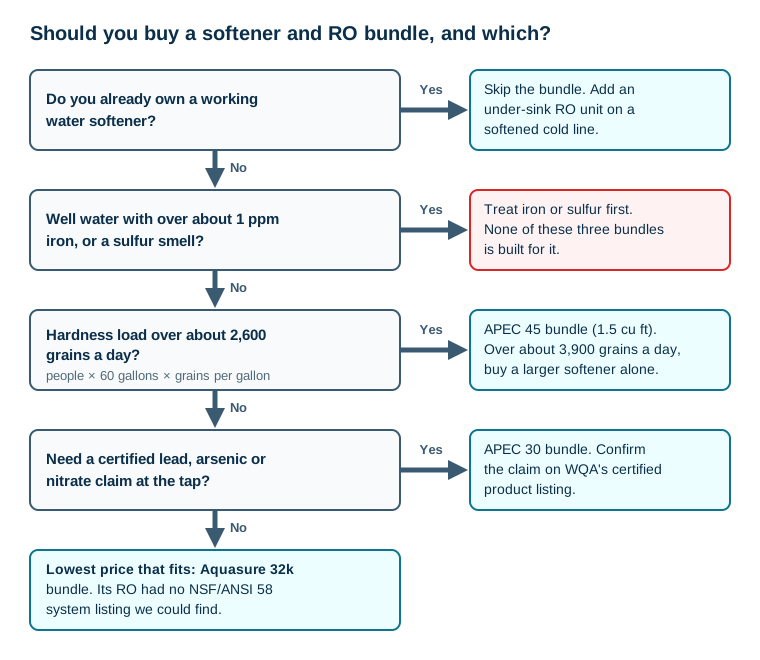
The order of the questions matters. Owning a softener already, or having iron in a well, rules a bundle out before price comes into it. After that, your hardness load sets the resin size. Only then does the RO certification decide between the two smaller bundles.
Bundles We Looked At and Did Not Rank
Several other Amazon bundles fit the category but could not be priced with confidence on 1 October 2026:
- DuraWater Fleck 5600SXT 48,000-grain + reverse osmosis. The listing is live, and a Fleck 5600SXT 48k softener is a well-understood half. We could not confirm a current price for the bundle or identify its RO unit's certification.
- SoftPro Elite "Ultimate" 48k with carbon filter and RO. The Amazon page would not load, and SoftPro's own site gave no bundle price we could date.
- Aquasure 64,000-grain + 75 GPD RO. There was no confirmed price for this listing.
- Aquasure Signature Elite. The listing now describes a 64,000-grain fine-mesh softener with a conditioner and RO. That makes it a well-water treatment train, not a like-for-like bundle.
A bundle missing from the table is not a judgement on its quality. It means a price or certification could not be confirmed on the day.
Before You Order: Install Notes That Change the Choice
- Feed the RO from a softened cold line. Some homes leave the kitchen cold tap hard on purpose. If yours does, the RO gets hard water and its membrane life suffers. How reverse osmosis and a water softener work together covers the layout and the membrane figures manufacturers publish.
- Plan two drains. The softener needs a drain near the main line for regeneration. The RO needs a drain saddle under the sink.
- Plan one outlet. Both softeners here use powered metered valves. The RO units in these bundles are tank systems and need no power.
- Leave room under the sink. The ROES-PH75's tank is about 11 × 11 × 15 inches. The Aquasure tank holds 3 gallons.
Who Should Buy None of These
- You already own a working softener. Buy an under-sink RO on its own and feed it from a softened line. A bundle would make you pay for a second softener.
- You are on a well with iron, manganese or a sulfur smell. Treat that first. None of these softeners is sold as an iron remover, and iron fouls an RO membrane as readily as it fouls resin.
- Your hardness load is above about 3,900 grains a day. Buy a larger softener on its own and add an RO unit separately.
- You need a specific contaminant removed and cannot find it in the RO unit's certification listing. Buy the RO for that claim first, then pick a softener on its own merits.
- Your water is only mildly hard and the reason you want the RO is taste. A certified RO unit alone may be all you need. Softening is a separate decision about scale, soap and the water heater.
For everyone else, a softener and RO bundle is a reasonable way to buy two things you need at once. It saves a little money, it is one order and one delivery, and the two halves were at least chosen to go together. Check that both halves would have made your list on their own, and the bundle is worth having.
Frequently Asked Questions
Is it cheaper to buy a water softener and reverse osmosis system as a bundle?
Usually a little. When we compared them, the three bundles on this page cost slightly less than the same softener and RO unit bought separately at the brands' own list prices, a saving of less than a tenth. A sale on either half bought alone can wipe it out, so price both ways on the day you buy.
Do I need a water softener if I already have a reverse osmosis system?
If your water is hard, usually yes. An under-sink RO unit treats one tap, so the shower, water heater, dishwasher and fixtures still get hard water. Hard feed water also shortens the RO membrane's life, and many RO makers ask for feed hardness at or below about 7 grains per gallon.
Which goes first, the softener or the reverse osmosis system?
The softener. It sits where the water enters the house and treats everything. The RO unit sits under the kitchen sink and should be fed from a softened cold line, so its membrane sees water with the calcium and magnesium already removed.
Is the RO system in a softener bundle NSF certified?
Not always. Check whether the RO unit itself is certified to NSF/ANSI 58, the reverse osmosis standard, and for which contaminants. A listing for NSF/ANSI 372 or an 'NSF certified lead-free faucet' covers the lead content of the parts only, not what the system removes. APEC describes the RO in its bundles as WQA Gold Seal certified. Aquasure's RO product page names only a lead-free faucet.
Does reverse osmosis remove the salt a water softener adds?
Most of it. A softener adds about 7.9 mg/L of sodium for each grain per gallon of hardness it removes. A household RO system rejecting 90 percent of dissolved solids takes the 157 mg/L added to 20 gpg water down to about 16 mg/L at the drinking tap.
Can I install a softener and RO bundle myself?
Many owners do, if they are comfortable cutting into the main line and working under a sink. The softener needs a bypass, a drain within reach and, for these metered units, an outlet. The RO unit needs a cold feed, a drain saddle, a hole for its faucet and space for its tank. Check your local code first, because some areas require a licensed plumber for work on the main line.
