
HALO 5 Review: Each Stage, What It Costs to Run, and What Replaced It

This HALO 5 review finds a capable carbon filter attached to a conditioning stage that does not do what most buyers think. The HALO 5 puts four media stages in one tank, mostly carbon, which reduce chlorine, taste and odour. Its fifth stage is a permanent magnetic module, not a softener and not template assisted crystallization (TAC). It removes no hardness. On 1 October 2026 the maker's website was offline and both Amazon listings were unavailable.
So the HALO 5 is now mainly a system you will be quoted by a plumber, not one you can order. What follows covers what each stage does, what it costs to keep running, and how it compares over 10 years with two pairings you can still buy.
Disclosure: Hard Water Solved may earn a commission if you buy through links on this page, at no extra cost to you. It does not change which products we include or how we rank them. Read our disclaimer.
How this review was built. HALO's own product description, FAQ and warranty are taken from archived copies of halowatersystems.com, because the live site no longer resolves. Amazon status comes from the two HALO 5 listings. Installer prices come from a plumbing company's published guide. Nothing here was physically tested. Prices are not listed here because they change often. Use the buttons to see the current price on Amazon.
Can You Still Buy a HALO 5?
| Check, 1 October 2026 | Result |
|---|---|
| Amazon, HALO 5 1-inch listing | "Currently unavailable", no seller |
| Amazon, HALO 5 1-1/4-inch listing | "Currently unavailable", no seller |
| halowatersystems.com | Domain no longer resolves; archived copies from 2025 redirect to a placeholder page |
| Installers | Some plumbers still publish HALO 5 pricing and install guides |
| Published price | None. Dealers sold under minimum advertised pricing |
That matters for more than convenience. A whole-house filter is a 10-year purchase that needs media, seals and valve parts along the way. If the brand no longer supplies them, an owner relies on the installer, or on generic carbon and a generic valve when the time comes. Ask any installer quoting a HALO 5 who supplies the parts now, and who stands behind the warranty.
What Is Inside: A Stage-by-Stage HALO 5 Review
All five stages sit in one tank on a backwashing control head. HALO's archived FAQ says its 1-inch units held 1.5 cubic feet of activated carbon and its 1-1/4-inch units held 2 cubic feet.
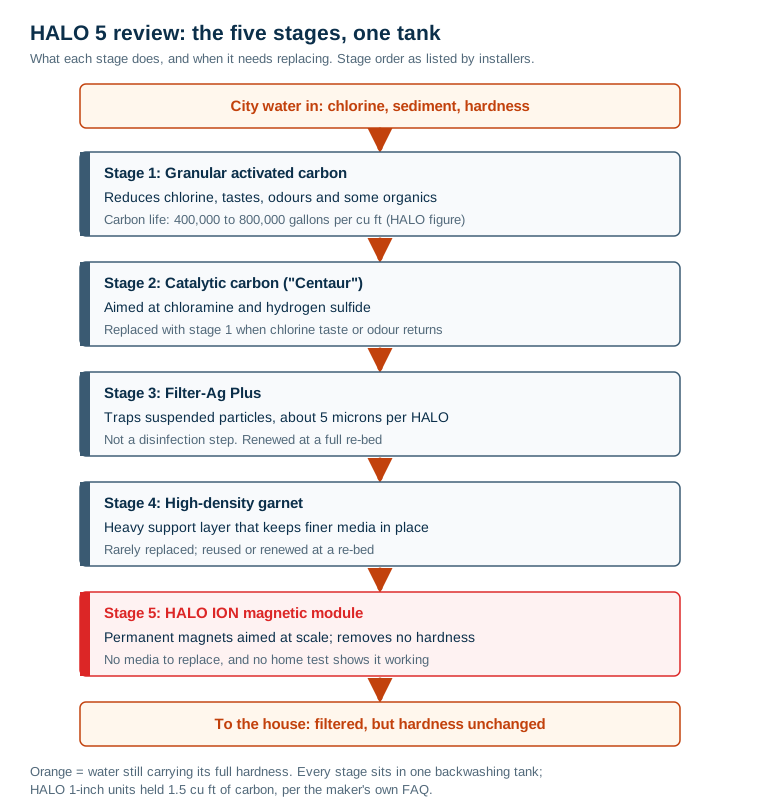
| Stage | Media | What it does | When it is replaced |
|---|---|---|---|
| 1 | Granular activated carbon | Reduces chlorine, tastes, odours and some organic chemicals | When chlorine taste or odour returns; HALO put carbon at 400,000 to 800,000 gallons per cubic foot |
| 2 | Catalytic carbon (HALO's "Centaur") | Aimed at chloramine and hydrogen sulfide, which plain carbon handles poorly | With stage 1, at a full re-bed |
| 3 | Filter-Ag Plus | Traps suspended particles; HALO cited about 5 microns | At a full re-bed; backwashing keeps it clean in between |
| 4 | High-density garnet | A heavy support layer that keeps finer media from migrating | Rarely; reused or renewed at a re-bed |
| 5 | HALO ION permanent magnetic module | Magnetic fields intended to stop scale forming; adds or removes nothing | No media to replace |
Stages 1 and 2 are the real value. Catalytic carbon matters on city water treated with chloramine, which ordinary carbon removes slowly. HALO said its carbons were certified to NSF/ANSI standards as media, with the Centaur carbon under NSF/ANSI 42. That is a certification of the media as a material. It is not a performance certification of the HALO 5 system.
Stage 3 is a particle filter, not a disinfection step. HALO's 2009 product page claimed Filter-Ag Plus removed organisms including E. coli, Giardia and Cryptosporidium. A granular media bed rated around 5 microns is not a disinfection device, and no system certification backed that claim in the sources we found. If your water has a bacteria problem, it needs disinfection, such as UV or chlorination, not a filter medium.
One oddity worth knowing. HALO's own 2009 product page also listed an ion-exchange stage regenerated with sodium chloride. The HALO 5 sold on Amazon from 2013 was described as chemical free with no salt. If you are quoted a HALO 5, ask exactly which media are in the tank.
The Conditioning Stage Is Magnetic, Not TAC
Several distributors describe the HALO 5 as a salt-free conditioner, and buyers often assume that means TAC media, the salt-free technology with the strongest test results. It is not. HALO's own FAQ described the HALO ION module as producing "multiple reversing polarity magnetic fields" that alter calcium and magnesium ions so they "repel one another" instead of forming scale. It "does not add or remove anything from water."
The independent evidence for that class of device is weak. The WateReuse Research Foundation's study 08-06 tested softener alternatives under the German DVGW W 512 heated protocol. TAC reduced scale formation by more than 88 percent. Electromagnetic and electrically induced devices reduced it by about 50 percent. Other studies of magnetic devices found no effect at all. The comparison is set out in water softeners vs electronic and magnetic descalers.
Three practical consequences follow:
- A hardness test cannot show it working. The calcium and magnesium are still in the water. A test strip after the HALO 5 reads the same as before it.
- You get none of the soft-water benefits. Lather, spotting on glass and the feel of the water on skin stay the same, because those depend on the hardness being gone.
- There is nothing to maintain, and nothing to verify. The module has no media to replace, which is convenient, but there is also no home check that tells you whether it is doing anything.
Whether you need scale control or true softening is the first decision, ahead of any brand. Salt-based vs salt-free water treatment sets out what each measurably does.
What Each Stage Costs to Keep Running
The HALO 5's running costs are low, because only the carbon stages wear out and they wear out slowly. HALO's FAQ worked it out using 22,500 gallons per person per year. At the 75 gallons per person per day used across this site, a family of four uses about 109,500 gallons a year.
| Stage | Life for a family of four | What gets replaced |
|---|---|---|
| Carbon, stages 1 and 2 (1.5 cu ft in a 1-inch unit) | About 5.5 to 11 years, at 400,000 to 800,000 gallons per cubic foot | 1.5 cubic feet of catalytic carbon media, plus labour if a dealer fits it |
| Filter-Ag Plus and garnet | Usually renewed at the same re-bed | Small extra media cost plus labour |
| Magnetic module | No consumable | Nothing |
| Backwash water | Every backwash sends water to drain | Not published for the HALO 5 |
HALO's archived FAQ answer on media life is the source for the carbon figures. It also advised testing the water every year, or simply waiting until chlorine taste or odour returns. With HALO's own replacement media no longer sold, a re-bed means generic carbon of equivalent grade, installed by a dealer or a confident DIYer.
The same pattern of "maintenance-free" claims hiding a real replacement schedule applies to most salt-free systems. The general schedule, and how to tell when media is spent, is in salt-free water conditioner maintenance.
HALO 5 vs a Softener and Carbon Pair Over 10 Years
The fair comparison for a HALO 5 is not a softener alone. It is what two tanks you can still order would do instead. We compared two pairings for a family of four on 15 gpg city water:
- Salt softener plus carbon filter: Aquasure Harmony 48,000 grain (Check price on Amazon) with an Aquasure Fortitude Pro 1.5 cu ft KDF/GAC filter, rated by Aquasure at 1,000,000 gallons (Check price on Amazon).
- Salt-free plus carbon bundle: Aquasure Serene 10 GPM salt-free bundle with Fortitude Pro and a pleated sediment pre-filter (Check price on Amazon). Aquasure rates the Serene for city water below 25 grains per gallon and calls its anti-scale media a 10-year media.
| 10 years of ownership, before installation | HALO 5 | Softener + carbon pair | Salt-free + carbon bundle |
|---|---|---|---|
| Equipment | $1,500 to $3,500 (installer estimate) | Two tanks; check the current price | One bundle; check the current price |
| Salt | None | Ongoing, and the largest running cost | None |
| Regeneration or backwash water | Not published | Every regeneration sends water to drain | None |
| Carbon replacement | 1.5 cu ft media re-bed, around year 8 | Replacement media tank, around year 9 | Replacement media tank, around year 9 |
| Sediment cartridges, assumed one a year | None listed | About 10 over 10 years | About 10 over 10 years |
| Removes hardness? | No | Yes | No |
| Scale-control evidence | Magnetic, about 50% at best in WateReuse testing | Hardness removed | Aquasure's anti-scale media; ask for the test protocol |
Illustrative. The softener's salt use assumes a standard 9 lb per cubic foot dose; programming it for efficiency lowers it. Carbon life depends on your chlorine level and water use.
The pattern is clear. A HALO 5 is cheap to keep running, because only its carbon wears out, but it buys filtration plus the weakest kind of scale control. The softener pair has the highest running costs, mostly salt, and it is the only one of the three that removes the hardness completely. The salt-free bundle avoids salt, with scale-control media that is at least a different technology from a magnet. Set the current prices of the pairings against your installer's HALO quote before deciding.
Installation is excluded from every column. A HALO 5 is one tank to plumb in, and each pairing is two or three. Expect the pairings to cost a little more to install.
The Water the HALO 5 Is Not Built For
- Hard water where you want soft-water results. Spotting, soap scum, lather and dry skin are hardness problems, and the HALO 5 leaves the hardness in.
- Well water with bacteria. It is not a disinfection system, whatever older marketing said about Filter-Ag Plus.
- Iron and manganese. Catalytic carbon can handle a little, but iron above trace levels calls for dedicated iron treatment ahead of anything else.
- Water heaters and tankless units with hardness terms in their warranty. Some makers set a hardness limit. Check yours before relying on a device that leaves the hardness in.
- Anyone who wants to verify results. With no hardness change to measure, you are relying on the claim.
Warranty: What the Paper Said, and Who Stands Behind It Now
HALO's archived limited lifetime warranty promised one replacement mineral tank for a manufacturing defect, valve parts within five years of manufacture, and components available for the life of the system. It excluded all water-conditioning media, because media life "is highly reliant on influent water conditions". Installer guides published since then describe the warranty variously as 5 years or 10 years.
The terms matter less than the question of who would honor them. With the manufacturer's site gone, assume the effective warranty is whatever the installer personally commits to in writing.
Who Should Not Buy a HALO 5
- Anyone who wants soft water. Buy an ion-exchange softener and add carbon if you also want chlorine removed.
- Buyers who need a supported product for 10 years. The maker's site is offline and the Amazon listings are dead.
- Households relying on it for safety. It is not a disinfection system and carries no system-level health certification.
- Anyone comparing it with TAC salt-free media. The HALO 5's conditioning stage is magnetic, and magnetic devices test well below TAC.
The Verdict
The bottom line of this HALO 5 review: its carbon stages are a sound whole-house filter for chlorine, chloramine, taste and odour, and its running costs are low. Its conditioning stage is a permanent magnet that removes no hardness, backed by the weakest evidence in salt-free treatment. Add a vanished manufacturer and no Amazon availability, and it is hard to recommend over two tanks you can buy today. If you want soft water, a salt softener and carbon filter pair is the option that actually removes the hardness. If you only want filtration and some scale control without salt, a salt-free bundle with a named media and a carbon stage is the more supportable choice.
Frequently Asked Questions
Is the HALO 5 a water softener?
No. The HALO 5 is a whole-house filter with four media stages, mostly carbon, plus a permanent magnetic module that HALO said would stop scale forming. Nothing in it removes calcium or magnesium, so a hardness test after the system reads the same as before it. If you want soft water, meaning better lather, fewer spots and no hardness on a test strip, you need an ion-exchange softener.
Can you still buy a HALO 5?
With difficulty. On 1 October 2026 both HALO 5 listings on Amazon, the 1-inch and the 1-1/4-inch, showed as currently unavailable, and the halowatersystems.com domain no longer resolved. Some plumbers still quote and install HALO 5 systems. Before buying one, ask the installer who supplies replacement media and valve parts now, and who would honor a warranty claim.
How long does the HALO 5 media last?
HALO's own FAQ put activated carbon at 400,000 to 800,000 gallons per cubic foot, and said its 1-inch units held 1.5 cubic feet. At 75 gallons per person per day, a family of four uses about 109,500 gallons a year, which gives roughly 5.5 to 11 years before the carbon needs replacing. HALO advised testing the water each year, or replacing the carbon when chlorine taste or odour returns.
Does magnetic water conditioning work?
The evidence is weak and mixed. The most cited independent test, a WateReuse Research Foundation study, found electromagnetic and electrically induced devices cut scale formation by about 50 percent under its heated test, against more than 88 percent for template assisted crystallization media. Other studies of magnetic devices found no effect. None of these devices removes hardness.
How much does a HALO 5 cost?
HALO sold through dealers under minimum advertised pricing, so there is no public list price. One Colorado plumbing company estimates $1,500 to $3,500 for the unit and $2,000 to $5,000 installed. For comparison, check the current price of a salt softener and carbon filter pair you can still order, such as an Aquasure Harmony 48,000-grain softener with a Fortitude Pro 1.5 cubic foot carbon filter, and add installation.
Does the HALO 5 use salt or electricity?
The current HALO 5 description calls it salt-free and chemical-free, and no salt is needed for the carbon or magnetic stages. Installers describe an automatic backwashing control head on the tank, and electronic heads of that kind run from a plug-in transformer, so expect to need an outlet. Backwashing also sends some water to a drain.
