
What Maintenance Does a Salt-Free System Need?

Salt free water conditioner maintenance is lighter than a softener's, but it is not zero. The media has a finite life. Watts says to replace OneFlow tank media every three years and its cartridge models every one to two years. Most installations also have a sediment prefilter, and sometimes a carbon prefilter, that need changing on their own schedule. In a typical worked example that adds up to roughly $210 to $290 a year, which at moderate hardness is more than a softener's salt bill.
The rest of this page sets out the calendar, how to tell when media is worn out (hardness tests will not tell you), and the annual cost comparison worked through line by line so you can put your own prices in.
What "Maintenance-Free" Leaves Out
Salt-free systems do remove several softener chores, and that part of the pitch is true. There is no salt to carry, no brine tank to clean, no regeneration, no drain line and no electricity. Watts describes its whole-house OneFlow systems as needing "no backwashing, regeneration or discharge water".
What the label leaves out is everything the media depends on:
- The media itself wears out. Its surface does the work, and that surface gradually loses activity and picks up deposits. Every manufacturer publishes a replacement interval.
- The prefilter protects the media, and it clogs. Sediment that reaches TAC media coats it. A cartridge that nobody changes restricts flow first and then, if it bypasses or tears, lets grit through.
- Carbon has a capacity. Where chlorine is above the media's limit, the carbon filter protecting it is used up gradually. Once it is spent, chlorine reaches the media.
- The water heater still needs attention. Next's ScaleStop manual recommends draining the heater 30 to 60 days after installation and again a year later.
None of that is a reason not to buy one. It is the actual ownership picture, and the claims to weigh critically usually sit in the gap between "maintenance-free" and this list.
The Salt-Free Water Conditioner Maintenance Schedule
Intervals come from manufacturer literature where it exists. Where the interval depends on your water and the cartridge you buy, it is marked as typical.
| Task | Interval | Source | Why it matters |
|---|---|---|---|
| Replace tank media (whole-house) | Every 3 years | Watts, OneFlow OF744RM media page | Surface activity declines over time |
| Replace inline cartridge (single appliance) | Every 12 months | Watts, OneFlow OF110–140 specification | Smaller media volume, shorter life |
| Replace tankless-heater cartridge | At least every 2 years | Watts OFTWH specification | Same reason, sized for one heater |
| Replace Filtersorb SP3 cartridge | Every 2 years | Watch Water cartridge literature | Manufacturer recommendation |
| Change sediment prefilter | Typically every 3 to 6 months | Your cartridge maker; sooner on wells | Grit coats media |
| Change carbon prefilter (if fitted) | Typically 6 to 12 months | Your cartridge maker, sized to chlorine level | Chlorine damages media |
| Drain water heater | 30–60 days after install, then at 1 year | Next, ScaleStop residential manual | Clears loosened old scale |
| Retest iron and manganese (wells) | Annually, after the iron filter | Good practice | Pretreatment performance drifts |
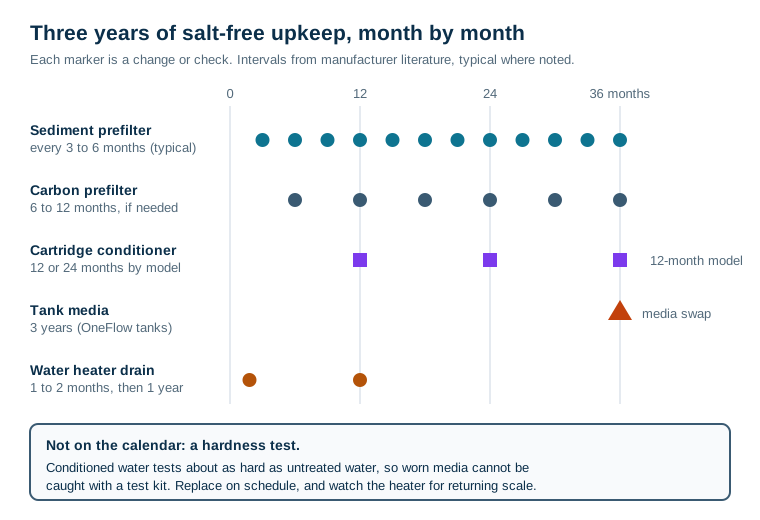
Two practical additions make the schedule easier to keep:
- Fit pressure gauges either side of the prefilter. A widening pressure drop across a sediment cartridge tells you it is loading up, which beats guessing from a calendar. It also stops you blaming the conditioner for low pressure that is really a clogged filter.
- Write the install date on every housing and the tank. Media lasts long enough that nobody remembers when it went in. That is exactly how a three-year replacement becomes a seven-year one.
How to Tell Salt-Free Media Is Worn Out
This is the awkward part of owning a salt-free system. With a softener, a hardness test at the tap tells you whether it is working. With a salt-free conditioner it tells you nothing, because a salt-free system does not soften the water. A working unit and a dead one give the same reading.
The signs of worn media are indirect and late:
- Scale returning on a heating surface. An electric water heater element, a tankless heat exchanger, a kettle or a coffee maker furring up again after staying clean.
- Harder spotting than before. Some spotting is normal with conditioned water. A clear change for the worse, on the same water, is a signal.
- Tankless performance drifting. A falling outlet temperature at low flow, the early symptom of an exchanger scaling up.
Each of these appears after the media has already lost ground. That is why the manufacturer interval matters. Replacing on schedule costs one media change. Replacing on symptoms costs one media change plus whatever scale formed in the months before you noticed. Next's ScaleStop media carries a two-year performance warranty. That is a useful reference point for how long the maker is prepared to stand behind the media, and it is shorter than the three- to five-year lives often quoted in sales material.
Real Annual Cost: Salt-Free vs an Equivalent Softener
Here is the comparison worked in full, so you can swap in your own prices. The household is four people on city water, using about 300 gallons a day (roughly 110,000 gallons a year). Only running costs are counted. Purchase and installation are left out, because they depend heavily on the product and installer. The purchase and install prices for salt-free systems are worked through separately.
Salt-free (whole-house tank system):
| Item | Assumption | Per year |
|---|---|---|
| Media replacement | $450 per change, every 3 years | $150 |
| Sediment cartridges | 4 a year at $15 | $60 |
| Subtotal | $210 | |
| Carbon cartridges, if chlorine is over the media limit | 2 a year at $40 | +$80 |
| Total with carbon | $290 |
Softener (same household, same water):
| Item | At 10 gpg | At 25 gpg |
|---|---|---|
| Hardness to remove | 1.1 million grains | 2.75 million grains |
| Salt, at 3,000 grains removed per lb | 367 lb, about 9 bags | 917 lb, about 23 bags |
| Salt cost, 40 lb bag at $8 | $73 | $183 |
| Regeneration water and power | $15 | $30 |
| Resin and service, spread over its life | $25 | $25 |
| Total | $113 | $238 |
These prices are examples, not quotes, and 3,000 grains per pound is a middling salt efficiency. A well-tuned softener does better and an old timer-based one does worse. The structure of the result holds whatever prices you use, though.
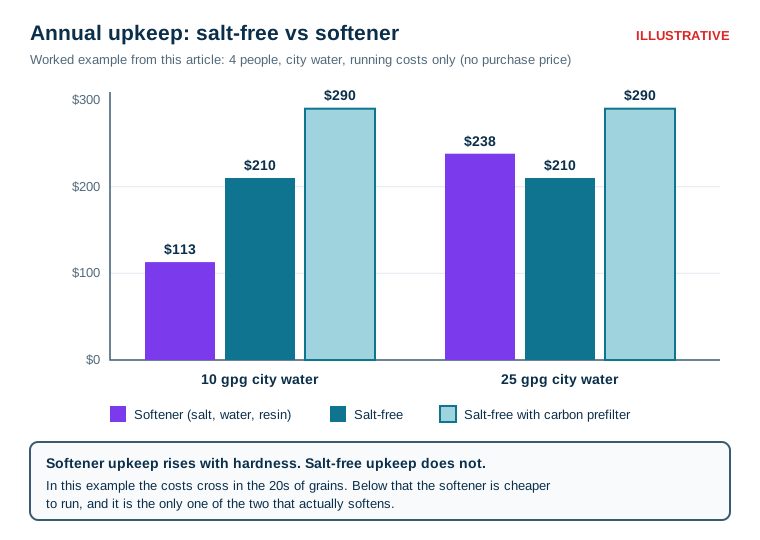
The salt-free system costs the same at any hardness inside its rating. Media and cartridges wear out on time, not on grains treated. The softener's cost scales almost linearly with hardness, because salt use is proportional to the grains removed. So:
- At moderate hardness, a softener is cheaper to run than a salt-free system. In this example it costs about half as much at 10 grains.
- In the 20s of grains, the two meet. At 25 grains, the softener's $238 sits between the salt-free system's $210 and $290.
- At high hardness, the salt-free system runs cheaper. It also gets steadily worse at preventing spotting above about 30 grains, which is a different kind of cost.
That is the honest answer to "which is cheaper to maintain". Neither side of the industry tends to publish it, because it depends on a number, your hardness, that sits on neither sales sheet. If you are pricing a softener, the annual salt cost at your own hardness is worth working out precisely before you compare.
What Moves Your Numbers
Several things push the comparison one way or the other.
- Well water adds a filter to the salt-free side. An iron and manganese filter in front of the conditioner brings its own media, servicing and sometimes electricity. The ownership cost can double. City and well water change the salt-free picture more than any other factor.
- Cartridge systems cost more per gallon. A small inline cartridge replaced every 12 months treats far fewer gallons per dollar than a whole-house tank. They make sense protecting one appliance, not a house. Watts' OneFlow Plus, which pairs a scale cartridge with a carbon block, shows how two cartridge schedules add up.
- Potassium chloride changes the softener side. Households that use potassium instead of sodium pay considerably more per bag. That can move the crossover well below 25 grains.
- Chlorine level decides the carbon line. If your utility's residual sits under your media's limit, the $80 carbon line disappears. Some systems build the carbon into the main tank instead, and the HALO 5 review prices each of its stages over ten years, including a magnetic conditioning stage that removes no hardness.
- DIY or dealer service. Media changes and cartridge swaps are within most owners' reach. Some warranties require an authorised dealer, and a service visit can cost more than the media itself.
And one factor is not a cost at all, but it should sit next to the numbers. The two systems do not deliver the same water. The softener's bill buys water that lathers, does not spot and tests soft. The salt-free bill buys scale protection for heaters and pipes, with water that otherwise behaves exactly like hard water.
Frequently Asked Questions
Do salt-free water conditioners need maintenance?
Yes, though less often than a softener. The media wears out and must be replaced. Watts says every three years for its OneFlow tank systems, and every one to two years for cartridge models. Most installs also have a sediment prefilter, and on some city supplies a carbon prefilter, both on their own change schedules. There is no salt, no regeneration and no drain line, which is the genuine saving. What is not true is the maintenance-free label.
How often do you replace the media in a salt-free conditioner?
It depends on the format and your water. Watts specifies every three years for OneFlow whole-house tank media, every 12 months for its small inline cartridges and at least every two years for its tankless heater cartridges. Watch Water recommends two years for its Filtersorb SP3 cartridges. Some retailers quote three to five years for tank media, shorter on well water. Next warrants ScaleStop media performance for two years.
How do I know when salt-free media needs replacing?
Not with a hardness test. Conditioned water tests about as hard as untreated water whether the media is new or exhausted. The signs are indirect: scale returning on a water heater element or tankless heat exchanger, a kettle furring up faster, or spotting getting noticeably worse. By then the media has usually been weak for a while. That is why replacing on the manufacturer's schedule, rather than waiting for symptoms, is the sensible approach.
Is a salt-free conditioner cheaper to run than a water softener?
Not always. In the worked example on this page, a four-person home on 10-grain city water spends about $113 a year running a softener, against $210 to $290 for a salt-free system once media and prefilters are counted. At 25 grains the softener rises to about $238 while the salt-free cost stays put. Salt-free running cost is flat with hardness and softener cost climbs with it, so the answer depends on your hardness.
Does a salt-free conditioner need backwashing or a drain?
No. Watts OneFlow and Next ScaleStop run without backwashing, regeneration or discharge water, and neither needs electricity or a drain connection. That is the genuine maintenance advantage over a softener, and it makes salt-free systems easier to site in closets and condos. The upkeep that remains is filter cartridges, periodic media replacement, and, on some models, the manufacturer's advice to drain the water heater after installation.
Can I replace salt-free conditioner media myself?
Usually, yes. Cartridge systems are a housing wrench job, with the unit bypassed and depressurised first. Tank systems mean bypassing the unit, removing the head, emptying the old media, refilling to the right level and restarting per the manual. Check the warranty first, because some manufacturers require an authorised dealer to install and service the system to keep the tank and head warranties valid. Next's ScaleStop warranty has that condition.
