
How Often Should a Water Softener Regenerate?

How often should a water softener regenerate? As often as its usable capacity divided by your household's daily hardness load. For most homes with a correctly sized softener that works out to every three to seven days. Daily regeneration usually means a leak, a programming error or an undersized unit, and a bed that goes several weeks without a cycle needs a day override to force one.
Frequency is not a number to copy from a forum. It is a result you can calculate in three lines, and comparing your calculated result with what the softener actually does is one of the quickest ways to find out whether it is sized and programmed correctly.
Why There Is No Single Right Interval
Two numbers set the interval. One is how many grains of hardness the resin can remove between regenerations at your salt setting. The other is how many grains your household sends through it each day. A softener holding 20,000 grains serving a house that uses 3,000 grains a day needs regenerating roughly weekly. The same softener serving a couple on moderately hard water could go two weeks.
How the control reacts to those numbers depends on its type:
- Metered (demand-initiated) controls count gallons and regenerate when the calculated capacity is used up. Their interval changes with your water use, and a guest-filled week brings the next regeneration forward.
- Timer controls regenerate on a fixed number of days, whatever you used. Their interval is whatever someone programmed, which is why the worksheet matters most for timer units.
How Often Should a Water Softener Regenerate? The Three-Line Worksheet
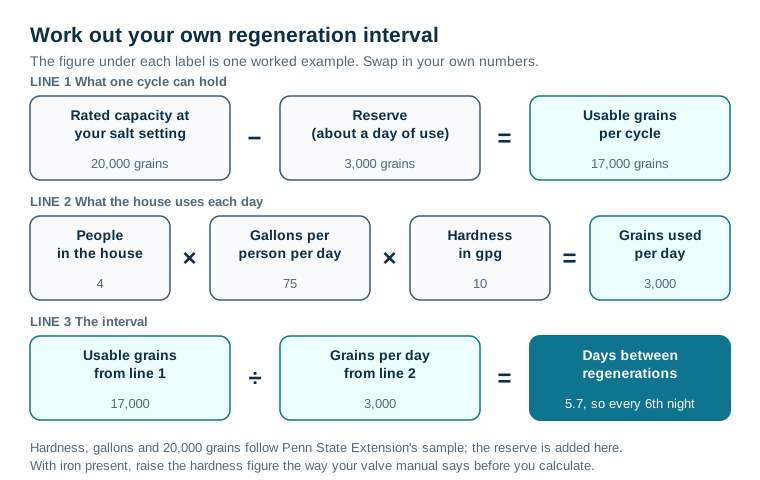
Line 1: what one cycle can hold. Start from the softener's capacity at the salt dose it is actually set to, not the headline number on the box. Capacity drops as the salt dose drops; a unit sold as 32,000 grains may deliver far less at an economical salt setting. Subtract a reserve, the amount the control holds back so you do not run out of soft water before the regeneration time. Pentair's Fleck 5600SXT manual says the reserve on a delayed-regeneration valve should cover the water used between capacity running out and the actual regeneration time; about one day's use is the usual figure.
Line 2: what the house uses each day. Multiply people by gallons per person per day by hardness in grains per gallon. Penn State Extension's water softening guide uses 75 gallons per person in its sample. If your water contains iron, raise the hardness figure the way your valve manual describes before you calculate, because iron uses up capacity too.
Line 3: the interval. Divide line 1 by line 2. That is the number of days between regenerations. A metered valve regenerates on the night the remaining capacity falls below the reserve, so a result of 5.7 means the sixth night.
Penn State's own sample, 20,000 grains of capacity and 3,000 grains a day, gives "6-7 day regeneration" without a reserve. With a one-day reserve it becomes about six.
Three Households, Worked Through
| Household | Daily load (people x 75 gal x hardness) | Capacity at salt setting | Reserve | Interval |
|---|---|---|---|---|
| Couple, city water at 8 gpg | 2 x 75 x 8 = 1,200 grains | 20,000 | 1,200 | 15.7 days: the day override will trigger first |
| Family of four, 10 gpg | 4 x 75 x 10 = 3,000 grains | 20,000 | 3,000 | 5.7 days: every sixth night |
| Family of five, well water at 20 gpg | 5 x 75 x 20 = 7,500 grains | 30,000 | 7,500 | 3 days |
| Family of six, 25 gpg, same small unit | 6 x 75 x 25 = 11,250 grains | 20,000 | 11,250 | Under 1 day: undersized |
The rows show the three outcomes the worksheet can give. The couple's softener is large for their use, so the backstop setting governs. The family of four sits in the middle of the normal range. The last row is a softener that cannot keep up, which no amount of reprogramming fixes; the signs of that situation are covered in signs a water softener is undersized.
Reading Your Real Interval Against the Worksheet
Now compare the calculated figure with what the softener actually does. Check the display for days remaining or a regeneration history, or note the salt level and the date and watch two or three cycles.
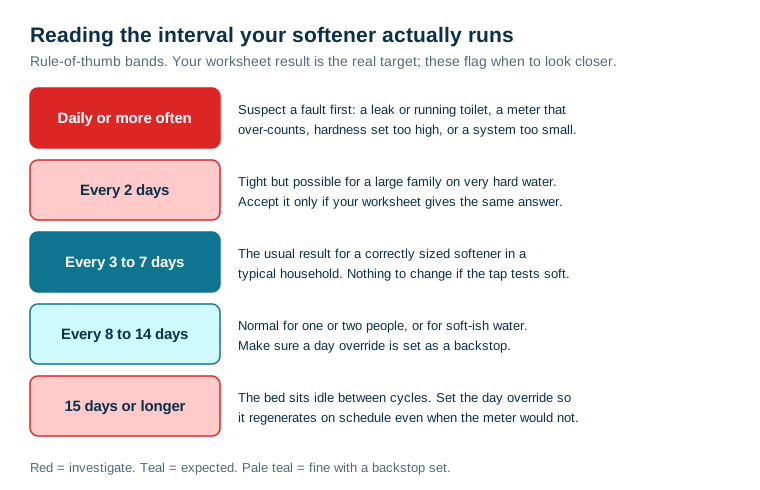
If the real interval is within a day or so of the calculation, the softener is doing what it should. If it is much shorter or much longer, one of the next two sections applies.
When It Regenerates Far Too Often
Clack's WS1 service manual lists the two classic causes in its troubleshooting table under "control valve regenerates frequently": leaking fixtures exhausting the capacity, or a system that is undersized. Work through them in this order:
- Look for water you are not using on purpose. A running toilet, a dripping outdoor tap or a leaking irrigation line runs through the meter all day. Check the flow indicator on the display with every tap closed; if it shows flow, something is leaking.
- Check the hardness setting. A valve told the water is 30 gpg when it is 15 regenerates twice as often as it needs to. Retest the raw water and compare.
- Check the capacity setting. Capacity or grains-per-regeneration set too low, or a reserve set too high, shortens every interval. Fleck's manual caps a fixed reserve at half the calculated capacity; a reserve near that limit halves the interval.
- Check the regeneration type. A timer set to regenerate daily will regenerate daily whatever the water use. That is a programming choice, not a fault, but it is often an accidental one.
- Only then conclude it is undersized. If the worksheet itself says less than about two days, the unit is too small for the house.
When It Regenerates Too Rarely
A long interval is fine if the worksheet predicts it and the water is soft right up to the next regeneration. It is a problem when the water turns hard before the cycle, or when the softener seems to go weeks without regenerating at all.
- The meter is not counting. Most metered displays show a flow indicator while water runs. If it never lights, the turbine may be stuck or its sensor disconnected, and the valve thinks no water is used.
- The bypass is partly open. Water that bypasses the softener is not metered or softened.
- Capacity or hardness is set too generously. The softener runs out of capacity before the valve thinks it has.
- The softener is oversized for the house. Correct, but large, which is where the day override comes in. Whether a very large unit causes other problems is discussed in can a water softener be too large.
If the water is hard before each regeneration, shorten the interval by correcting the settings, not by guessing a new number of days.
The Forced-Regeneration Interval: Setting the Day Override
Metered valves carry a setting that forces a regeneration after a set number of days, even if the meter has not called for one. On the Fleck 5600SXT it is Day Override, described as "the maximum number of days between regeneration cycles," with a range from off to 99 days. Clack calls it the same thing and states that day override and volume capacity cannot both be turned off.
It exists for the softener that is large relative to its use: a couple with a family-sized unit, a holiday home, a house with a long gap between occupants. Without it, the resin sits in the same water for weeks, the brine in the salt tank sits unused, and any iron in the bed has longer to set.
How to set it:
- On a metered valve, set it longer than your calculated interval, so it only acts when use is unusually low. Many installers settle on somewhere around 7 to 14 days. For the couple in the table above, the day override would trigger before the meter every time, which is exactly its job.
- On a timer-only valve, the day override is the schedule. Set it to your calculated interval rounded down, so the softener regenerates before the capacity runs out.
- For a house left empty, a scheduled regeneration keeps the bed moving, or you can use a vacation setting if your valve has one.
Exact steps for reaching the capacity, reserve and day override settings on common valves are in how to set capacity and reserve on a softener.
Recalculate When Something Changes
The worksheet is not a one-time exercise. Any change to either line changes the answer, and a softener programmed for the old situation will quietly run out of capacity or waste salt.
- People move in or out. A new baby, a lodger or a child leaving for college shifts line 2 by a quarter or more in a small household. A metered valve adapts on its own; a timer does not.
- The water changes. Well water hardness can shift with the seasons and with drought, and a city can switch sources. Retest the raw water at least once a year and after any notice from your utility, then update the hardness setting.
- Iron appears. Iron uses up capacity alongside hardness. If a well that was clean starts staining, the interval the worksheet gave is now too long.
- The salt dose changes. Turning the salt down to save money lowers capacity, which shortens the interval. The saving is smaller than it looks if the softener then regenerates more often.
- Water use changes a lot. A new irrigation system run through the softener, a pool top-up or a new bathroom all move line 2.
- The resin ages. Old or chlorine-damaged resin holds less than its rating, so a softener that used to last six days may manage four. If nothing else has changed and the water turns hard earlier than before, the resin is the suspect.
Redo the three lines, update the settings, and check the interval against the new figure over the next few cycles.
What Frequency Cannot Tell You
A softener that regenerates on a sensible schedule is not necessarily softening. The interval tells you the control is counting and triggering. It does not tell you that brine was drawn, that the resin is healthy, or that the hardness setting matches your water.
The only proof is the water. Test a cold tap for hardness the morning after a regeneration and again just before the next one. Soft at both points means the interval is right. Soft after regeneration but hard before the next one means the interval is too long for the capacity actually available. Hard even after regeneration means the problem is in the regeneration itself, not its timing.
Work out the figure, compare it with what the softener does, and fix the settings that do not match. The right frequency is the one your own numbers give, backed by a day override so the bed never sits idle for long.
Frequently Asked Questions
How often should a water softener regenerate?
As often as its usable capacity divided by your daily hardness load works out to. For most households with a correctly sized softener that is every three to seven days. Penn State Extension's sample calculation, a family of four using 75 gallons each per day at 10 grains per gallon against a 20,000 grain capacity, comes out at six to seven days.
Is it bad if my water softener regenerates every day?
Not always, but it should be explained before it is accepted. Daily regeneration is correct only when the worksheet says so, for example a large household on very hard water with a small unit. Otherwise it usually means a leak or running toilet, hardness programmed too high, capacity programmed too low, or a softener that is too small for the house.
How do I know how often my softener is regenerating?
Look at the control. Many metered valves show days to regeneration or gallons remaining, and some keep a history of regenerations. Otherwise mark the salt level or the date of the last cycle and watch for the next one: a drop in salt, a note in the display, or water running to the drain in the early morning. Two or three intervals give a reliable figure.
Should a softener regenerate if no water is used?
Yes, eventually. Metered valves have a day override, the maximum number of days allowed between regenerations, so the bed is regenerated even when the meter would never trigger it. It stops the resin sitting unused for weeks. On a Fleck 5600SXT the setting is called Day Override and ranges from off to 99 days.
What should the day override be set to?
Longer than your normal calculated interval, so it only acts as a backstop, but short enough that the bed never sits unused for weeks. Many installers use somewhere around 7 to 14 days. On a timer-only softener the day override is not a backstop but the schedule itself, so set it to your calculated interval rounded down.
Does regenerating more often make water softer?
No. Once the resin is regenerated, extra cycles do not make the water any softer; they only use more salt and water. What makes water softer is a correct hardness setting, enough brine per cycle and regeneration before the capacity runs out. If water is hard just before each regeneration, the interval is too long or the capacity is set too high.
